Personal Pearls Of Wisdom: Go With The Flow.
As the followers of my blog, my online students with the BPSOP, and the photographers who have attended my “Stretching your Frame of mind” workshop all know, I have a plethora of random thoughts gathered throughout my photographic and teaching career. I call these thoughts my “Personal Pearls of Wisdom“.

Dating back to the early eighties when I first started teaching, I’ve conjured up these expressions as situations called for them, either from my own experiences or those of my students. Although I love all my Pearls for one reason or another, there is none that brings a laugh to me faster than “Go With The Flow“.

If you’ve been shooting long enough, I’m sure at one time or another you’ve been faced with a situation that you either didn’t expect or didn’t want. You probably had a certain idea in your mind, or a pose, or a composition that come hell or high water you were going to shoot…no matter what!!!

If you were anything like I was in the old days, those days before Medicare, Social Security, and mellowing out, you got flustered or probably a little pissy because it wasn’t going your way. For me, it was usually the subject that wouldn’t cooperate or a lot of the times it had to do with animals.

I don’t remember exactly when it was, but at some point I decided to stop fighting it and joining it. I began to “go with the flow“. If someone wasn’t taking my direction, or for some reason really didn’t want to be photographed the way I envisioned, I would just let them do what they wanted and when I discovered that it usually resulted in a better photo, I started waiting and hoping it would happen again. It’s not something you can create yourself, it has to be spontaneous and coming from the subject. It’s also very important to anticipate the possibility because if something does happen, it’s a good chance that it won’t happen for long and won’t ever happen again.

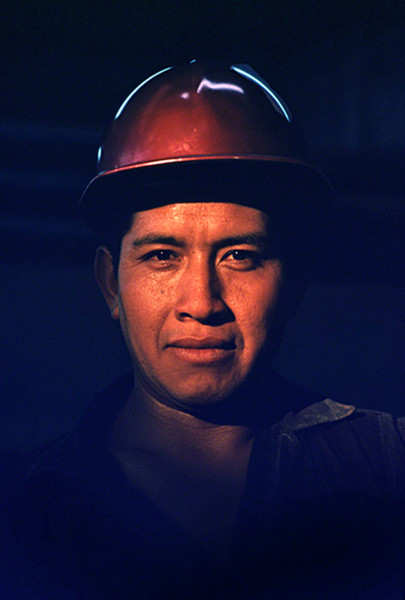
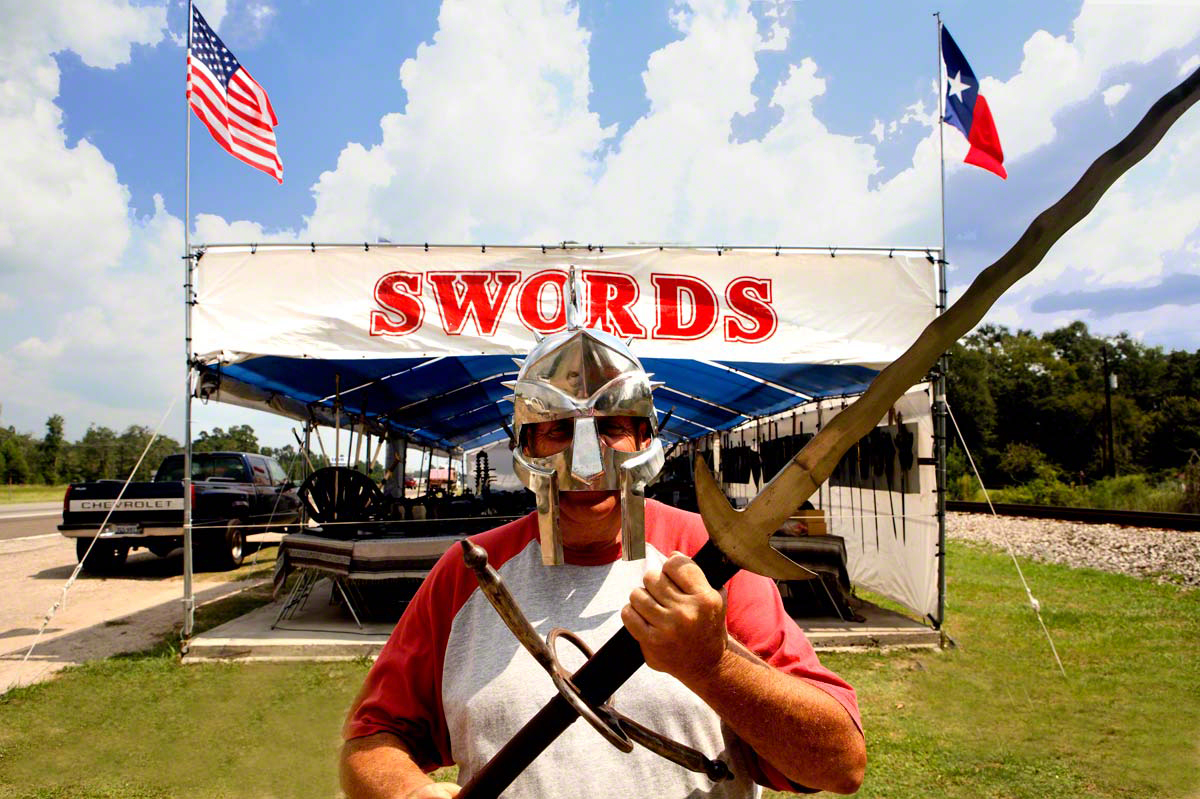
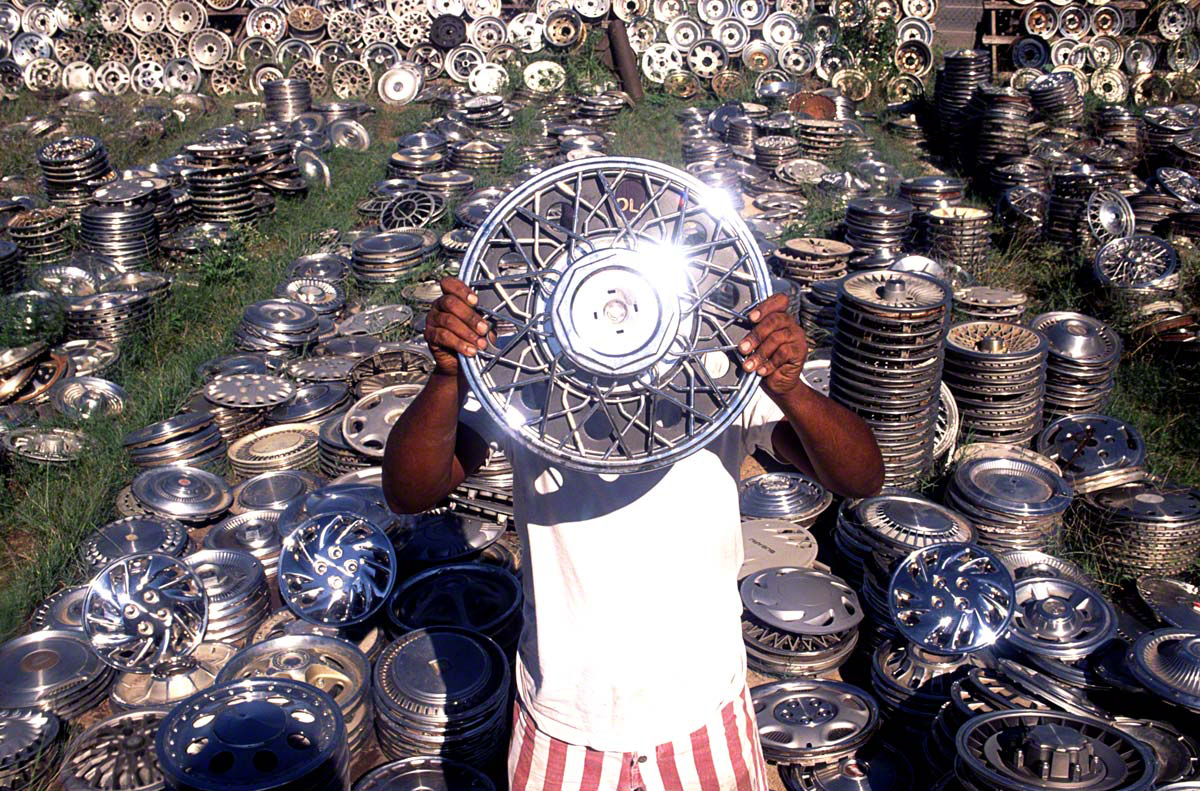
The two photos you see above and below are perfect examples of “Going With the Flow“. I was working on a photo essay called “Back-road Businesses where I traveled the smaller roads throughout Texas looking for the entrepreneurs of these  weekend businesses. These are businesses that spring up all over Texas on the weekends, opening on Fridays and closing Sunday afternoons after all the travelers were back home.

In the photos taken of the owners of the sword and knife business, and the hubcaps, they didn’t want to show their faces. No matter how much I was willing to pay for a hubcap or a sword, they were just not interested. The sword man said that I could take his picture but it had to be his way. He told me to go out and get setup and he would think about what he was going to do (after buying a knife). When he finally came out wearing the helmet, I thought I would start crying in utter happiness!!! How could I have ever planned that?

When I asked the guy with the hubcap to take a picture of him in front of all his hubcaps, he said fine, but I couldn’t show his face (maybe something to do with his britches?). He leaned over and grabbed a hubcap and put it in front of him. He said that if I still wanted to take his picture it was OK.

OK!!!!!!!! Someone please pinch me, because I knew I had to be dreaming!!!! I shot as fast as I could before he could change his mind.
hubcap-man1_DM

So my friends, be prepared to forgo your initial idea and be ready to “Go With the Flow”. Just let it happen because it just might prove to be a better idea.

Visit my website at: www.joebaraban.com, check out my 2018-19 workshop schedule and come shoot with me sometime. Hear my “Pearls in Person”!!!

JoeB
My Favorite Quotes> W. Eugene Smith


If I followed the rules, I wouldn’t have taken this

One of my all time favorite photographers was W. Eugene Smith. I have several of his books (Minimata being the most powerful) and love going back and look at his work.

He once said in an interview, “I didn’t write the rules. Why would I follow them?”. This quote comes to mind as much as any in my category My Favorite Quotes. Why, you might ask?

I teach an online class with the BPSOP, and I conduct workshops all around the planet. The reason why I think about this quote is because I’m constantly asked if I follow any rules pertaining to how I go about deciding on how I compose my final composition.

At that point I will invariably quote Eugene Smith. I also didn’t write these so called rules, that were written merely to take us down a one way path to mediocrity; so why should I also follow them?

A lot of people that have recently fallen in love with photography, seek out advice from others. I can understand since they are new and want to take the best photos they can. The problem is that they will listen to anyone and take what they hear as gospel; after all, they must know more since they are already photographers and have really nice cameras; don’t be fooled by that…it’s the ten inches behind the camera that really counts.

Here’s where I stand: I’m not going to follow rules that I didn’t write and especially ones that I don’t believe in; as long as the rules aren’t actually laws that could eventually wind up being a bad decision!!

🙂

I have one rule as it applies to my photography. I never crop my photos, and haven’t for the fifty years that I’ve been shooting profssionally.

So, my fellow photographers, while it’s important to have personal rules when it comes to your new found love, whatever you do don’t listed to those that think it’s important to follow rules just because someone, somewhere, wrote them.

Visit my website at: www.joebaraban.com, and check out my workshop schedule at the top of this blog. Come shoot with me sometime.

JoeB

Quick Photo Tip: Turn Your Photo Upside Down

A balanced composition

Closing in on fifty years of taking pictures, I can turn the composition I’ve created in the viewfinder upside-down in my mind, without having to physically rotate my  camera to see my photo inverted on the display. So, you’re probably asking yourself why in the world would I want to do this? To make sure my photograph has balance, either symmetrical (formal) or asymmetrical (informal).

Okay, have you ever looked at one of your images and for some reason it didn’t feel quite right to you; and you weren’t sure why? One potential reason is that it wasn’t a balanced composition.

In my “Stretching Your Frame of mind” workshop I conduct around the planet, and in my online class I teach with the BPSOP, students submit photos that (hopefully) represent the assignment or the discussion of the day. In my workshops, I teach photographers how to use the Elements of Visual Design to make their photos stronger. One of the basic elements is Balance. 

Images submitted to me will often have a strong subject or a point of interest on one side, leaving the other side empty, or areas of color or light that aren’t compatible with one another. A good photograph will have an equal amount of color, shapes and areas of light and dark. Each one needs to have a certain amount of value or visual weight (mass) in relation to all the other elements in your photo, and be placed accordingly to create a sense of balance.

In my classes, I deal specifically with the balance between Negative and Positive space. If a student submits a photo that is obviously out of balance, I’ll turn their photo upside down and show it to them. Why you ask again?

Still balanced

Because when the student views his or her photo upside down, they’re now using a different part of their brain to process information. When they’re looking at it right side up, they’re looking at it with the right side of their brain. It’s the creative and visual side. They’re looking at the parts that make up the whole. i.e., Shape, Pattern, Texture, Form, and Color.

When I turn their photo upside down, they’re using the left side of their brain, the analytical side. They’re now looking at the whole first then putting them into a logical order and drawing a conclusion.

In other words, their image is no longer a photo that has a subject, meaning, or tells a story. It’s simply shapes, colors and areas of light and dark; it now reads only as Negative and Positive space. The student immediately sees that their photo is out of balance.

Try it yourself sometime.

Check out my workshop schedule at the top of this blog, and my website at: www.joebaraban.com. Follow me on Instagram: www.instagram.com/barabanbjoe. Come shoot with me and together we’ll look at your photos upside-down!!!

JoeB
Food For Digital Thought: Leading the Viewer Around the Frame

Moving the viewer around the frame

Creating memorable photos, as you probably know, is not an easy task. Keeping the viewer around as long as possible is a very important ingredient in doing just that. Unless you’re shooting strictly for yourself, the idea is to take control of how the viewer perceives and processes our images. Making him an active participant is the best way I know of to achieve this lofty goal.

In my part II online class with the BPSOP, we spend an entire lesson just working with Line; the most important of all the basic elements of visual design. I will also talk about this element in my workshops I conduct all over the planet.

One of the best ways to keep the viewer involved is to use Line to move the viewer around your composition. Leading him in and out of the frame using lines to do so will keep him interested. Another way to use Line effectively is to arrange the lines to leave an impression or make a statement that communicates a visual idea.

In the above photo, I came around the corner, looked down, and saw this happening right in front of my eyes. The first thing I thought about was the artist M.C. Escher. The second was what a great way to not only move the viewer around, but to keep him around by offering six to eight seconds of visual entertainment.

Communicating a visual idea

When you look at these images, you can’t help but to follow the lines, and steps from one side of the frame to another; letting the viewer enter and leave the frame at different points in the composition.

By using the right side of my brain, the creative side, I was able to see this subject not as a walkway and steps that I would see by only using the left side, but a series of patterns, lines, and shapes; all basic elements of visual design.

So, my fellow photographers, look for ways to move the viewer around your frame, and you’ll be taking your imagery what I refer to as”up a notch”.

Visit my website at: www.joebaraban.com, and check out my workshop schedule at the top of this blog. Come shoot with me sometime.

JoeB
Personal Pearls of Wisdom: Just say NO to the “Leading In Rule”

Wonder what she’s looking at?

I’ve been an advertising, corporate, and editorial for fifty-three years, and in that time I’ve enjoyed teaching and showing photographers how to use their eye in a different way than they have been.

This is my ninth year teaching an online class with the BPSOP, and my first workshop, “Stretching Your Frame of Mind”,  was in 1983. I have been told by students way too many times that they, in return, have been told to always have their subject walking, running, or facing into the frame.”Always leave more room in front of your subject than in the back”, is a direct quote (and one of their rules) from a site on the internet; whose name I will leave out. This is referred to as “leading in”.

It’s a ‘mind-bender’ for me! Why on earth would anyone tell you that?  I suppose the reason is that they want you to become good little photographers, and whoever keeps saying this is indeed a good photographer. If being a good photographer is your goal, then that’s great, and follow the path most traveled.

If you want your photos to consistently be “up a notch”, you might consider coloring outside of the lines. If you want to be more than just a good ‘shooter’, you might want to consider other points of view…like mine for one example.

If I put someone looking into the frame, then the viewer will know what that person is looking at. If I have someone walking or running into the frame (giving the subject room to run as they say), the viewer will know where they’re going. Where’s the mystery and drama in that? Sounds pretty boring to me. I want the viewer to wonder what the subject is looking at, and where he’s going NEXT. By placing the subject close to the edge of the frame facing out, two things will happen:

Placing the subject close to the edge of the frame, and minimizing the ‘Negative Space’ between the subject and the edge, you’ll generate Tension. The Tension comes from the anticipation of the subject leaving the frame. Second, you’ll imply content outside the frame.

All this is a big part of the Psychology of Gestalt I teach in my workshop. In short, we want the viewer to take an active part in our pictures.  The viewer will always react to that which is most different. In our reality, making the mind work harder is not necessarily a good thing, but in photography it is.  By leading the viewer’s eye in and out and around our composition, or having them complete an image, or have them consider the scene, they are taking an active role, and when we can accomplish that our images will definitely be stronger.`

Here are some examples of just what I mean:

JoeB
Check out my website at www.joebaraban.com and my 2012 workshop schedule then come shoot with me sometime.

Life Before Photoshop: Asics Tennis Shoes.

Look ma, no Photoshop!!!

For those out there that have been following these posts, I hope you’re enjoying them as much as I did when I was taking them…way back when Adobe was a type of house in the southwest part of the country.

It was never in question whether I could solve the clients problem or not. If I took on the project, then there could be only one ending…a happy one where everyone lived happily ever after. If there wasn’t a happy ending, you never worked for that advertising agency again. you became persona non grata. If the art director, writer, or account executive went to another agency, and it happened all the time, your name went with him.

There wasn’t anything to help you in those days in the form of post processing. Hell, in the early days there weren’t even computers…just me and my Kodachrome 25.

I teach an online class with the BPSOP, and I also conduct my “Stretching Your Frame of Mind” workshops around the planet. In both cases, I ask my fellow photographers to not use any post processing. Everything they submit has to be right out of the camera. I want people to become better photographers, not better computer artists or digital technicians. Don’t get me wrong, I’m not some old guy that can’t change with the times; quite the contrary. I use CS5 to some degree on just about every image I take…why not? Having said that, I like the challenge of getting it in one exposure, one click, and in the camera. To me that’s what being a good shooter is all about.

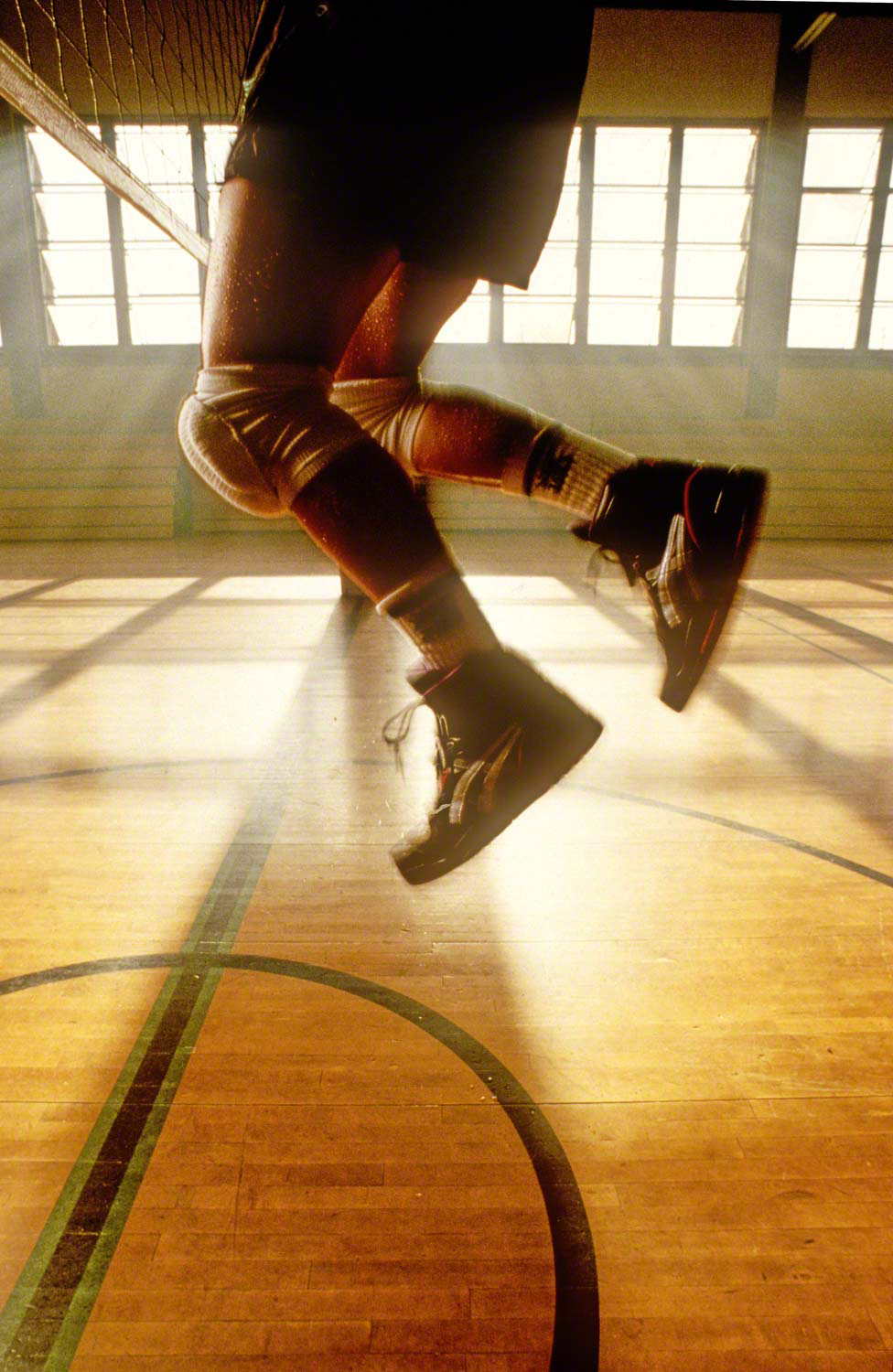
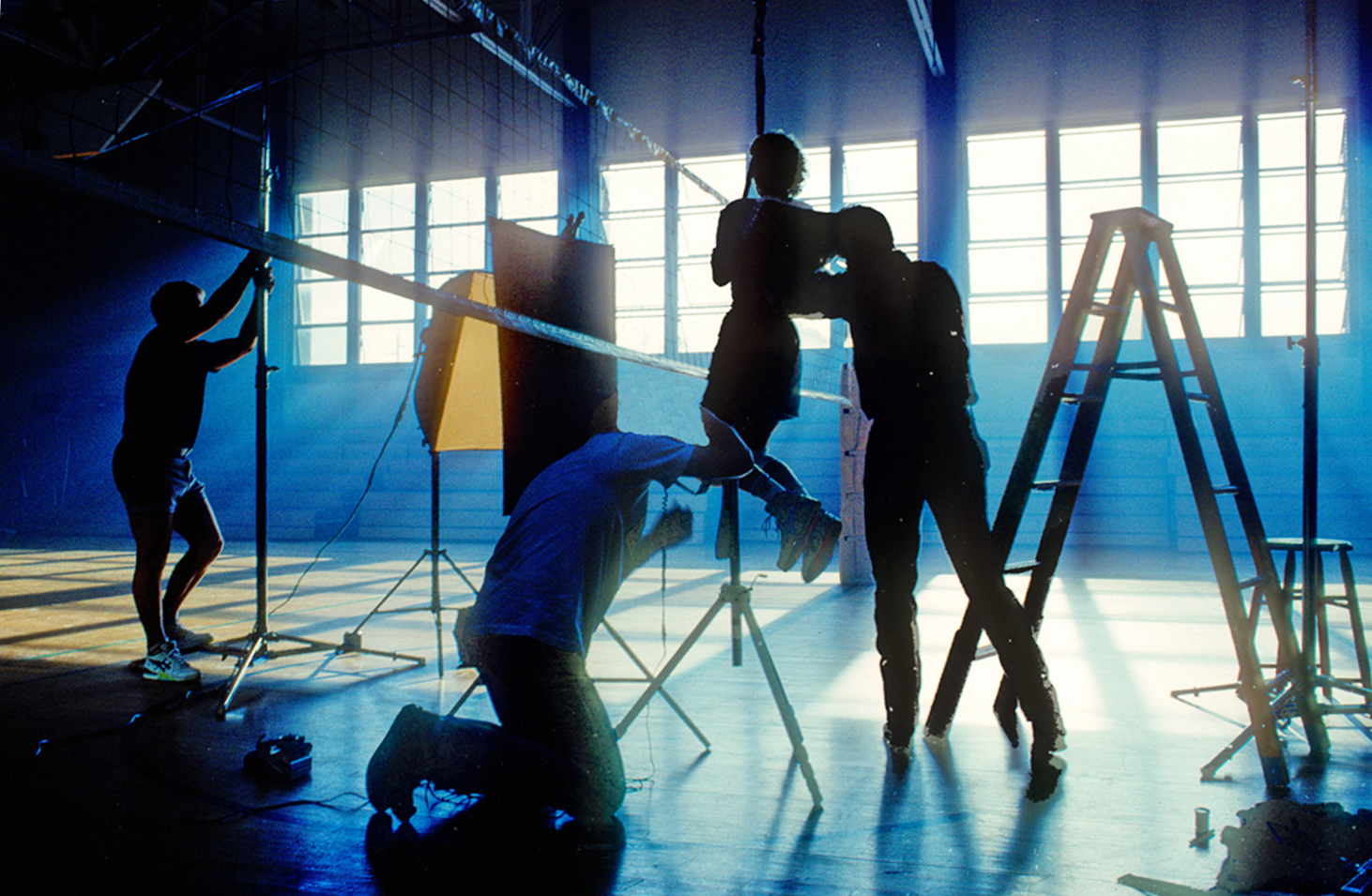
The above photo was part of an advertising campaign for Asics Tennis Shoes. This particular shoe was worn by members of the Woman’s Olympic Volleyball team, and the client wanted a shot that was full of action while showing the shoe.

I created a way to make it look as if she was jumping for a ball by building a frame that could support her weight. In those days getting it without the use of electronic flash just wasn’t going to work. We built a harness that had a large bungee cord attached to the top. We could pull her down, let go, and it would spring back with her with it. I used a shutter speed that was slow enough to record the ambient light in the gym, and a synch delay that would fire the large strobe in the soft box at the end of the exposure instead of the beginning. This is what creates the slight blur and feeling of motion. When we pulled her down and let go she sprang back up we would click the shutter at that moment.

Right before I started to shoot, we wafted some fog juice to add to the drama.

The production photo.

Since it was before digital, I could only get an idea of what I was getting by taking a small 35mm polaroid before the actual shot. After that, I would bracket all over the reading my meter gave me. If it wasn’t right on the money, I had nothing to help make it right. Back then, it was just the way it was and if you didn’t think you could pull it off, you just didn’t do it.

I never turned these kinds of assignments down. I loved the challenge of solving the problem, and never thought I couldn’t do it.

Visit my website at: www.joebaraban.com and watch for my schedule at the top of this blog.

JoeB


Anecdotes: I Always Wanted to be a Clown.

I always wanted to be a clown

For those new to my blog, I was an advertising and corporate photographer for almost fifty years, and now being semi-retired I teach an online class with the BPSOP, and I also conduct my personal “Stretching Your Frame of Mind” workshops around our planet.

One of my favorite categories to write a post in is Anecdotes. It brings back great memories of the assignments and projects I used to shoot on a daily basis.

Back in my youth, as in my very early thirties, I shot a lot of assignments for a magazine called  Texas Monthly. When they called me to do a photo essay on the Ringland Bros. & Barnum and Baily Circus, I was all over it like a cheap fitting Lassie costume.

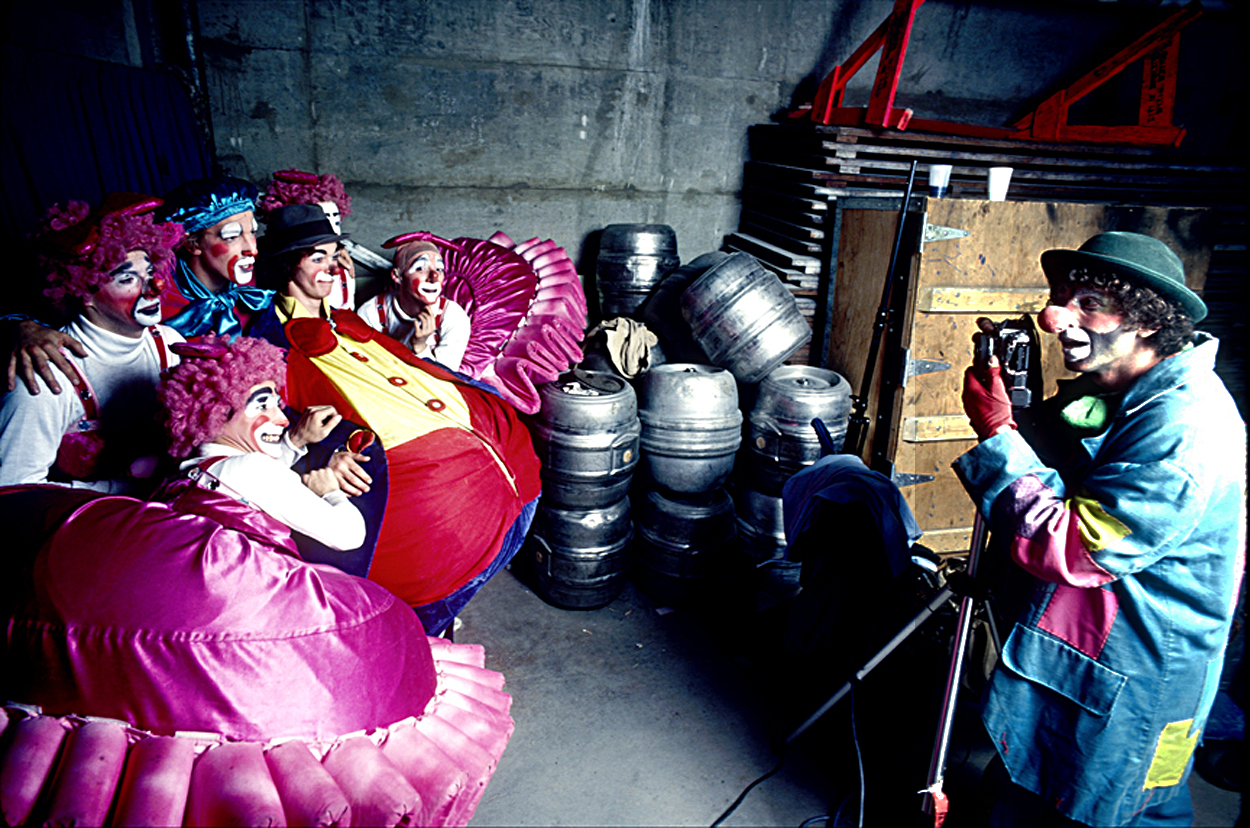
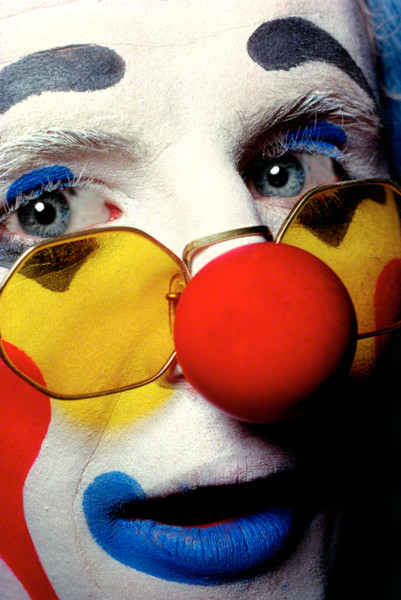
I decided to shoot a series of portraits featuring the clowns backstage and use a large softbox on a Bogen boom that had wheels, so I could just roll it around behind the large arena; from clown to clown; worked like a charm!!

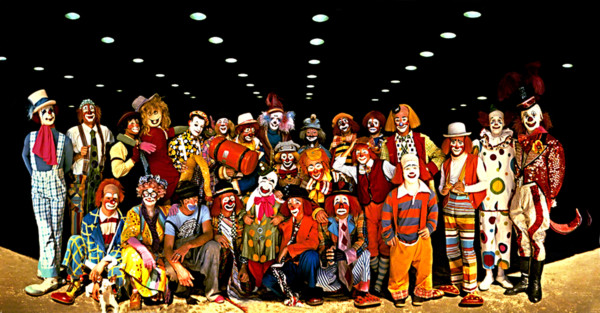
I asked the boss clown if I could be made up and go out with the rest of the clowns on what they called a walk-around during the intermission. My assistant and I did two shticks:

We were in the group of seventeen clowns that were piled into a very small car, and when we all popped out there were “little “people” waiting with big, soft mallets to hit us on the heads. In the second shtick my assistant and I walked around with an oversized book that said, “The history of aviation” on the cover. We would walk up to the kids and open it revealing a large fly; why, I had no idea!!

I loved the idea of my true persona completely hidded, so much so that I would up shooting the portraits while still in my clown make-up.

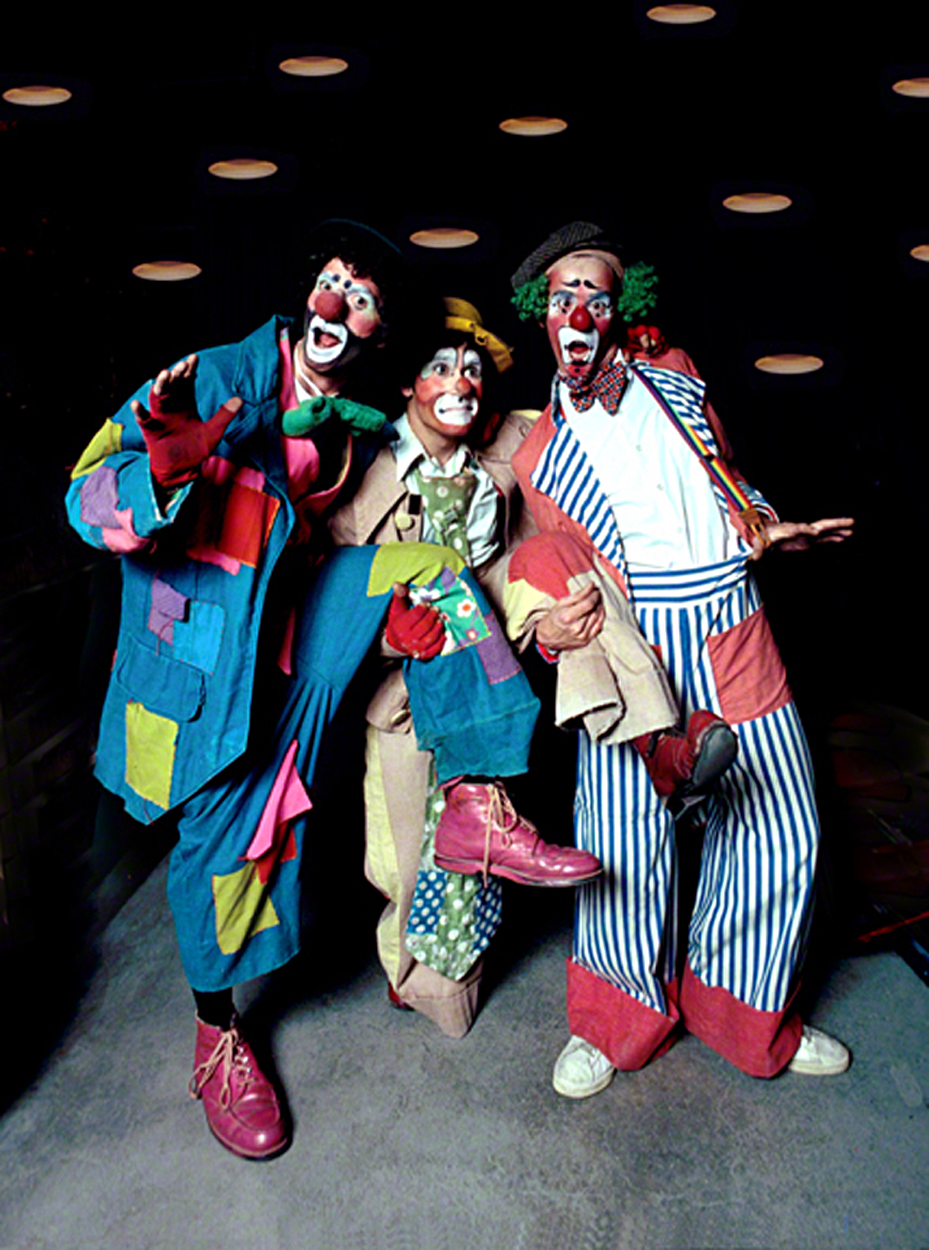
Here’s a sampling of some of my portraits, and by the way, the photo at the top of the blog is me on the left, the boss clown in the middle, and my assistant on the right.

Enjoy:

Visit my website at: www.joebaraban.com, and check out my workshop schedule at the top of my blog. Come shoot with me sometime and we’ll clown around together.

JoeB

BPSOP CLASS IMAGES

Bonnie’s image from my September part I class

For those of you new to my blog, I teach two online classes witht the BPSOP. I also conduct my “Stretching Your Frame of Mind” workshops around our planet.

I show my fellow photographers how to incorporate the elements of visual design into their imagery: Texture, Pattern, Form, Balance, Shape, Form, Line, and Color are the basic elements that we work on in this four week class.

In my part II class we continue working on these elements with more emphasis on Line; the most important of all the elements since none of the others would exist without Line.

We also work on ways to create Visual Tension, and in my part II class integrating a Vanishing Point into their composition, as well as spending an entire lesson on the silhouette, and shadows…which are your best friend!

Every so often I like to show the images from my part I and II classes, and I’m extremely proud and impressed with just some of the images from the last three months.

The methods we use to gain attention to our photography will vary, but what’s important is how we manage what the viewer perceives and processes when looking at the visual information we lay out to him in the form of a photograph.

Humans rely on perception of the environment that surrounds them. Visual input is a part of our everyday life, and as photographers it’s our prime objective to present this visual information in a way that takes control of what the viewer sees when looking at our imagery.

I hope you’ll agree that these photographs have done just that.

Visit my website at: www.joebaraban.com, and chckout my upcoming workshops at the top of this blog. Come shoot with me sometime, and I hope to work with you in one of my BPSOP classes.

JoeB

My Favorite Quotes: William Shakespeare

What does her eyes say?

William Shakespeare once said, “The eyes are the window to your soul”.

In both my online class with the BPSOP and my “Stretching your Frame of Mind” workshop I conduct around the planet, we work on the elements of visual design and composition. One of the most important elements if not the most important is LINE.

Briefly, a line is a mark made by a continuously moving point across a surface. There are horizontal, vertical, diagonal, round, curved, parallel, zigzag, and wavy lines…not to mention dotted lines and dashes. All these lines have the same thing in common: direction, length, and thickness.

All the above-mentioned lines are straightforward and easy to grasp, but what about ‘implied lines’? What about those lines that are more of an ambiguous nature? For example, all the edges around ‘Form’ are implied lines. A statue of Abraham Lincoln is Abraham Lincoln because his outLINE shows him to be. What about the ‘horizon’ line that people are always forgetting to straighten?

But that’s a whole other issue!!

There’s one more implied Line that most photographers usually don’t consider. It’s that line that runs from the subject’s eyes to the lens.  To my way of thinking, it’s a very important line that connects the photographer to the subject, creating an intimate bond of sorts that also generates a kind of energy field.

Personally, I love that bond and the majority of photos I’ve shot in my career has, for the most part, had my subject looking directly into the camera.

The hard part about having the subject look into the lens is keeping his or her look fresh. It’s very much like asking the subject to smile. If you don’t shoot immediately, the smile starts to lose the freshness.

Since I’ve been shooting people for fifty years, I can tell you that the eyes can talk to you and can portray emotions and feelings as quick as one blink to another.

If you have clicked on the link and read the post that I sent on one click, one smile, you can adapt that thought process to this current post on having eye contact. Remember that the eyes are indeed, the windows to the soul.

Visit my website at: www.joebaraban.com, and check out my workshop schedule at the top of this blog. Come shoot with me sometime.

JoeB

Food For Digital Thought: Dangling a Carrot

Who and why?

Besides being an advertising, corporate, and editorial photographer for the past fifty years, prior to that I had received a BA in Journalism and was writing even before I was taking pictures; soon after I became a Black Star photoographer and shot for UPI and AP.

I have always loved telling a story photographically as well, and especially getting the viewer to do some thinking when looking at my images. I call it…“dangling a carrot”.

I have written on similar subjects where I either implied the presence of humanity. or I have talked about every picture telling a story…don’t it? What I really love doing is creating some kind of mystery in my imagery so that I can keep the viewer around as long as possible.

The viewer will perceive and process information we lay out to him in the form of a photograph. It’s in our DNA to rely on the perception of the environment that surrounds us, and visual input is a part of everyday life.

If we can make him an active participant in out thought process as it relates to photography, he’ll stay around longer looking at our photos. For me, I want the viewer to do some thinking by asking a question or to form an opinion; a very good way to keep him involved.

In the above photo, I was conducting one of my “Stretching Your Frame of Mind” workshops Houston, my hometown. As usual, there were several people that had taken both my online classes with the BPSOP.

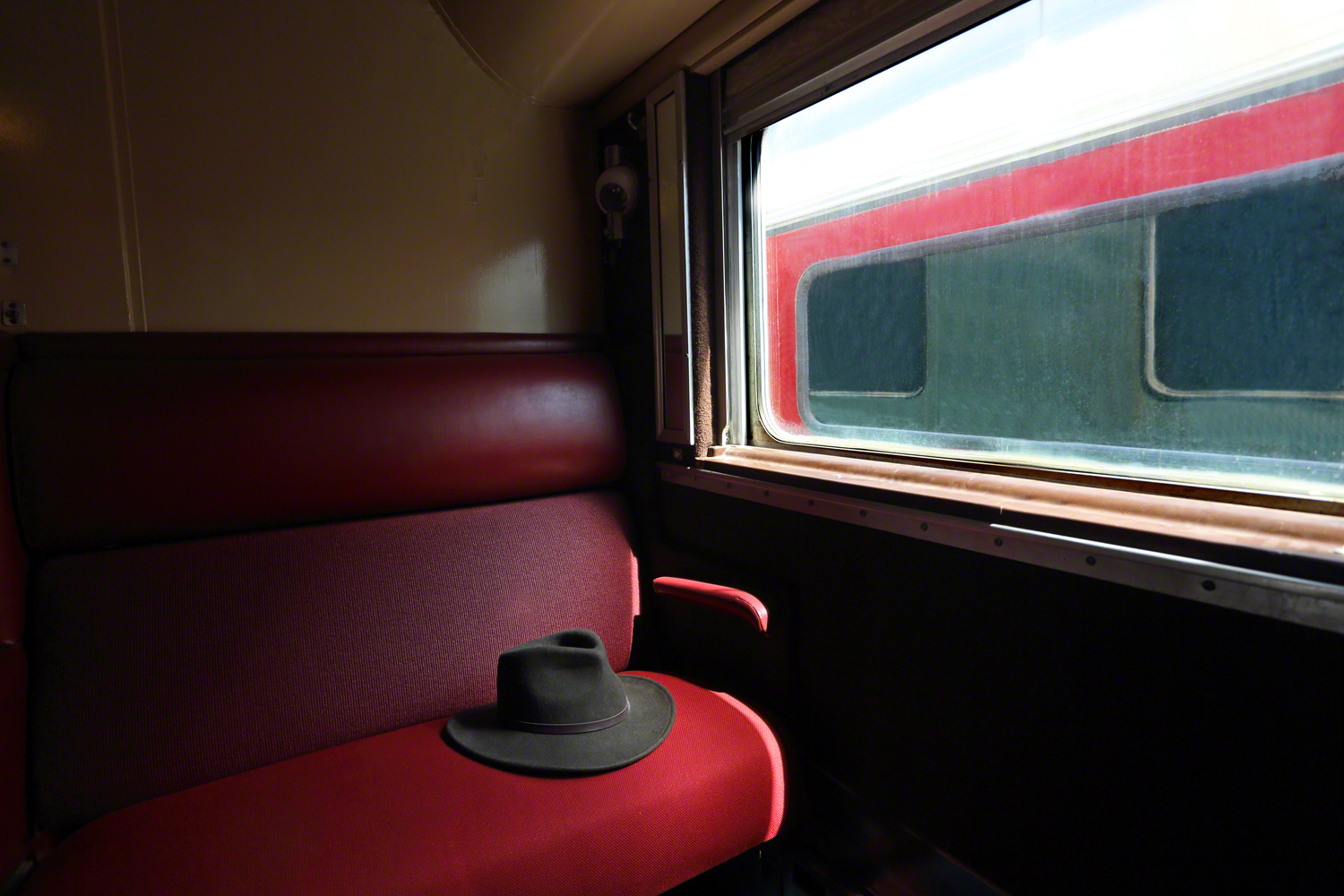
One of the locations we shot at was the Railroad Museum in Galveston, about an hour away. I was walking through one of the passenger cars and immediately though of a way to create a visual mystery.

I took off my fedora and set it on the seat. I stepped back and created just that with my 17-40mm lens. Now it was up to the viewer to figure out why some guy left it there, and why would he have.

So, my fellow photographers, the next time you goout shooting, take a prop or two with you. You just never know when there’s a story to be told.

Visit my website at: www.joebaraban.com, and check out my 2018 workshop schedule at the top of this blog. Come shoot with me sometime.

This coming July 29th will be my 30th anniversary teaching at the Maine Media Workshop. I’ve always picked this time as it’s the week of the Lobster Festival down the road in Rockland. This ofers a unique set of photo ops, different from the Maine Coast, fishing villages and lighthouses. The Lobster Festival is all about color, design, light, energy, people watchng and environmental portraits everywhere you look; some people are there in costumes and loved to be photographed.

In conjunction with The Santa Fe Workshops, on October 2nd I’ll be leading a group in San Miguel de Allende. A beautiful oasis and artist colony, and the entire city is a UNESCO site.

Come join me for a week of fun and photography…what could be better?

JoeB

Anecdotes: Conoco

Just a figment of my imagination.

I just love going through old files looking for ideas to write about. I always hope that I’ll come across an image that will bring back fond memories of the time I was traveling two hundred and fifty days out of the year. One of these images I came across was from a campaign for Conoco.

Once in a while I’ll bring out a photo to answer a question one of my students that are taking my online class with the BPSOP has asked. I always keep a folder of these to show in one of the daily reviews I have during one of my personal workshops I conduct all over the place.

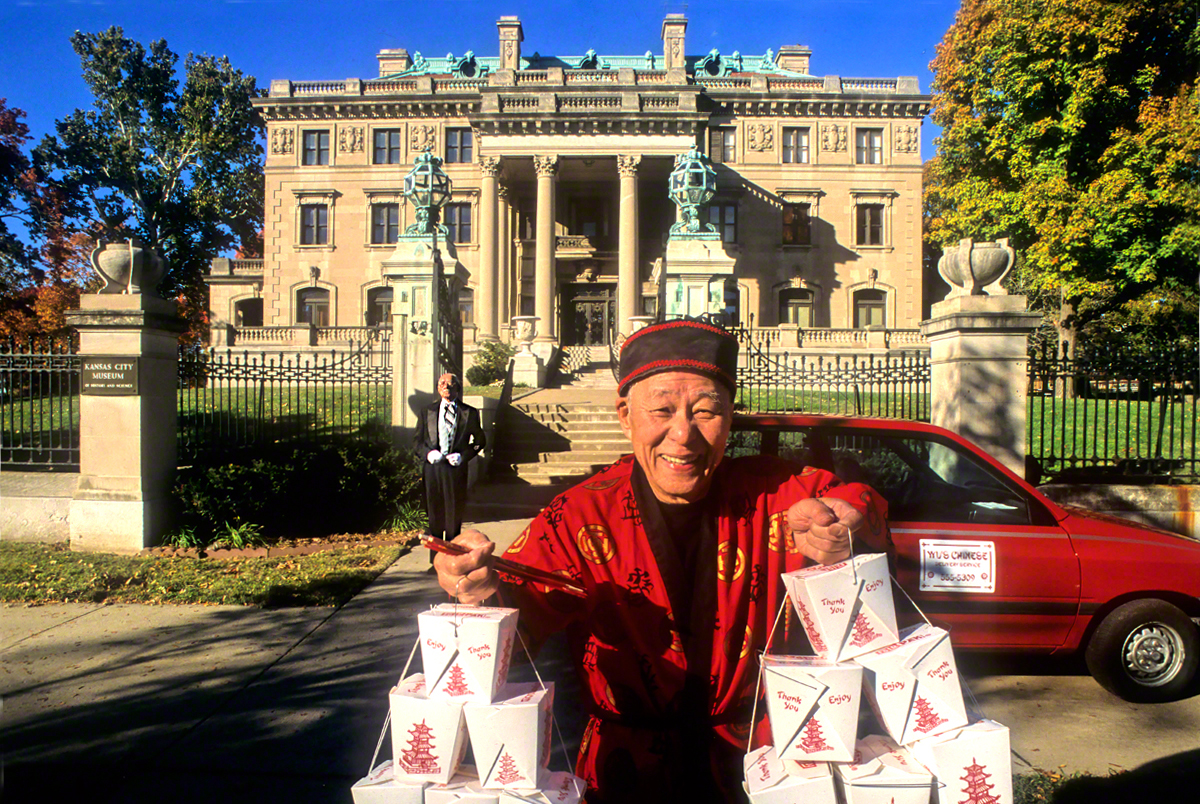
This image was taken during a ten day print and billboard campaign I did for Conoco. We produced most of these in Kansas City, Missouri (my hometown) since the largest advertising buy was in the midwest.

During a weekend creative retreat up at my lakehouse several weeks before, we came up with several ideas that would later become either a two page spread or a billboard. We also saved some time to come up with ideas that we had not thought of and if time permitting would create; a dream assignment!!

We spent some pre-production time in KC to scout possible locations in case we came up with a story that would match it. Btw, the building in the background is actually a museum, not a residence.

That evening we were having dinner in a Chinese restaurant and suddenly an idea began forming in my mind. I quickly began telling the art director what I was thinking and he immediately was all over it; like a cheap suit.

The idea involved using the museum as a private residence and having Chinese takeout being delivered..all we needed was someone Chinese to be the model.

It was too late to call a local modeling agency and because of the schedule we had only the next afternoon if we were going to pull it off. The   actually the uncle of the local hair and make-up person we had on the shoot; and the suit was actually his!!!

Since we were in a Chinese restaurant, surely we could convince someone to be our stand in. Especially since we had money in the budget for just such a thing.

Sitting over in the corner was a couple that just had their menues delivered.  I sent my producer over to ask the man if he would be willing to be our model and that we would pay him five hundred dollars in cash. After explaining my idea to him he thought it would be fun to do; and the money was a big factor.

We spent the next morning gathering props, a property release, vehicle, and wardrobe so we could be set up and ready to shoot in the late afternoon. So what you are seeing was only happening in my imagination and not actually a part of real life.

Unfortunately the client didn’t want to spend additional resources in producing this ad so it wound up on the pervebial cutting room floor…but I still have the photo and memory to enjoy!!!

Visit my website at: www.joebaraban.com, and check out my workshop schedue at the top of this blog. Come shoot with me sometime.

JoeB

Food For Digital Thought: Know Thy Subject

  As I write this post I can’t help but feel some biblical overtones in the title. I can’t wrap my head around it but I swear I’ve heard something similar before…maybe in a Cecil B. Demille movie?

At any rate it’s so important to know what it is you’re shooting, why you’re shooting it, and if the viewer will understand it…that is if you care if anyone besides you sees it.

I don’t know about you but for me I don’t take pictures just for my own gratification. I also take pictures to make people happy, smile, ponder, wonder, etc., or in the old days as a photo-journalist, to make people mad enough to get involved.

I write this particular post on this particular subject bcause of three scenarios that happened in my online class with the BPSOP, and in my “Stretching Your Frame of Mind” and also my less structured springtime photo tours (with daily reviews) that I conduct all over the place.

First, in my online class, I recently did a video critique of a student’s photo that was submitted for a lesson on ways to create depth. There were just random objects/points of interest, none of which made any sense as how they related to one another.

When I asked what was her subject she didn’t know. In fact she couldn’t remember why she even did what she did. She was merely trying to follow the lesson by trying to anchor a subject in the foreground (using a wide angle lens) to create layers of interest, thus depth; there was no subject or even a dominant center of interest.

Another time that I distinctly remember was in one of my trips to Cuba with the Santa Fe Workshops. I was walking behind two photographers that were taking pictures of anything and everything that moved or that they walked by.

They were basically taking pictures just to be taking pictures with no thought process behind any of them. I stopped them and ask to see what they had been shooting, and after going through them on the back of their cameras I asked what subjects they were trying to show, as far as going back home with anything memorably that portrayed Cuba…being the overall subject. Several of their photos could have been shot anywhere so why bother spending time and money coming all the way to Cuba?

Just recently I was with a group in my springtime in Berlin trip and during the daily reviews a women posted a shot of people on the other side of a store’s doorway. It was taken as she walked by without stopping to think about who they were, what were they doing, and what kind of store it was. When I asked her about it she said that there really wasn’t much of a subject and she really didn’t want to stop and spend any time with it…YIKES!

My way of thinking is that if you’re going to raise your camera up to your eye, then you should be willing to spend some time making sure you’re creating the best photo you can with a subject that the viewer will understand…but that’s jut me.

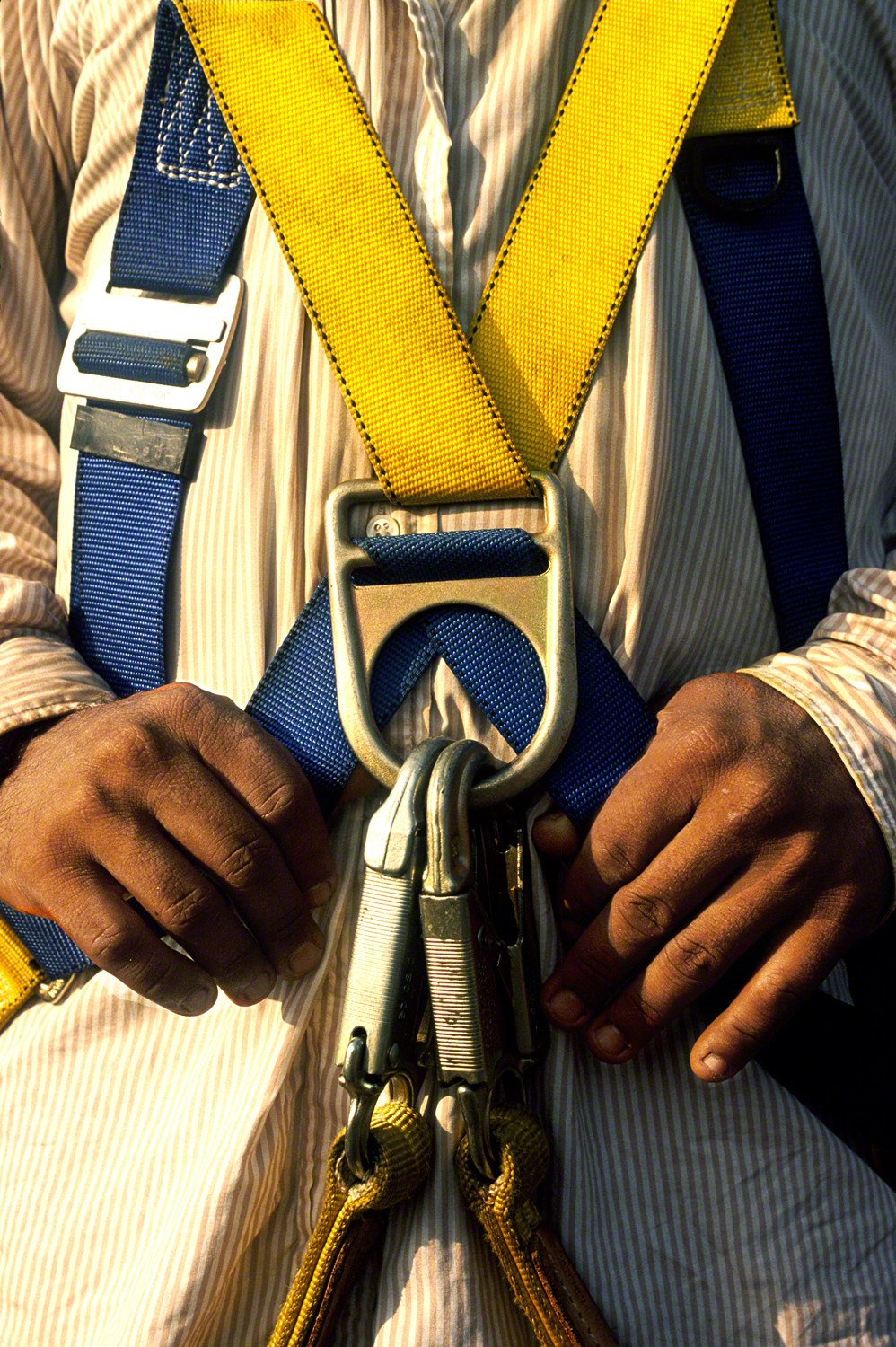
FYI, as long as the subject is known to a particular viewer, it can be somewhat esoteric. In the above photo the subject was safety, and although it’s a strong graphic photo, unless you were a stockholder in this company and read the annual report, you would’t know what the subject was.

Visit my website at: www.joebaraban.com, and check out my workshop schedule at the top of this blog. Come shoot with me sometime.

JoeB

Personal Pearl of Wisdom?

I just love diamonds, don’t you?

Ok, I’m not sure what category this fits into so I’m thinking three of them: My Favorite Quote since there’s a little of that, Food for Digital Thought since there’s some of that, and a Personal Pearl of Wisdom since there’s also a touch of that.

What am I getting at? Well I was talking to a friend that has a kid whose age is just right to let her watch The Wizard of Oz. He said that they were singing some of the songs together and reciting some of the dialogue.

As soon as they said, “lions and tigers and bears! Oh my!” a thought hit my eye like a big Pizza Pie! “squares and circles and triangles! Oh my! Btw, I left out rectangles since it just didn’t have the same flow.

Where in the world am I going with this you ask? Well, I show people how to use the elements of visual design in their photography. I do this in my online class with the BPSOP, and I often remind people during my daily critiques in my “Stretching Your Frame of Mind” workshops I conduct all over the place.

Shape is one of these elements and if used to enhance your composition, you will definitely be on your way to creating stronger photos.

There are four basic shapes, hence the inclusion of three of them in my adjusted quote for any upcoming remake of the iconic movie. Although shapes are all around us there are four basic ones: circles, squares, triangles, and rectangles.

Whether the viewer knows it or not, he’ll see them and react. When you begin to see with the right side of your brain, the creative side, you’ll be able to use shapes in your imagery. They will provide a sense of structure and unity to your composition, and will be perceived by the viewer as systematic, stable, and symmetrical.

The shapes that are similar but are more irregular such as an isosceles triangle or a trapezoid have more energy. Besides those that are more prevalent in our world, the diamond is a great shape, filled with a great deal of energy and evokes a sense of motion; not to be overlooked.

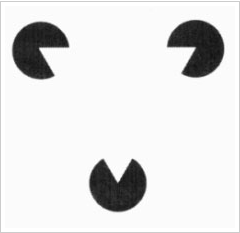
There are even implied shapes that one can perceive through the use of Closure; one of the six concepts in the Psychology of Gestalt; For example, in this diagram the viewer will fill in the triangle:

I saw a triangle

Shapes live among us and once you begin seeing past first impressions you’ll be able to not only see the positive shapes, the implied shapes, but the negative shapes as well. When we think of shapes, we think of the kind that has mass and therefore considered as positive space.

However, a shape can be the negative variety that’s created by the positive space that surrounds it. Imagine an ornate fence that has a row of wrought iron circles at the top and running the length of the fence. The circles are positives shapes and have mass, but what about the area inside the round wrought iron? Those are also circles, but they have been created by the positive shape and have no mass. They are the negative shapes.

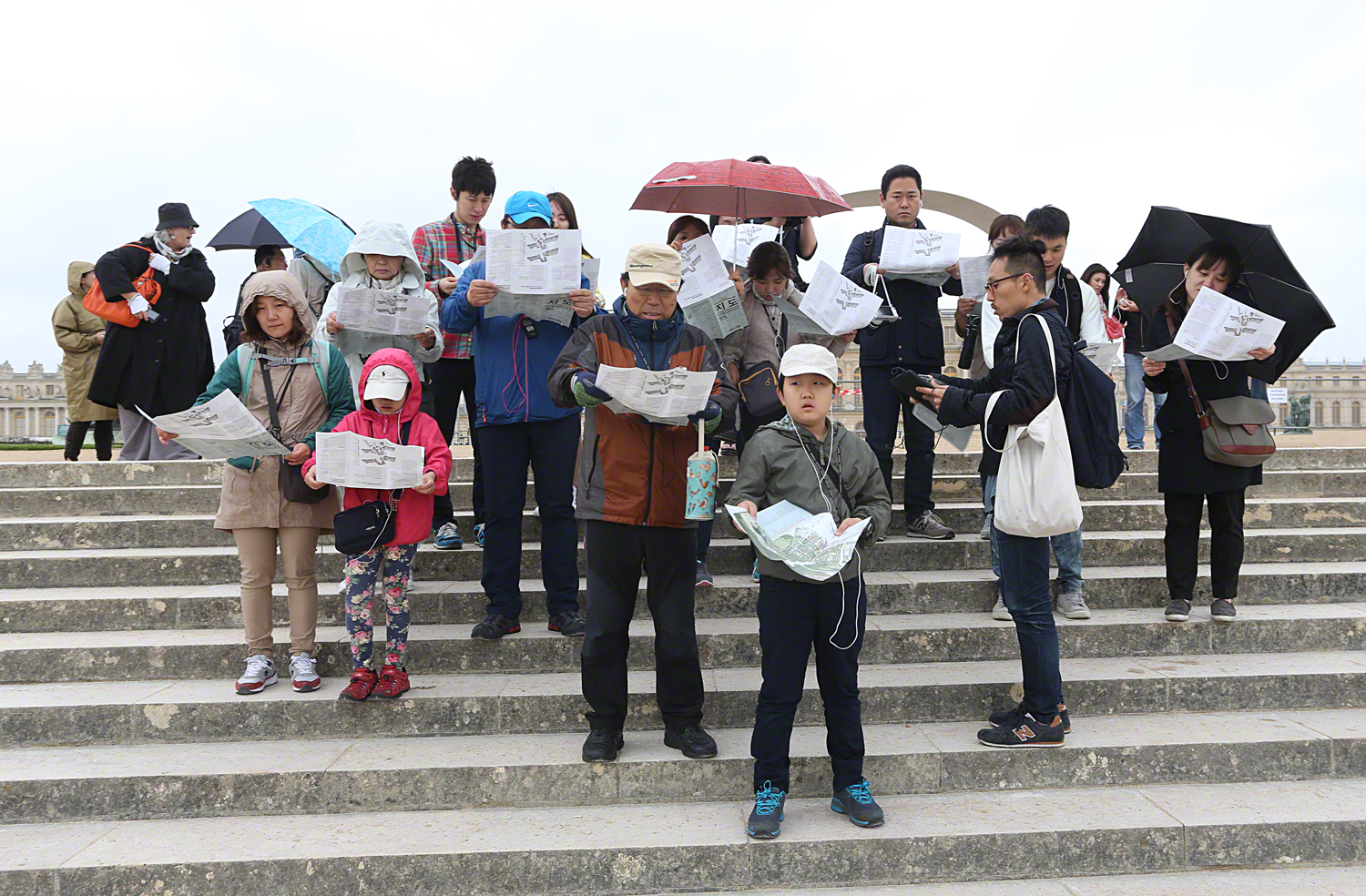
As I was talking about seeing past first impressions and using the right side of your brain, this certainly came in handy during my springtime in Paris workshop. The group went to the Palace of Versaille one cold and gray day so I was walking around looking for something else to shoot.

I noticed a group of Asians standing on the steps, all of them looking at the map of the entire grounds. What I saw was not a group of Asians all looking at maps, what I saw was a triangle made up of Asians all looking at their maps. I laughed and quickly took their picture, and as I always say, humor is the one thing that can work even with bad light.

Visit my workshop at: www. joebaraban.com and check out my workshop schedule at the top of this blog. Come shoot with me sometime.

JoeB

How to Take Memorable Portraits on a Castle Tour

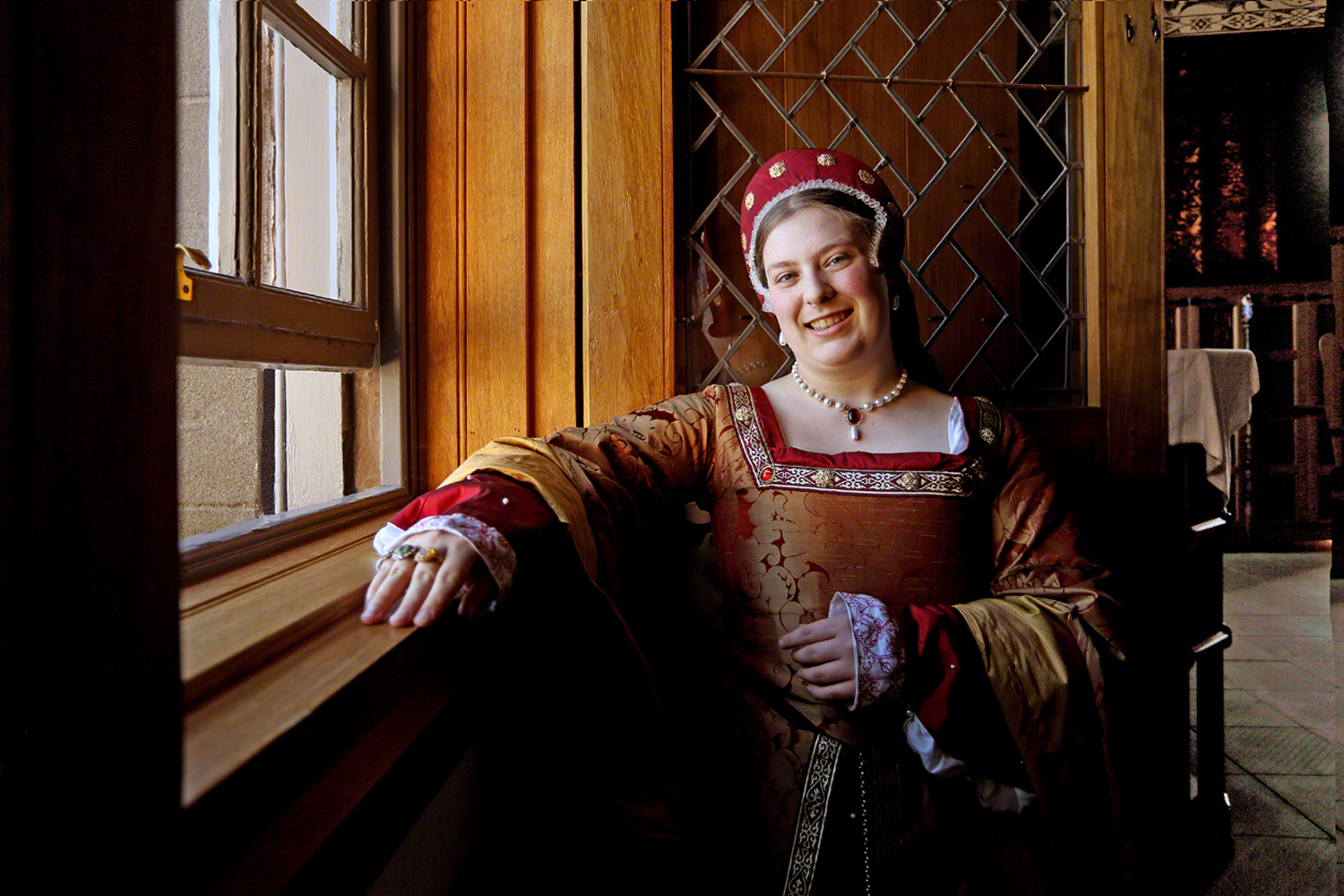
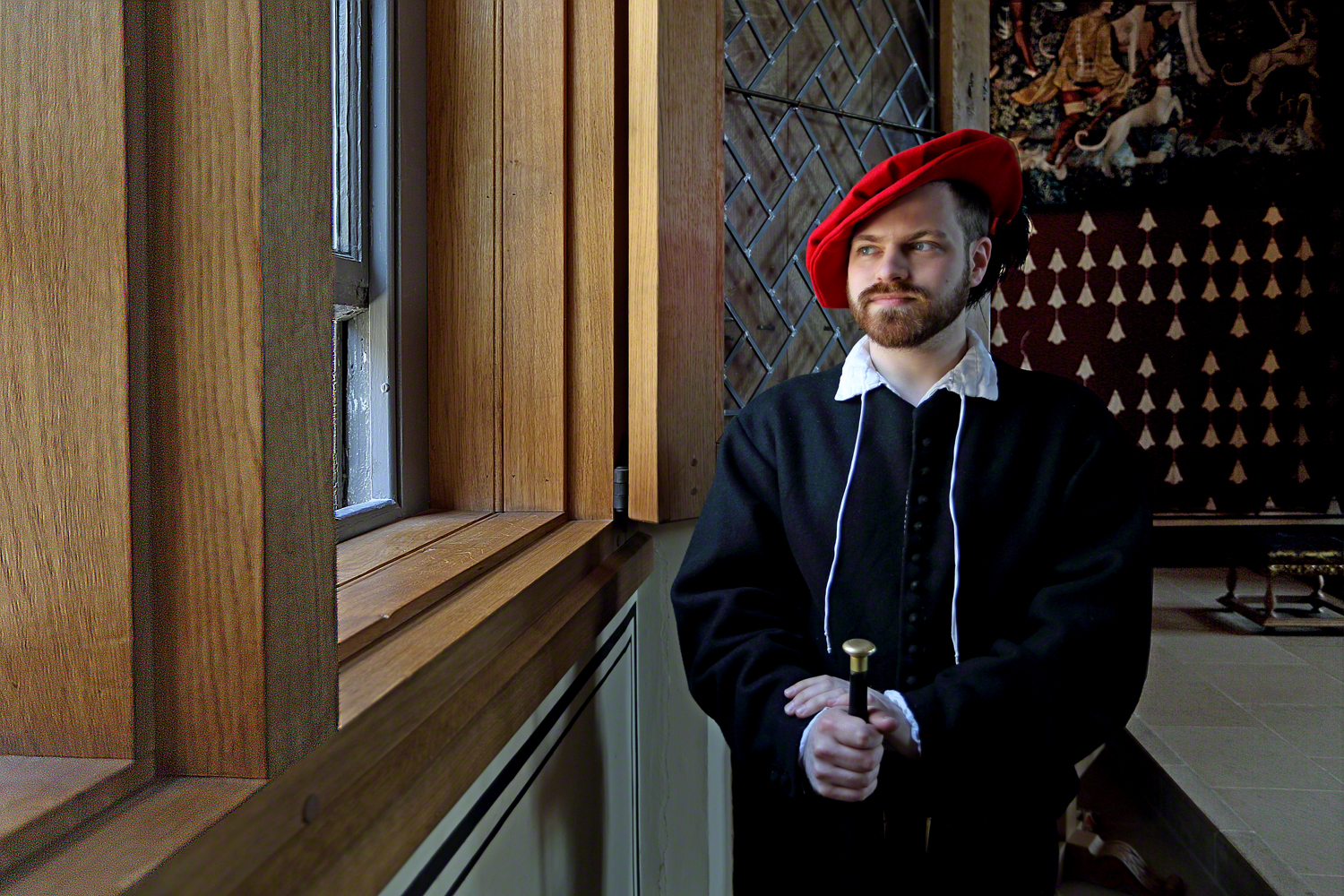
Nothing but window light.

For those of you new to my blog, I teach an online class with the BPSOP, and I also conduct my “Stretching Your Frame of Mind” workshops all over the place. I was going through some old photos of a trip we took after my Paris Workshop. We spent a week in an apartment in St. Andrews, Scotland, right across a small street where the British Open is played.

We decided to take the advice of a newly acquainted friend we met in a pub and check out a castle about an hour’s drive from us. The name of the castle escapes me but it’s really not important as far as this quick photo tip is concerned.

I say that because of the nature of this castle (as well as so many others) is to be “user-friendly”. In other words there were people standing around answering questions dressed up in period clothing; and more than willing to be photographed.

That’s all well and good, but the problem with that is the lighting. It’s a castle so it’s fairly dark which maks it difficult to shoot a decent portrait…unless you are using a flash which is worse!! Of course you always have your trusty phone but the lighting is sill the same. You’re just not going to get the contrast, depth, and visual interest you would if you had better lighting.

There is a solution and it will take your images way up a level. It’s possible if you have models willing to give you some time; especially if you email them a copy.

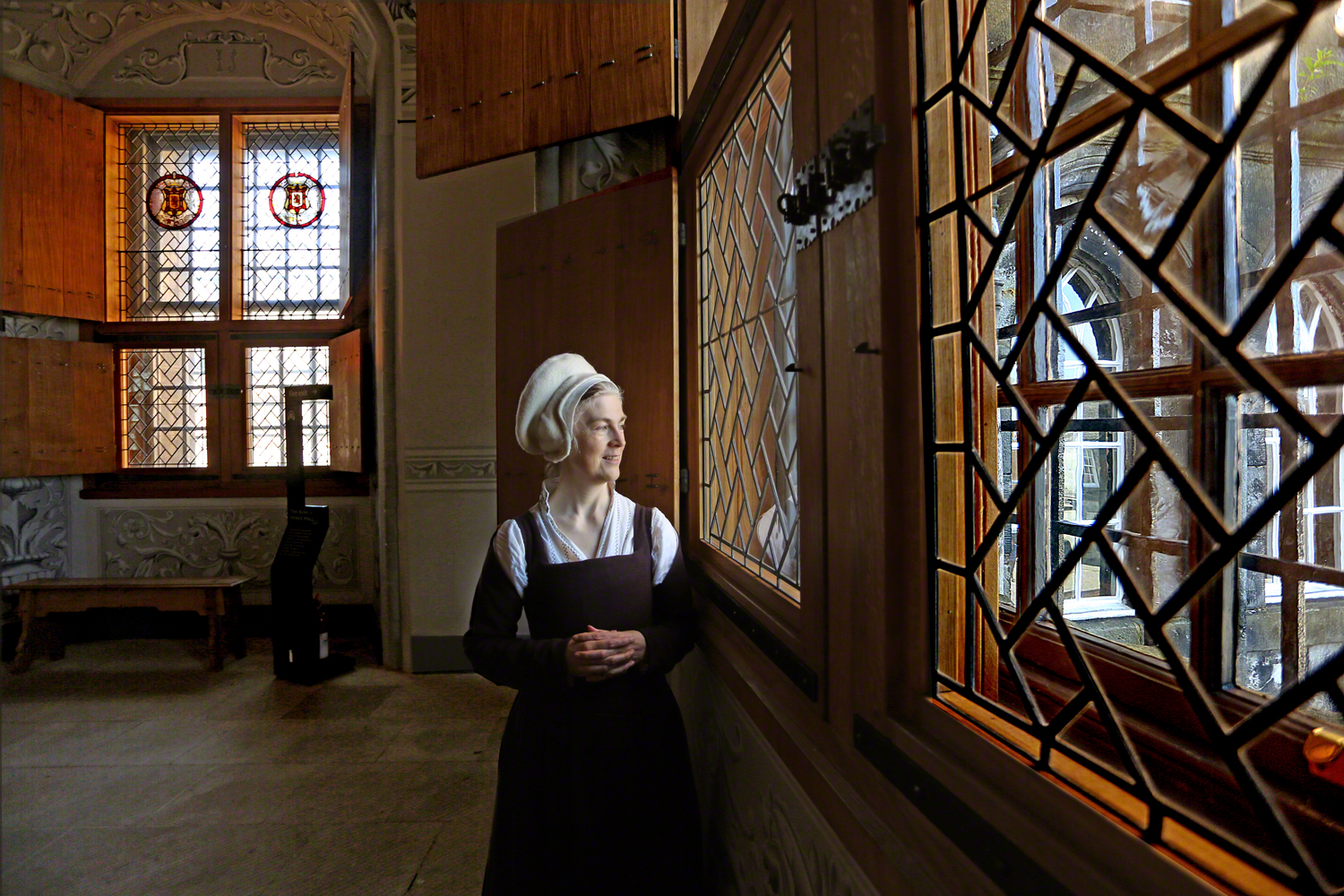
In the three images I’ve shown, I asked the three people if they would come over and stand next to a window so I could use the beautiful available light coming in…worked like a charm!!

Of course by doing this and exposing for them, the rest of the room became quite dark. This is an easy fix by merely spending a few minutes in either Lightroom or Photoshop. I opened up the shadows a little too much making them appear flat. I then went into ‘Levels’ and made the blacks blacker to add contrast.

It’s called “Crushing the Blacks” and I’ll be writing a post about it in the near future.

So my fellow photographers, the next time you’re traveling and you either read or hear about some castle or any historical building, find out if people are dressed up and walking around answering qustions. Most importantently if they’re letting people take their photo.

Visit my website at: www.joebaraban.com, and check out my workshop schedule at the top of this blog. Come shoot with me sometime.

JoeB