I enjoying this category and I especially love to hear the comments from those that take my online class with the BPSOP when I explain that there was a time when not only did we have to focus our own cameras, but Adobe was a type of house in the SW corner of the USA.
I also love to actually see the expressions of those that take one of my “Stretching Your Frame of Mind” workshops I conduct around the planet if I show my PowerPoint presentation entitled, “Life before Photoshop”.
Unfortunately, the large majority of my students started in the digital era, and can’t fathom not being able to enhance their photos after the shutter has been clicked. It’s almost scary, as in freaks them out, when I tell them that they’re not allowed to use Photoshop in my class, and that I want to see their UN-CROPPED images right out of the camera. You see in my class it’s about becoming better photographers, not better photo-technicians.
Don’t get me wrong, I love CS5, and I use it all the time. But when I use it it’s because I didn’t have the control I needed to create my image in the camera. WOW, how about that content-aware tool…it’s crazy!!!!!! Don’t you just love it???
I digress once again.
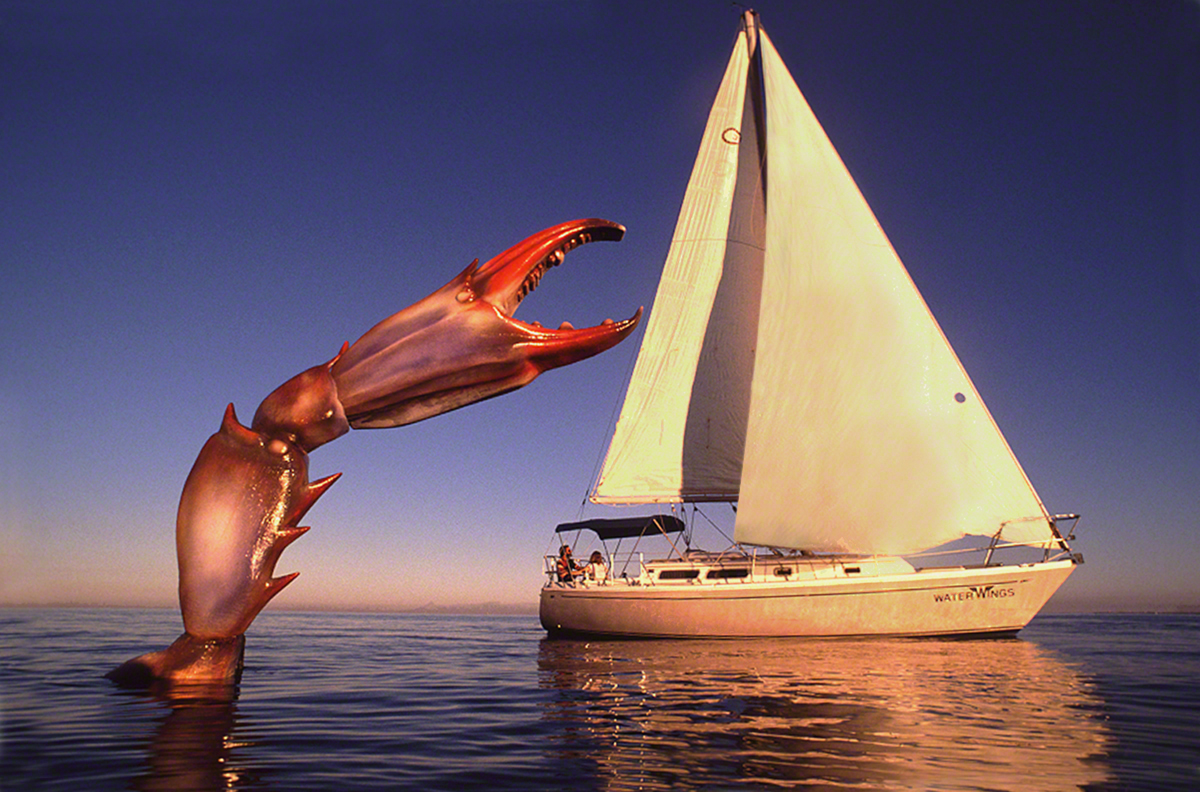
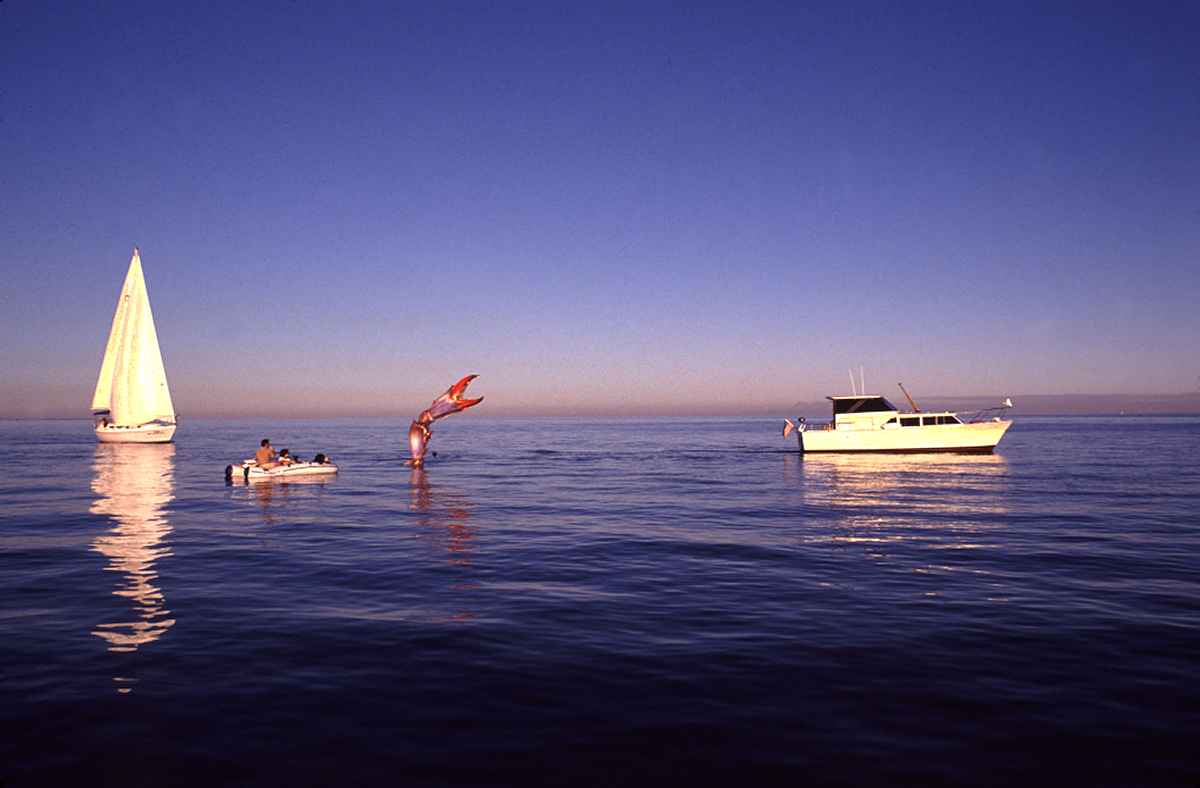
In the above photo, I was hired by the advertising agency that handled a company who insured boats and yachts of all sizes and shapes. The Art Director didn’t have much of a layout to follow, but what he wanted was to show a giant lobster attacking both a motor-yacht and a sailboat. I hired a good friend that’s a terrific model builder, and after we had a preliminary conversation over the size he carved my claw out of hard foam. He also devised a way to keep it standing up in very shallow water (as seen in the photo) while I had a sailboat and a large motor-yacht follow each other around me in a circle at sunset.
Remember that in those days everything had to be in perfect scale since it was to be created in the camera. Now, the claw would be a foot tall, shot in a controlled studio and Photo shopped into the image with just the boats.
What’s the fun doing that??? For me, there’s a sense of accomplishment in knowing that I could do this in the camera. I could never feel that sitting in front of a computer.
But that’s just me!!!
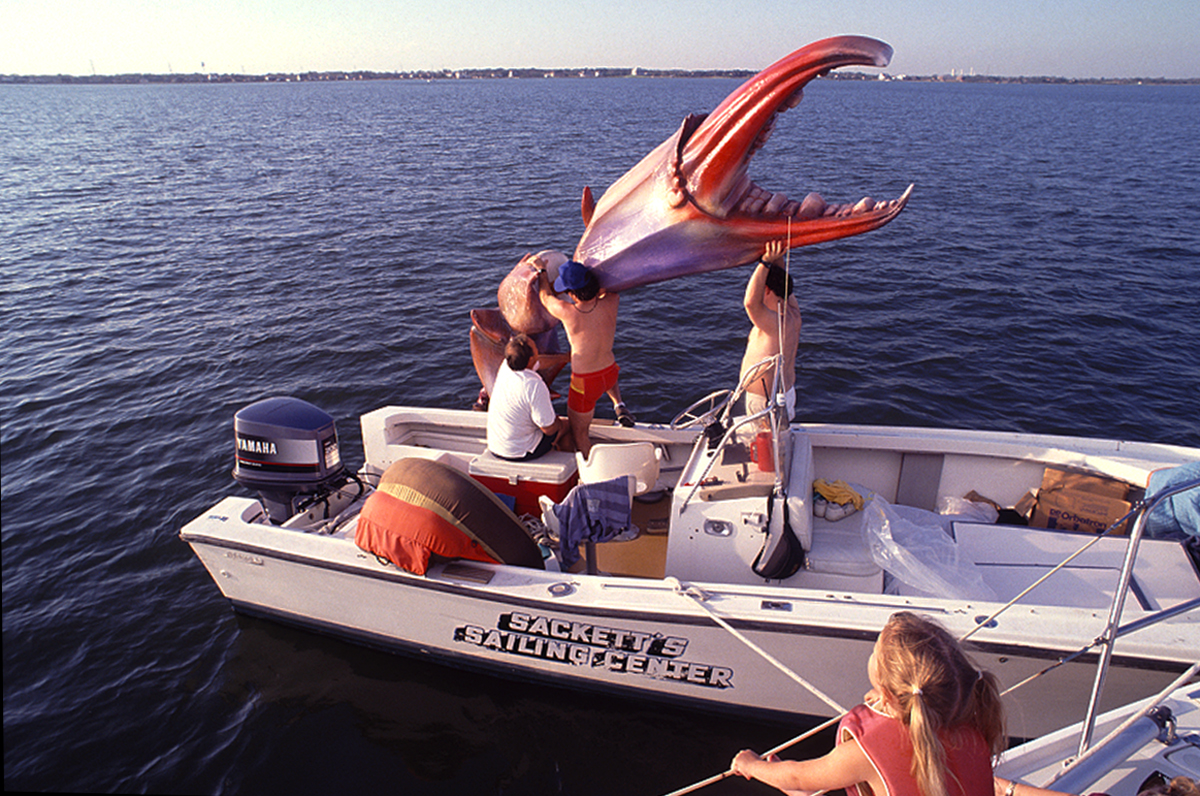
Here’s how we did it. The first photo shows Danny getting it ready, and the second shows me in a Zodiac shooting it.
Btw, the first day as we were getting ready to shot, the device Danny built did not cooperate and wouldn’t stay up. We had to scrub it for the day and let the kinks be workd out. Fortunately for yours truly, the next day was as clear as the day before…so no harm done.
Visit my website at:www.joebaraban.com, check out my 2018 workshop schedule, and come shoot with me sometime.
This coming July 29th will be my 30th anniversary teaching at the Maine Media Workshop. I’ve always picked this time as it’s the week of the Lobster Festival down the road in Rockland. This ofers a unique set of photo ops, different from the Maine Coast, fishing villages and lighthouses. The Lobster Festival is all about color, design, light, energy, people watchng and environmental portraits everywhere you look; some people are there in costumes and loved to be photographed.
In conjunction with The Santa Fe Workshops, October 2nd I’ll be leading a group in San Miguel de Allende. A beautiful oasis and artist colony, and the entire city is a UNESCO site.
Come join me for a week of fun and photography…what could be better
In lesson one Part I of my four week online classes with the BPSOP, we work on the negative and positive space aspects of a composition. From this online class many of my fellow photographers have signed up for one of my “Stretching Your Frame of Mind” workshops I conduct around our planet.
As part of the daily reviews I will invariably talk about achieving the balance between both the negative and positive space and continuing to plant this concept in their minds; because it’s that important.
There are two kinds of space, positive space and negative space. Positive space has mass and is usually the main subject or object, and negative space is everything else…specifically the area bordering the positive space defining it but not a part of it. Since negative space carries its own visual weight, we must be careful not to let it distract in any way from the main subject, although there’s one exception: when the negative space is the subject.
By the way, negative space is not negative. A good photograph will have a good balance (one of the basic elements of visual design) between the positive and negative space. As photographers (artists), it’s easy to think only of the positive space. So easy, we sometimes forget about the part that’s just as important…the negative space in our composition. Training your ‘eye’ to see around the subject will make the practice a powerful compositional tool that can, and will strengthen your photographs.
To some, this concept can be difficult to understand, yet it is one of the easiest once you can overcome the need to only focus on the positive space (your subject). One way is to concentrate on the space between the subjects and around them. This will put the impetus on giving the viewer a place to rest his eyes; as well as seeing the shapes that are caused by the negative space.
In the above photo, I was sent to D.C. to take environmental portraits of all the partners in a law firm. They wanted these partners in close proximity to one of the monuments. I positioned this man with a keen eye as to keeping some negative space between the Washington monument and the cherry blossoms; while being cognizant of the balance between the three subjects.
In the photo of the church dome in France, once again I moved around until I could get some negative space between the leaves and the top of the dome….so the viewer could rest his eyes.
In the photo of the couple standing on a small hill in Hawaii, I was hovering in a helicopter and was communicating with them by way of a walki-talki in the chopper and one on the man’s belt on the right. The object was to create negative space so all of their arms and legs would be well defined; by directing them with the walki-talkis.
So the next time you’re out shooting pay as much attention to the negative space as you do with the positive space; usually the subject.
Visit my website at: www.joebaraban.com, and check out my 2018 workshop schedule at the top of this blog. Come shoot with me sometime.
This coming July 29th will be my 30th anniversary teaching at the Maine Media Workshop. I’ve always picked this time as it’s the week of the Lobster Festival down the road in Rockland. This ofers a unique set of photo ops, different from the Maine Coast, fishing villages and lighthouses. The Lobster Festival is all about color, design, light, energy, people watchng and environmental portraits everywhere you look; some people are there in costumes and loved to be photographed.
In conjunction with The Santa Fe Workshops, October 2nd I’ll be leading a group in San Miguel de Allende. A beautiful oasis and artist colony, and the entire city is a UNESCO site.
Come join me for a week of fun and photography…what could be better?
I recently had a blog follower ask me to post one of his all time favorite posts that I wrote almost eight years ago. WOW! That’s a long time to remember something, especially when I can’t remember what I was doing last week.
It was on the 101 things I think all photographers should know about photography and the art of taking pictures.
I was “surfing the world wide web”, and I came across an interesting post on things to know about photography. It listed things I’ve been teaching, thinking and talking about for over twenty-five years in my “Stretching Your Frame of Mind” workshops I conduct around the planet, and in the past two years with my online class with the BPSOP.
While a few were on my list, there were several I didn’t agree with or were left out. In any event, it inspired me to share not only the link to the post, but to reveal my own personal 101 list as well.
Here’s my list, enjoy:
101 things to know about photography:
1. It’s not the camera; it’s the ten inches behind it that’s important.
2. Never photograph a child without asking permission from a parent first.
3. “When you get lucky, be ready”…Eddie Adams.
4. Be sure to always have a tripod with you.
5. Light is everything.
6. Remove the Histogram from your camera; it’s not what you want to be looking at when you have seconds of light left.
7. Get up close and personal to your subject.
8. Always have a roll of duct tape and WD-40 with you.
9. Crop in the camera so you’ll know where the edges of your frame and the four corners are.
10. Shadows are your best friend.
11. Clip the highlights.
12. See past first impressions.
13. Always consider the scene and its outcome.
14. It’s not what you put into a picture that counts, it’s what you don’t put in that matters.
15. Always carry a camera with you.
16. Marry someone whose father owns a big camera store.
17. Bracketing in the camera will make you a better photographer.
18. It’s ok to get dirt on the front of your shirt when you’re composing a photo.
19. Always shoot in RAW.
20. Lens shades help.
21. Pick up the trash in your composition before shooting.
22. Sometimes a pretty sunset to you is just another pretty sunset to someone else.
23. Challenge yourself. Try shooting with your least favorite lens.
24. Only show your best photographs.
25. Study the ‘Masters’, they were here before you.
26. Pre-visualize. Try to see it in your mind first.
27. Use the elements of visual design and composition when taking pictures.
28. Shoot on manual, don’t ever let the camera tell you what to do.
29. Take an online class or a workshop to hone your skills.
30. Break all the rules you can, but first I suggest you find out what they are.
31. Have your camera body facing down when changing lens to keep the dust out.
32. In photography, bigger (cameras) is not better.
33. Take along a big golf umbrella and shoot in the rain.
34. Pictures make great Christmas gifts.
35. Golden light is the prettiest light.
36. Don’t let your camera fall into a Lava Pool.
37. Manufacturing excuses for your photos is not in your best interest.
38. Underexposing looks better than overexposing.
39. Make pictures, don’t take them.
40. Martinis and photography don’t mix very well.
41. Taking art classes will improve your photography.
42. The Rule of Thirds is boring.
43. The Horizon Line is the most important line.
44. You need not go any farther than your bathroom to take good photos.
45. Sometimes asking forgiveness is better than asking permission.
46. A copyright stamp won’t protect you unless your photo is registered with the library of Congress.
47. Taking a great photograph is a lot like scoring a touchdown. Never tell anyone it was your first one.
48. A camera on a tripod is like a canvas on an easel.
49. Make the viewer an active participant in your imagery so he’ll stick around longer.
50. Let someone that knows what they’re doing clean your sensor.
51. “ You can’t depend on your eyes if your imagination is out of focus”…Mark Twain.
52. You find the Light, and you’ll find the shot.
53. When you buy a new camera, read the manual.
54. Good pictures are like good jokes. If you have to explain them, they’re not so good.
55. Shoot to live, live to shoot.
56. Stick with one ISO, and you’ll never have to worry about switching back and forth.
57. Back up all your images all the time.
58. Controlled distortion can work.
59. Always brake for photographs.
60. “The voyage of discovery is not in seeking new landscapes, but having new eyes”…Marcel Proust.
61. We perceive in a 2X3 ratio (a rectangle).
62. An active imagination is the Fountain of Youth.
63. See, feel and sense the ever-changing Light.
64. The background is just as important.
65. Have your subject walking or looking out of the frame.
66. Don’t show the sky in bad light.
67. Vertical formats have more energy than horizontals.
68. Make sure that when you format your card, you really wanted to.
69. Sometimes when more’s better, too much is just right.
70. Always know the direction of the light.
71. Make your life simpler. Set your camera on AWB and ‘Fuhgetaboutit’.
72. Never leave any of your equipment in your photographs.
73. Including Patterns in our photos is a good thing; breaking the rhythm of the pattern is even better.
74. Shooting in the Blue Hour is a lot of fun.
75. A triple colored mat won’t make a bad photograph look better.
76. A glass of wine after a great sunset shoot is intoxicating.
77. Balance the Negative Space and Positive Space.
78. “Been there shot that” is not a good thing to say.
79. Create ‘energy’ in your photographs.
80. Try to lead the viewer around your composition.
81. Photoshop is a good thing, used sparingly.
82. If you really want to be a better photographer, shoot on manual.
83. Buy your kid a toy camera on his first birthday, then start upgrading.
84. Be objective not subjective when editing your pictures.
85. There’s nothing like seeing the world through a viewfinder.
86. 1/60th of a second at F/8 is the same exposure as 1/125th of a second at F/5.6.
87. Color communicates ideas.
88. If you had to choose between Lightroom and Photoshop, pick Lightroom.
89. Follow Photography Blogs.
90. Don’t loan equipment to friends without including the phrase, “you break it, and it’s yours.”
91. Take portraits with wide-angle lens.
92. Learn “The Decisive Moment” by studying Henri Cartier-Bresson.
93. Give the viewer several ways to enter and leave the frame.
94. Don’t forget about silhouettes.
95. Setting your WB to cloudy on an overcast day won’t necessarily make your picture look better.
96. More shots per hour.
97. HDR prints sell like hotcakes on the sale table in the decorative center of your local Wal-Mart.
98. The early bird always catches the best light as well as the worm.
99. Use gesture to communicate an emotional response.
100. When you have a gray day, be funny. Humor conquers all.
101. Never come home with an empty flash card.
Visit my website at: www.joebaraban.com and check out my 2018 workshop schedule at the top of this blog. Come shoot with me sometime. I’ve a couple of openings in my Springtime in Berlin workshop next May 23rd. A fantastic city with so many great locations we’re going to be shooting.
This coming July 29th will be my 30th anniversary teaching at the Maine Media Workshop. I’ve always picked this time as it’s the week of the Lobster Festival down the road in Rockland. This ofers a unique set of photo ops, different from the Maine Coast, fishing villages and lighthouses. The Lobster Festival is all about color, design, light, energy, people watchng and environmental portraits everywhere you look; some people are there in costumes and loved to be photographed.
In conjunction with The Santa Fe Workshops, October 2nd I’ll be leading a group in San Miguel de Allende. A beautiful oasis and artist colony, and the entire city is a UNESCO site.
Come join me for a week of fun and photography…what could be better?
I don’t know about you but I like to have people stick around spending time looking at my photos. Now, I suppose there are photographers out there that shoot solely for their own gratification and never share their images for whatever reason. However, if we go on the assumption that photographers are artists that have chosen the camera as the medium, then it stands to reason that said photographers like to have people admire their work; I for one as an example.
Having said that, we can’t expect the viewer to spend very much time looking (unless they are wives, mothers, aunts, and sometimes even siblings) unless we give him something that makes it worthwhile; people just don’t have the time anymore.
One of the best ways is to add an editorial slant to your composition, and I talk about this a lot both in my online class with the BPSOP and in my “Stretching Your Frame of Mind” workshops I conduct all over the place.
Ok, so what do I mean by editorial? The word editorialize means to express or form an opinion; to ask the viewer to pose a question.
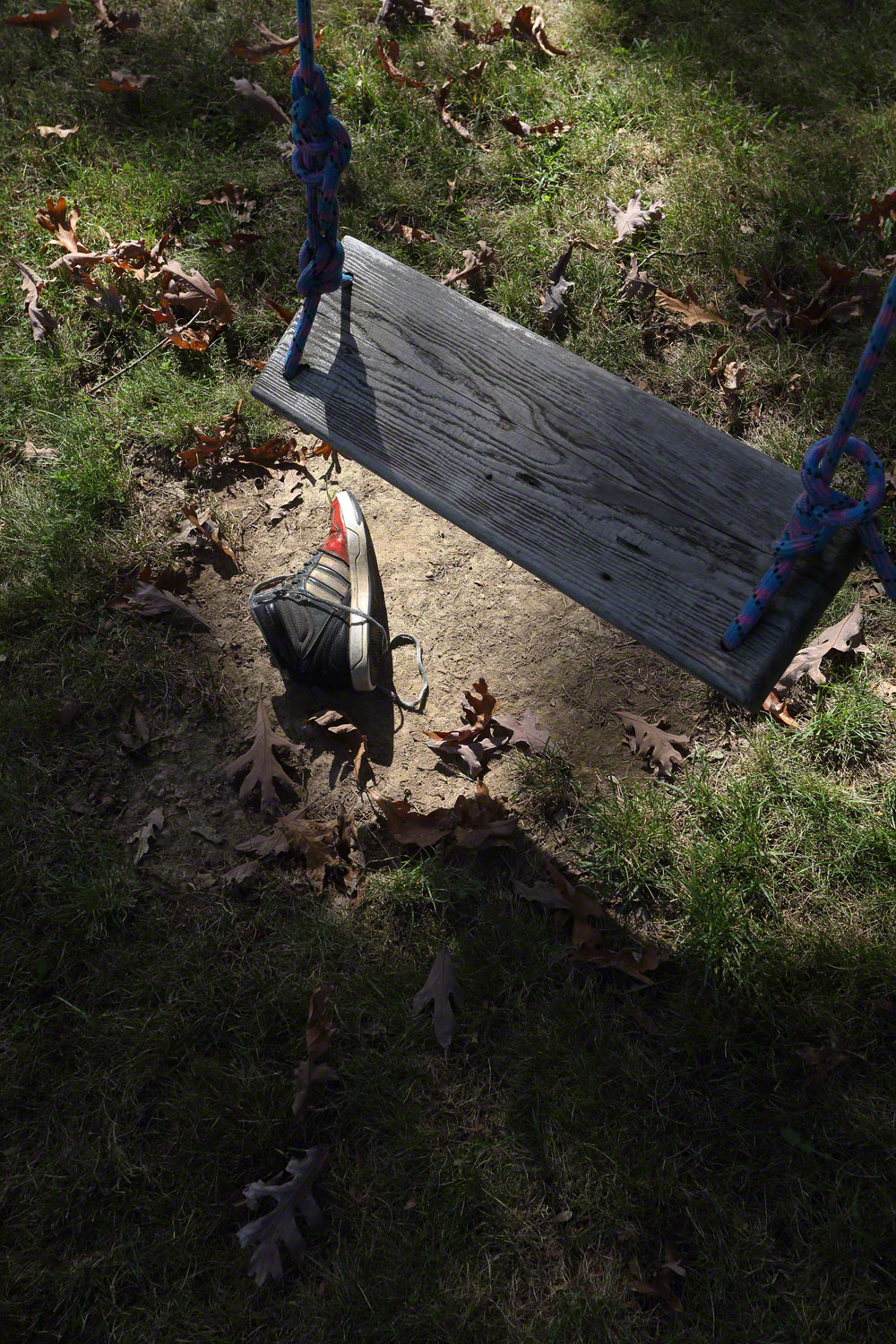
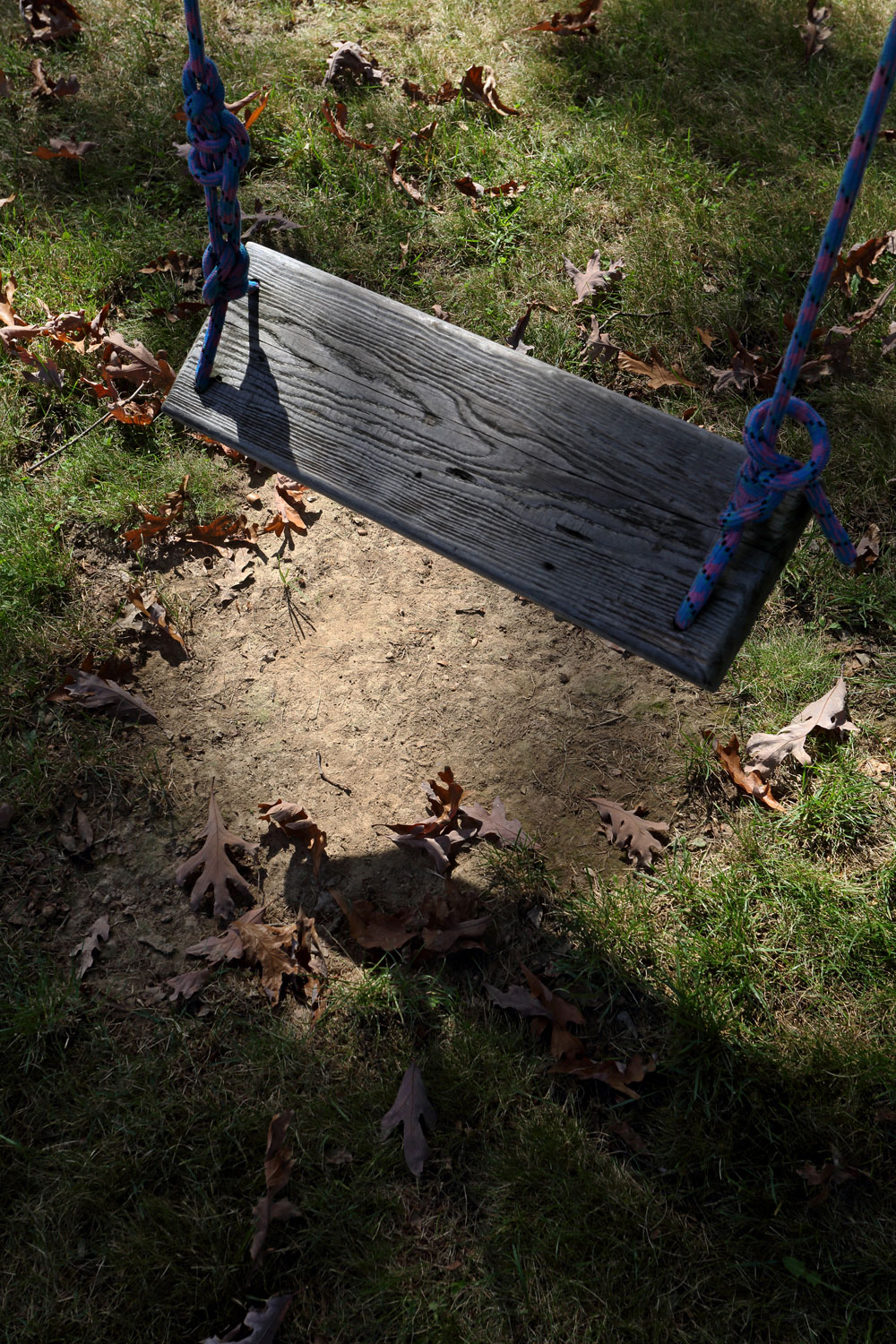
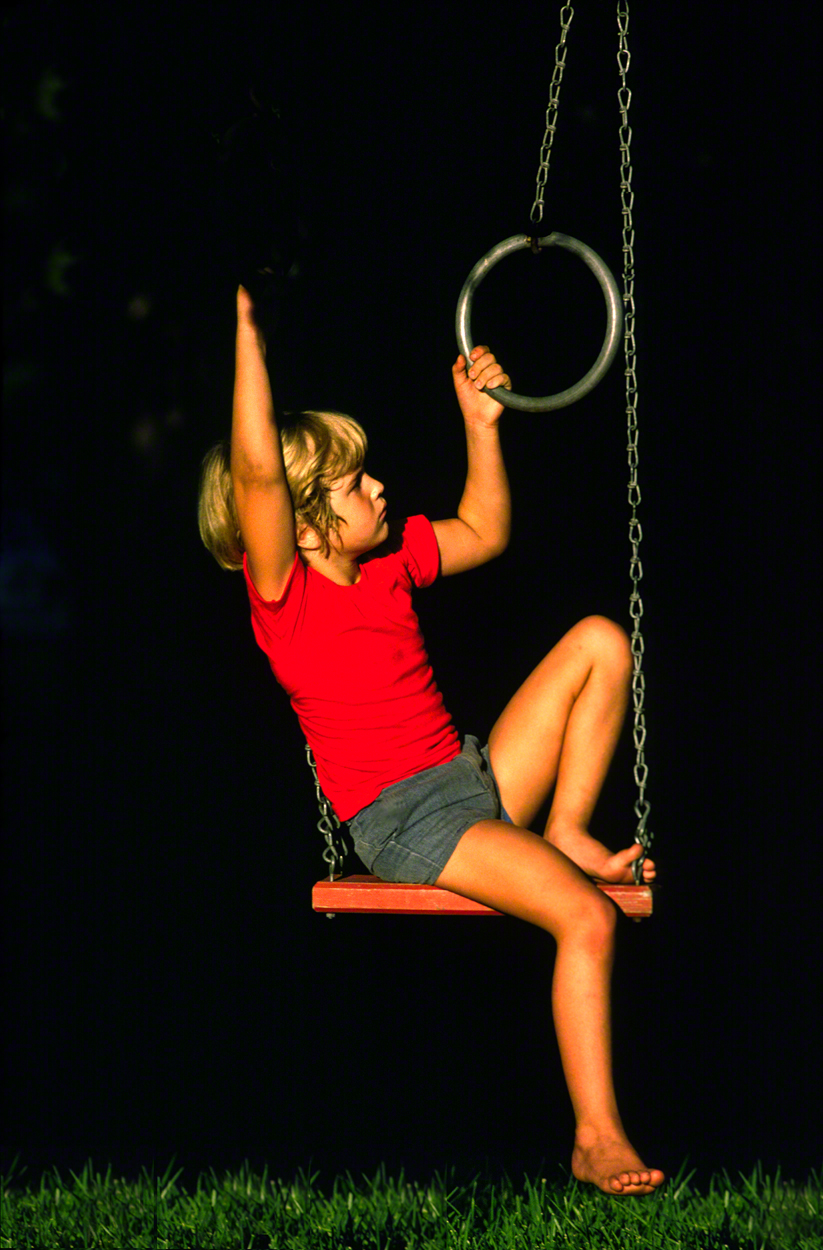
In the photos above I have added a slide bar so you can go from one photographic thought to another. I shot the swing first by itself, then added one of my grandkid’s shoes. This concept is predicated on the idea of making the viewer an active participant. In other words, keeping him involved will keep him around longer. This is about taking control of how the viewer perceives and processes information we give to him in the form of a photograph.
When you look at the swing by itself, you’re looking at a fairly interesting image mostly as a result of the dramatic way it’s backlit, the texture of the grass, the leaves, and the shadow.
When you use your cursor to move the slide from left to right, it reveals an entirely different photograph. Simply by adding a red sneaker, I ask the viewer to raise a question. What question do you think it conjures up?
To me, it asks: Why is that one shoe there? Why just one? Who does it belong to? What happened to make him forget or lose one shoe? Was he hurt? Is he going to get into trouble? Etc., etc. It’s the Who What Where When, and Why” of photography.
So next time you’re out shooting take some props with you and try to add an editorial element. Remember that you’re an artist whose camera on a tripod is not unlike a blank canvas on an easel; you’re a painter, so paint.
Visit my website at www.joebaraban.com, and check out my 2018 workshop schedule at the top of this blog. Come shoot with me some time and we’ll editorialize together.
In conjunction with The Santa Fe Workshops, October 2nd I’ll be leading a group in San Miguel de Allende. A beautiful oasis and artist colony and the entire city is a UNESCO site.
Come join me for a week of fun and photography…what could be better?
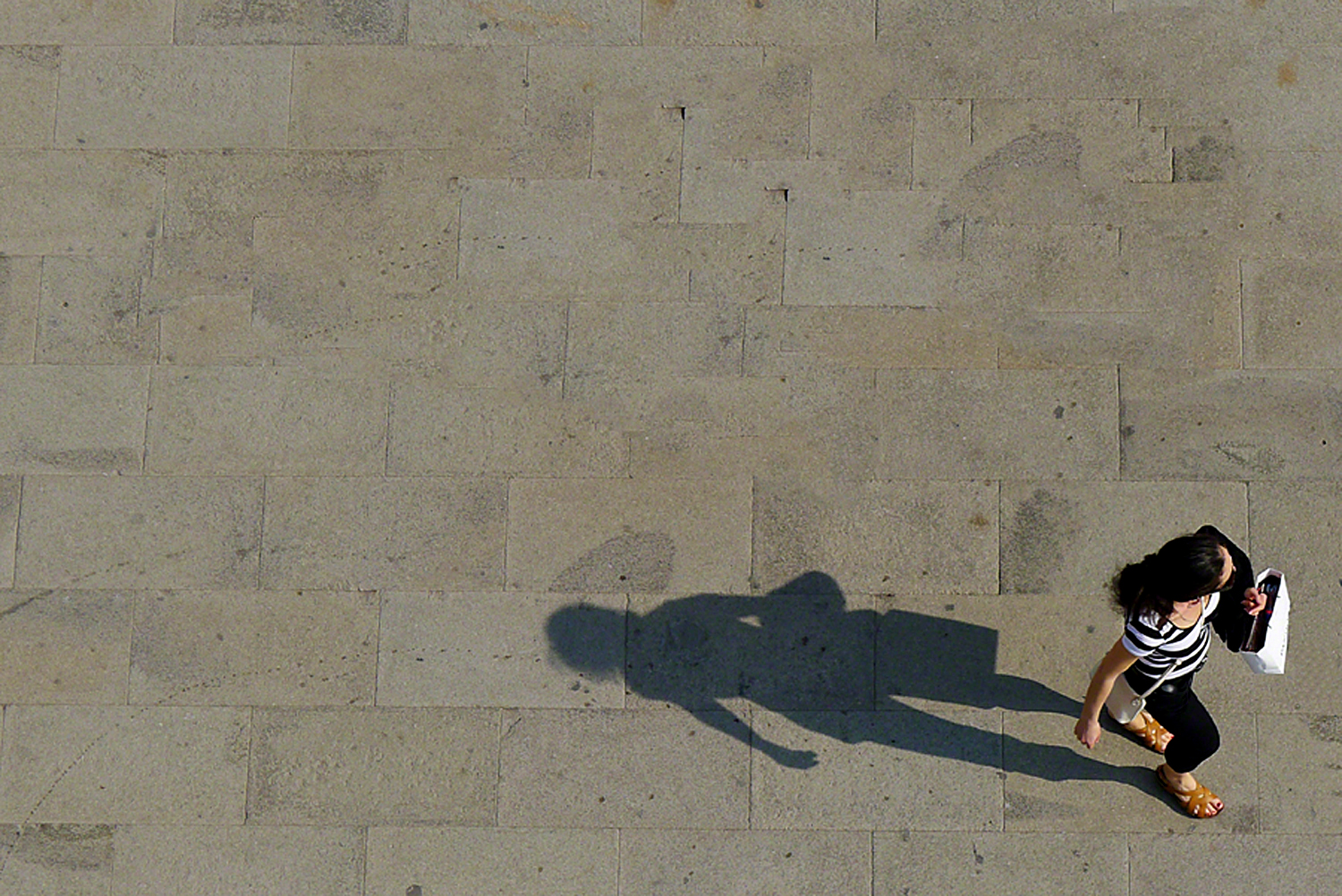
A very long time ago I was actually young, and I still remember my mother singing along to a 1927 hit song called called, “Me and my shadow”, and it actually continued with…”walking down the avenue”.
Although not actually a quote on its own it’s part of a song that I occasionally think of as I watch people and their shadows strolling down a street, avenue, or as in the photo above which I took from a balcony in the Piazza San Marco square in Venice.
I watched several people walk underneath the balcony and I waited until I could one of them cutting a diagonal from one corner to another. Finally, I saw a woman come walking towards me cutting the exact diagonal I was hoping for. I waited because I wanted her to be leaving the frame as to generate visual tension, as well as implying content outside of it.
Yes, I know some of you have been told to always have someone walking into the frame (the leading in rule) , but where’s the mystery if you know where they are walking? I want the viewer to wonder where they’re going by saying that there’s something more that can’t be seen.
I digress.
I love shadows and make no mistake, they are your best friend. I hear all the time both in my online class with the BPSOP, and in my “Stretching Your Frame of Mind” workshops I teach around our planet that my fellow photographers fear shadows, find them intimidating, and go out of their way to avoid them; when in fact they should embrace them.
What’s important is the interrelationship between the light, the subject, and the shadow, and when that happens it gives a dramatic edge to your photos; and will often create an abstraction.
Look for shadows and try to incorporate them into your imagery, and when you do you’ll find that your photo has taken on a layers of interest that will propel it to another level. When that happens, and you’ll know it, pay tribute to whatever shadow you’ve included.
Visit my website at: www.joebaraban.com and check out my 2018 workshop schedule at the top of this blog. Come shoot with me sometime. I’ve a couple of openings in my Springtime in Berlin workshop next May 23rd. A fantastic city with so many great locations we’re going to be shooting.
This coming July 29th will be my 30th anniversary teaching at the Maine Media Workshop. I’ve always picked this time as it’s the week of the Lobster Festival down the road in Rockland. This ofers a unique set of photo ops, different from the Maine Coast, fishing villages and lighthouses. The Lobster Festival is all about color, design, light, energy, people watchng and environmental portraits everywhere you look; some people are there in costumes and loved to be photographed.
In conjunction with The Santa Fe Workshops, October 2nd I’ll be leading a group in San Miguel de Allende. A beautiful oasis and artist colony, and the entire city is a UNESCO site.
Come join me for a week of fun and photography…what could be better?
Louis Daguerre was a painter and Physicist, but he was better known for inventing the Daguerreotype; the first process for making photographs. Actually it was Nie’pce that was the first, and later they both actually became partners working on it together.
One of my all time favorite quotes was made by Daguerre. He said, ” I have captured the light and arrested its flight. The sun itself shall draw my pictures.”
When I first read this quote I was instantly struck by my own thoughts I’ve been carrying with me for the past fifty years of being an advertising and corporate photographer and now that I’m retired those same thoughts are with me when I show my fellow photographers how to “make pictures”, as well as using the light and sun effectively. That is, how critical light is and should be to them when they’re out shooting and more importantly, how the sun affects every aspect of a photographer’s thought process as it relates to his or her imagery.
Back light for energy
I’m constantly advising my online students with the BPSOP, that shooting when the sun is no more than 15 degrees off the horizon offers the optimum light as far as the quality and softness is concerned; known as the Golden Hour. As far as as my “Stretching Your Frame of Mind” workshops I conduct, we might be street shooting midday, but we’re always out there early in the morning and late in the afternoon as well.
If you’re a student of light, you think about the sun and where it is any time you’re holding a camera. I have talked for years about my clock and how I determine what the subject will look like under various conditions. In other words I always let the sun draw my pictures.
Front light for contrast
Where I place myself in relation to the sun will create different visual interest and tension. For example, if I want to add the third dimension to my subject, the illusion of depth, I’ll use light coming in from the side. If I want the feeling of energy and make my subjects seem to be glowing, I’ll back light them. If I’m looking for extreme contrast I’ll place the sun at my back and front light, providing I can get the area behind the subject dark.
So many photographers just don’t give the light and the sun much credence. For them if the sun is out nice and bright and right above their heads that means that it’s beaming down enough to “take pictures”…albeit hot and harsh.
If I had a dollar for every time I saw a photographer look up to make sure the sun was shining as much as possible on their subject, I would be writing this from a lounge chair next to a pool on some Island; a blue and frothy cocktail with an umbrella hanging down on one side, sitting on a table very close to me.
Here’s what I can promise you…if you become cognizant of the light and where the sun is at any time you’re out shooting, and let it draw your pictures, you’re photography will move up at least one notch.
Visit my website at: www.joebaraban.com and check out my 2018 workshop schedule at the top of this blog. Come shoot with me sometime. I’ve a couple of openings in my Springtime in Berlin workshop next May 23rd. A fantastic city with so many great locations we’re going to be shooting.
This coming July 29th will be my 30th anniversary teaching at the Maine Media Workshop. I’ve always picked this time as it’s the week of the Lobster Festival down the road in Rockland. This ofers a unique set of photo ops, different from the Maine Coast, fishing villages and lighthouses. The Lobster Festival is all about color, design, light, energy, people watchng and environmental portraits everywhere you look; some people are there in costumes and loved to be photographed.
In conjunction with The Santa Fe Workshops, October 2nd I’ll be leading a group in San Miguel de Allende. A beautiful oasis and artist colony, and the entire city is a UNESCO site.
Come join me for a week of fun and photography…what could be better?
Here’s a very interesting concept I created that I want to share with all of you. Something to think about when you’re shooting:
There are two men swimming in the ocean, and while doing so one of the men sees a gray spot against a calm blue horizon. That man decides to swim to shore, the other man doesn’t and is eaten by a huge shark. By reacting to something different, the man that swam to shore survived. He saw something different!!!
Creativity is the gray spot. It was that which was the most different. As photographers we want the viewer to react (and will always react) to that, which is the most different.
Imagination keeps us young. It’s the gas and oil that keeps our mind running smoothly. Hopefully, the kinds of people that will look at our work do have some semblance of being creative…or they wouldn’t be bothered…so who cares about them??? That goes for ourselves as well. Let everyone else be predictable in his or her approach to shooting pictures. Remember that good photographers follow the more traditional ways and adhere to all the rules. The great photographers “follow the beat of a different drummer”, and break the rules.
Most people put a high value on creativity, but since it’s an intangible commodity it’s also misunderstood. It takes a somewhat flexible mind to even get close to realizing its importance in our society. I’ve had students in my workshops tell me that in order to be really creative you have to be original, and they also say that there aren’t any photos left that haven’t already been taken. While it’s true that there aren’t very many if any original ideas left, the creative part comes in when you take those existing ideas and show them in a new way. Marcel Proust, a French novelist said, “The voyage of discovery is not in seeking new landscapes, but having new eyes”.
One way to see new landscapes is to what I call “Seeing past first impressions”. The great photographs that you aspire to take will come with seeing new ways to look at old ideas. Go out and be prepared for the unexpected. Eddie Adams, a Pulitzer Prize-winning photographer once said, “When you get lucky be ready”.
In my opinion, one of the best inventions to ever come around, hell-bent on stifling creativity is the Histogram and those pesky blinking areas in the back of your camera that tells you that in a certain part of your frame the highlights were clipped (see my post on this subject). DANGER-COMBUSTIBLE-DO NOT MIX THESE WITH CREATIVITY-HARMFUL IF SWALLOWED!!! Truth be told, they actually slow the process down and no doubt were put there because that’s our world now. If you free yourself of those things your photos will have a much better chance of moving “up a notch”.
To my way of thinking it’s going to do more harm than good, and wind up complicating those creative juices. Learn to feel/see/ find the light, then be creative with it. It’s so important to be able to sense when it’s changing all around you and make immediate corrections without looking at your Histogram because make no mistake, light is so fleeting that just a few seconds can make the difference in going home empty handed or excited because you just took the best photo of your photographic life.
Spark those creative juices. Shoot photos without looking through the viewfinder. Stand on top of something, lay on your stomach, shoot with the lens you like the least, etc. I tell people to take art classes as a way to expand your current thought process; as a way to get new ‘creative juices into your veins. This is what I always tell my online students I teach with the BPSOP, and my “Stretching Your Frame of Mind” workshop I conduct around the planet when they ask what else they can do to take stronger photos.
If you really want to enjoy the power of creativity in it’s purest form, KNOW YOUR CAMERA, UNDERSTAND WHAT GOOD COMPOSITION IS, MASTER THE ELEMENTS OF VISUAL DESIGN, HOW EXPOSURE WORKS, and FOLLOW THE LIGHT. In my opinion, you could forget everything else. I did and my photos still come out pretty good.
Be creative, stay thirsty, and survive my fellow photographers.
Visit my website at www.joebaraban.com and check out my 2018 workshop schedule at the top of this blog. Come shoot with me sometime. I have a couple of openings in my Springtime in Berlin workshop next May 23rd. A fantastic city with so many great locations we’re going to be shooting.
This coming July 29th will be my 30th anniversary teaching at the Maine Media Workshop. I’ve always picked this time as it’s the week of the Lobster Festival down the road in Rockland. This offers a unique set of photo ops, different from the Maine Coast, fishing villages, and lighthouses. The Lobster Festival is all about color, design, light, energy, people watching and environmental portraits everywhere you look; some people are there in costumes and loved to be photographed.
In conjunction with The Santa Fe Workshops, October 2nd I’ll be leading a group in San Miguel de Allende. A beautiful oasis and artist colony and the entire city is a UNESCO site.
Come join me for a week of fun and photography…what could be better?
The beginning of August, 2017, I was conducting my latest Maine Media Workshop (also known as my “Stretching Your Frame of Mind” workshop”) for the twenty-ninth time. I always go up a day early to look around for possible ideas to add to the way I’ve already structured the week long class.
Among other discussions I always work on getting people to see with the right side of their brain, the creative side, instead of the left side, the analytical side; this is also a big part of my online class with the BPSOP.
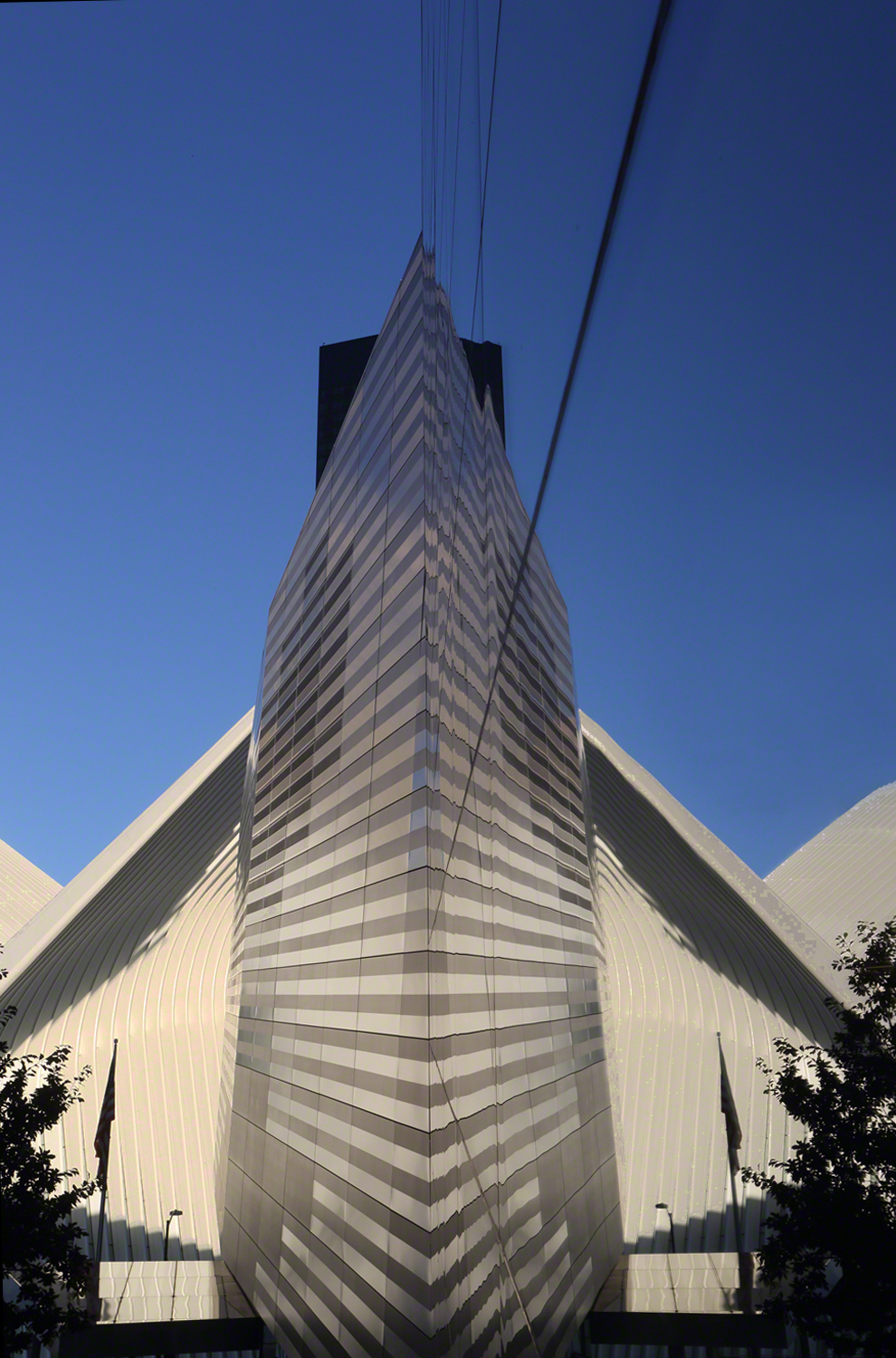
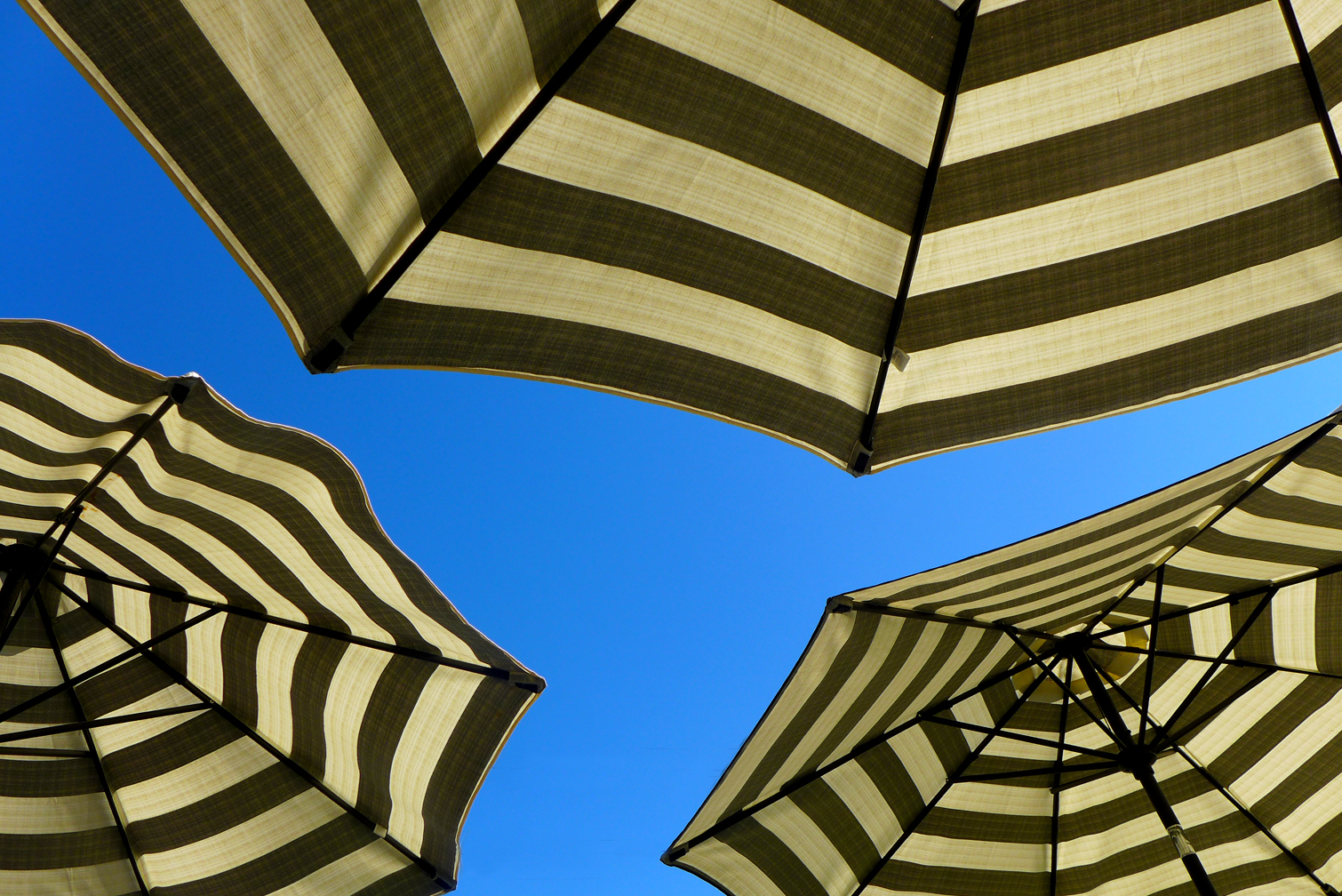
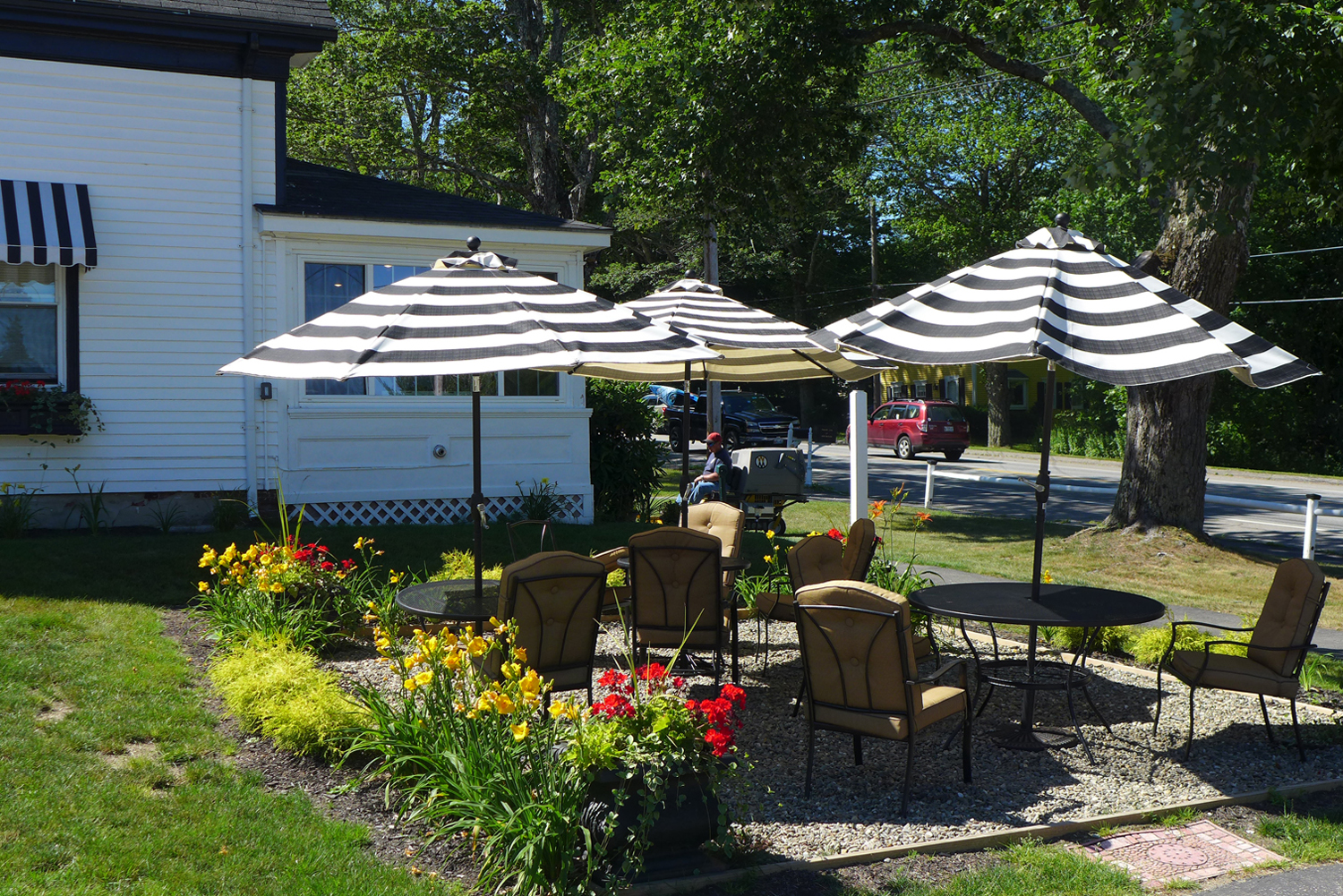
I was driving from Rockport where the workshop campus is located down to Rockland where the Lobster Festival was slated to start a few days later. As I passed one of many motels along scenic Route 1, I noticed several striped umbrellas grouped together that offered shade to the residents wanting to sit around and enjoy the fabulous weather.
I kept driving but after a few miles I had an epiphany, and when I have one of those while driving around with a camera next to me I immediately make a U-turn; people driving with me are usually not as excited as I am!!
the left side of my brain.
As I passed these umbrellas I first saw them with the left side of my brain, the side that only saw a group of umbrellas. It didn’t take me long to switch off the left side of my brain and imagine those umbrellas with the right side. The side that saw something entirely different.
In my mind I envisioned several of the basic elements of visual design: color, shape, line, and pattern. I saw them no longer as umbrellas, but an arrangement of elements in a way that became an abstraction of a group of ordinary objects.
I knew that what I was originally looking at was not what I was going to get, which was why I made the decision to go back and take a closer look.
To my fellow photographers my point here is to look at the world around you not with the left side of your brain, the analytical side, but with the right side, the creative side. When you can start doing that, a whole new world will open up and you be able to see things not as they are, but what they could be.
Visit my website at: www.joebaraban.com and check out my 2018 workshop schedule at the top of this blog. Come shoot with me sometime. I’ve a couple of openings in my Springtime in Berlin workshop next May 23rd. A fantastic city with so many great locations we’re going to be shooting.
This coming July 29th will be my 30th anniversary teaching at the Maine Media Workshop. I’ve always picked this time as it’s the week of the Lobster Festival down the road in Rockland. This ofers a unique set of photo ops, different from the Maine Coast, fishing villages and lighthouses. The Lobster Festival is all about color, design, light, energy, people watchng and environmental portraits everywhere you look; some people are there in costumes and loved to be photographed.
In conjunction with The Santa Fe Workshops, October 2nd I’ll be leading a group in San Miguel de Allende. A beautiful oasis and artist colony, and the entire city is a UNESCO site.
Come join me for a week of fun and photography…what could be better
I often refer to photography as the art of taking, making, or creating pictures. In fact, these three concepts can determine the strength of your composition. They will decide on how long the viewer will look at your images and if they will even be remembered.
First let’s look at the approach my fellow photographers take when they either submit their photos in my online class with the BPSOP or during the daily critiques in my “Stretching Your Frame of Mind” workshops I conduct.
For the most part, when I see their photos the one thing that usually stands out is that I find these photographers takingpictures. In other words they stand there and bring their camera up to their eye and start shooting without thinking about how to keep the viewer around; because of the visual interest and tension needed to do just that.
I have found a common thread between these types of pictures and it stems from always shooting at the same height, the same POV, the same F/stop, the same direction of the light, the same lens, and letting the camera decide on the exposure…which is usually the wrong advice.
My desire as a teacher is to show photographers the difference between taking and making pictures, and try to get them to stop the practice of taking pictures and move them forward to making them.
Making pictures is all about looking a your subject differently. Putting the light up front and among the most important aspects of your photographic vision. Unless you’re street shooting where capturing the moment is critical, light is everything!!!
I show my students how to incorporate the Elements of Visual Design into their imagery, and these elements are put on an imaginary ‘Artist Palette’. The same ‘Artist Palette’ I’ve been carrying around in the back of my mind for the past forty-nine years.
When I’m out shooting I look for things not immediately visible without the help of my palette. I look for: Light, Texture, Patterns, Shapes, Vanishing Points, Perspective, Color, and most important Line.
I look for different ways to show the subject, whether it’s lying on my stomach and getting dirt on my shirt, or finding a way to shoot down on objects. Maybe panning is the answer, or a slow shutter speed, or using lens not necessarily meant for what I’m thinking about; a 100mm macro lens or a 300mm for portraiture as one example.
I look for ways to use Negative Space to define my subjects, as well as balancing my composition. I use lines to move the viewer around the frame, especially if I can introduce a Vanishing Point. I introduce Color on overcast days, and I also use color to communicate ideas. I see a tree, and I look for what else it is.
This is making pictures and a hell of a lot more fun than just bringing the camera up to my eyes and clicking the shutter.
Finally, there’s creating pictures, and this is my favorite way to shoot. To me, my camera on a tripod is the same as a blank canvas on an easel.
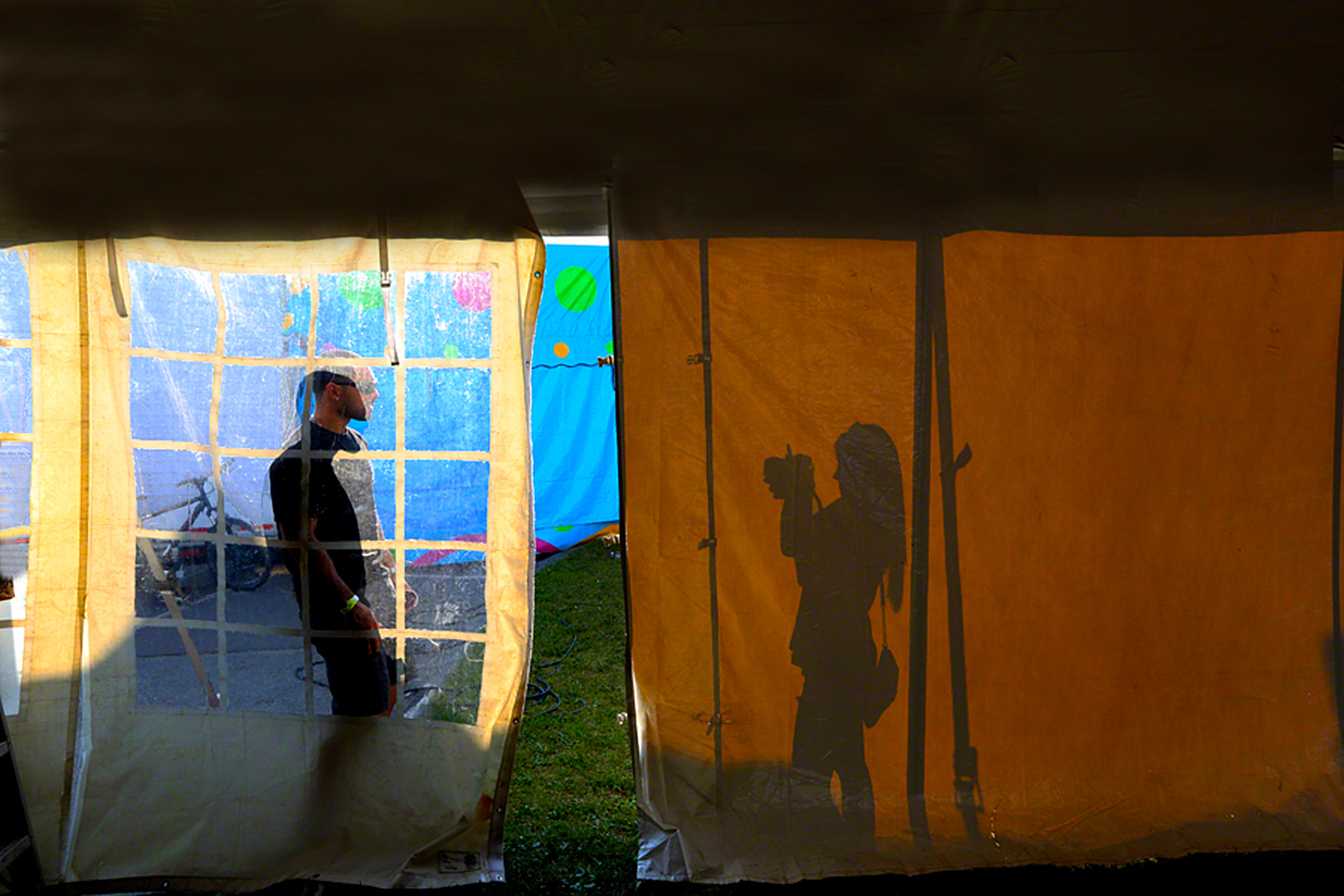
Creating pictures means adding a prop, asking someone to pose for me, or moving things around to gain more interest and tension. The above photo was taken during my Maine Media Workshop I conduct every year at the end of July beginning of August.
This was at the Lobster Festival in Rockland. I saw the couple outside of the tent taking turns shooting each others picture so I asked them if they would mind if I took a picture of the young woman taking a picture of her boyfriend. I had first noticed the wonderful light creating silhouettes from others walking by and the wonderful squares (shapes) that were backlit.
I placed the woman so all I would see is her silhouette, and I put the man so his face would appear in one of the squares. I then told them to forget I was here and continue taking pictures. The blank canvas was in my mind so I began creating my art.
So now you’ve read about three approaches to the art of photography. You can continue to take pictures and travel the well worn road to mediocrity, you can begin making pictures and experience a whole new way to gain attention to your images, or you can create pictures and really have fun…even reaching Nirvana!!!!
🙂
Visit my website at: www.joebaraban.com, and check out my 2018 workshop schedule at the top of this blog. Come shoot with me sometime. I can promise you a lot of fun, reaching Nirvana might be a little more difficult. I’ve a couple of openings in my Springtime in Berlin workshop next May 23rd. A fantastic city with so many great locations we’re going to be shooting.
This coming July 29th will be my 30th anniversary teaching at the Maine Media Workshop. I’ve always picked this time as it’s the week of the Lobster Festival down the road in Rockland. This ofers a unique set of photo ops, different from the Maine Coast, fishing villages and lighthouses. The Lobster Festival is all about color, design, light, energy, people watchng and environmental portraits everywhere you look; some people are there in costumes and loved to be photographed.
In conjunction with The Santa Fe Workshops, October 2nd I’ll be leading a group in San Miguel de Allende. A beautiful oasis and artist colony, and the entire city is a UNESCO site.
Come join me for a week of fun and photography…what could be better?
Spanning almost forty years of teaching photography workshops, I have compiled a list of my own “Personal Pearls of Wisdom” that I have written over the years.
When talking to photography students from around the world, either in person, or online, or by email, I often refer to a catchphrase I’ve created throughout my photographic career. These ‘Pearls of Wisdom’ are usually used in a critique, but sometimes I just throw one out for everyone’s enjoyment. Most of the time it gets a laugh…not all the time but a LOT.
Here’s one of my favorites, and one I’m constantly using: “I came, I shot, I left.”
What that means is that photographers usually don’t spend a lot of time taking a photo. They will invariably walk up to a subject or location, shoot the first idea that comes to mind, and then move on leaving a lot still ‘on the table’. By the way, the photograph is usually taken at eye level since it’s the easiest and less stressful way to compose. STOP!!! Don’t leave!!! Use this first shot for what I call the ‘Master Shot’ and stick around to observe what else is going on.
I can’t remember when I started doing this, but I think it was when I started as a director/cameraman and began with TV commercials…about thirty years ago.
I learned to take the ‘Master Shot’, which was the first set up in a scene. It was important because it set up the rest of what was left of the thirty seconds. It’s the key shot, and when you could walk away with in case it started to “rain on your parade”.
In my online class I teach with the BPSOP school, and my “Stretching Your Frame of Mind” workshop I teach around the world, I have them take a ‘Master Shot’, which is the first idea that they see when they come upon a worthy subject/location. Then, I have them take two more photos of the same location/subject. These two shots should come to them while taking this first shot. The idea is to find ways to segue your first photo into a better and stronger way to see it.
What I don’t mean is to stay in the same position and just zoom in or out in the same composition.
For example:
Up close and personal
Change lens
Up high then down low
Different light
Change a prop
Put in a person, or take one out
Look for something that might be unexpected or unpredictable.
Master shot
When I’m shooting, I have one eye in the viewfinder and the other scouring the location for a way to segue my current composition into a stronger shot. As I’m shooting, I’m constantly making small to medium-sized changes.
I’m always looking for that elusive “OMG” shot.
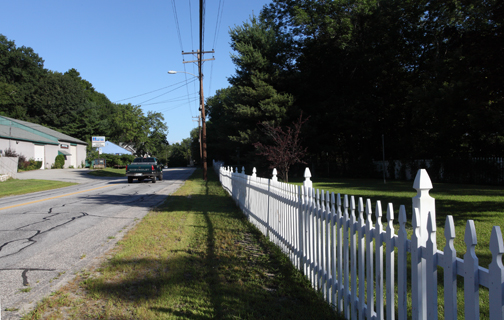
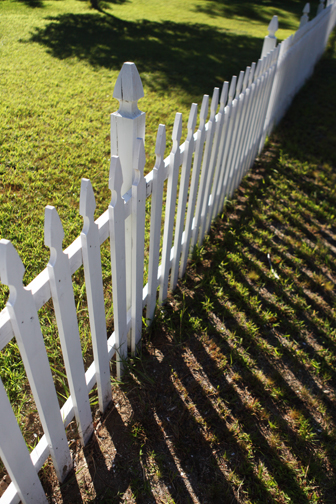
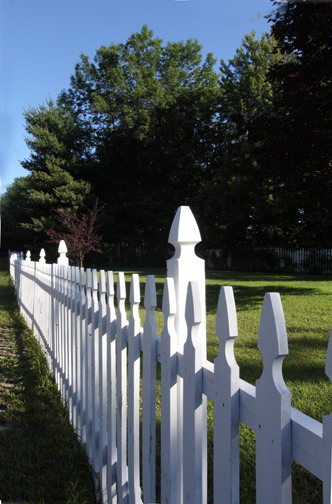
Here’s an example of a ‘Master Shot’: While driving around with my class at the Maine Media Workshop, Chasing the Light as I refer to it, I stopped at this location to show them what I meant. While these photos are not going to win any awards, they are an excellent example of taking a ‘Master Shot’, then looking for other ways to make it more interesting before leaving.
So the next time you’re out shooting think about taking a master shot then see what other possibilities come from it. Once you try it and see that it works, you’re on the right road to taking your work to the next level.
Visit my website at www.joebaraban.com and check out my 2018 workshop schedule at the top of this blog. Come shoot with me sometime. I have a couple of openings in my Springtime in Berlin workshop next May 23rd. A fantastic city with so many great locations we’re going to be shooting.
In conjunction with The Santa Fe Workshops, October 2nd I’ll be leading a group in San Miguel de Allende. A beautiful oasis and artist colony and the entire city is a UNESCO site.
Come join me for a week of fun and photography…what could be better
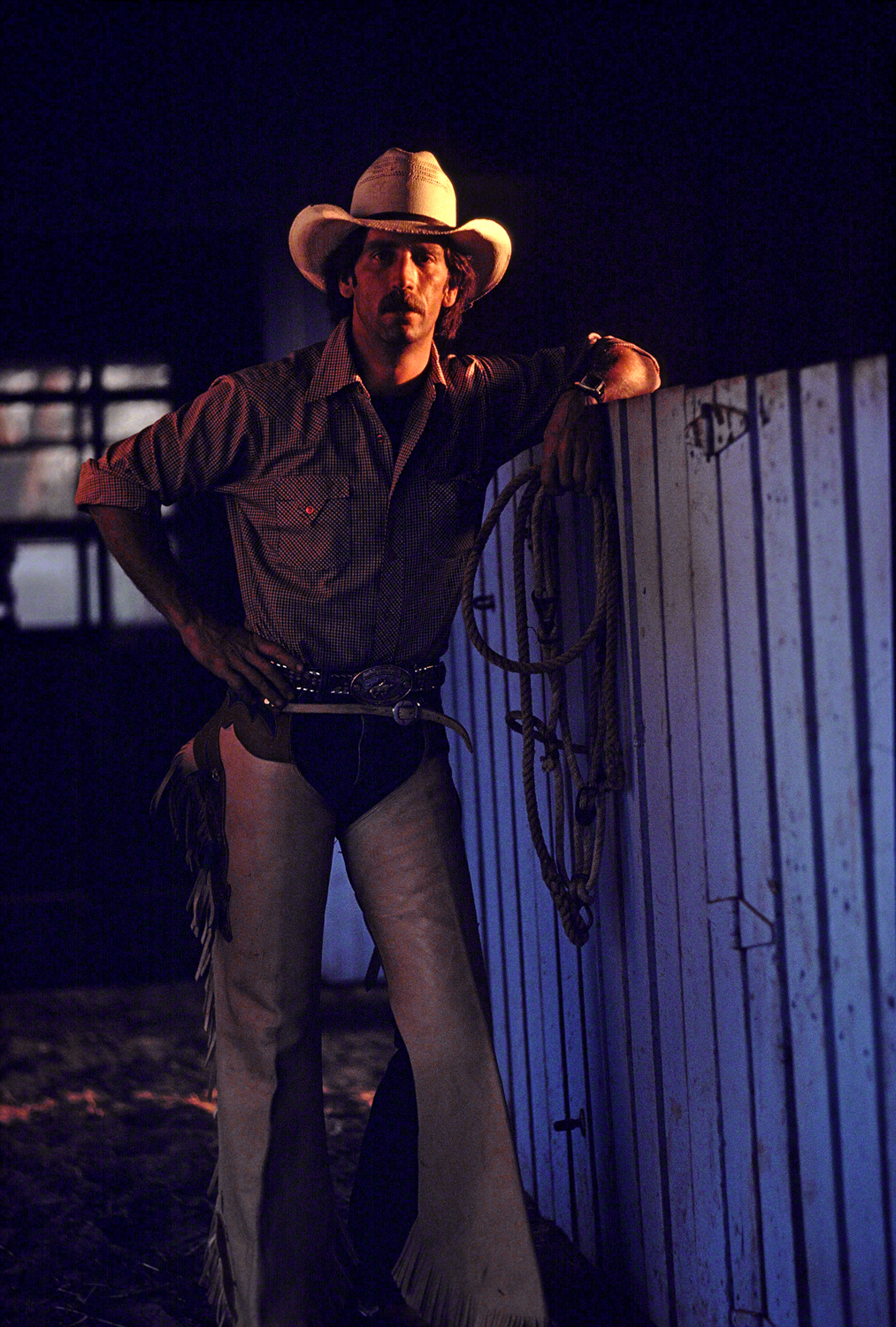
This portrait I took was actually of one of my students.
I wanted to send out this post dedicated to the new 2018 workshops I have coming up.
I want to share two new workshops I have planned this year. The first one is the Maine Media Workshop beginning July 29th. I will be celebrating my 30th anniversary there and after all these years, I still love going there. I’ve always had it the same week, as it’s the week of the Lobster Festival just down the road in Rockland. The reason is that it offers a completely different set of photo opportunities than the Maine coast, fishing villages and lighthouses. At the festival there’s color, design, energy, people watching, and being able to shoot various environmental portraits of people (sometimes in costume) willing to be photographed.
Here’s a couple of links from past workshops images taken by students:
https://joebaraban.com/2016maine-media-workshop/
https://joebaraban.com/workshop-stuff-maine-2017/
https://joebaraban.com/2014-maine-media-workshop/
The second one is in conjunction with the Santa Fe Workshops. Beginning October 2nd, I’ll be leading a workshop in San Miguel de Allende. This is not a city you might think of when considering Mexico as a destination. San Miguel is an oasis high up in central Mexico.
First of all, let me explain what is meant by “clipping the highlights”:
According to several definitions I’ve read over the information highway, clipping occurs when there is an incorrect exposure. When an exposure is increased so is the amount of light, and increasing the exposure too far will cause the lightest areas in your photograph to ‘clip’ or appear ‘blown out’.
Here’s one of those definitions, and would I love to meet the person that wrote it!!!!!
“The clipped area of the image will typically appear as a uniform area of the minimum or maximum brightness, losing any image detail. The amount by which values were clipped, and the extent of the clipped area, affect the degree to which the clipping is visually noticeable or undesirable in the resulting image.”
UNDESIRABLE??? SERIOUSLY???? If you’re the one that wrote this please contact me so I can try to get your head screwed back on so you’ll see where you’re going instead of always looking behind you and in the past.
It’s always amazing to me when a student tells me that he had a photography instructor or a fellow member of the camera club, tell him or her to never clip the highlights. It’s also amazing when I’m looking at the back of a student’s digital camera and there’s a bunch of “blinking stuff” on it.
The first thing I tell my fellow photographers is to get that stuff off of their display. You know, the areas that blink when they’re being clipped.
It would drive me crazy!!! In fifty-three years of shooting professionally I’ve NEVER, and I do mean NOT ONCE ever worried or even thought about whether my highlights were clipped; I want that energy…that visual tension!!
Always remember this: “The viewer will always react to that which is most different.” It’s what I teach/preach when I talk about the Psychology of Gestalt and how the different concepts within it can help us make stronger images.
Here’s some examples of when I clip the highlights:
My last thought on this is when those same fellow photographers tell me that during their camera clubs yearly competition, if they were to submit an image where areas are blown out they’re either disqualified or told to go sit in a corner; can you just image the degradation one would encounter?
The answer I usually give is for them to start their own camera club that encourages photographers to color outside the lines.
Blow out those highlights, and be damn proud of it.
Visit my website at: www.joebaraban.com and check out my 2018 workshop schedule at the top of this blog. Come shoot with me sometime. I’ve a couple of openings in my Springtime in Berlin workshop next May 23rd. A fantastic city with so many great locations we’re going to be shooting.
In conjunction with The Santa Fe Workshops, October 2nd I’ll be leading a group in San Miguel de Allende. A beautiful oasis and artist colony, and the entire city is a UNESCO site.
Come join me for a week of fun and photography…what could be better?
I would safely say that the biggest hurdle I have in my online class with the BPSOP, and in my “Stretching Your Frame of Mind” workshops I conduct around the planet, is to get my students to use a tripod. The digital era has brought with it a new class of photographers that think the only way to take a photo is to always hand hold their camera; and that’s fine a lot of the time. When I’m walking around, either when I’m traveling or just taking snapshots around my hometown, I’ll carry my camera over my shoulder. That’s when the photos are for a record of where I’ve been, or possibly for planning out my next shoot, or for showing a family member something or someone I might have seen, or perhaps for a teaching aid.
However, when I’m going out to take serious photos, I always use a tripod…why you ask?
Because I’ll never let my camera tell me when and where I can take a photo. I’m going to be the only one that decides if I can shoot something or not…certainly not a machine. Ok, I know you can jack up the ISO to a million (give or take a few hundred thousand), but I wish I had a dollar for every time a student explained that the reason the photo they submitted looked weird is because they forgot to change the ISO back to the normal range. I’ve also been told that they don’t shoot when the light is toooooooooo low because they can’t hand hold their camera during that time…YIKES!!!!! Tell me it ain’t so!!!!!!
All this is predicated on the idea that early in the morning or late in the evening is going to be the best light, and therefore that’s when I’m going to shoot; it’s the only time I shoot when I’m serious. I want to be able to shoot at any shutter speed I want, and with any aperture setting…and any combination of the two. This is how I maintain control of my photographs.
If you like shooting after breakfast right after lunch, and before dinner and your goal is to take “half way decent pictures” and be a fairly good photographer, then by all means hand hold your camera. If you want something more, then get a tripod. The key is to get a tripod that’s simple to use and lightweight. So many students of mine have inexpensive tripods that are only good for putting hanging plants on. It’s a life time investment and one of the best you’ll ever make. Buying one and occasionally using it won’t do you any good. It takes practice…a lot of practice. When you get use to it you’ll find that it’s going to open up soooooooo many creative doors for you. It’s going to free up your hands…why is that important you ask?
To me, I think of a camera on a tripod like a canvas on an easel. When I’m on a tripod, I can leave the camera and adjust something in my composition and know that when I take a look at whatever changes I’ve done, the camera will be in the exact same position. If you’re hand holding your camera and you make a change, you’ll never be able to go back to the same position. When I’m designing the Negative and Positive space for example, or moving something into or out of my frame, I want to be able to see the exact change in my viewfinder
BTW, buy the best tripod you can, that way you’ll only cry once!!
Visit my website at: www.joebaraban.com, and follow me on Instagram: www.instagram.com/barabanjoe. Check out my 2018 workshop schedule at the top of this blog. Come shoot the sunrise and sunsets with me. You might want to bring along a tripod!! I’ve a couple of openings in my Springtime in Berlin workshop next May 23rd. A fantastic city with so many great locations we’re going to be shooting.
It’s amazing how often I see photos that were taken either for my online class with the PPSOP, or in my “Stretching Your Frame of Mind” workshops I conduct around the planet, that appear to be taken from the exact same height; that height being the distance from their eyes to the ground.
In other words, my fellow photographers shoot from the same POV (point of view) all the time….why you ask?
Two reasons:
The first is because it’s the easiest and laziest way to take a photo. All you have to do is raise the camera up to your eyes, aim, then pull the trigger (Texas talk for clicking the shutter). Simple and quick, am I right? The second reason is because most of my fellow photographers take instead of makepictures. Part of that is what I refer to in a past post as “I came, I shot, I left“.
🙁
If I can make a suggestion, that will help take your photos what I always refer to as “up a notch”, change your point of view the next time you go out shooting. Instead of bringing the camera up to your eye and shooting from the same height as always, think about getting down low to the ground. Look all around, there might be a railing or balcony you can shoot from. How about shooting through a window or the windshield in your car? Is there a ladder nearby? If you’re shooting flowers, get down to their level. Get some dirt on the front of your shirt!!!
The next time you’re shooting your kids, or your friends kids, or your grand kids, don’t just stand over them and point your camera down. Get on their level, and you’ll immediately see how much more powerful your photo is.
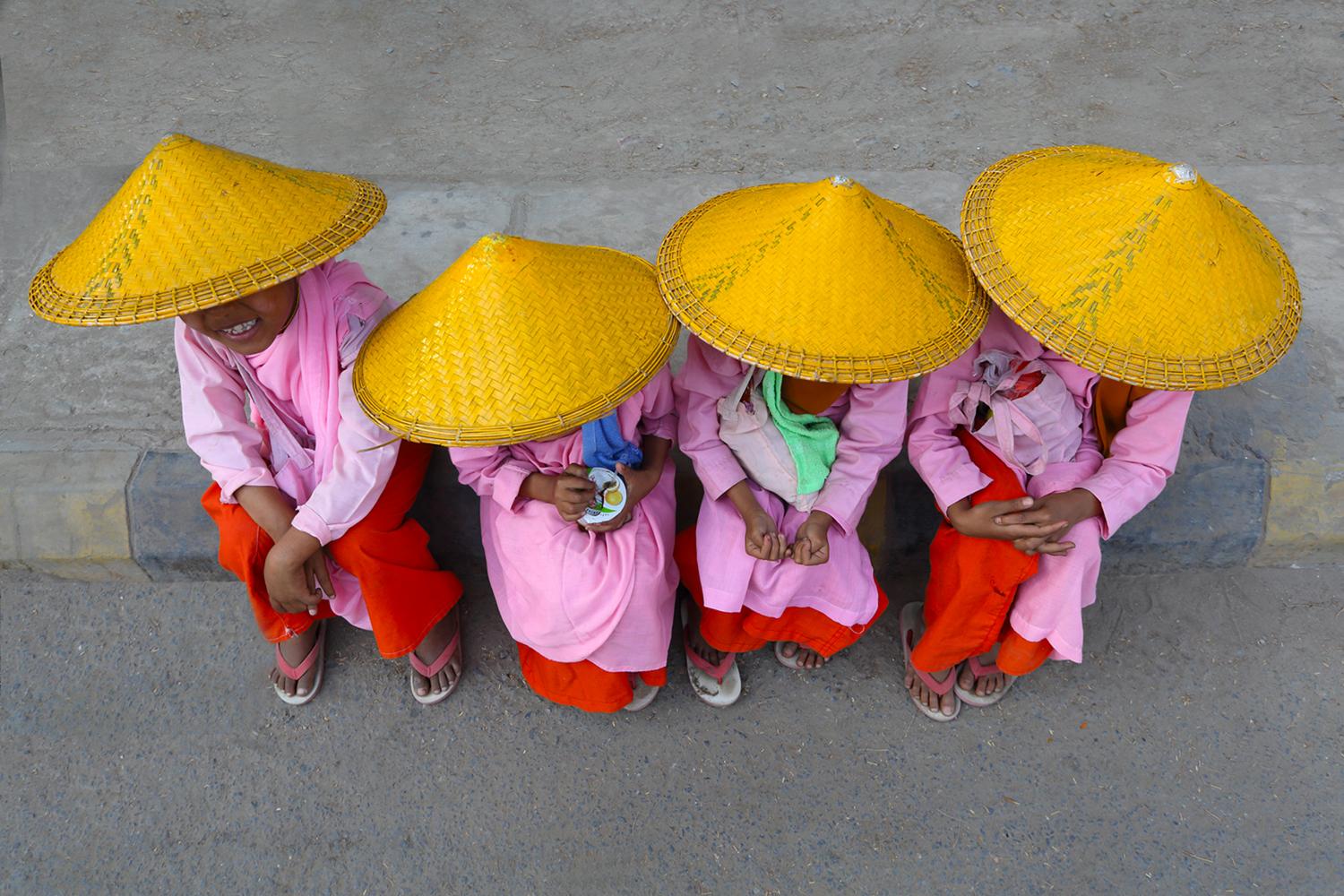
The above photo was taken while I was conducting a workshop in Myanmar. Our guide had these small girls that were about to go in a convent to become nuns pose for my fellow photographers. They all had fun taking various portraits of individual girls and as a group. When they were all done I asked our guide to have them sit next to each other on the curb. I put on my 17-40mm Canon lens and stood on my tiptoes above them.
I had pre-visualized the photo in my mind so it took just a few seconds to shoot it. This photo is one of my favorite, if not the number one favorite, of everything I had taken while in the country.
Visit my website at: www.joebaraban.com and check out my 2018 workshop schedule at the top of this blog. Come shoot with me sometime. I’ve a couple of openings in my Springtime in Berlin workshop next May 23rd. A fantastic city with so many great locations we’re going to be shooting.
Don’t forget to send me a photo and question to: AskJoeB@gmail.com.