My Favorite Quotes: Claude Monet
Signs or Triangles…and one circle?

Since my background is in art and not photography, I studied Art History; among other areas in this field. My favorite painters were the Impressionists, and one of my favorite painters was one of the founders of that movement named Claude Monet. Actually, I really loved all of the Impressionist painters mainly because they saw things differently than the painters that preceded them, and as a result were not accepted for quite a while.

They broke all the rules and as I now tell my fellow photographers that I teach or mentor to.learn all the rules of photography, then as fast as you can… forget about them as they will most certainly lead you down the one way, one lane path to mediocrity…why you ask???? Because rules are impediments that will block your chances of ever observing the environment around you through better vision.

Monet said, ” In order to see, we must forget the name of the thing we’re looking at.”

In my online class with the BPSOP, and in my “Stretching Your Frame of Mind” workshop I conduct around the planet, I talk a whole lot on being able to “see past impressions”. In fact, it’s one of my many mantras and it can be so hard to do for people that have spent the majority of their life seeing and doing things with their left brain.

First, a disclaimer: There are those out there that suggest that this is a distorted myth…psycho babble. However, most psychologists agree that there’s enough basis in facts to accept it.

You see, the left side of your brain is the analytical side. Left-brained people tend to be more logical and objective, and rarely see any artistic content. Their photos will tend to be those that are “for the record”. It’s the linear way or the highway for them!!! The right-brained person tends to be more creative, expressive,  and intuitive. Ok, just how does this have anything to do with Monet or my approach to teaching people how to see past their first impressions?

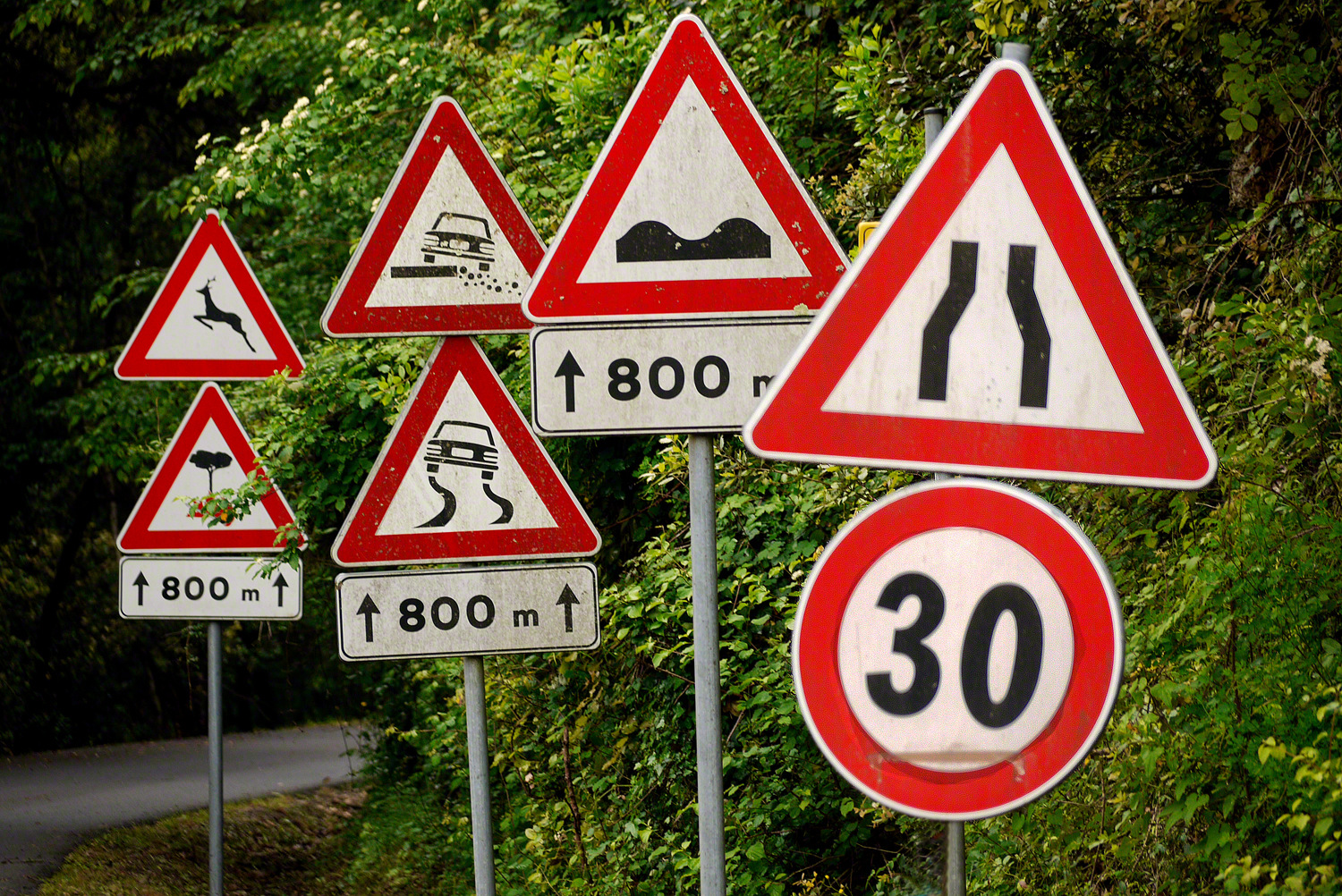
In the photo above, a left-brainer will look up and see a group of traffic signs directing you to either go, avoid, or do something. When I first looked up I immediately saw shapes, as in triangles and one circle. I saw these shapes beause for years I’ve trained my eye to “see past my first impression”. As a result I composed my photo to accentuate these important shapes…since Shape is a basic element of Visual Design.

The next time you go out don’t just look at the labels, be sure to taste what’s inside…see past your first impression.

Visit my website at: www.joebaraban.com, and check out my workshop schedule at the top of this blog. Come shoot with me sometime. I just announced my New York, New York Workshop beginning September 17th, 2019 and ending at noon on the 23rd. This will be my second workshop there and this time we’ll be shooting in all the five boroughs.

JoeB
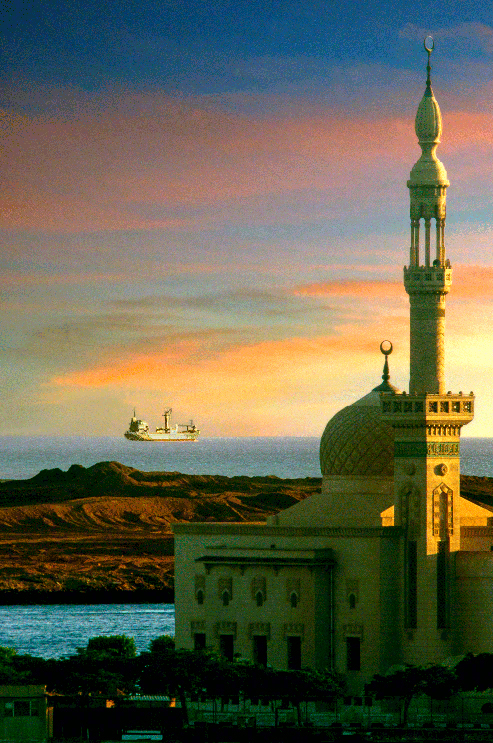
Quick Photo Tip: Always Look Behind You.

I can’t begin to think of how many times I was through shooting at some location and after we had wrapped things up to head back to the car, I turned around to see the dying moments of a spectacular sky streaming light that wasn’t there a moment ago, or a one in a million cloud formation. I can tell you that it’s been years and years and years since I made the mistake of putting all my equipment away before it was absolutely over.

What happens is that once you’ve taken a great photo or series of photos filled with wonderful light you become satisfied, mentally tired, and even a touch on the complacent side of smugness thinking you got all there was to get.  So you sort of become anxious to get to the car and either head home or to the hotel where you’re staying to relax in the bar and mull over the last couple of hours of shooting with a cold beer or a very cold Bombay Martini in your hand, as I have.

Well, I’m here to say that it ain’t over until it’s over, as in dark!!! After forty-five years of shooting, I can tell you that you just never know when something can happen that you had better be ready for or you will surely miss it. As I tell my online students with the BPSOP, and the participants that take my “Stretching Your Frame of Mind” workshops I  conduct around the planet, Mother Nature has an uncanny way of sneaking up on you when you’re not looking to provide you with an extraordinary opportunity to capture her in action. Remember that she’s stingy and won’t give you much time. She’s been known to tease the unprepared mortal, dressed up to look like a photographer, with literally seconds of incredible perhaps even once in a lifetime light.

How do I stay ready? As I’m headed back to the car I keep my camera on the tripod, I make sure I still have shots left on my card, the tripod is over my shoulder, and as I’m walking I keep turning around and looking over my shoulder. Also, even when I’m driving away I’m still looking in the rear view and side mirror. There’s been more than once when I made a quick ‘bat’ turn and went back and grabbed a great shot.

In this photo, we were through shooting the Suez Canal and were eating dinner in a restaurant. I had my 300mm F/2.8 lens still on my tripod right next to me. I turned around as I always do, saw this light, shot the photo and in less time it took me to write this one sentence it was gone.

By the way, I missed the light just once in my forty-five career and once was too much!!!

Here’s a few examples of when I turn around.

Visit my website at: www.joebaraban.com, and check out my 2012 workshop schedule at the top of this blog. Come shoot with me sometime.

Don’t forget to send me a photo and question to: AskJoeB@gmail.com

JoeB

Quick Photo Tip: My Least Favorite Light

 Shooting in old barns
Shooting in old barns

To me, the worst light starts mid-morning and end mid-afternoon. These are the times I avoid shooting since I know the photos would have a hard time coming out the way I’d want them to.

There have been times when I had no choice but to shoot in less than ideal light. If, for example I’m traveling and can’t come back to a location when the light is better. Or, the only time someone is available is during those times of harsh light. If the location doesn’t open until the sun is high in the sky, or it closes early. I’m sure there’s other examples that you have experienced like family members who think you need your head examined if you think they’re getting up for a  portrait during the sunrise light…like my daughters for three examples!!

One problem that always comes up is when I’m conducting one of my my “Stretching Your Frame of Mind” workshops. After an early morning shoot we will spend several hours discussing the images that were shot the day before. After lunch we’ll go out and shoot. This is when the light is usually hot and harsh.

So, what do you do? As I also tell my online students with the BPSOP, you look for ways to minimize the sky or hide it completely. Or, you find locations can only be photographed when the sun is high; for example small villages with narrow streets. That’s when you look for areas in shadow next to the areas in the sun; so you can create contrast…one of the ways to generate visual tension.

I’m sure you’ve all seen or taken those pictures where the sky is a whitish blue from being photographed during mid-morning or mid-afternoon. Another idea is to go indoors and shoot the available light coming in from a window.

When you’re not taking one of my workshops, you can go out in the country and look for old barns or antique stores. There’s always subject matter there, you just have to look for it. I’ve had success in junkyards, and those places where old cars go to die is a potential plethora of photo opts.

Here’s some examples:

Visit my website at: www.joebaraban.com, and check out my workshop schedule at the top of this blog. Come shoot with me sometime. I just announced my New York, New York Workshop beginning September 17th ,2019 and ending at noon on the 23rd. This will be my second workshop there and this time we’ll be shooting in all the five boroughs.

JoeB
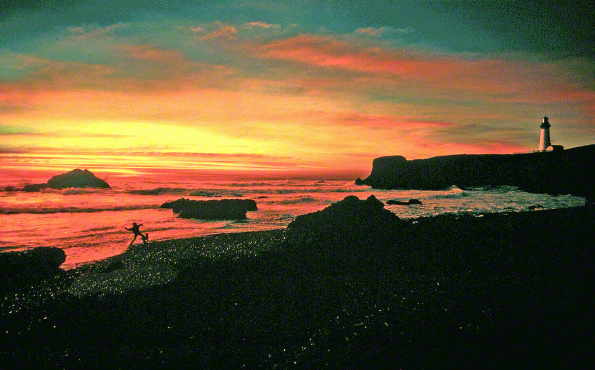
Food for digital Thought: Light In Four Part Harmony

Four Part Harmony

One of my favorite topics to discuss with students taking my online BPSOP class,  and in my “Stretching Your Frame of Mind” workshops I conduct around the planet is the Light. Unless you’re street shooting where timing and and capturing a moment are important, Light is everything.

I’ve been a student of light for as long as I can remember, including those B/W years spent shooting with AP and UPI. I studied art and design, with a couple of semesters plodding through Art History, where we studied each of the Masters and later impressionists approach. This is where I learned notable techniques like Renaissance portrait lighting.

When I first started studying the Light, I broke it down in what I termed Four Part Harmony: Hue, Intensity, Direction, and Quality.

Hue: Refers to the color of the light. The color is dependent on the time of day you’re shooting. When the sun is low on the horizon, it appears warmer since it’s going through more atmosphere. As the sun rises in the sky, the color of the light becomes bluer. The reason being that it’s going through the shorter blue and violet wavelengths.

Intensity: The intensity of the light is associated with how hard or soft the light source is. When you consider the intensity, don’t think of it as being either bright or dim. It means a whole lot more than that. One needs to think about it in terms of how it will render the final outcome to your photos. When you consider the Hue, consider the intensity as well. The lower the light is to the horizon, the more atmosphere it’s going through making the light much softer than it is when the sun is higher and going through less atmosphere.

Cloud cover can have a huge effect on your images, mostly when the sun is high and it’s a day that’s considered partly sunny. It’s a good time to shoot as it’s referred to as open shade. The only drawback is that with open shade, it’s hard to create the third dimension (depth) since you need side light to accomplish that.

Using artificial light can greatly impact the intensity of the light. Aiming your flash directly at your subject will render it harsh and contrasty. Shooting through diffusion, or bounced off a white umbrella, or bounced off the ceiling will provide a softer light; it’s the only way I light when I’m indoors.

Direction: There are three basic ways to light a subject. Side, front, and back. The first thing I ever do, before raising the camera to my eye, is to determine where the source of the light is. I avoid front light like the plague…why? because Form is a basic element of visual design, and it refers to the three-dimensional quality of a subject. When you front light, you eliminate the third dimension (depth) and as a result you’re left with the other two…height and width. Front light provides the least amount of information.

When you sidelight your subject you create the third dimension…depth. A simpler concept is when you side light, you provide shading to your subject. Side light is also used to emphasize the texture of an object; or any patterns in your composition. It’s also a good way to separate the subject from the background.

Back light is when the source of the light is behind your subject. It’s my favorite way to light since it adds a rim of light around the subject. When I’m shooting something transparent, such as water, grass, flowers, leaves, etc.,  the back light makes those subjects glow. It also can add strong shadows, and as I always say, shadows are your best friend.

Quality: The quality of the light affects mood and drama. It also refers to the softness or hardness of the light source. What kind of look or mood you’re trying to create is determined by how the light is used. Harsh direct light gives you sharp and defined shadows, where a softer diffused or bounced light might not offer near as defined shadows, and sometimes none at all.

My favorite light is available light. As far as the quality of the light goes, most of the studio shooters I know, including myself try to emulate available light and will go to great lengths and expense to do so. I can’t tell you how many “North Light Studios” there are to rent in NY. I say North light because it’s the softest. Since it faces north, you’ll never get any direct sunlight coming in to affect your photos; and the light remails constant throughout the day.

Visit my website at: www.joebaraban.com, and check out my workshop schedule at the top of this blog. Come shoot with me sometime. I just announced my New York, New York Workshop beginning September 17th ,2019 and ending at noon on the 23rd. This will be my second workshop there and this time we’ll be shooting in all the five boroughs.

JoeB
Anecdotes: Quaker Oats

Stay Lucy!!!!

For those of you that might be new to my blog, I was an advertising, corporate, and editorial photographer for over forty years and for the past ten years I have been teaching an online class with the BPSOP, and once again traveling the world only this time conducting my “Stretching Your Frame of Mind” workshops.

Over a glass of wine or martini I will often talk about some of the stories that would happen during my shoots; and they would usually make me laugh.

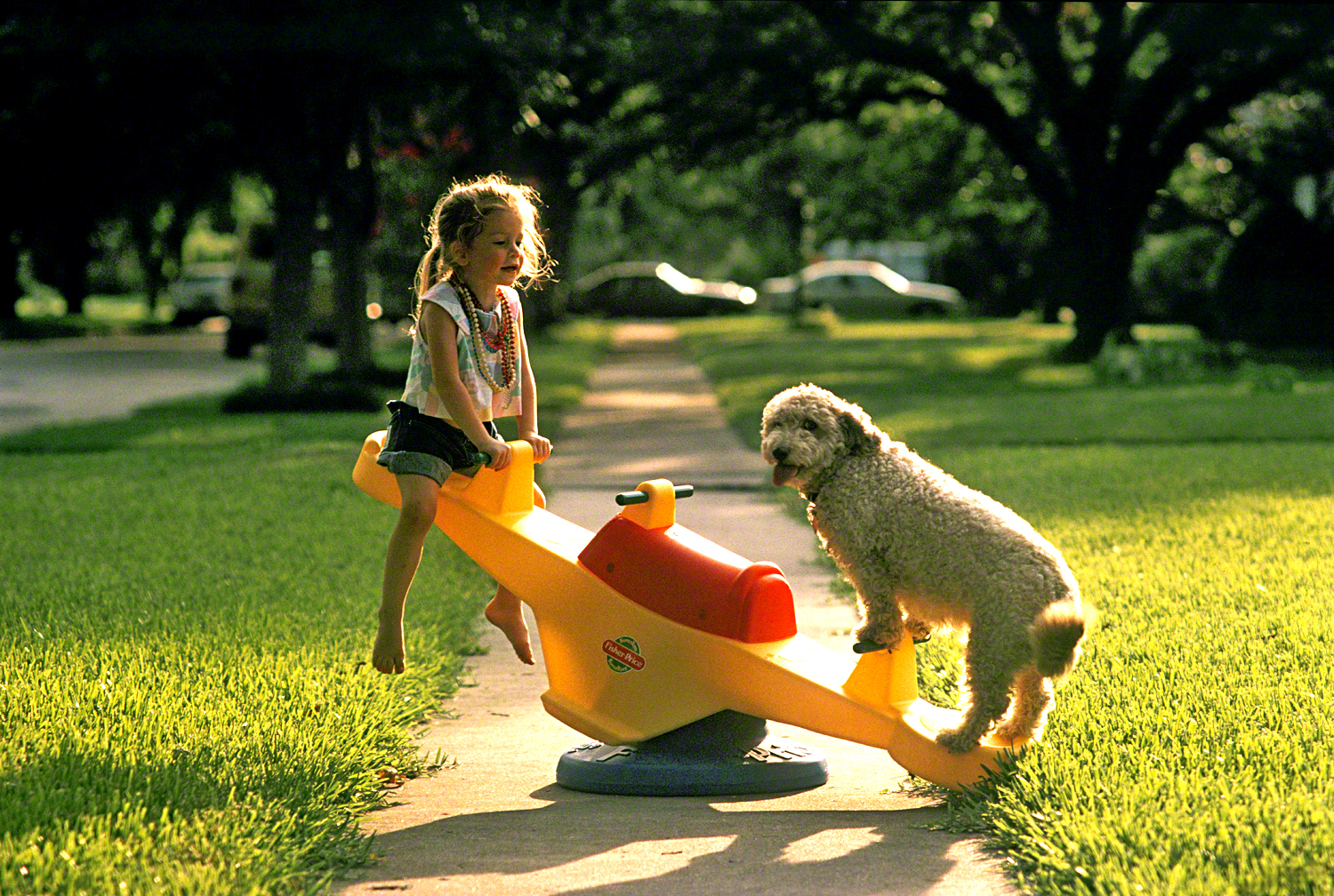
I was shooting the Quaker Oats annual report for Genisis, a graphic design firm in Denver, and one of the companies subsidiaries was Fisher-Price.

I loved working for Mike Miller (the owner) because he would just give me a list of photos he wanted, and then just turn me loose to come up with an idea that would visually illustrate the company.

I went to the local Toys-R-Us and shopped around for ideas. I saw this teetor-totter seesaw and immediately envisioned a shot. Btw, whenever I saw clearly something in my mind, I could always create it.

Scouting around neighborhoods looking for the best light to hit in an area late in the afternoon was a challenge. Since the prettiest areas were covered with large trees, finding just the right spot would take some doing. As was always the case, I would use my Sunpath program and  a hand bearing compass called a Morin2000.

With these I could pinpoint to the one degree exactly where the light would hit, what time it would, and how long it would be in the same spot; as it turned out my front yard was perfect.

My idea was to have two kids playing on it and since  there wasn’t a lot in the budget for professional models, I was just going to use my two daughters…they wouldn’t work for free, but for a dollar plus they got to keep the seesaw, we struck a deal; or so I thought.

When the time came, my daughter that was a year older decided that SHE WAS NOT going to come outside!!! Knowing that I had just a few minutes, I brought Lucy, our dog out with a leftover cheeseburger in my hand.

As luck would have it Lucy weighed more that Blair. I pointed to Lucy to get on the seesaw and gave her half the burger and told her to “stay”!!!

I ran back to the camera and was able to get off a couple of shots before I would have to run back and give Lucy another bite. I was able to do this a few times before I ran out of Lucy’s modeling fee. As you can see by her looking at me she was ready for either more cheeseburger or she was done. At that time she promptly got off and ran back to the house…and that was a wrap!!

Visit my website at: www.joebaraban.com, and check out my workshop schedule at the top of this blog. Come shoot with me sometime. I just announced my New York, New York Workshop beginning September 17th ,2019 and ending at noon on the 23rd. This will be my second workshop there and this time we’ll be shooting in all the five boroughs.

JoeB

My Favorite Quotes: Ralph Waldo Emerson

I break rules

Ralph Waldo Emerson was someone I studied  in my English Literature class in college. I wasn’t a fan of poetry, so most of what we read was a tad on the boring side. He did write some interesting essays, and was considered an “American Transendentalist”. In a couple of words, they believed that each individual could transcend or move beyond the physical world; I was a hippie wannabe back then so I sorta dug it!!!

I digress.

I’ve pretty much been someone that always ‘colored outside the lines’, and have always promoted this thought process to my online students with the BPSOP, and to those that have signed up for my “Stretching Your Frame of Mind” workshops.

That’s the reason I specifically remember this quote that Emerson once said, “Do not go where the path may lead. Go instead where there is no path and leave a trail.”

How I can relate this quote to photography is relatively easy, especially when you’ve had to defend it countless times to those that prefer to travel the safe road; the road most traveled.

These are the photographic naysayers that resist anything that deviates from what they learn at camera club meetings, while shooting with friends, or what they read in photography magazines.

More broken rules

I’m talking about those pesky rules that are the shackles that hinder creativity. You all know them in one form or another: The Rule Of Thirds, The Leaning in Rule, shooting into the sun, The Rule of Odds, The left to Right Rule, and here’s a couple a student told me: Avoid the color red, and never shoot a building straight on…YIKES!!!!!

In my opinion these rules can only do one thing, and that is to take you down a one way road to mediocrity. Ansel Adams once said, “There are no rules for good pictures, there’s only good pictures.

So my fellow photographers, the next time you grab your camera and head out, give yourself an assignment. Study up on all the rules (just in case they haven’t already been hammered into your brain) and do exactly the opposite of what you read.

You just might be surprised with what you comeback with. I for one would love to see the results. Take the road less traveled and leave a trail for others to follow.

Visit my website at: www.joebaraban.com, and check out my workshop schedule at the top of this blog. Come shoot with me sometime.

JoeB

Quick Photo Tip: Left to Right, Right to Left

Out of the comfort zone

Part of my conversaions with  those that sign up for my online class with the BPSOP is how to make the viewer an active participant when composing our photos.

Humans rely on on the perception of the environment that surrounds them, and we as photographers can manage what the viewer perceives and processes when looking at the information we lay out to him in the form of a photograph.

As Westerners we were brought up to read from left to right. As a result, that’s the way we perceive, from left to right; that’s our comfort zone.

While it’s always nice to keep the viewer in his or her comfort zone, sometimes it’s also good to take them out of that zone of contentment. How you ask? By composing your photos so the viewer has to go move from right to left instead of left to right.

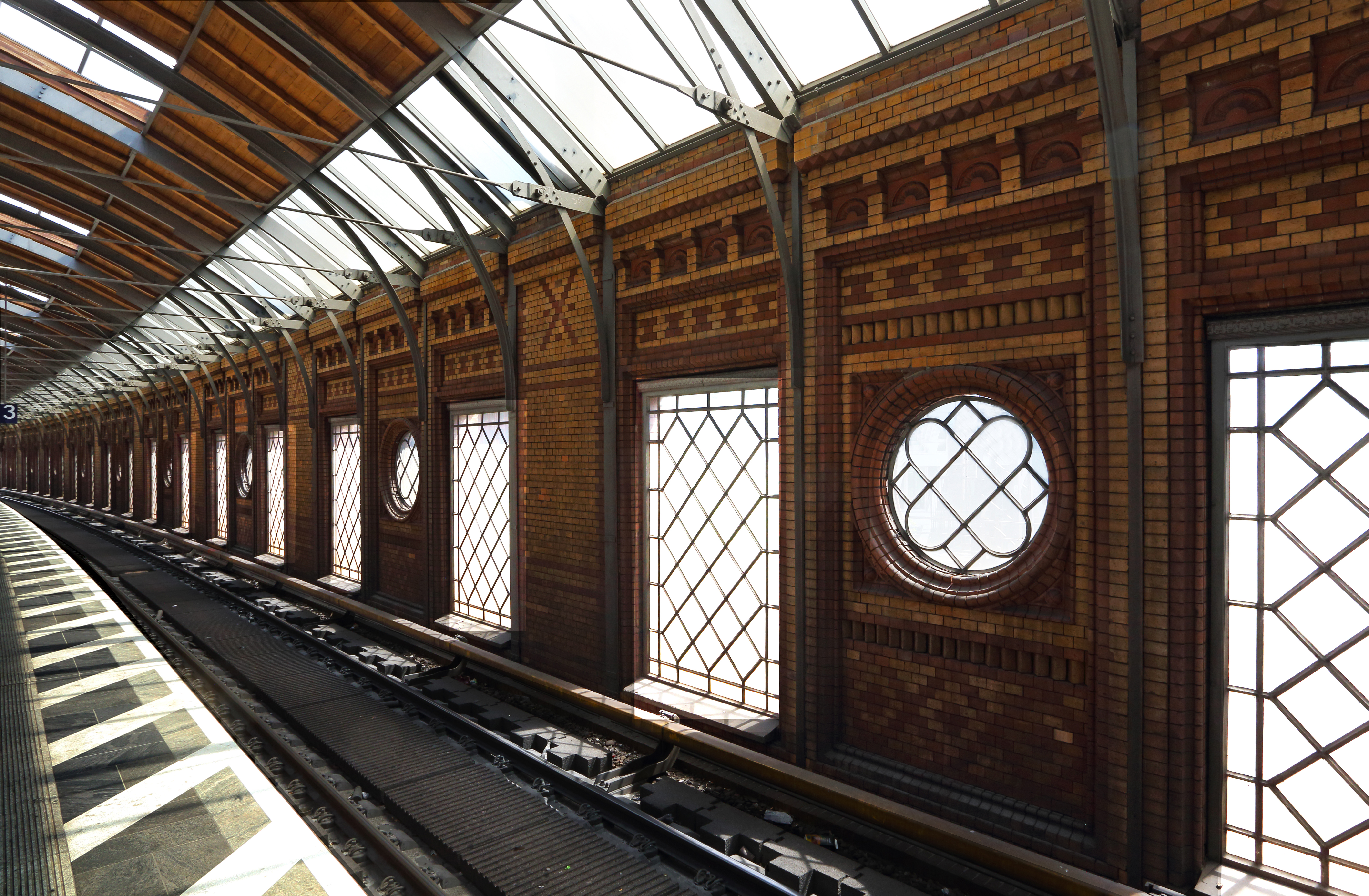
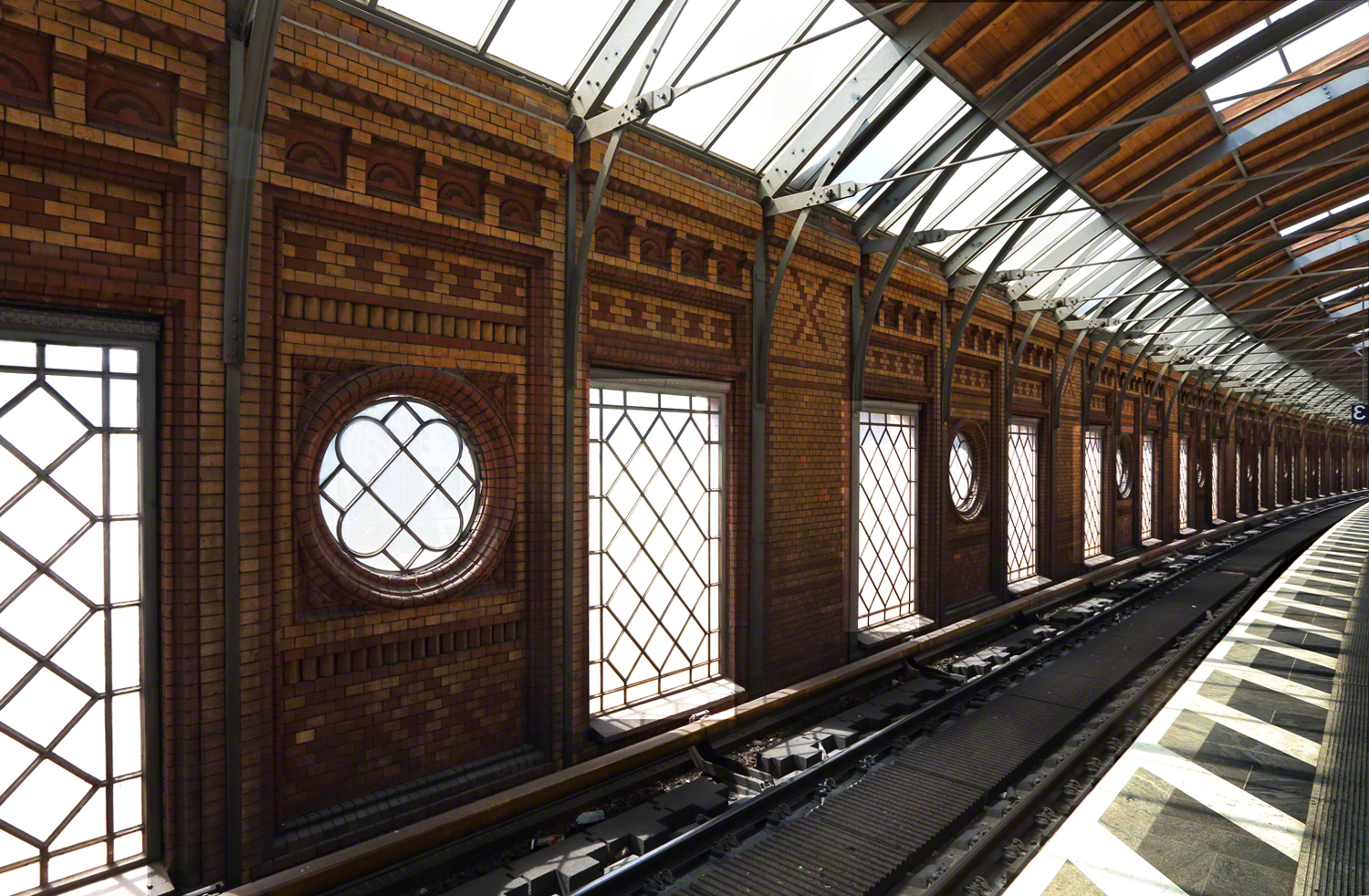
In the above photo, I was at the lower level in the main train station in Berlin and immediately saw this Vanishing Point. I pointed it out to a few of the photographers that had signed up for my “Stretching Your Frame of Mind” workshops I conduct around the planet. A Vanishing Point a very important element of composition to move the viewer around the frame.

Standing in a position to shoot it from right to left, I didn’t have enough time to walk down and show people what it looked like from left to right. Take a look at the image now that I’ve flopped it in Photoshop.

The actual way we perceive

I  certainly don’t condone doing this after the fact, it’s merely a way to show the power we have as photographers to control how the viewer perceives and processes our photos.

So, the next time your out and about with your camera, find a location and subject matter that you can compose either from left to right or right to left and see the amazing difference for yourself.

Visit my website at: www.joebaraban.com, and check out my workshop schedule at the top of this blog. Come shoot with me sometime. I just announced my New York, New York Workshop beginning September 17th ,2019 and ending at noon on the 23rd. This will be my second workshop there and this time we’ll be shooting in all the five boroughs.

JoeB

Personal Pearl of Wisdom: You Find the Light, You’ll Find the Shot.

And that was that!

As most of you know, one of my favorite topics to discuss with my fellow photographers is “The Light” . You also have heard me say that the only thing that would upstage great light is in street shooting where capturing a moment in time or stopping an action is more important.

In my online class with the BPSOP, and in my “Stretching Your Frame of Mind” workshops I conduct around our planet I have what I call my “Personal Pearls of Wisdom”. These are thoughts and ideas I’ve accumulated over the course of my forty-eight years as a professional photographer and my thirty-two years as a workshop instructor and teacher.

One of these Pearls that I’ve been mentioning for a very long time is, You find the light and you’ll find the shot. Time and time again when I’ve been out shooting the light has saved the day for me. I’ve also found that after all these years, the light can make just about anything look good.

Sometimes I find the subject first with light already working to my advantage, and sometimes I find the light first and place a subject in it. Since I’m not one of those so called purist that refuse to change anything in their composition ( but have no problem altering said composition in post-production), I have no problem…why you ask?

I guess it’s because of my background being in painting and not in photography. I still consider myself an artist/painter, I’ve just changed the medium from a paintbrush to a camera. To me, a camera on a tripod is just like a blank canvas on an easel…I paint…I make pictures the same way I use to paint.

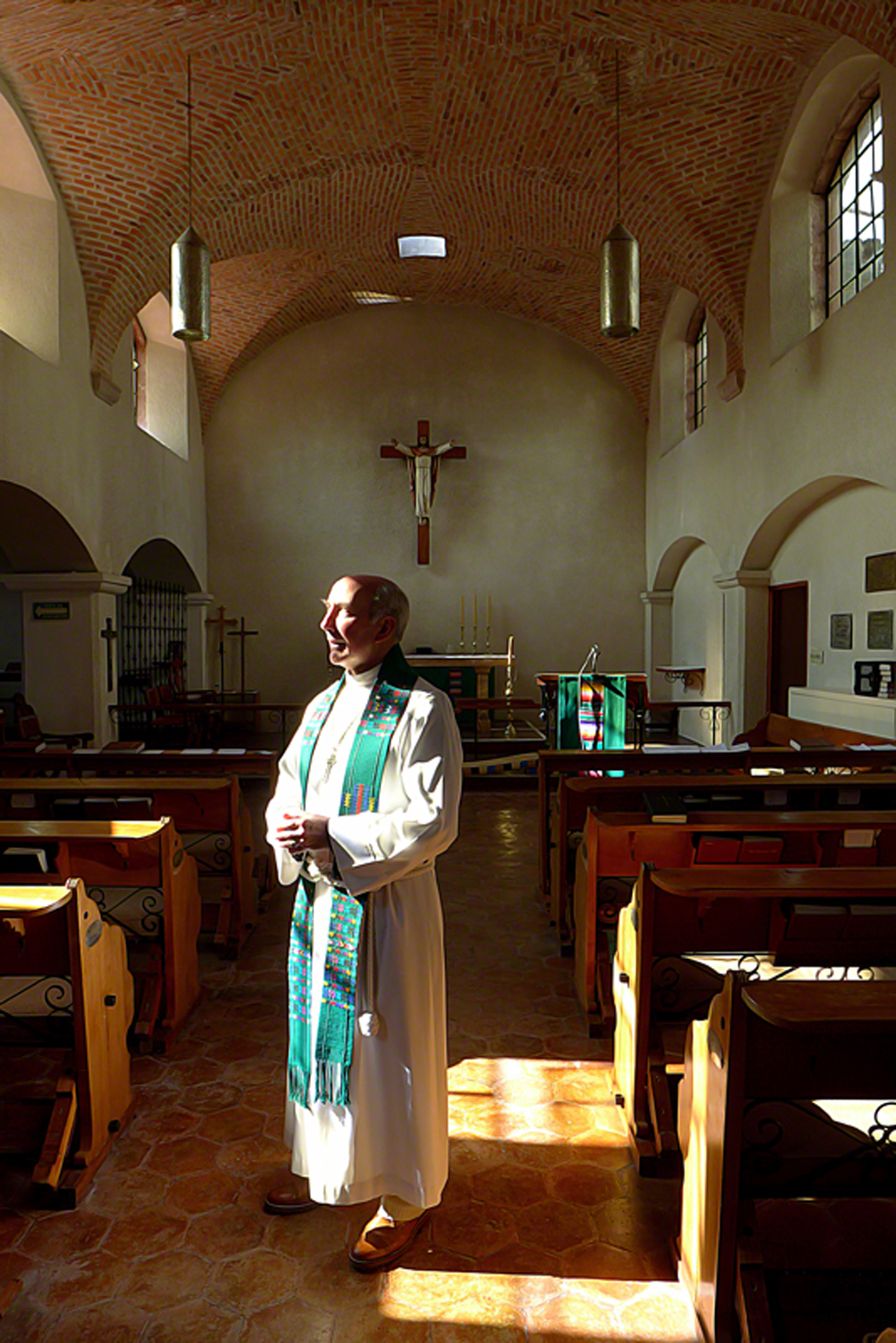
In the above photo I wandered into a small church because I just happened to notice that the sun was coming up and striking the large windows on the east side of the building.

Well to remind my fellow photographers of a quote said by a famous photographer named Eddie Adams, as I was contemplating what I was going to do with this great light streaming through the windows the priest came through the door and began smiling and welcoming me.

“OMG” I thought to myself (no pun intended), I couldn’t believe my good fortune. I immediately asked him if I could take his portrait and he said he would love it; because he needed a new picture of himself.

I placed him in the light and that was that…end of story!!!!

So the next time you go out shooting look for the light all around you, and more than likely there will be a photo there just for the taking!!!

Visit my website at: www.joebaraban.com, and check out my workshop schedule at the top of this blog. Come shoot with me sometime. I just announced my New York, New York Workshop beginning September 17th ,2019 and ending at noon on the 23rd. This will be my second workshop there and this time we’ll be shooting in all the five boroughs.

JoeB

My Favorite Quotes: Jimmy Jones

It was all about “good timin”.

Okay, so you’re looking at the title of this post and you’re scratching your heads wondering just who in the hell Jimmy Jones was; certainly not a famous photographer.

As I’ve stated before, the quotes in this category are not necessarily written by well known photographers or even painters. That said, they are quotes from artists in their own right.

I realize that I might be showing my age, but in 1960 a man named Jimmy Jones wrote one of my favorite songs…”Good Timin”, and it’s one of the concepts I’m always mentioning to students in my BPSOP online class, and to those that signup for my “Stretching Your Frame of Mind” workshops I conduct around the planet…why you might be asking yourself?

When I was recently walking around with my fellow photographers on the streets in Berlin, I noticed that they were usually too quick or sometimes too late to click the shutter; missing the peak of the action. Btw, Berlin is not the only time I’ve seen this happening.

In the case of being too quick, I watch people bring their camera up to their eye when they see something they want to photograph and just start clicking away. Needless to say I’m talking about something that moves i.e., a person, car, animal,  etc., and not some stationary subject.

There’s always the chance that your timing might be perfect, but I’m here to tell you that the odds are that you’ll be too early or too late. Okay, so now you say why not start shooting right away so you’ll be sure to get it.

The answer (based on fifty years of shooting) is that in the case of a person, once they see you they won’t continue any action for one reason or another; in other words you might just have one shot at it…literally!!!

The solution? What I do is have my camera down at my side and slightly behind me (being un-obtrusive as possible) with my finger on the shutter release. Once I see where it’s going, I quickly bring my camera up and take the shot and at least get it “in the can”. Then I continue until I feel that whatever it was that made me bring my camera up was over.

As far as being too late, the same sort of applies. I have the same camera down at my side and (always) at the ready. If I’m on time, then being too late is moot. I’m looking for that moment in time when I’m able to stop an action leaving it un-completed; one of the ways to create visual tension. It’s all about being aware of your environment and constantly looking all around for posible ‘keepers’.

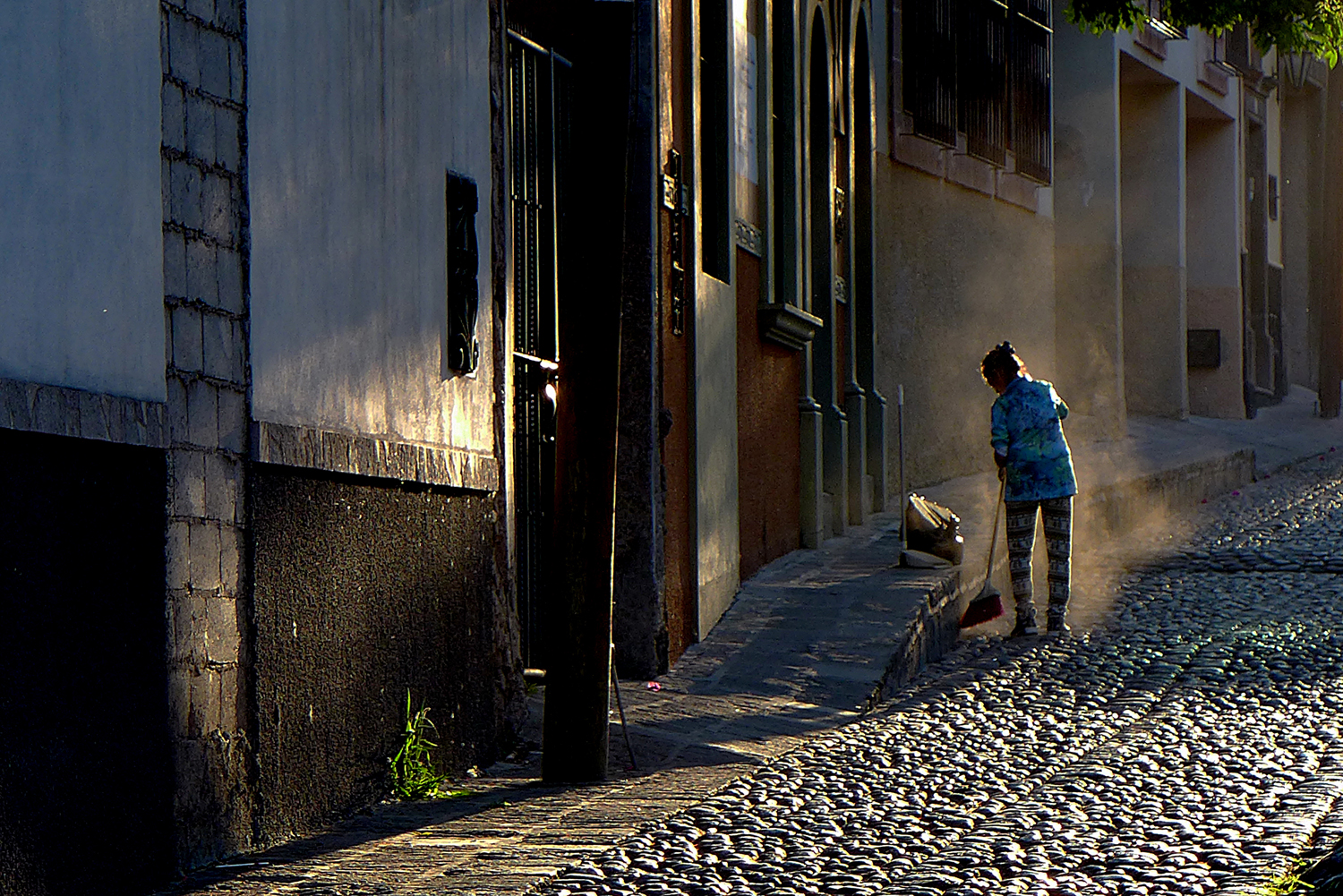
In the above image taken during my workshop in San Miguel, I was stading outside my house early in the morning and saw this woman cleaning the sidewalk. The sun was coming up right down the small cobblestone street, and as she was sweeping she was kicking up a little dust. Because it was backlit it seemed to glow, so I waited until I could get the most dust…with my camera at my side with my finger on the shutter release.

She looked at me and since I was not theatening she lost interest. For one brief moment she stepped into the street and began sweeping. I was able to get off one shot before she saw me and ducked back into the doorway.

Here’s the link to my song: https://www.youtube.com/watch?v=modfq47onwU

Visit my website at: www.joebaraban.com, and check out my workshop schedule at the top of this blog. Come shoot with me sometime. I just announced my New York, New York Workshop beginning September 17th ,2019 and ending at noon on the 23rd. This will be my second workshop there and this time we’ll be shooting in all the five boroughs.

JoeB

Anecdotes: Shell Rotella Oil Calendar

Happy Halloween!

I love writing a post for this category. It conjures up such great memories that I can re-live through this blog. It’s also a story that I will sometimes share with my online students with the BPSOP, and also my fellow photographers tha join me in one of my “Stretching Your Frame of Mind” workshops I conduct around our planet.

Many moons ago, I was asked by the advertising agency that handled the Shell account to shoot the upcoming yearly calendar. Once a year truck drivers from all over the country gathered in a city for the chance to be picked for the calendar; and party in the evenings at the same time.

Among eighteen-wheel super rig truck drivers this is a really big event, and usually a couple hundred of them show up. They spend several days in a huge truck stop washing their trucks, polishing the chrome, and adding Armor-All to their tires.

They do all this for the chance to be one of twelve that make it, since the calendar is distributed all over the country.

To back up a little, every year after they have decided on a city they would rent a huge warehouse that was opened on both ends so each truck could drive in, park in front of a huge white seamless, be photographed, and drive out. I knew that it was going to be hard and time consuming with literally no feeling of accomplishment; creatively speaking that is.

July

That year they picked Nashville but I told the art director that I really wasn’t interested, and gave him an alternative idea. “Why not let me take each month and come up with an idea for it and shoot all twelve on location; and shoot a portrait of the truck’s owner in front of his truck?”

He liked the idea and ran it up the chain of command. Well, low and behold the top guy loved it and approved the fairly large budget.

I sat down with my producer/location scout and told her my ideas for each month and to find me several locations that would fit the bill. I sent her a couple of days ahead of time to start the proces. The art director and I arrived and while she was still scouting, that the art director and I walked around and picked the twelve trucks that we liked the best.

For October I wanted to do something that said Halloween, and found the perfect red-orange truck for it. Needless to say, the owner was thrilled and honored, and when I told him what I wanted him to do and wear, he just looked at me and a very big grin began to run from ear to ear.

We found an old cemetery and obtained permission to shoot there one evening. I rented several small one thousand watt spots and positioned them behind the truck and various headstones. We dressed him then I used a small softbox for his face. The final touch was to fog it up so all the lights would be backlit and the ‘very scary’  mood set.

I have to say that in all the years of shooting, this is right up there for the most fun a photogrqpher could ever have.

Visit my website at: www.joebaraban.com, and check out my workshop schedule at the top of this blog. Come shoot with me sometime. I just announced my New York, New York Workshop beginning September 17th ,2019 and ending at noon on the 23rd. This will be my second workshop there and this time we’ll be shooting in all the five boroughs.

JoeB

Food for Digital Thought: Editing

My final pick

One of the more common conversations I have with either the people that sign up for my online classes with the BPSOP, or the ones that take one of my “Stretching Your Frame of Mind”  workshops I conduct around the planet, is the art of editing; and take my word for it, it is an art.

These photographers when submitting an image for me to critique, will invariably choose the wrong one…that is if they shot more than one variation…which they should have!!!

It all goes back to keeping the viewer around as long as possible, and that is all about two important factors: The psychology of Gestalt, and my ‘Artist Palette’ that has all the elements of visual design and composition on it.

I recently was asked to help edit three-hundred and eighty images down to sixty for his second book. When we were discussing an image, his reasons for keeping it in were sometimes to subjective. In other words it was a location that held certain emotions and memories to him.

Well, that’s all well and good, but the viewer won’t have those feelings. To him it’s an objective visual reaction, and the photo will have to stand on its own merit…unless he always around to explain his thought process or adds some text under the photo. Here’s a great post that will help. One of the lines in it goes like this:

“REMEMBER THAT BELOVED SUNSET OR SUNRISE YOU HAVE–SO EXCELLENTLY CAPTURED, SO EXPERTLY PRINTED AND FRAMED–MAY BE JUST ANOTHER SUNSET TO SOMEONE ELSE”.

Trust me I know how difficult it is to delete one of your very favorite ‘children’…after all, isn’t that what they are?

My second choice

When I edit, almost all the time I have several different photos of the same subject. I will usually put them up on my monitor and comapre them side by side. I’m looking for various things: Things that should have been in the composition, but weren’t. Things that were in my composition, but shouldn’t have been; I always use my fifteen point protection plan before clicking the shutter, but I will sometimes miss something. Did I remember my border patrol? Checking my four corners?

When looking at each image, was I successful in keeping the viewer interested for six to eight seconds? Did I move him successfully around the frame? Was my photo balanced as far as the negative and positive space?

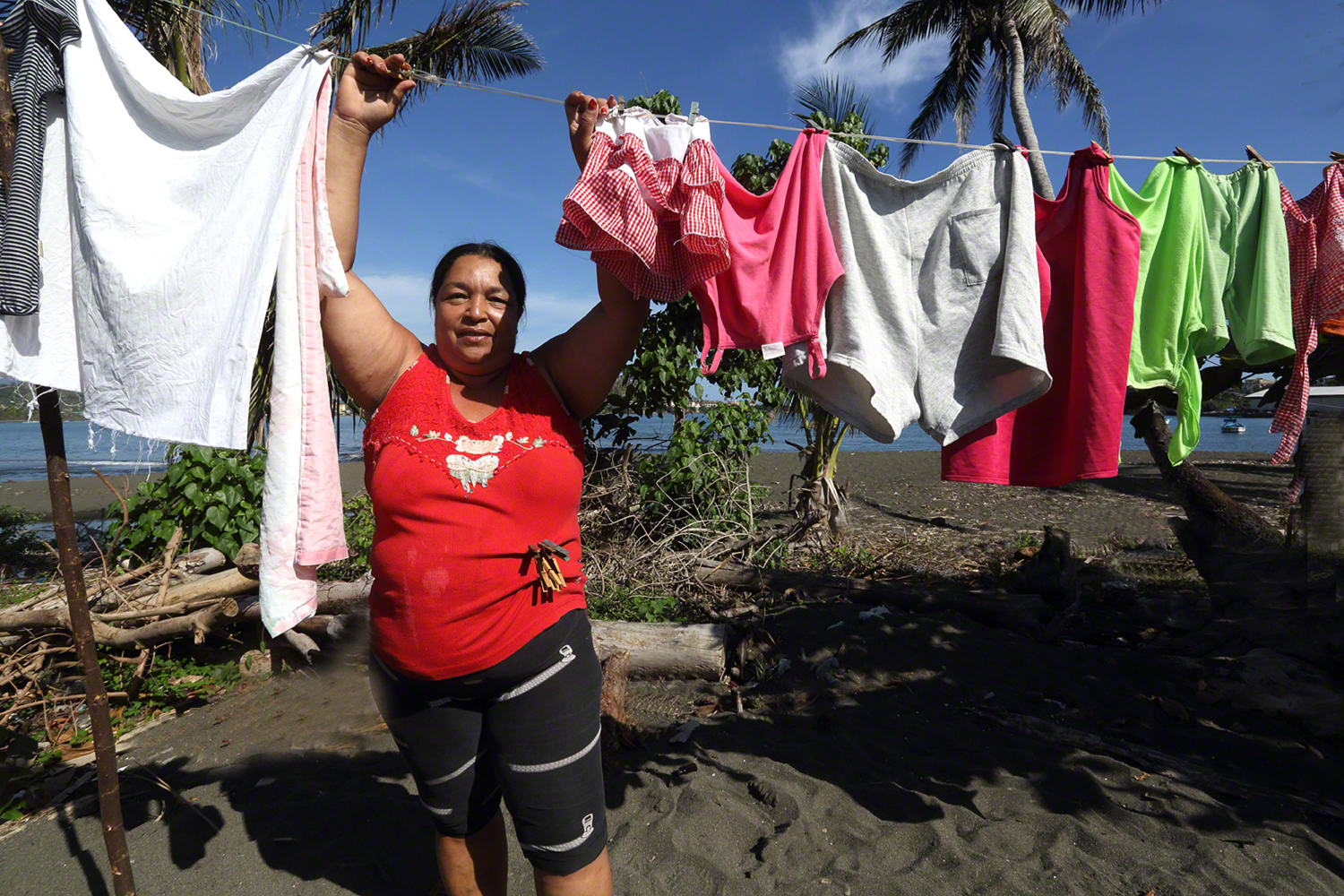
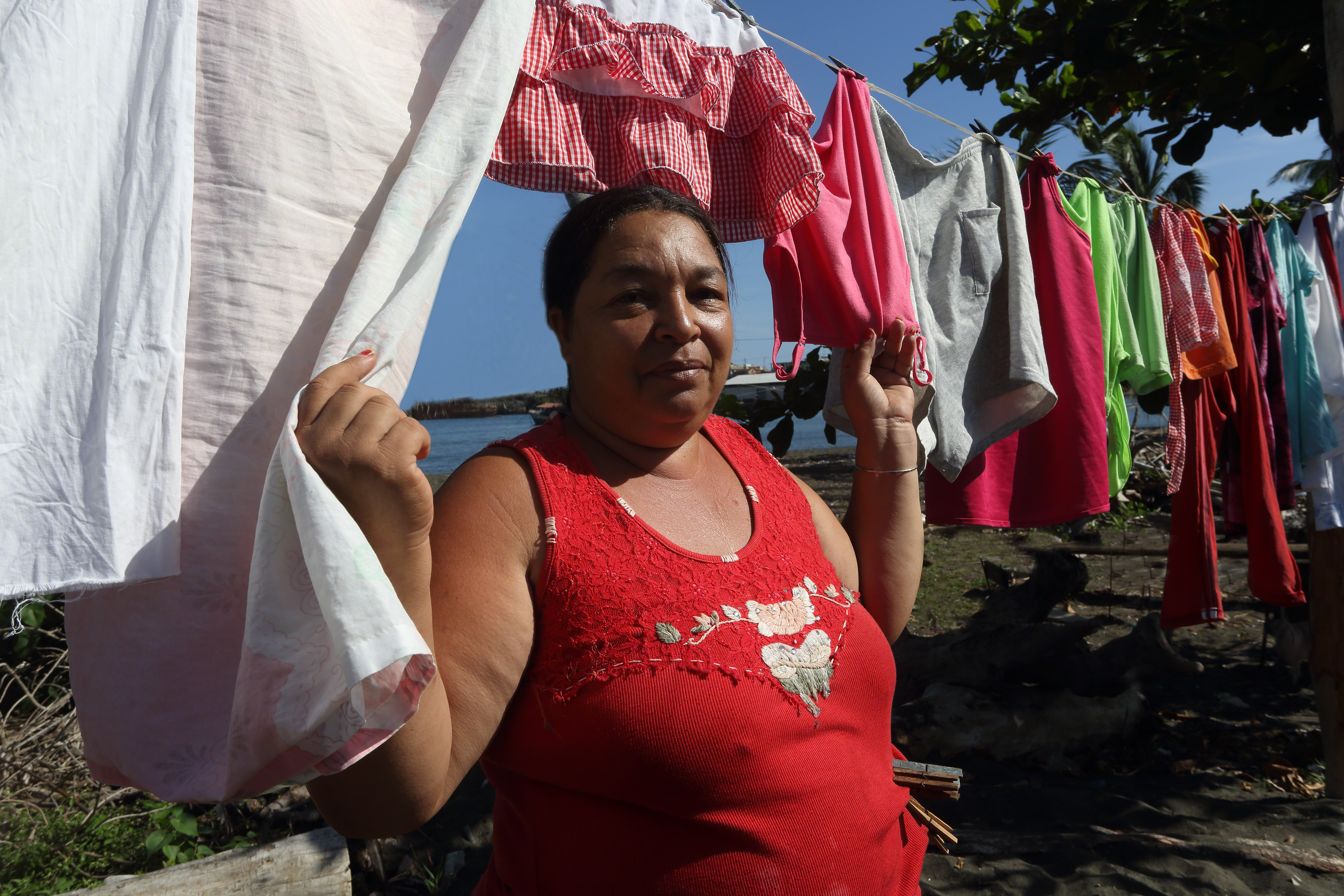
The two photos you see were part of several I shot of the woman during my workshop in Cuba. I narrowed it down to these and finally decided on the one at the top. I’d love to have your comments.

So my fellow photographers as you can see there’s a lot of variables when trying to pick the right photo. Whether it be to print, a webside, or whatever suits your fancy, editing is not for the faint of heart!!!

Visit my website at: www.joebaraban.com, and check out my workshop schedule at the top of this blog. Come shoot with me sometime. I just announced my New York, New York Workshop beginning September 17th ,2019 and ending at noon on the 23rd. This will be my second workshop there and this time we’ll be shooting in all the five boroughs.

JoeB

Food For Digital Thought: Incident vs Reflected Light

I was recently mentoring a student that was just beginning to take the plunge into being a full time professional photographer. He was setting up a portrait shoot in his semi-new studio and showed me his lighting setup; using his son as a stand in. He ws having trouble getting the background to show up…even a little.

I finally spotted the incident meter and new immediately why he was having trouble getting the light balanced on the son’s face and a much darker background.

It’s one of the very important pieces of information on light I always share with my online class with the BPSOP, and my “Stretching Your Frame of Mind” workshop I conduct around the planet.

Okay, there are two different ways to read the light. There is incident light, and there’s reflected light.

Incident light is the light falling on a subject, and reflected light is the light reflecting (bouncing) off a subject. For the past forty years, when I take a reading, I take a one degree spot reading of a scene or subject (reflected) because it will be  more accurate. BTW, it’s a hand held meter made by Minolta; they aren’t made anymore but you can find them on Ebay. Incidentally, I’ve been reading that the hand held meter is gaining popularity.

I’m sure you have all seen a photo that has both white and black people in it. In almost all examples, the black person looks darker that the white person…Why?

Because the black person absorbs more light than he reflects; much less than the white person. If you were to take an incident reading of both people standing right next to one another, you would get the same reading…you’re measuring the light falling on them. It’s the same falling light, and it doesn’t know where or what it’s landing on.

If you were to take a reflected reading of both their faces, there would be a big difference between the two people. When I’m shooting both people in one shot, I always have the black man stand next to the edge of the frame, so I can bounce some extra light on him to bring him up to the same exposure as the others. Yes, I know you can do all this in Photoshop To a point), but like myself, there’s a lot of photographer’s still out there that like doing things in the camera. For me, not only does it make you a better shooter, but it’s a lot more challenging…and I love a challenge!!!

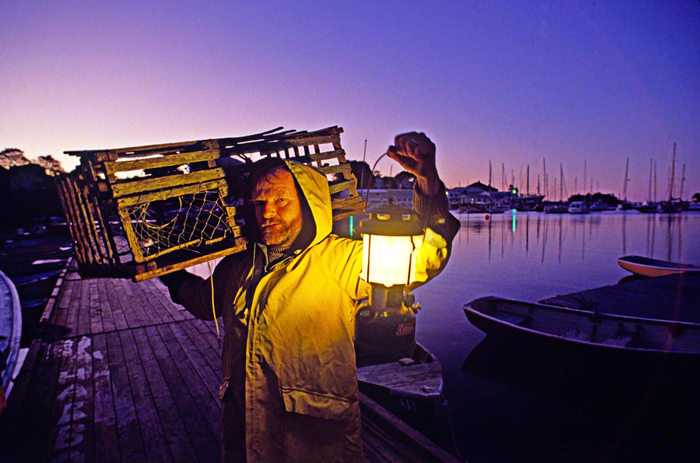
The same goes with other subjects and scenes. Take a look at the above photo of the Lobster fisherman holding the trap. First of all, I knew to the degree where the sun was going to come up by using my Sunpath software and my Morin 2000 hand bearing compass.

I read the early morning sky somewhere between the brightest and darkest part, then the light on his face. When both readings were the same (reflective light), I knew it was time to shoot. As the ambient light got brighter, in order to keep the exposures the same, I had him move the lantern closer to his face until I had lost all the colors of dawn  in the sky behind him.

If I had used an incident meter, I would not have been able to get as close a reading as I did…why? Because the sky was reflecting (reflected light) a completely different exposure than the one falling (incident light) on hs face.

I’m all into having complete control which is why I like to read one degree of reflected light at a time, and shooting photos “in the camera”, because I like the process and the challenge.

So, getting back to my mentoring student problem: The light falling on the dark background and the light falling on the subject were being read exactly the same. If he had been reading the reflected light off the background and the reflected light reflcting off the subject’s face, he could have easily adjusted for it…which he finally did!!!

Visit my website at: www.joebaraban.com, and check out my workshop schedule at the top of this blog. Come shoot with me sometime. I just announced my New York, New York Workshop beginning September 17th ,2019 and ending at noon on the 23rd. This will be my second workshop there and this time we’ll be shooting in all the five boroughs.

JoeB

Food For Digital Thought: Shooting in the Blue Hour

After a beautiful sunset

I have always been surprised when someone in either my online class with the BPSOP, or in my “Stretching Your Frame of Mind” workshops I conduct all over our planet asks me what I mean when I say not to forget to shoot in the Blue Hour.

As a result these same photographers will get to a location maybe a few minites before the sun comes up or will pack up when the sun sets (or even sooner) and head for home. All I can tell you out there that you’re missing out on some quality time.

OK, maybe for some of you out there I need to explain exactly what I mean by the Blue Hour, and let’s get the technical stuff out of the way first:

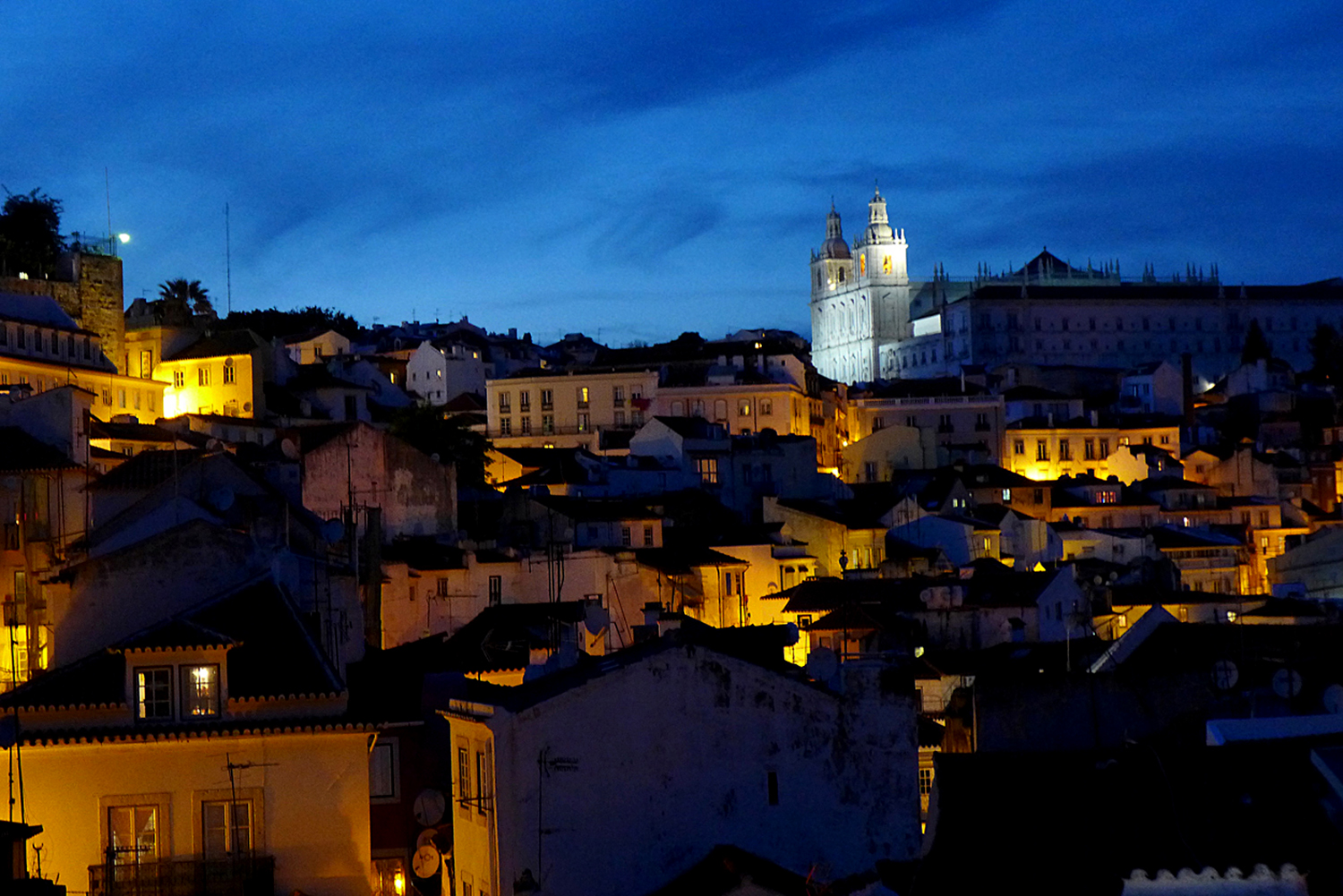
Depending on where you are on our planet and the time of year, the blue hour occurs when the sun  is between -6 to -8 degrees below the horizon. During the blue hour the sun is so far below the horizon that only the blue and violet wavelengths are  scattered and visible in our sky; while the red and yellow wavelengths pass through into the rest of the universe.

As the sun comes up (golden hour) the blue and violet wavelengths diminish leaving the red yellow and orange to start taking over; this is what’s referred to as dawn. Dawn lasts until the sun breaks the horizon, and at that point it’s sunrise.

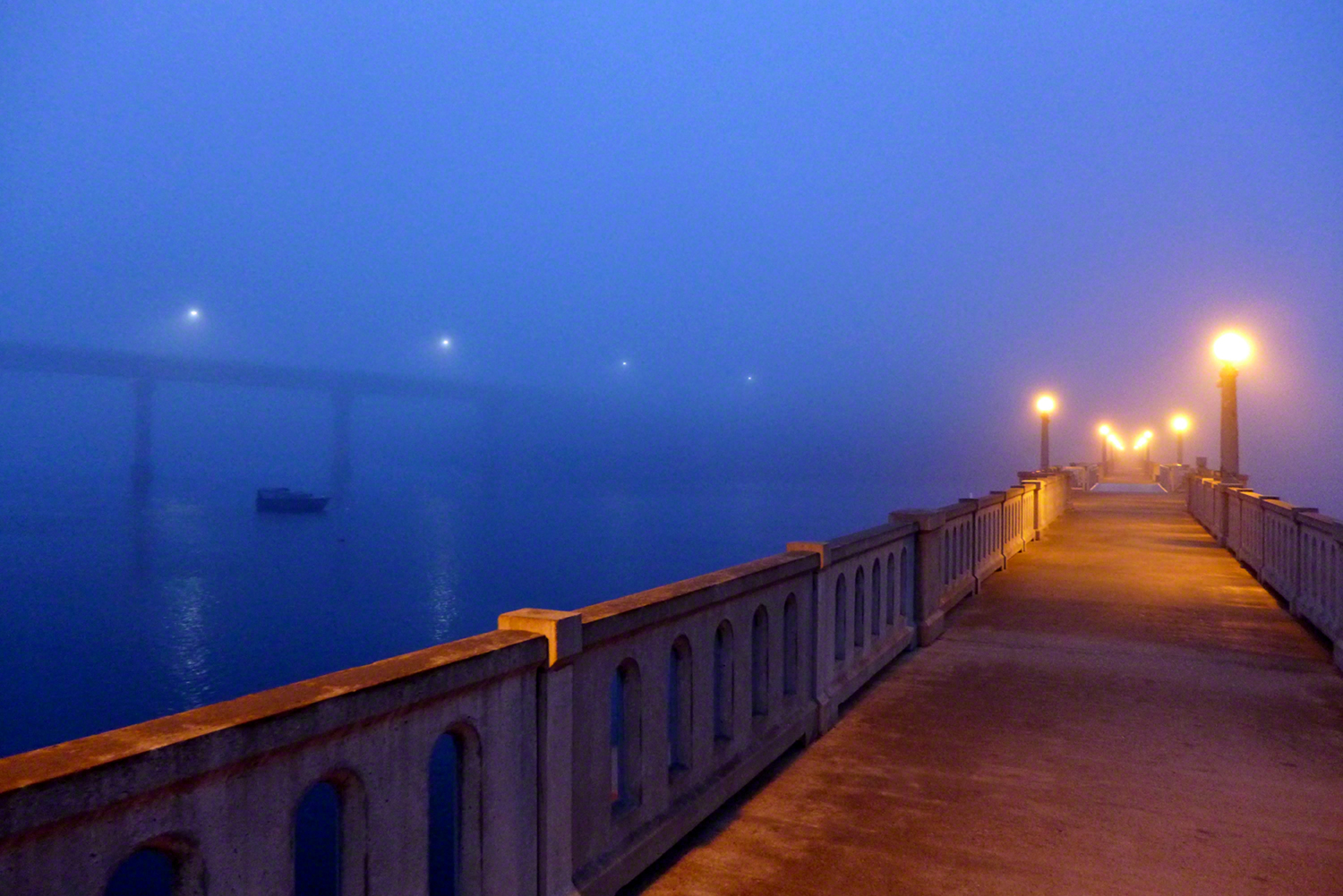
After a gray overcast sunset

Conversely, Sunset (golden hour) is when the sun is nearing or on the horizon, and it’s followed by dusk when there’s no direct sunlight anymore. The red, yellow, and orange wavelengths are fading and the blue and violet are becoming dominant; this is the blue hour…then only darkness.

Btw, blue hour happens even when it’s overcast so don’t pack it in and go home. The length and strength depends on how much cloud cover there is.

I love shooting in the blue hour. It’s moody and magical and can often make up for not so good photos you’ve taken during the day; especially if for some reason you were late for the golden hour.

Since it requires longer exposures and slower shutter speeds, unless you’re using ancillary lighting, you best finish up any portraits before the sun is too far off the horizon.

I like shooting landscapes scenes with structures in them, cityscapes, silhouettes, and anything that has water as one of the main subjects or dominates the foreground. Red and white car lights are great subjects, filled with visual interest and tension.

So, my fellow photographers, next time you go out either go out earlier for the morning blue hour or stay late after the sunset. You’ll thank me for it!!!

Visit my website at: www.joebaraban.com, and check out my workshop schedule at the top of this blog. Come shoot with me sometime. I just announced my New York, New York Workshop beginning September 17th ,2019 and ending at noon on the 23rd. This will be my second workshop there and this time we’ll be shooting in all the five boroughs.

JoeB

Personal Pearls of Wisdom: Get Up Close And Personal

I got up close and pesonal

I’m quite sure a lot of you have heard this at one time or another by lots of different people in lots of different situations. It’s an important expression that’s been around for a long time, and I personally have been using it since the middle eighties in my “Stretching Your Frame of mind” workshops, and in the my online class I teach with the BPSOP. I don’t claim to be the author of it, but I figure after teaching this concept for thirty-five years, whose to say I didn’t??? At least, I can say that it’s one of my favorite Personal Pearls of Wisdom.

It’s a phrase I’ve been using for a while and one that occasionally appears in Cyberspace… ” Get up close and personal”. I’ve  added… “get so close it hurts, then get closer”.  I often quote a very famous photographer named Robert Capa who once said, ” If your pictures aren’t good enough, you’re not close enough”. For those that know who Robert Capa was you know he was a war photographer that was always close to the fighting.

Relax, I’m not suggesting you go out and get close to that kind of action, but I am suggesting you get close to your subject, be it a person, place, or thing. Sometimes it’s even a good thing to be so close that you don’t show all of it. This falls under one of the concepts of Gestalt called ‘Closure‘.

One reason I like to get close is to achieve depth. Since the camera has but one eye (the lens) it can only see in two dimensions, height and width. You can trick the lens and create the third dimension…depth, by getting up close and personal.

By getting close to your subject  you’ll be anchoring it in the foreground, (and the best way to do this is with a wide-angle lens), you’ll create what I call layers of interest. This will keep the viewer around longer as he goes from your anchored subject in the foreground to the background. If you can place enough elements in-between, then he have more to discover on his or her way to the horizon…or implied horizon.

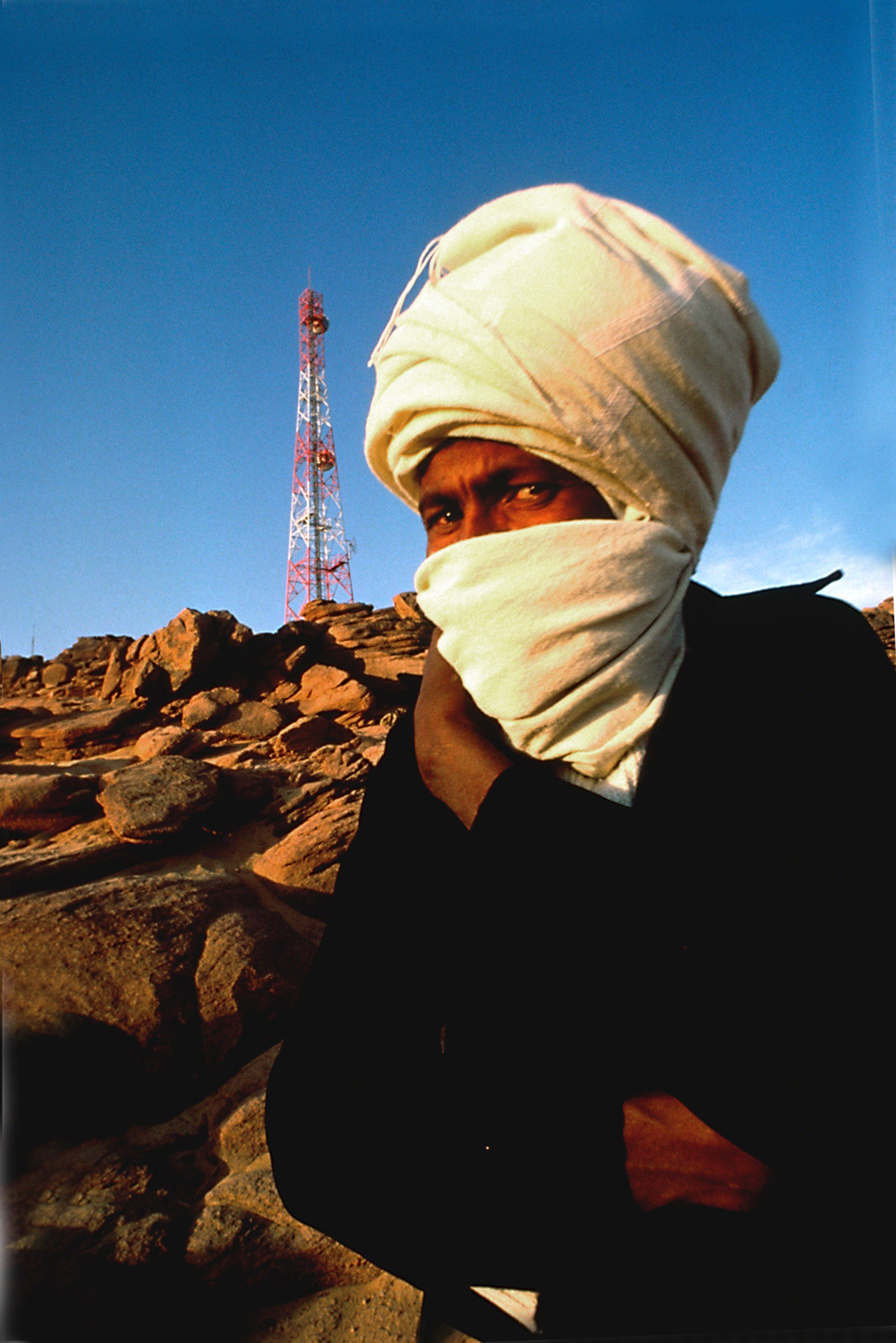
In the Psychology of Gestalt, we want to take control of what the viewer sees in our composition. It’s all about visual perception, and how the viewer will react to our photos. I like a strong reaction so in the photo of the Egyptian, I wanted to really get a reaction, so I got about as close as you could get without having to follow up with any ‘marriage vows’!!!

Take a look at some more examples of getting “up close and personal”:

Visit my website at: www.joebaraban.com, and check out my 2019 workshop schedule at the top of this blog. Come shoot with me sometime. I just announced my New York, New York Workshop beginning September 17th ,2019 and ending at noon on the 23rd. This will be my second workshop there and this time we’ll be shooting in all the five boroughs.

JoeB