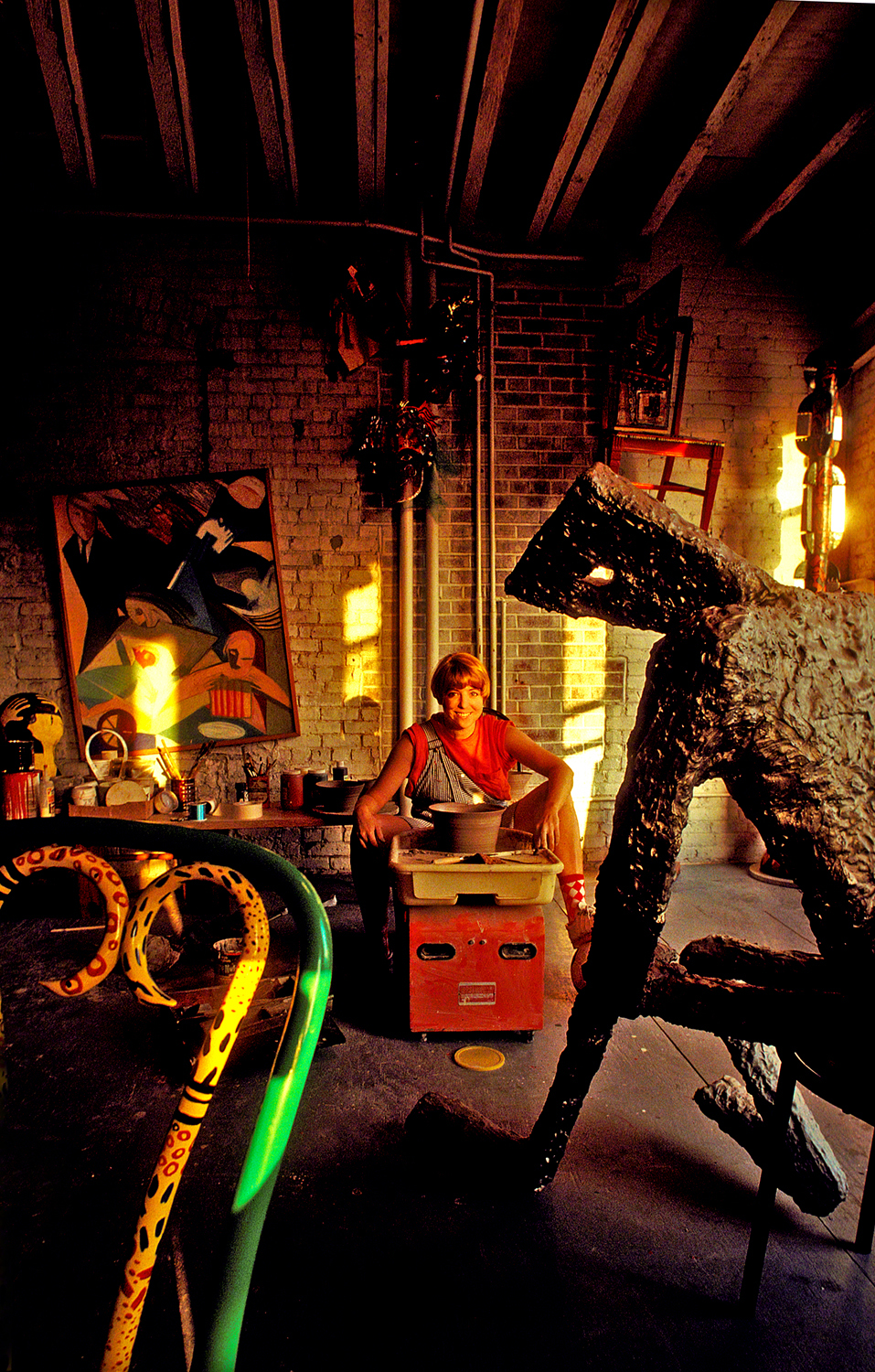
Quick Photo Tip: Using the Least Likely Lens

I never thought about using this lens.

I’m a huge believer in coloring outside the lines and I’m always telling my fellow photographers that take my online classes with the BPSOP and the ones that join me in my “Stretching Your Frame of Mind” workshops I conduct around our plant to do just that.

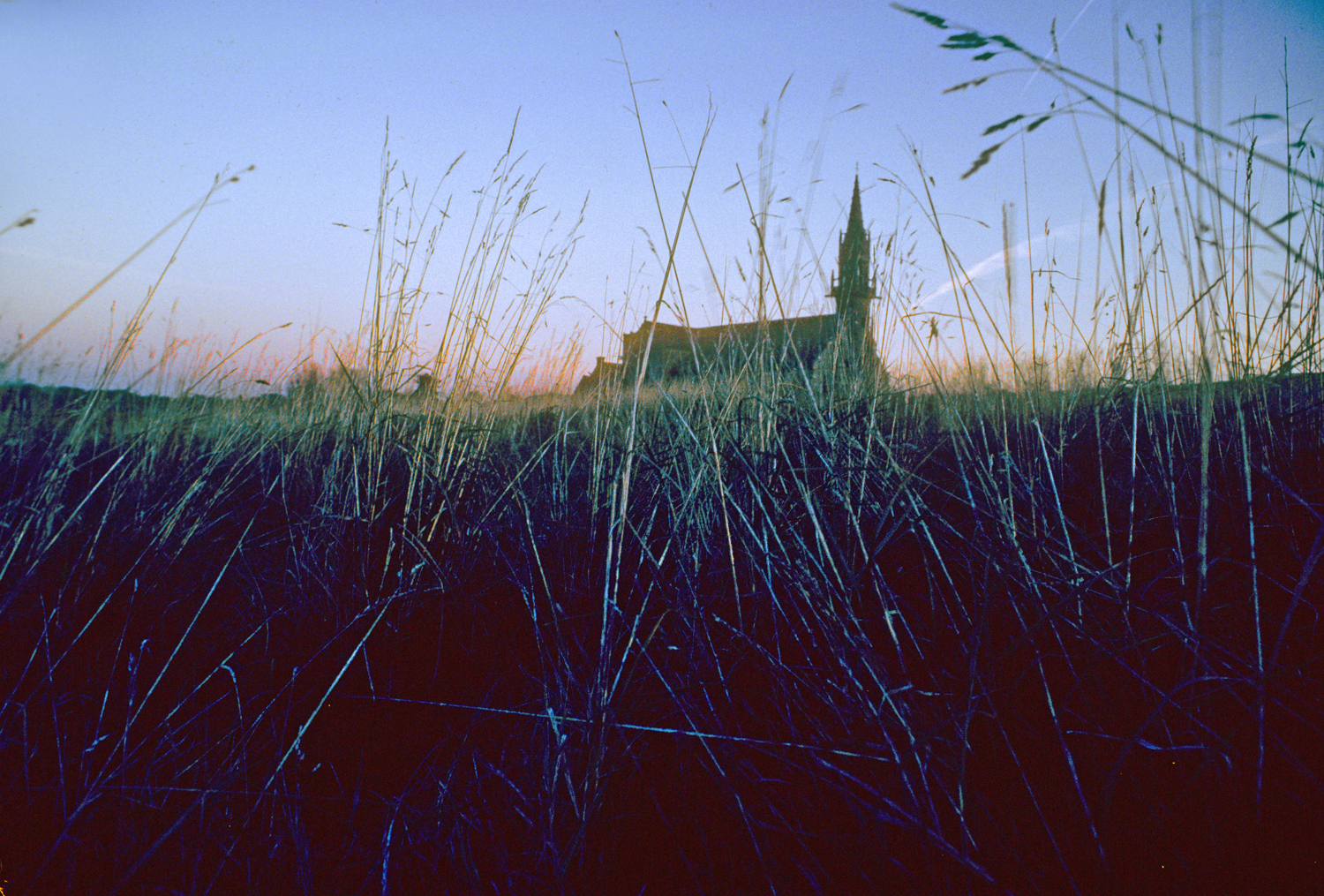
I wrote a post on it almost four years ago and because of it I followed my own advice. I was in an area in the south of France, and when I got out of my rent car to walk along the area surrounding a chateau, I decided to not use my usual go-to lens and put on something I would never think about using for this type of situation…my 100mm Macro.

It was a fortuitous decision as it turned out giving me what I still consider to be a very unusual depiction of swans that were nestled in a small stream next to this incredible well-known chateau. Although (sadly) it looks like I did considerable post processing work to it, it was shot in the camera, one exposure on one 35mm Kodachrome frame with no post work done to it; this is what Kodachrome looked like, and boy do I miss it!!!!

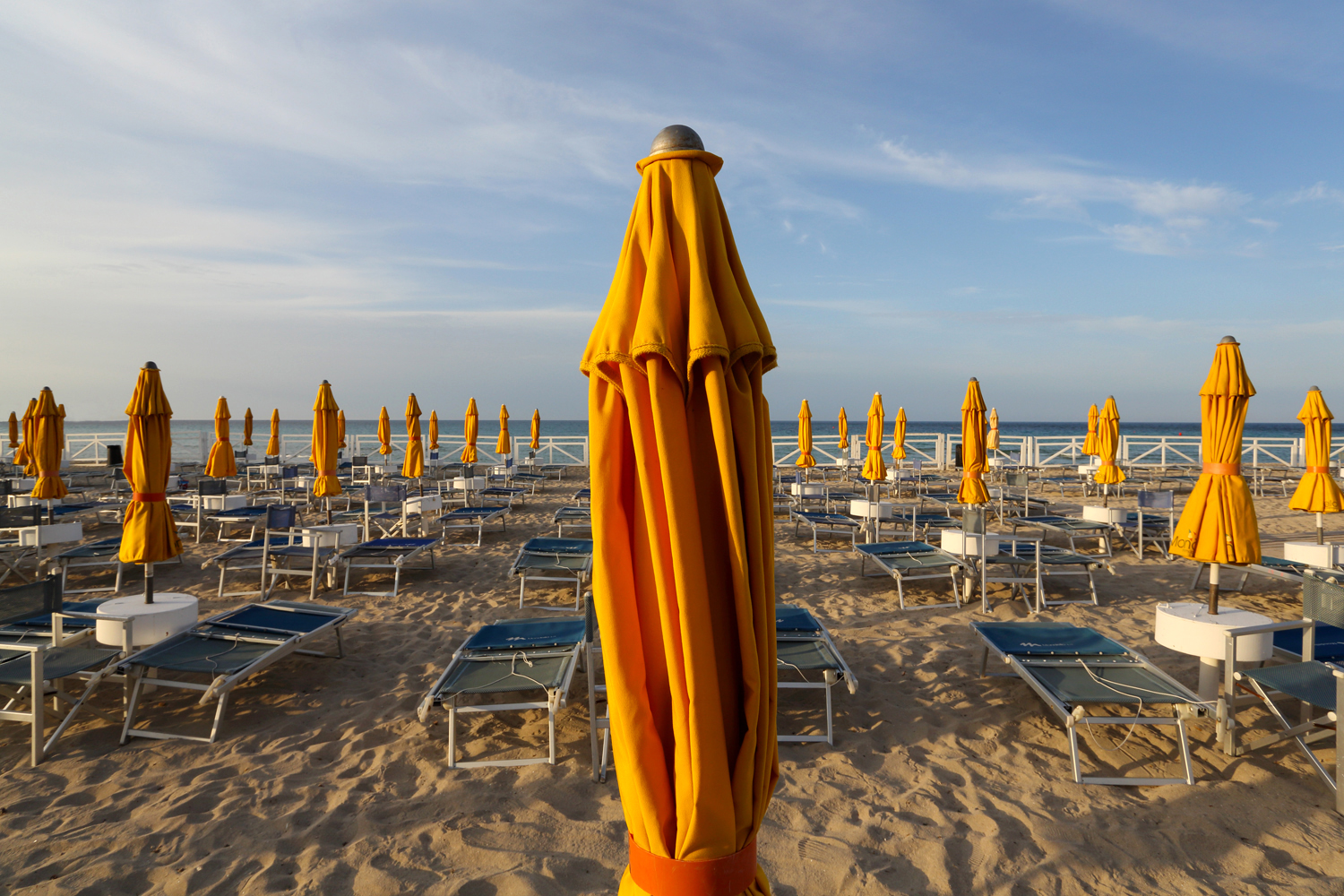
I know so many of you out there get comfortable with one or two lens that always reward you with good photos. The only problem is that they always look the same, as in the same compression or lack thereof, the same focal length that might be on one of your zooms, or the same dOF because you’re using a lens (like a prime) and rendering the same F/stop to all your compositions.

So my fellow photographers bite the bullet, take a leap of faith and grab a lens you haven’t use in forever, or one you would never use in a situation you’ve been in a hundred times and have been comfortable to the point of being complacent.

Visit my website at: www.joebaraban.com, and check out my workshop schedule at the top of this blog. Come color outside the lines with me sometime.

Keep sending in your photos and questions to: AskJoeB@gmail.com and I’ll create a video critique for you.

JoeB
Anecdotes: Apache Oil and Gas

The one I pre-visualized

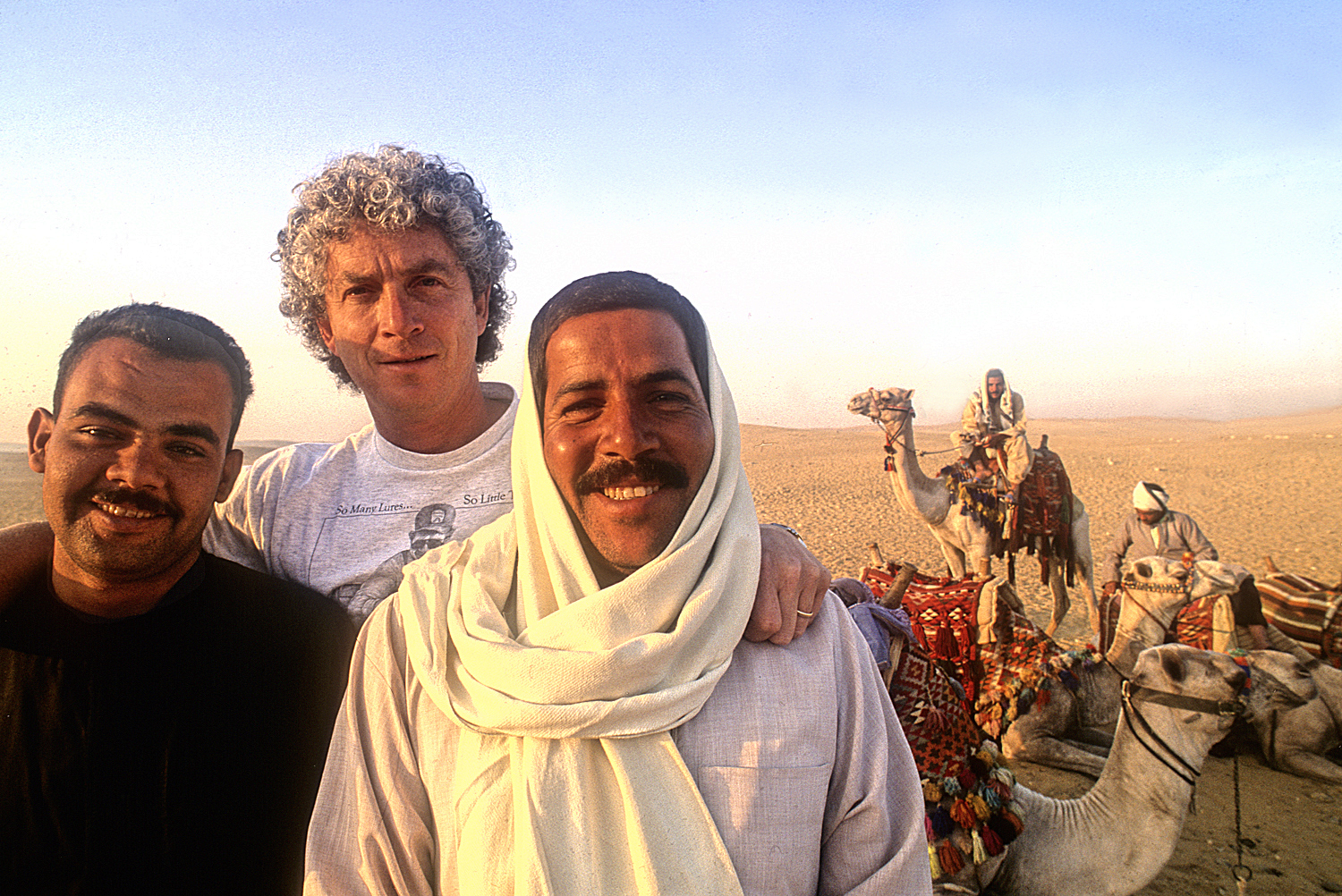
I was shooting the annual report for Apache Oil and Gas, and the company sent me to Egypt to pretty much shoot whatever I wanted that represented the people and country. The reason being that they were going to enter into a partnership to begin drilling there.

The one photo they did want was a photo of a new tower that was recently built in Aswan; a city just south of Cairo. When I got to Aswan, I was driven out to somewhere close to the middle of nowhere, and there was absolutely nothing around except this tower.

Photo #1
Photo #1

As the sun was getting ready to set, I was doing the best I could to try and create an interesting picture out of basically nothing but a tower and some rocks.

In my online classes with the BPSOP, and in my “Stretching Your Frame of Mind” workshops I conduct around our planet, never give up! There’s always something you can do and whatever it’s going to be, it’s going to be better than what most people would shoot…why?

Because not only do I show people how to incorporate the elements of visual design into their imagery, but I also give my Did It Do It list for good composition out to my fellow photographers; on that list is pre-visualization.

Btw, I also send them a link to one of my favorite quotes said by Eddie Adams.

Photo #2
Photo #2

As I was thinking and scratching my head, this man appeared out of nowhere and came up to see what we were doing. I thought to myself, “Did I just get really lucky or what??? I told our driver to ask him if he would be willing to be in my photo, and that I was willing to pay him the equivalent of ten dollars in his currency.

Even though that was more money that he would see in several months, he was simply to shy to pose for me; and the money wasn’t really a factor. We finally got him to be in it providing he was far away from the camera…photo #1.

Photo #3
Photo #3

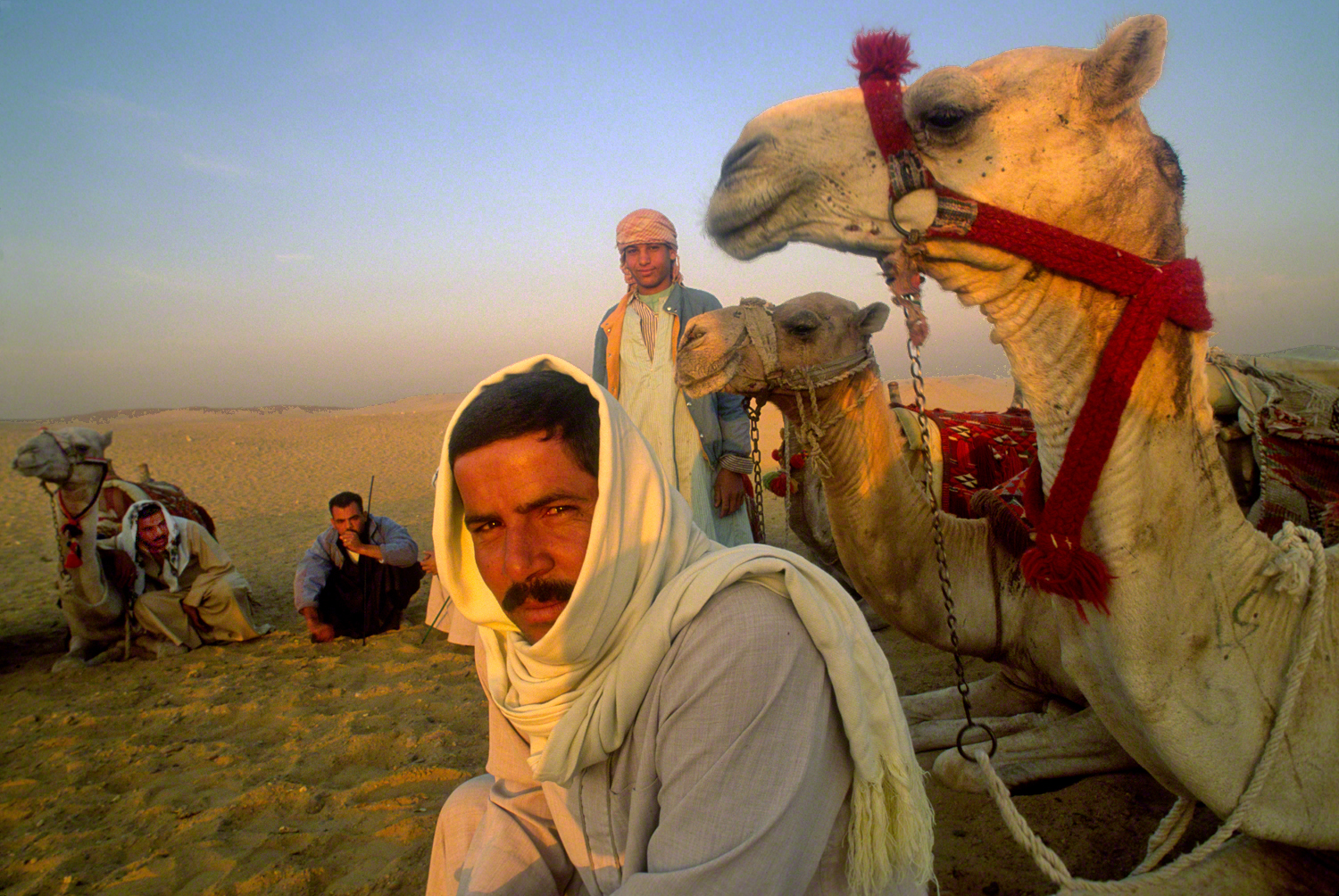
As he became more comfortable, I moved him closer to the camera, knowing where I wanted him to end up…photo #2

FYI, the featured photo above was what I had pre-visualized all along.

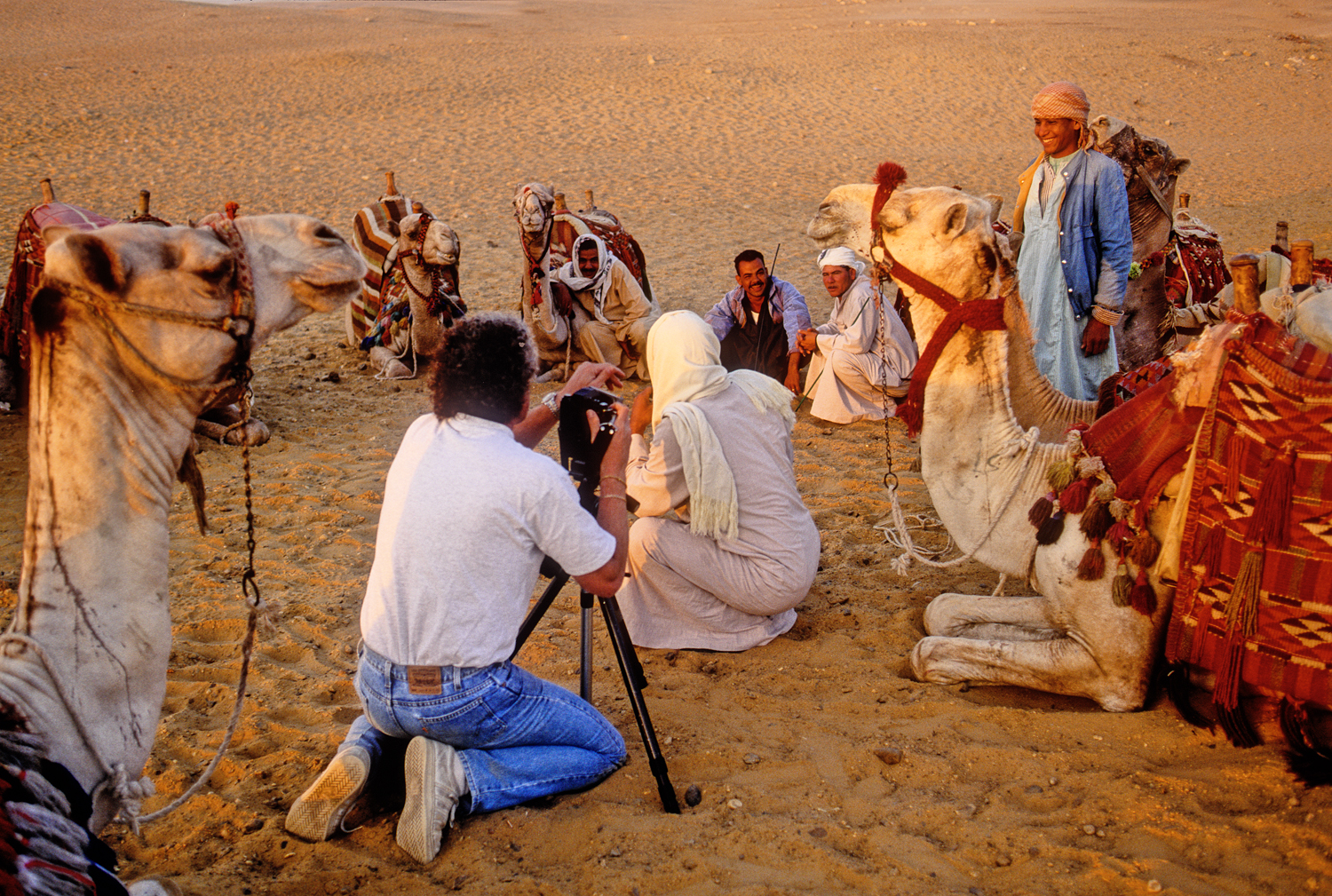
When I was done and gave him his modeling fee, his friends decided to get in on some of the action; they were also each paid, but just half…photo #3

Visit my website at: www.joebaraban.com, and check out my workshop schedule at the top of this blog. Come shoot with me sometime.

Keep sending in your photos and questions to: AskjoeB@gmail.com and I’ll create a video critique for you.

JoeB
Ask JoeB: Is this a good use of light, atmospheric perspective and line?

00080005

Gary, one of my long time blog followers, sent me this photo to talk about. As usual, I like to let my readers know what my fellow photographers had to say. The reason being that there might have been times when the same situation happened to them, or perhaps they had or have a similar question.

Here’s what Gary had to say:

“Hello Joe,

I know your a big believer in light and how good use of light can really kick your photos up a notch. In this photo I was trying to use the sunlight as best as I could to really make it feel like a tangible part of the picture. Also with virtually every part of the image at the same focus (infinity), I tried using atmospheric perspective with the background mountain ranges to create depth. Lastly I tried using the railroad tracks to create some movement in the picture to help lead your eye to the mid ground rock formation. Of course no train ever seems to come at the right time when I am taking the picture :).

Is this a good use of light, atmospheric perspective and line?”

Thank you,

Gary

Gary,

First of all it’s important for people to know what is meant by Atmospheric Perspective. I talked about it in my online class with the BPSOP, and in my “Stretching Your Frame of Mind” workshops I conduct around our planet. I actually wrote a post in 2014 that touched on it: https://joebaraban.com/quick-photo-tip-adding-depth-to-your-photos/

Atmospheric Perspective isn’t necessarily something you try using, it’s something that’s naturally inherent in our daily lives; simply a scattering of dust particles that’s between you, the subject, and the horizon. As photographers we merely work with it or around it, and it’s not always going to be in our best interest…photographically.

The phenomenon has been around since the time of Roman wall paintings. Leonardo da Vinci wrote about it, ” Colours become weaker in proportion to their distance from the person who is looking at them”.

For me personally, the fact that the farthest away objects takes on the color of the haze is not appealing and as a result I usually try to avoid it.

Take a look Gary:

http://www.screencast.com/t/fOqAHtjFRWVQ

I’m not sure Line comes into play here as there’s not really any leading or directional lines, or a Vanishing Point that moves the viewer around the frame. It’s the depth from front to back that’s moving the viewer from front to back.

One last note…I’m not sure the viewer would ever see the train tracks unless you mention that they’re there. Since you won’t be around to explain your thought process, it would need to be a “quick read”.

I like your photo, as it has a certain quiet mood created by the de-saturation (caused by the scattering of water vapor) occurring from front to back.

Thanks for the submission.

Visit my website at: www.joebaraban.com, and check out my workshop schedule at the top of this blog. Come shoot with me sometime.

Keep sending in your photos and questions to: AskJoeB@gmail.com, and I’ll create a video critique for you.

JoeB
Student Work: November Part I BPSOP Class

A self portrait in a Vanishing Point.

As most of you that follow my blog know, I teach three online classes with the BPSOP. In my part I class, I show my fellow photographers how to incorporate the elements of visual design into their imagery: Light, Color, Line, Shape, Texture, Balance, Form, and Pattern. We also work on the relationship between negative and positive space, ways to create depth , and the power of a Vanishing Point as a tool to move the viewer around the frame.

At the end of the four week class, they walk away with what I call an Artist Palette that has all these elements on it. Now, they are armed with the tools to “make pictures” instead of taking them. They can now begin to “see past their first impressions”.

The left side of the brain (the analytical side) says it’s a tree, but what else is it? The tree is the completed puzzle, but the pieces of the puzzle are the patterns, the lines, the texture, the way the light hits it, and the color of the leaves; this is what the right side of the brain (the creative side) sees. Besides talking about this in my online classes, I also talk about it in my “Stretching Your Frame of Mind” workshops I conduct around our planet.

I just completed my part I four week class and the images that the class created are amazing. I would safely say that it’s one of the all time best classes since I began teaching at the school almost six years ago.

I’m certainly impressed, and I hope you are as well. If there’s too many, think of all the ones I’m not showing…just keep the mouse on the arrow and let it roll!!!

Enjoy the show:

Visit my workshop at www.joebaraban.com, and check out my workshop schedule at the top of the page. Come shoot with me sometime.

Keep sending me photos and questions to: AskJoeB@gmail, and I’ll create a video critique for you.

JoeB
Life Before Photoshop: Pacific Bell

Look ma, no Photoshop.

I shot corporate and advertising photography spanning a forty year career, and most of those years (the dark ages) were spend without the help of Lightroom, Adobe Photoshop, and the plethora of plug-ins one can find shopping on the internet; if ones needs help that much.

In fact, Adobe was a type of house in the Southwest part of the US. Thinking back, I can also remember when there weren’t even computers, and as they came into being companies were quick to include photography of their new (freezing) computer room to go out to stockholders in the form of annual reports; to assure them that they were on the leading edge of technology. It’s amazing to think that my maxed out iMac27Retina is probably as powerful than the entire room full of giant machines.

Most of my fellow photographers that take my online classes with the BPSOP, and take my “Stretching Your frame of Mind” workshops I conduct around our planet became photographers during the digital age and have no idea that you can actually “make” good photos before clicking the shutter.

A million years ago, right after the dinosaurs disappeared,  I was shooting an advertising campaign for Pacific Bell, the California based telephone company. I was sent to three locations: Nameless, Tennessee, Remote, Oregon, and Home, Pennsylvania. Three very small but real places spread across the US. With me, I had a phone booth a wall phone and a phone that was mounted on a stand and placed where people could drive up to it.

Before I left my studio, I had a sign made up to look like it was a sign you would see on a road stating the miles left to a particular town or city; in this case Home, PA. I had an idea in mind so in case I found the right location, I would have the prop I needed.

Using my Sunpath coordinates I found just the road I wanted where the sun would set just to one side and down the road apiece!!

We set up the sign and with a portable generator, lit it up.

I remember it missing something and was going to put the rent car driving away from the phone, but at that moment an Amish man drove by and saved the day. As Eddie Adams once said, “When you get lucky, be ready”.

I know that in today’s world, the phone and sign would have been shot in a studio, and the back end of the Amish buggy would have been bought from some stock agency and added after the fact.

I consider myself very lucky that I started out in the film days when you were able to use your head and imagination to solve problems… in the camera where it was fun instead of in front of a computer.

Visit my website at: www.joebaraban.com, and check out my workshop schedule at the top of this blog. come shoot with me some time.

Keep sending in those photos and questions to: AskjoeB@gmail.com, and i’ll create a video critique for you.

JoeB
Personal Pearl of Wisdom: 25X4=100

I looked to my right.

In both my online class with the BPSOP, and in my “Stretching Your Frame of Mind” workshop I conduct around our planet, I have my Pearls of Wisdom that my fellow photographers have become to know and I dare say…grown to love?

Maybe.

One of my all-time attention grabbers is when I say it’s all about 25X4, and I especially remember using it a lot in my last “Springtime in Sicily” workshop. I used it every day that we were walking around Palermo, Siracusa, Cefulu’ on the West side of Sicily and Catania, Taormina, and Ortygia on the Eastside.

As I do in my workshops, I show people how to see things occurring all around them. As Henry David Thoreau said, “It’s not what you look at, it’s what you see”. I’ll suggest they look at things with the right side of their brain, the creative side instead of the left side which is the analytical side.

The analytical side sees a tree, and the right side sees texture, patterns, lines, color, light, shapes, and form; all basic elements of visual design.

Having said all that, if you just look straight ahead while you’re walking, you’re only using twenty-five percent of your possible vision that has an immediate correlation to photo ops that either surround you or you pass by. I can say from years of experience, the majority of photographers do just that; it just doesn’t make sense.

It reminds me of the blinders that some racehorse trainers have their horses wear to keep them focused on what’s in front of them rather than what’s behind them or on each side. It keeps them focused on the race rather than the distractions around them.

YIKES!!! Is that what you want to be compared to…a racehorse with no distractions? I think not!!

OK, when I’m walking around hunting that elusive “keeper”, looking for the light in all the right places, I use 100% of the potential shooting area that’s always there following me down the street. In other words, I look straight ahead twenty-five percent of the time for a few steps, then to my right side (a few more steps) twenty-five percent of the time, to the left twenty-five percent of the time and behind me twenty-five percent of the time…now that sure makes sense to me.

In the above photo taken after my workshop in Sicily in Lisbon, if I hadn’t been looking from side to side instead of straight ahead, I would have never seen this guy mixed in with several of his friends….missing what would soon be one of my favorite photos/examples.

BTW, I will also look up and down, and have discovered many of my best shots doing just that.

So there you have it, my 25X4 pearl of wisdom. I can guarantee you that if you make a conscious effort to follow my advice, a whole new set of photo opportunities will open up for you, and it will be a lot more fun.

🙂

Visit my website at www.joebaraban.com and be sure to check out my 2016-17 workshop schedule at the top of this blog. Come shoot with me sometime.

Keep those eyes wide open and always moving around,

JoeB

Anecdotes:

They could have been brothers.

I was shooting a series of ads for Dewars Scotch in Edinburgh, Scotland, and one of the ads featured two men exchanging their secret fly-fishing spots to one another.

We scoured the city for an authentic Scottish pub that fit the layout that had previously been approved by the client…without any luck. It seems that all the old antique wooden bars, tables, and paneling had been bought up by entrepreneurs in the US to use in their new restaurants being built.

We found a room in the back of a boy’s prep school that fit the layout. The only problem was that it was an empty room and needed a lot of help to convert it to a typical Scottish pub. As I tell my online students with the BPSOP, and also my fellow photographers that take my “Stretching Your Frame of Mind”, if you’re going to use props and set things up (which I always encourage) make it look like you didn’t. It’s gotta look real to the viewer. Right before they click the shutter I have them ask themselves…”Do I believe it?”.

While we were dressing the room, my producer went out on the street to look for a couple of men we could use in the ad. Fairly easy since all the older men could have come straight out of central casting; everyone looked great. We picked out two separate men, total strangers, who agreed to play the role of the two fly-fishermen for a fee of $250.00 each.

I had a 12K HMI (a very large daylight balanced twelve thousand watt motion picture light) outside the window to act as the late afternoon light. To bounce light back into the men, I set up a roll of white seamless paper between us and cut a small hole in it to stick my 20mm lens through. That done, I couldn’t see anything except what I saw in the viewfinder. To make it more realistic and to get the men loosened up we use the real thing…a bottle of Dewars.

We had been shooting for quite a while and every time their glasses looked empty, my assistant would fill them up again. Finally, when I saw their glasses needed to be refilled I mentioned it, whereas I was told that the bottle was empty. They had consumed the entire bottle, drinking it ‘neat’ or in other words without anything mixed in it including ice.

It was over!

The two men, who never laid eyes on one another in their lives, were so drunk that they were laughing and falling over each other…and in a matter of an hour and a half had become close enough to be brothers. In fact, so drunk that they could barely walk and were in no condition to find their way home. It made us so nervous that we renting two private cars to drive each one home.

Visit my website at: www.joebaraban.com, and check out my 2016-17 workshop schedule at the top of this blog. Come shoot with me sometime and I’ll buy you a drink!

Keep sending in your photos and questions to: AskJoeB@gmail.com and I’ll create a video critique for you.

JoeB
Food for digital Thought: It’s not what you put in a picture that counts, it’s what you don’t put in that matters.

What else did I need to say pharmaceuticals lab?
What else did I need to say to represent a pharmaceutical lab in a photo?

Photography is the “art of subtraction”. Unlike painting where you start out with a blank canvas on an easel and fill it in until you have a finished work of art, the camera on a tripod starts out with everything the lens can see, and you take things out until you have a finished photo.

The key to finishing up with a finished photograph, worthy of being on a wall is, in knowing what to take out and what to leave in. To me, this is one of the most difficult parts of the process; from the first idea/composition to the final act of clicking the shutter.

I’ve been teaching an online class with the BPSOP for five years, and conducting my personal “Stretching Your Frame of Mind” workshops for over forty years, and one thing that hasn’t changes is that my fellow photographers don’t know when to quit. When to say ok I’m comfortable with what I have so it’s time to let go and click the shutter.

I’ve found that people have a tendency to not trust their judgment and with that comes an insecurity in what they’re doing, and while they’re doing it..therefore their thought process centers around more is better.

Years ago, perhaps a million of them, I was represented by The Stock Market”, one of the first, largest, and most popular stock photography agency in the world. The co-owner and photo editor told me that what she liked about my pictures was that I knew what not to to put into a photograph.

For the most part, I’ve always tried to “keep it clean”. If something in your composition isn’t helping it then more than likely it’s probably hurting it…or at the least taking up unnecessary space. Sometimes you don’t even realize it until you’re sitting in front of a computer, and maybe you can fix it then; which doesn’t make you a good photographer.

I do suggest three ways to help you out on that: My fifteen point protection plan, the border patrol, and the four corner checkoff. At least it might get you to see those pesky UFO’s…those parts of things that invade the edges of your frame – i.e., a part of someone’s hand or foot, the last three letters of a sign, half a light post, etc.

The viewer will fill in the rest of the plant.

Sometimes you don’t need the entire horse running through the field, maybe it’s just the neck and head. What if it’s just the grill of a 57′ Chevy? Try it sometime, and let the viewer work at filling in the missing pieces to the puzzle you left him.

Visit my website at: www.joebaraban.com, and check out the workshops I offer at the top of this blog. Come shoot with me sometime.

Keep those photos and questions coming to: AskJoeB@gmail.com, and I’ll create a video critique of your photo.

JoeB

My Favorite Quotes: Henri Matisse

Coloring outside the lines takes courage.

I’ve enjoyed writing poss for this category for some time, the first one going back three years. As my fellow photographers that follow my blog know, I don’t limit these quotes to just photographers. Artists of all types and genres are my sources, and as long as their quotes make an impact (as it relates to teaching) on me, then I want to share it with everyone.

My background is in painting and design, so part of my education was spent in Art History; specifically in the study of painting. Among my favorites was the French painter Henri Matisse. Not only known for his use of color, but he was also a printmaker and sculptor. Matisse once said, “Creativity takes courage”.

Until the death of Bryan Peterson, the founder of BPSOP, (the Bryan Peterson school of photography) of which I taught at since 2011, I had often talked to photographers that took my online classes, and my “Stretching Your Frame of Mind” workshops I still conduct around our planet, about stepping out from the coattails of photography past and present and those that would lead you down the path to mediocrity; and photographic purgatory.

I’m talking about those that follow (with the strictest regularity) rules meant to hinder any chance to being creative; they are the shackles of any original artistry. Creative in the sense of following your own path instead of those others have blazed a million years before..at least during the onset of camera clubs…and now the ruts are are beginning to be too deep to climb out of.

Coloring outsides the lines instead of listening to bad advise offered by those that are too afraid to do so themselves takes courage. We have become a  nation of sheep, and find it easier to go with the flow than follow the beat of a different drummer.

For the most part, I’ve found that photographers want/need  to be safe in their approach to creativity and strive for that first, second, or third place ribbon awarded to those that follow the rules laid out in their respective clubs; or perhaps a big smile and gentle pat on the back from friends or family members…that love you unconditionally.

Without the revolution started by these influential impressionist painters: Pisarro, Monet, Degas, Renoir, and Bazille, art may have never been so radically changed; they challenged the art world and although scorned at first finally won. As photographers we should consider ourselves as painters who have chosen a camera as our medium; our cameras on a tripod is the same as a blank canvas on an easel.

Break all those silly rules that I’m sure all of you at one time or another have either read about or someone has been whispering in your ear; for the most part it’s really bad advice.  If your photos are constantly being degraded from fellow photo club members because they don’t follow their rules…start your own club and enlist only those that dare to be courageous.

FYI, I know of people that have done just that.

Visit my website at: www.joebaraban.com and check out my 2016-17 workshop at the top of this blog. Come shoot with me sometime and we’ll be creative together.

Don’t forget to send me a photo and question to; AskjoeB@gmail.com and I’ll create a video critique for you.

JoeB
Quick Photo Tip: Making one person stand out

Isolating just the woman executive takes time.

I’m not sure how many of my fellow photographers out there ever have the need to light and shoot a group of people and make just one of them stand out without the others knowing; and still make the lighting even on everyone. As they now say, “Being politically correct”.

Having complete control of both your exposure and shutter speed is essential, to pull it off. In this executive portrait, I set up in an empty room in the company’s offices. By using  black board in between the lights that are on each of the temporary stand in models (we used so we wouldn’t take up too much of the real executives time), I was able to control the reflected light hitting each one separately. Using my Minolta One Degree Spot Meter model ‘F’ for both ambient and electronic flash readings I matched the light on all three executives.

Now having the light readings the same, I then could control my DOF. I could have all three in focus, just the man in the middle, or the man on the left end. In this situation, the woman was the key executive, and the one the company wanted to feature in their annual report to the stockholders.

By using a 300mm telephoto lens, I could isolate the woman at F/2.8 even though the next man was sitting close to her. I did this by getting as close to her as the lens would focus, approx. twelve feet.

Then it was time for the real executives to come in and make it look as though they were in a real meeting; instead of looking at a whole lot of diffusion material. I tried countless variations where I had each executive doing something different; as though it was an actual working meeting.

Remember that lighting takes a lot of time to make your photos look good. So many of my online students with the BPSOP, and in my “Stretching Your Frame of Mind” workshops I conduct around our planet just don’t take the time necessary when you’re using flash; either inside or outside. They tend to only think about the main subject and let everything else fall where it may…not a very good idea.

Visit my website at: www.joebaraban.com, and check out my 2016-17 workshop schedule at the top of this blog. Come shoot with me sometime.

Keep sending in your photos and questions to: AskJoeB@gmail.com, and I’ll create a video critique for you.

JoeB
Life Before Photoshop: Budweiser

The finished product.

Looking back through all my post in this category, brings to mind all the years I spent without the help of Lightroom and Photoshop. I’m closing in on fifty years of shooting advertising and corporate photography, and I would say that three-quarters of those years were spent without their help. These years were during the period of time when computers were not invented, in their infancy stage, and later on when Adobe was a type of house in the Southwest part of the country.

I was recently talking to a woman that had taken both my online class with the BPSOP, and several of my “Stretching Your Frame of Mind” workshops I conduct around our planet. One of the things she said was, “I can’t imagine shooting and not seeing what you’ve captured while it is being developed.  That in itself, has to make one think very carefully before clicking the shutter. ”

She’s right, but it was a lot scarier than that!!!

Imagine a large production shot that included an out of town location, people, interior lighting you had to make believable, and important props that helped tell the story. Now imagine getting everything in the frame to be withing one stop of one another; from the front to the back, and from one side to the other…that’s not counting the exposure on the faces of the subjects. All this on one 35mm Kodachrome transparency.

Now, imagine not being able to see your finished photo until you got back home, sent the film to the lab, then waited nervously until you saw the first three to four frame clips. I only knew it would be close ahead of time based on the countless meter readings I took with my Minolta One-degree Spot Meter and bracketing in one third intervals. Had it not been for this meter, I would have never been as successful as I was…plain and simple.

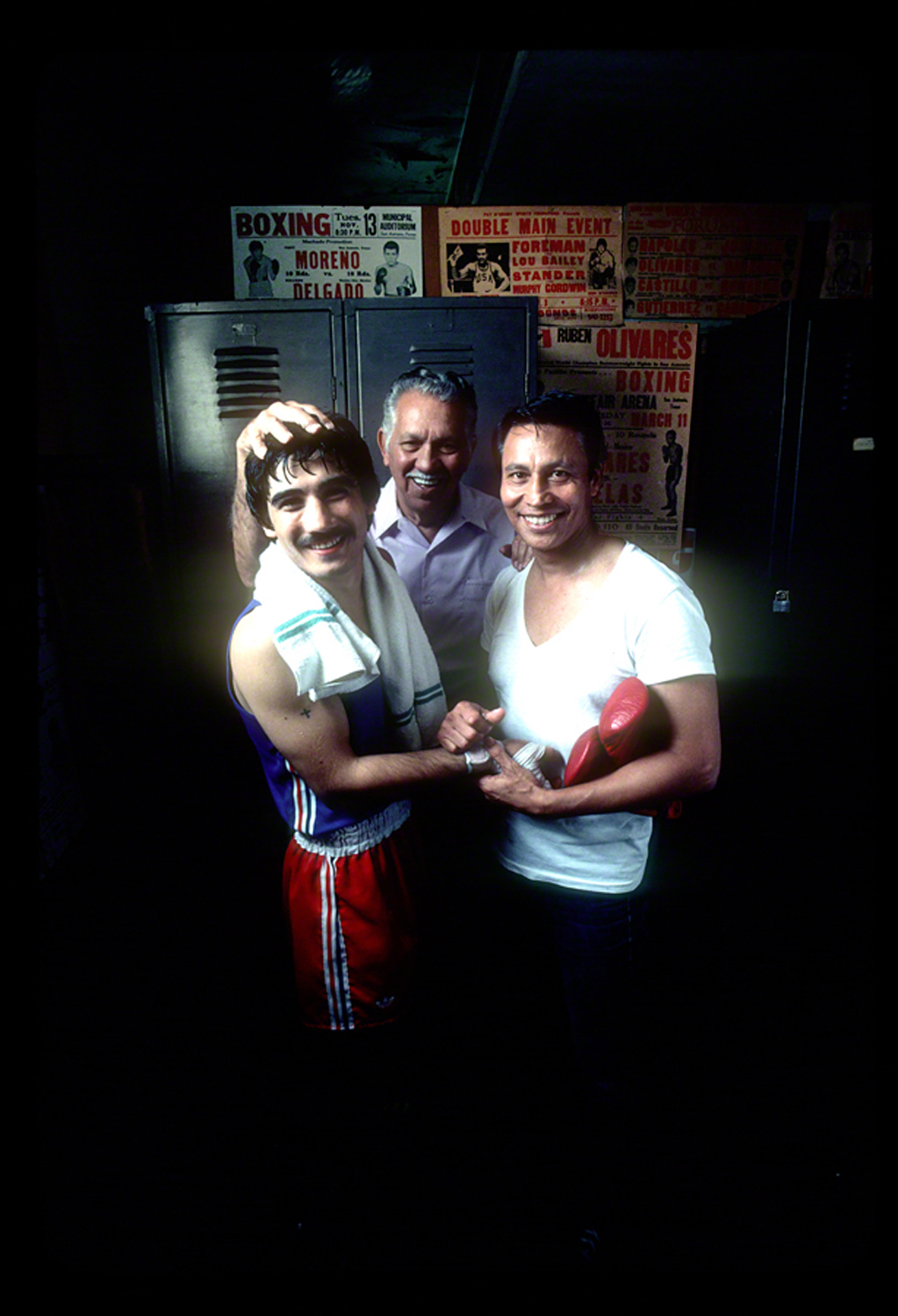
In the photo of the boxer, Budweiser sent me a layout depicting a young Hispanic man posing with his trainer and manager, to be taken in the gym they worked out in. These were not to be models, but the real deal. I sent a location scout to San Antonio to check out his gym to see if it fit all the requirements. In other words, if it looked real. Needless to say I was exited when I saw the photos and quickly set up a date to take their portraits.

Knowing from the photos that the room was going to be too dark to really work with, I took virtually all the lighting I had in my studio; I wound up using everything I took.

Here’s the finished production photo with a video of how I achieved it with out the help of any post processing. Everything was created in the camera on one piece of film.

http://www.screencast.com/t/lLw6jNdZiS

Visit my website at: www.joebaraban.com, and check out the workshops I offer at the top of this blog. Come shoot with me sometime.

Keep those photos and questions coming to: AskJoeB@gmail.com, and I’ll create a video critique of your photo.

JoeB

Personal Pearl of Wisdom: Hurry Up and Wait

What I was waiting for.

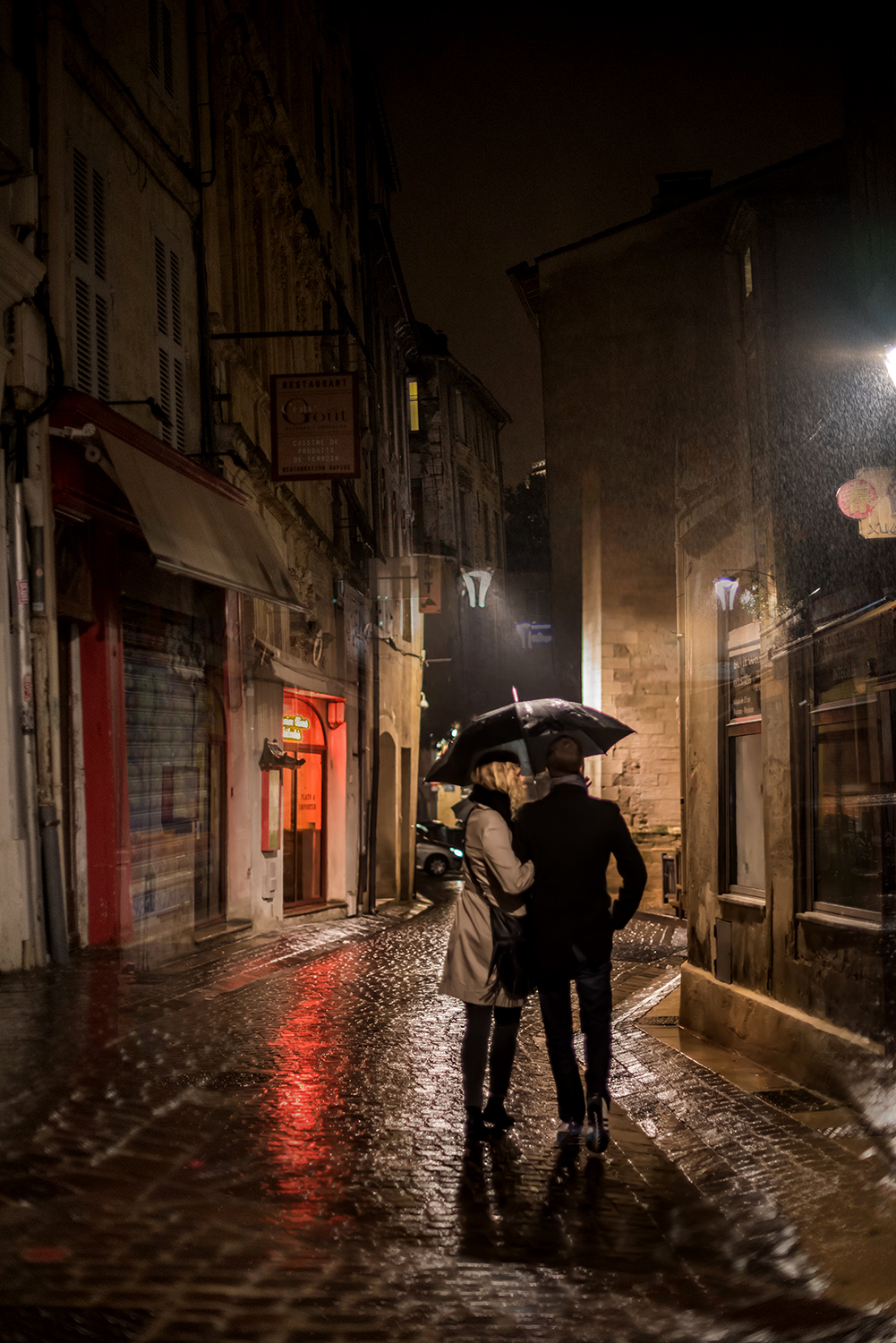
When I’m out walking the streets whether it be in Paris, Lisbon, New York, recently in Cuba, or in my own backyard, I pretty much follow the same routine. That is, I look for all the elements of Visual Design, light, and color. Any of these are what I call pieces to a puzzle, and when I can get enough of these pieces, I look for something that can tie them all together. The final touch, the glue, the last “layer of interest” that can complete my work of art…my photo.

If I see something that fits the bill, and I have the time to wait, I’ll find a nice comfortable place to sit (hopefully) or stand and wait. The hurry up part is to get what I think is the best exposure and lock it in to my manual settings. I arrange my composition to allow for that certain something, and when it comes I’ll know it.

It could come in a second, a minute, or ten minutes. The longer I’m willing to devote to it depend entirely on how important I think the photo could be. One thing I know from years of experience is that if and when it comes, I’m not going to have a lot of time to shoot; and as Eddie Adams once said, “When you get lucky, be ready”.

The above photo was taken on my recent third trip to Cuba for the Santa Fe Workshops. We were in a small town an hour outside of Havana, and it was mid morning. The sun was sky high, and it was incredibly hot with little to no shade; too hot to walk around aimlessly. Across the small square I spotted a brick wall with a grouping of buildings behind it.

I immediately saw the yellow and turquoise shapes, and what I also saw were semi-squares that created a pattern.  These are two of the basic elements of visual design. I loved the way the colors seemed to be in harmony and quickly took a vertical approach, minimizing the semi-squares that weren’t yellow. I always take into account what I always tell my online class with the BPSOP, and in my “Stretching Your Frame of Mind” workshops I conduct around our planet, “It’s not what you put in your pictures that counts, it’s what you don’t put in that matters”.

What I saw.
What I saw.

Ok, the hurry-up part was done, all I needed was that certain something to happen. Several people walked by, but no one was wearing anything colorful. After a longer period of time than I wanted given the time of day and the temperature, I spotted a mother and daughter sitting on a bench behind me.

The daughter was wearing exactly what I was looking for, so I asked the mother if they would cross the street and walk by the concrete wall. The little girl began walking at a faster pace maybe ten feet in front, she suddenly stopped, and stuck her head into one of the semi-squares. I was able to get off one frame before the mom came into the frame, said something to the girl and took her away.

If I hadn’t seen past my first impression and used my Artist Palette, had my composition and exposure set, and was able to minimize an ordinary hot blue sky, I would not have been able to capture this moment in time.

Visit my website at: www.joebaraban.com, and check out the workshops I offer at the top of this blog. Come shoot with me sometime.

Keep those photos and questions coming to: AskJoeB@gmail.com, and I’ll create a video critique of your photo.

JoeB

Anecdotes: Anderson Consulting

Mano a mano
Mano a mano

Years ago I was shooting the annual report for Anderson Consulting, and they had me travel virtually around the world shooting their clients in action. A dirty job but someone had to do it!

One of their clients was Spain’s Social Security Department. Shooting in Madrid, Cordoba, and Toledo, I basically had a free hand to photograph the people in their environments; environment portraiture being one of my favorite genres.

We were there in February during carnival, and I was walking around looking for interesting subject matter in Madrid’s most famous square (packed with tourists and locals) The Plaza Mayor, and saw this local artist starting to draw this young girl’s portrait.

As I tell my online students with the BPSOP, and also my fellow photographers that take my “Stretching Your Frame of Mind” workshops I conduct around our planet, always decide where you want to be in relation to the sun before you bring the camera up to your eye…and that’s just what I was doing.

In order to get the side light I wanted both on the girl and the artist, I needed to stand behind her; which is what I wanted to do in the first place. I wanted the artist drawing and the little girl looking over her shoulder at me as if she had just discovered that I was there.

To get her attention I would make the ‘psst’ sound and each time I did she would turn away from the artist to me, and just as she did I would click the shutter. It didn’t take long before the artist began to get upset, and finally he stood up, through his small piece of pastel on the ground, and started ranting and raving. He was yelling at me in Spanish and since I speak and understand the language just enough to get by, I knew pretty much what he was saying.

It didn’t take long before we had drawn a crowd, and as it grew people started laughing which made him more irate. He finally throw off his sunglasses, hat, and coat and “put up his dukes”…which made me start laughing;…which made him start jumping up and down.

Finally two local policia came up on each side and tried to quiet him down, and now he started in with them, which was not in his best interest. They picked him up by his elbows, and with him screaming what sounded like obscenities, carried him away.

That seemed to be a good time for me to make an exit from that side of the plaza. That was a very long time ago and for all I know he’s still locked up in Spain’s “ho-ho” house.

Visit my website at: www.joebaraban.com and watch for my 2016 workshop schedule at the top of this blog. The end of July marks my twenty-eight year at the Maine Media workshops. It’s a wonderful way to immerse yourself for a week and think about nothing but photography. It’s the same week as the Lobster Festival down the road in Rockland, and offers a completely different set of photo ops than the beautiful Maine coastline, amazing lighthouses, and quaint fishing villages. The full description is at the top of this blog.

I have added a new workshop to my 2016 schedule. On September 21st, ten photographers will get together with me at my evening “meet and greet” to begin a fantastic five-day workshop in New York, New York. Check out my description at the top of this blog. Come shoot with me.

Keep those photos and questions coming it to: AskJoeB@gmail.com, and I’ll create a video critique for you.

JoeB
Food For Digital Thought: It Won’t Make it Better

Nice and simple
Nice and simple

Since my background is not in photography but in painting and design, I still consider myself an artist; specifically a painter of sorts.

I tell my fellow photographers that take my online class with the BPSOP, and also those that are in my “Stretching Your Frame of Mind” workshops I conduct around our planet that a camera on a tripod is just like a blank canvas on an easel.

Ok, having said this, there are so many out there that don’t know when to stop painting…or in other words, stop adding things to a photograph. Either by arranging existing elements in your composition or by adding elements. I’m about “making not taking pictures”, photographing not what is but what could be., and this is what I suggest others try…but you gotta know when to stop!!

I use my artist palette when I’m looking for and taking photos, the same artist palette I show my students how to use. The palette that no longer has pigment on it but all the elements of visual design and composition. The key is knowing when to quit, and sometimes that’s the hard part. A lot has to do with security, and being insecure is a tough way to take your imagery forward, and it’s one of the main causes for overdoing it. This especially becomes evident when I see people’s photographs that have been over processed and saturated…to the point of being downright silly!!!

Let’s take painting for example. Adding more pigment won’t necessarily make your painting better, unless you were an impressionist. What it’s sure to do is make the pigments thicker and your canvas heavier. The last time I checked, paintings are not sold by the pound. The same holds true for photography. If you keep adding more and more light, and more props, it’s not going to create a stronger photo.

Remember that photography is the art of subtraction. Painting starts out with a blank canvas on an easel and you begin to fill it in until you have a finished work of art. When you have a camera on a tripod you start out with everything and start taking things out…or taking things out that you put in until you have a finished work of art. Therein lies the problem, knowing when to stop…when in doubt, cut it out!!!

I’ll leave you with this: It’s not what you put into a photo that counts, it’s what you don’t put in that matters.

Visit my website at: www.joebaraban.com and watch for my 2016 workshop schedule at the top of this blog. Come shoot with me sometime.

I have added a new workshop to my 2016 schedule. On September 21st, ten photographers will get together with me at my evening “meet and greet” to begin a fantastic five-day workshop in New York, New York. Check out my description at the top of this blog. Come shoot with me.

Don’t forget to keep those photos and questions coming in to: AskJoeB@gmail.com, and I’ll create a video critique for you.

JoeB