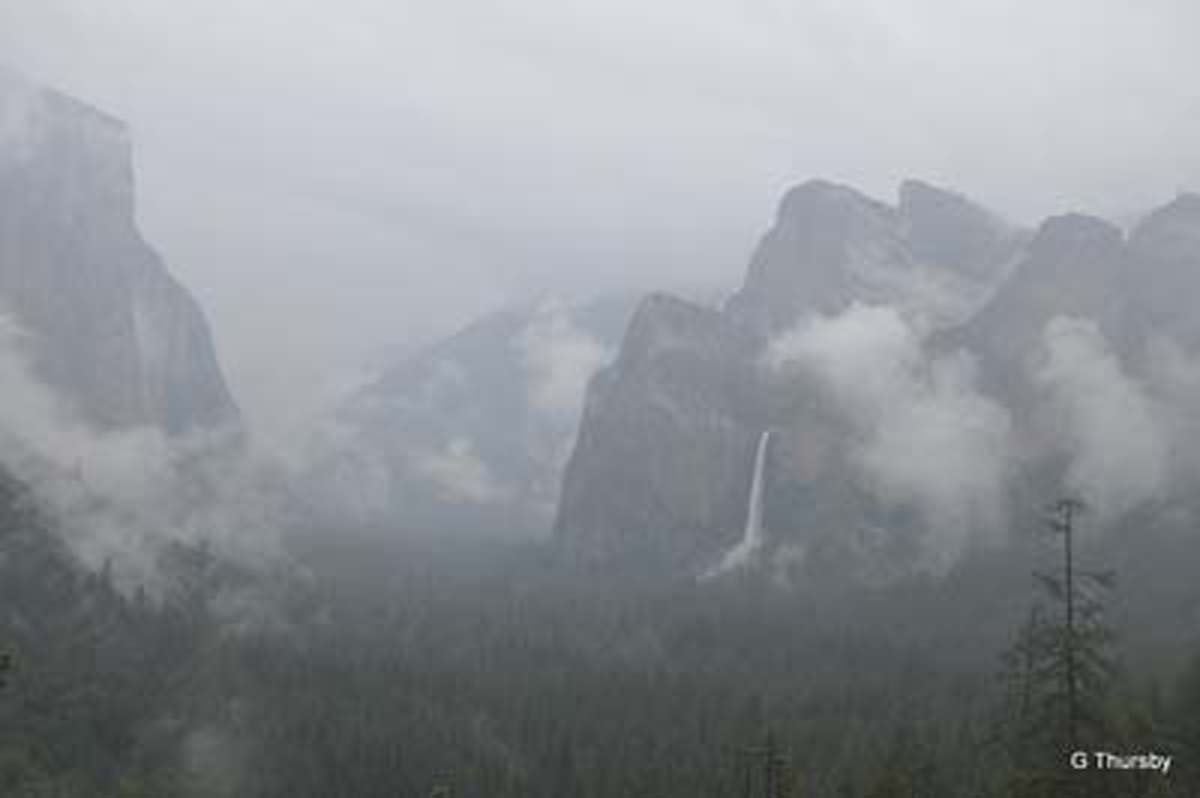
One of my students submitted this photo of Yosemite taken in the fog. His question was, “How I would compose this differently, and how would I deal with the exposure in the fog.”
Well, the first thing I would do is to get the notion that the Rule of Thirds will take your imagery what I refer to as “Up a Notch” out of your mind!!! Check out my past post entitled “The Rule of Thirds is not for everyone“. The essence of that post is that if you want to be a good photographer then by all means follow that rule. However, if you want to be a great photographer forget about that rule.
In my forty-two year career as an Advertising, Corporate, and Editorial photographer, I can honestly say that I’ve never…not once…thought about that rule…why?
Because it’s very hard to generate Tension when you follow that rule. Be sure to look at my photo examples if you go back and read that post.
The most important elements in this photo are the clouds, the mountains, and of course the falls. That being said why show so much sky? In my opinion, you don’t need so much of it because it’s really not doing anything to take your photo “up a notch”. I would have cropped the photo (in the camera ) right above the mountain on the left. The reason is that by doing so, you would be creating Tension two ways: by minimizing the Negative Space between the tip of the mountain and the top edge of the frame, and by placing the mountain close to that edge of the frame.
Also, I would have placed the falls where it could create some Tension as well…anywhere but in the “Rule of Thirds”. I would place it where the viewer would discover it, not where it’s the first thing he sees.. In my classes, I talk a lot about the Psychology of Gestalt. In this theory, it’s important for the visual to become an active participant. One of the ways is to have him keep discovering new things in our photographs. The more he discovers the longer he’ll stick around…isn’t that what we want?????
I love the fog and the clouds. It’s a photo that you don’t see very often, and for that reason alone, it works for me!!! As far as the exposure is concerned, do you ever bracket??? To me, this image is about a stop too dark. When I lightened it everything was brighter without losing the ethereal felling here.
In my online class I teach with the BPSOP, and my “Stretching Your Frame of Mind“workshops I conduct around the planet, we work on the elements of visual design and composition. Tension is a very important one. Use it to your advantage and let everyone else be predictable. Stretch your frame of Mind!!!
Thanks for sharing it with others.
Visit my website at: www.joebaraban.com and follow me on Instagram: www.instagram.com/barabanjoe. Check out my workshop schedule at the top of this blog. Come work on the elements with me sometime.
This is one of my favorite posts to write on. Whether intentionally or just stumbling upon something that either I’ve heard or read in various publications or when I’m searching Social Media looking for ideas to write my posts on.
I would strongly suggest you read “The f64 Group, as it talks about the early careers of some of the most famous photographers there ever was. One of these was Edward Weston. He once said, “Anything that excites me for any reason, I will photograph it.”
When I’m conducting my workshops and walking around with either one or a few students, we are looking for things that have Visual Tension or represents one of the basic elements of Visual Design.
When I see something that sticks out from it’s environment, it’s like a magnet drawing me in with it’s energy. It could be anything, dappled light on a wall, objects that create one of the basic shapes: triangles, squares, circles, and rectangles, or a person about to create the “Decisive Moment”, by altering their surroundings.
My job as their teacher is to point these occurrences out so that they can spend time creating their own POV. I love this part, watching them going about their creative business each one looking for that elusive ‘wall hanger’.
So, my fellow photographers, go out and look for those things that excite you. If it excite you, there’s a very good chance that it will excite others. My only advice is to make sure they know what they’re looking at.
Visit my website at: www.joebaraban.com, and follow me on Instagram: www.instagram.com/barabanjoe. watch for any upcoming workshops. They fill fast so they are not up on my blog for very long.
I realize that it sorta reminds one of a tongue teaser, but take it from me it isn’t.
For those that might be new to my blog, I have been putting out a post every five or six days since 2011. I teach an online class with the BPSOP, and I conduct personal workshops all over this perfectly round planet.
As most of you know, I prefer the challenge of getting it right in the camera with little or no Photoshop/Lightroom help. However, if there’s nothing I can do before clicking the shutter, a.k.a., moving forward, backwards, raising the camera up a little, or down to eliminate or adding an object, then as part of my thought process, and before I click the shutter I will realize what I have to do in post, and I have no qualms about doing it.
Having said that. I want to make sure that what I do, doesn’t look like I did it. So many of my students or even when they’re not, tend to over process their photos to the point of looking like some kind of cartoon. The real problem I face is that when they tell me how much someone loves their image, it’s hard to discourage them from stopping.
The general public basically has no taste and has no idea when something looks garish. It’s a dilemma that I constantly face when working with fellow photographers.
All I can do is to point something out and then rely on their photographic integrity and resolve to rise about any one sided compliments that are coming from family, friends, fellow photo club members and even to go as far as any service animals…”Oh the Horror”!!
All I can say, with years of experience, is that if it ain’t broke, don’t try to fix it. It will take firmness of purpose, and if I’m there to help you down the road of righteousness leading to a better world, you can count on me to supply the backbone you’ll need for those first few steps to photo glory.
WOW, now there’s a mouthful of utter BS!!!!
:-)))))))))))))))))))))))))))))))))))
Bottom line is to take a look at what you’ve done and ask yourself…Do I believe it?
Linda sent me her photo to talk about. here’s what she had to say, as I like to share each photographer’s feelings and situation. I’ve found that many of you out there are in similar situations:
Hi,
I am retired now and am an amateur photographer, always appreciative of positive criticism. I have a Canon Rebel xs and usually use Zoom browser for any post production, I do not have photoshop/lightroom.
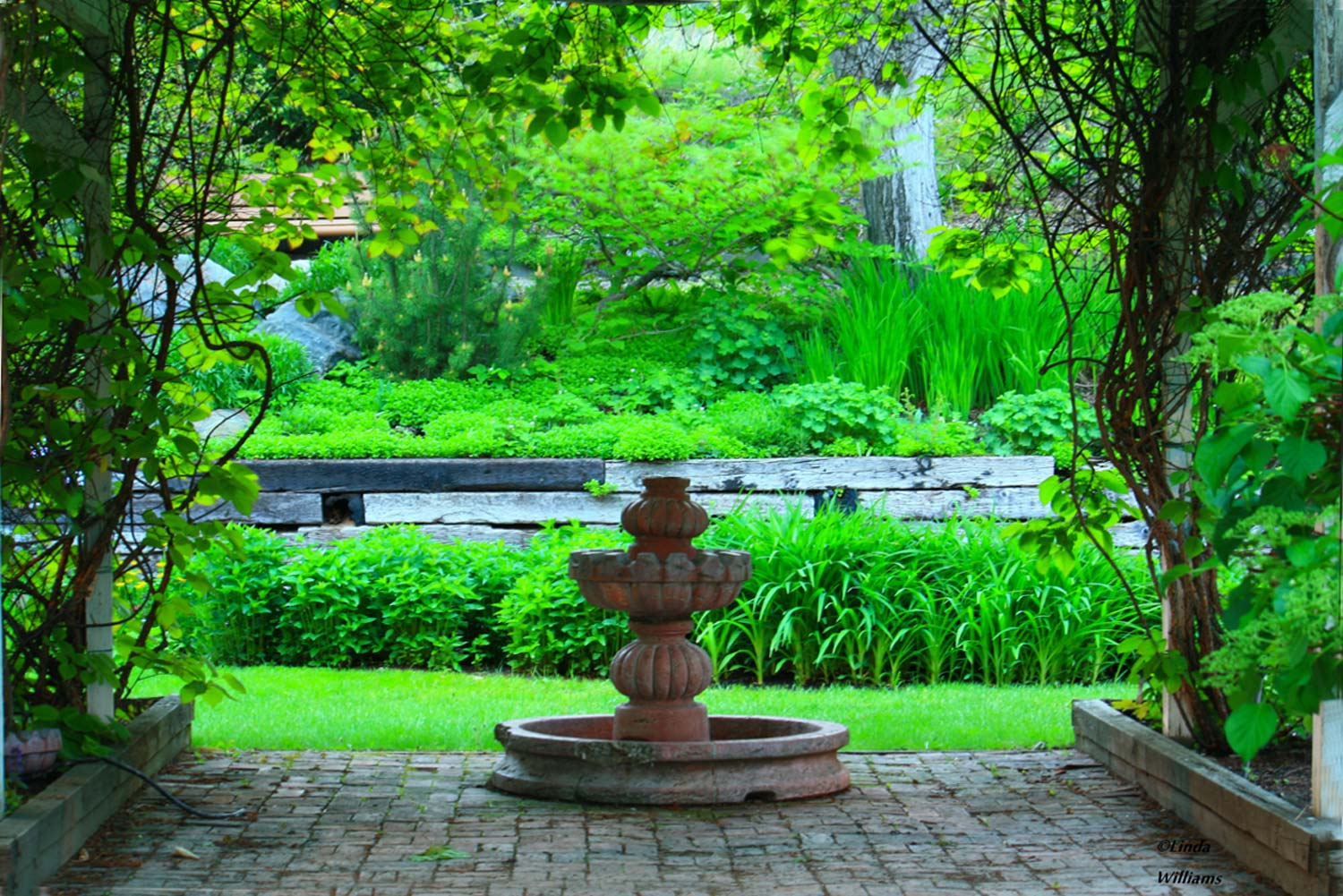
I was out with the local photo club, Kamloops, BC, Canada at the universities horticultural area and came across this beautiful setting, my first thought was the array of vibrant greens with the water fountain in front and wanted to create a window looking into this scene. Although pleased with the colors, I still see blur……even with a tripod.
Linda, first let’s address the issue you have with “blur”. What you have here isn’t an issue with blur, it’s an issue with your aperture settings. If you look at the area that’s in the foreground from the fountain to the camera, it’s all in focus. From the fountain to the implied horizon it’s not as sharp…not blurry, but just not in focus which is a big difference. Your aperture was not closed down enough to get everything in focus. Being on a tripod won’t matter if you don’t have enough depth of field.
If you want everything to be sharp from the foreground to the background, you have to make sure your aperture is stopped down to it’s smallest setting on your lens. If you’re shooting with a wide angle lens, you don’t have to stop down as much as you would with a longer lens. For example, with a lens that has a focal length of 28mm down to let’s say 16mm, F/5.6 will
The next time you’re in a situation like this and you’re on a tripod (which you should be to have complete control), shoot the same picture but with different aperture settings and compare them to each other. You’ll be able to see the difference and make future decisions based on you’re findings.
I would highly recommend setting your focus to manual and then focus about a third of the way in at F/22. That way you have control instead of your camera’s auto-focus function that would focus on the fountain.
Ok, let’s talk about the photo itself:
The first thing I want you to notice is that I straightened your horizon. The strong line above the fountain was going downhill. Line is probably the most important element of visual design, and it’s part of what I teach in my online class with the BPSOP, and in my “Stretching Your Frame of Mind” workshops I conduct around the planet. Without Line, none of the other elements would exist as they all require Lines. You and I wouldn’t exist as we both have an implied outLINE.
Having said that, the most important Line is the horizon line and when I see a photo that has a horizon line that’s not straight, it’s a sign that a novice took it. I can tell by your photo that you haven’t been a novice for a long time…why do I say this? Because you instinctively framed the background with the two posts with the plants growing on them. In my classes we talk a lot about the ways to create Visual Tension, and one of the ways is to frame a subject within a frame. Combining opposites also creates Visual Tension. The hardness of the concrete and the softness of the green area are the contrasting elements.
Color is another element of visual design, and you’ve used color here to communicate an idea….namely the plant life found in this botanical garden. Texture is yet another element found on my “Artist Palette”, and you have lots of it working for you here.
Linda, it’s a much stronger image than you probably thought!!! Thanks for sharing it.
Visit my website at: www.joebaraban and follow me on Instagram: www.instagram.com/barabanjoe. Be sure to check out my workshop schedule at the top of this blog. I still have a spot ope on my next trip to Cuba, see above.
One of my students sent me this photo and as always I like to copy exactly what each photographer had to say. I’ve found that there’s a lot of folks out there that have had similar experiences at one time or another.
Here’s what was said:
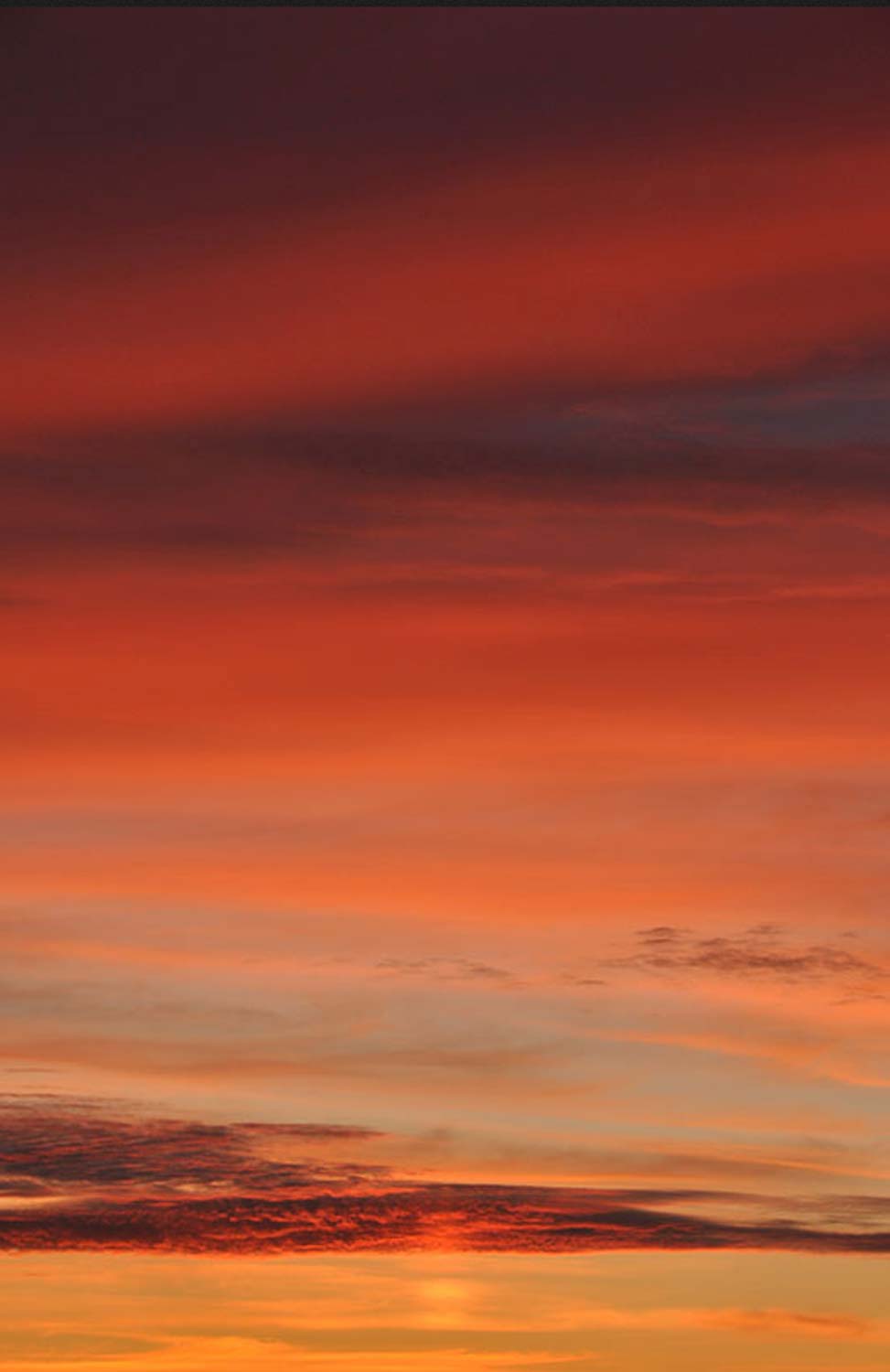
“I wanted to ask you if you thing that the attached picture makes a statement on its own, without any explanation required. It is called “Whatever the Dusk or the Dawn ” because I entered it in a Can Geo photo contest called “Whatever the Weather”.
I took it because I liked the colors and the multiple layers in the sky. I did not want to include the sun or other silhouettes in the frame, because I liked the simplicity of the colors alone.
I find that people don’t have the reaction I expected towards this photo. I believe that they take it as another pretty picture of a sunset that everybody can point and shoot.
This is one of those that does not scream the center of interest at you, but definitely has the visual interest through colors. When I look at it I see an abstract painting on canvas and all kind of other things, but as you say I am not there to tell my story.
Any critique will be appreciated.
Thank you very much.
I immediately wanted to send you a link to an article I read some time ago and have repeatedly show to my BPSOP and in my “Stretching Your Frame of Workshop” I conduct around the planet. It’s called “Giving meaning to photographs”. I think you’ll find it the answer to all your questions.
Remember that you’re not always going to be around to share your thought process or emotions at the time you created your image; it has to stand on its own merit. The feeling you had and the thoughts running through your mind were important to you. Unless the viewer was standing next to you, he can’t sense the same ethereal qualities just by looking at a pretty sky that he might have seen before.
So many times I’ve been driving down the road or walking on the beach and had the pleasure of witnessing a beautiful sunrise or sunset. The first thing I do is to look for anything else I can put in the photo to add what I refer to as a “layer of interest’. If I don’t see something I may shoot anyway just because I’m a photographer and like to take pictures of pretty things. There’s just as much chance as me not shooting it and just standing there smiling while I enjoy the forever fleeting moment.
Reason being that I’ve personally shot a million pretty skies and my files are crowded with them!
If Cuba has ever been on your ‘bucket List’, then now is the time to fulfill your personal desire to experience something that most people can only learn about and look at pictures in the National Geographic Magazine. If you’re subscribed, that is.
Sunrise in Havana
Join me and Nick DePasquale in Cuba next year for a fabulous cultural and educational experience. We are returning to Viñales and Havana in February, and for a different trip Santiago/Baracoa in January – two very different parts of the island not only in landscape but also in history and culture.
National Ballet of Cuba
I just returned from my seventh trip to Cuba. Kip Brundage, no longer with the Santa Fe Workshops, has left to work on his own leads a much smaller intimate groups of seven, making it more enjoyable and a lot less taxing. It’s just the perfect number and this year the group was great.
Dawn patrol in Havana
It is legal and safe to travel to Cuba. A very small group of 7 travelers with local guides, photography instructors, and a private driver will spend about 10 days together visiting locations and meeting people. You do not need to be a photographer to enjoy this trip. In fact, about 50% of the participants take pictures with their smartphone cameras. We will guide you every step of the way from when you register to when you return back to the US.
Small village near Havana
With Sandor who I would call an historian, along with Kip who has been doing these trips for many, many years, the trip takes on a multi-dimensional atmosphere that includes all aspects of the history and culture of the Cuban people.
Kip’s first-class daily schedule both in Viñales and Havana is filled with the sights and sounds of a magical country. It’s why I’m going back for the eighth time.
Dawn patrol in Havana
BTW, the Cuban people love Americans in every respect, and are even happy to welcome you into their homes. If you ever had Cuba on your bucket list, now’s the time to ‘just do it’!!
BTW, my favorite part of the trip is what’s called the “Dawn Patrol”. People that are interested in seeing an entirely different part of Cuban life go out each morning well before the sun comes up, and before the Blue Hour as well. People are up getting ready for the day which lends itself to some amazing photo opportunities.
Viñales/Havana February 2 – 12, 2025: 2 – spots left
Santiago/Baracoa: January 6 – 16, 2025
Email me directly for additional information at: Joe@joebaraban.com
Check out my new workshop on the six concepts in the Psychology of Gestalt: Gestalt Workshop link
As usual, I like to show the original note to me from a fellow photographer so everyone can read it and see what others are thinking. Perhaps some of you will identify with it.
One of my students in my online class with the BPSOP sent me this. I will will often do the same thing in my “Stretching Your Frame of Mind” workshops I teach all over the place.
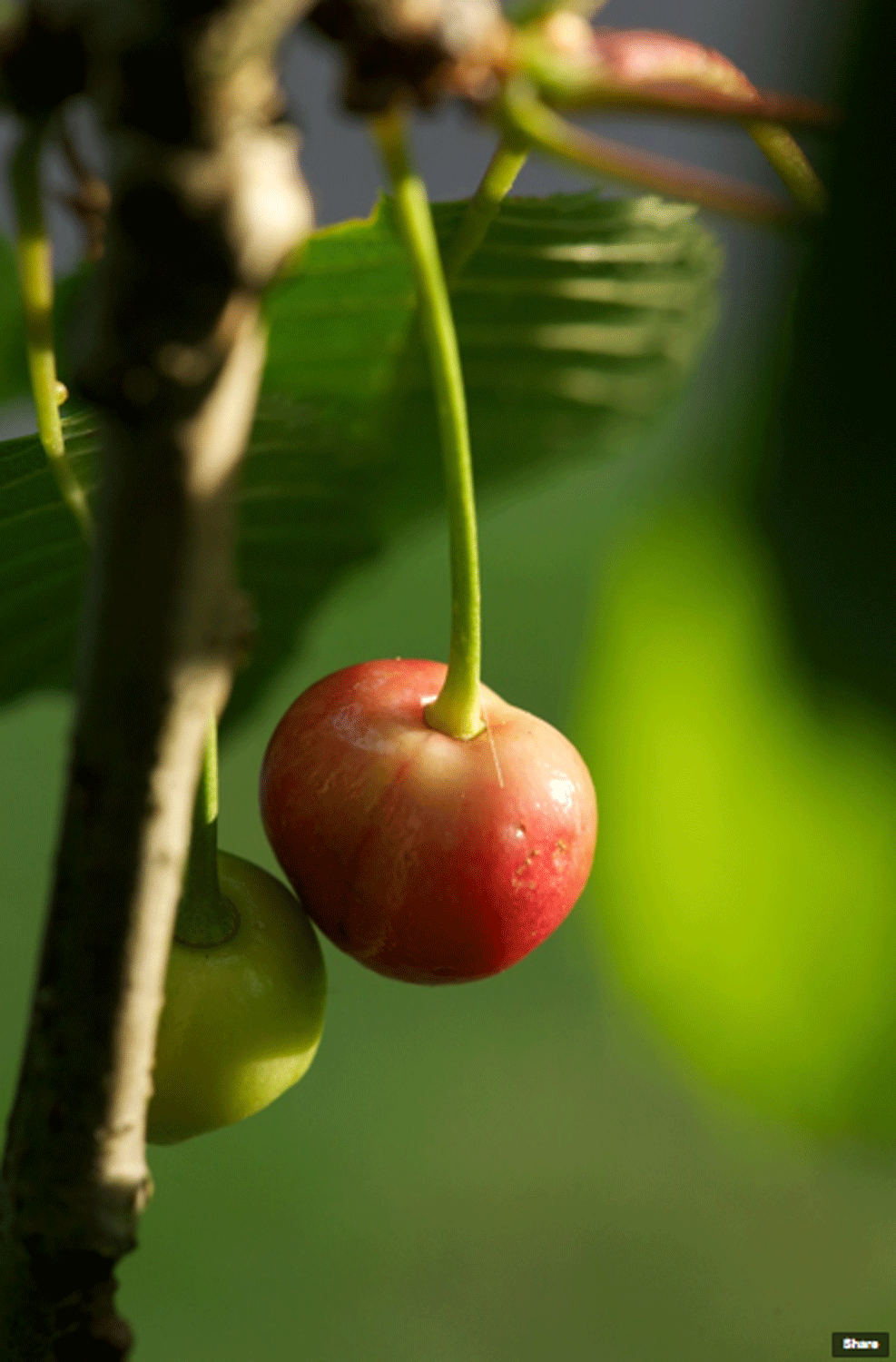
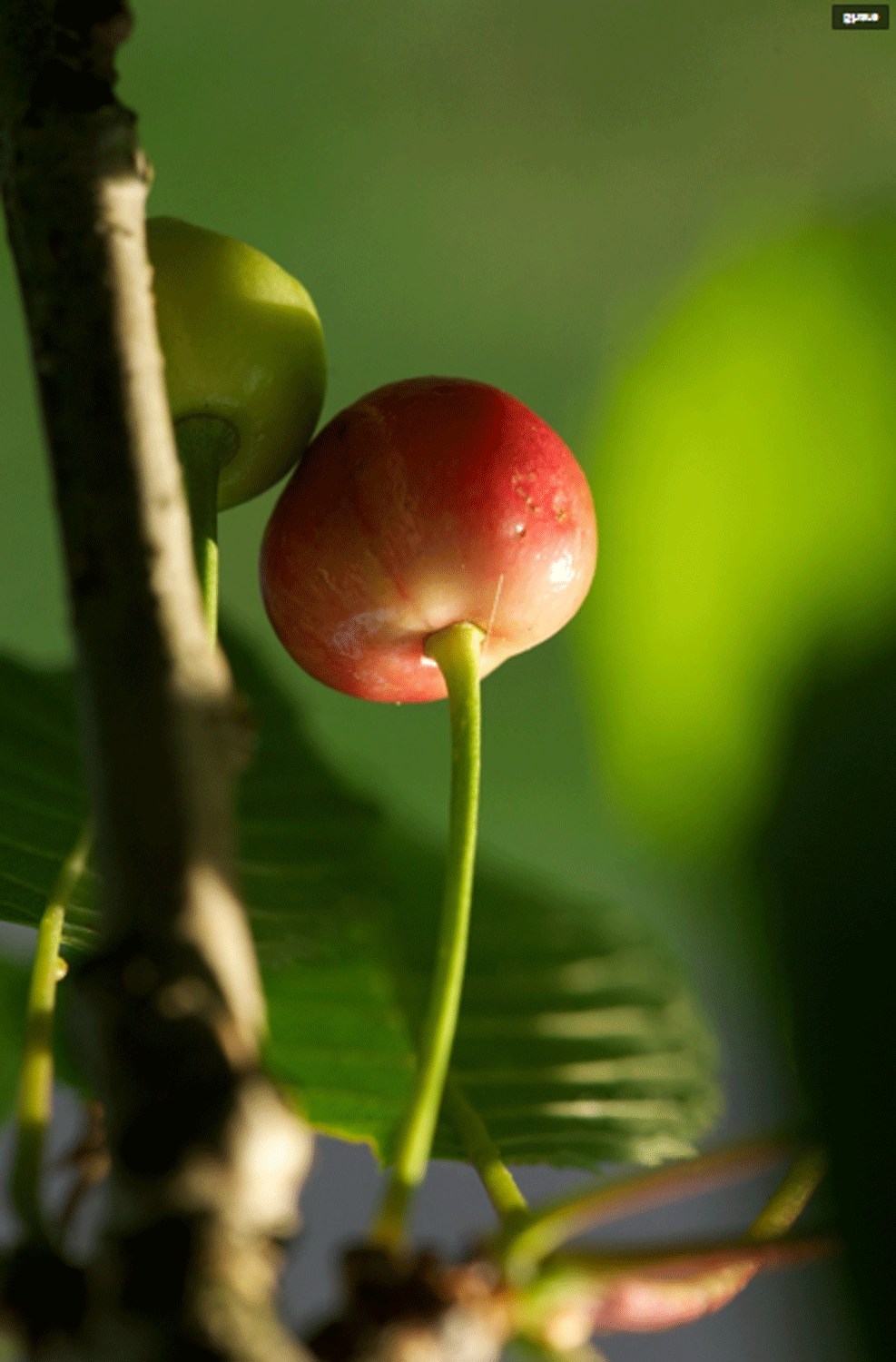
” Joe, I was doing some macro work in the backyard. Actually, I’m photographing for a macro contest and the rules are no flowers and no critters. So I thought the cherry tree would be cool. I was shooting the cherry tree and nothing was speaking to me. About an hour into it, the sun was getting lower and began to strike the tree at a nice angle so I got under and behind these cherries and the light was definitely speaking to me.
I brought the tree branch up from the left corner at a bit of an angle and the DOF seems about right in that just the cherries in focus. I wanted to limit any distractions around the red cherry. The top is too busy. If I were taller and branches weren’t hitting my head I may have been able to cut that business out. It is the light that really excited me. I remember your blog post about the angle of light being behind and at a 45 degree angle. As soon as I saw this I thought…that’s what Joe is talking about! I had taken a few other photos a bit later but the light was just uninteresting. So here you go. Thanks. I look forward to what you have to say.”
Shelle
Shelle, the first thing I wanted to do was to turn it upside down. The reason for this is to show you that it’s not well balanced. When you’re looking at your photos right side up, you’re looking at them with the right side of your brain, the creative side. You see the cherries, the stem, the leaves, etc. When I turn it upside down, you’re now looking at your photo with the left side of your brain, the analytical side. Now, all you see are shapes, the negative space and the positive space. Now it becomes easier to see how well balanced your photo is. Does it look and feel balanced now? To me it looks heavy on the left side with very little on the right to help out.
The dark, out of focus branch on the left is taking away from the delicacy of the cherries. It ‘s also taking the viewer away from what he wants to look at. Be sure to check your DOF preview button, or just look at the back of your camera to make sure that what you put in the foreground is in the proper focus based on your complete composition; because that’s what the viewer will see first.I wrote a post entitled “The Whole Enchilada” where I talked about making sure everything is working, not just what you want as the center of interest. It’s the whole enchilada, it’s the foreground and background that’s as important as your subject.
Nice light, and you’re right about it!!! It appears to be coming from about 3’oclock which would be sidelight. What I said was that I light everything from 9’oclock to 3’oclock, and 11’oclock to 2’oclock being my favorite way to light. Take a look at my post on the “Law of the Light“.
One last thought: To me this is a little overexposed. It’s missing the depth in the colors. I hope you’re bracketing!!!!
Thanks for the post. It gave me fond memories of my youth sitting/eating in the Cherry tree in our backyard. Macro work is not easy, especially when you’re not in a comfortable position. you might try a small step ladder next time.
The definition of psychology is the scientific study of the human mind and its functions.
Keep that in the back of your mind (on the right side, the creative side) when reading this description of the six principals of Gestalt workshop coming your way starting with the meet and greet Thursday, May 30th, 2024. The workshop to be held in Tyngsboro, MA.
Closure
First, let me give you some background information:
In the 1920’s a group of German psychologists, following the lead of their founder Max Wertheimer, developed a group of theories of visual perception they referred to as The Gestalt Principles. These principles made an attempt to describe how people perceive and process visual information when certain concepts are applied.
The origin of the word Gestalt is German/Austrian, and it simply means Shape, Form, or the Whole. It is often stated in this theory that, “The whole is greater than the sum of its parts.” It is this perception that has had the most controversy since the very beginning.
Some experts in the field say that each of the individual parts has meaning on their own. In other words, the whole is not necessarily made up of the sum of its parts, but different than the sum of its parts.
In my opinion, when we use these six Principles in our photography, we’re working with and structuring these parts (pieces of the finished puzzle) if you will) that will eventually make up the whole as in a completed photograph. These parts or elements are the elements of visual design. The elements we work on in my other classes.
The methods we use to gain attention to our photography will vary, but what’s important is how we manage what the viewer perceives and processes when looking at the visual information we lay out to him in the form of a photograph.
Humans rely on perception of the environment that surrounds us. Visual input is a part of our everyday life, and as photographers it’s our prime objective to present this visual information in a way that takes control of what the viewer sees when looking at our imagery.
Law of Common Fate
The more ways we can have the viewer move around our composition, while at the same time leaving and entering it, through the use of these concepts, the longer they will stick around. The more things we can get the viewer to discover while moving around the frame will also keep them around longer. Isn’t that what we want?
To be sure, the whole is important, but the parts that make it up are equally important. These concepts are visual rules (I hate rules) and I agree that once the parts are placed and the composition is framed, the whole does exceed the sum of its parts.
Here are the six principles that we’ll cover through assignments over the course: Closure, Figure-Ground, Continuance, The Law of Common Fate, Similarity, and Proximity.
Proximity
There are a lot of questions out there as to the number of concepts, but the important thing to remember is that these six principles will take our photos to new levels. To me, it’s so important to consider these concepts in our photography. However, I’m not suggesting that the only approach to taking memorable photos is a scientific or even a numerical one. What I’m suggesting is that great images can come when these concepts work in harmony with your photography.
One last thought is that when you look around, Gestalt is everywhere. It exists in our reality, and always has. It’s just that you may not have known the name. What’s important to know is that some of you have been using these principles since the time you were crawling around the floor looking for your pacifier.
For example, the age-old adage of whether the glass is half full or half empty falls under the concept called Figure Ground.
Similarity
This means is that when you show this representation, the half empty, and the half full images each carry the equal weight which creates tension…each threatens to overtake the other. It’s optimism verses pessimism.
I’ll be working with Nick DePasquale, an excellent photographer https://nickdepasqualephotography.com/ who you probably know, will take care of all the logistics and will be available to help with any questions that relate to Lightroom and Photoshop of which he is an expert…it being above my pay grade!!
BTW, Nick teaches a class in both lightroom and Photoshop.
Continuance
Once we have signed up the participants, I will send out links to all six concepts, with examples for you to study. Two weeks before the Meet and Greet, we’ll have a zoom session where we’ll talk about the six concepts, show examples, and answer questions.
At that point I’ll give you the first two concepts to work on and we’ll critique those (six images) the night of the meet and greet over pizza, wine, and beer.
Nick and I will be scouting ahead of time to determine the best places for the group to go to…at the best times. I’ll also pass out the schedule and final locations for the following days.
May 15th:Zoom session to review material show examples and give first assignment.
Meet and Greet: May 30th: @ 6PM Critique of six images with wine, pizza, and beer.
Friday, May 31st: We’ll be spending the day in Boston including sunset and the Blue Hour and will not be spending our time around the Fan Pier area.
Saturday, June 1st: We’ll have an extended critique in the morning and will spend the afternoon through sunset and Blue Hour at a place TBD.
Sunday, June 2nd: We’ll shoot in the morning, and the workshop will end at three.
Wednesday June 12th: Zoom session final critique.
The price of the workshop is $750.00…which will include three days of shooting, two Zoom classes, the meet and greet dinner and critique.
All the photographers who want to bring someone to the locations are welcome to, except for the critiques and meet and greet.
If interested, contact me at: joe@joebaraban.com
For those that have taken one or more of my workshops, you know that I run a professional in-depth learning experience. For those of you that haven’t, you can view my work at www.joebaraban.com and read just a few of my testimonials from some of my full eight-day workshops:
Alain
I recently completed my third workshop with Joe Baraban, and all I can say is that I will be coming back for more. All aspects of the workshop were fantastic. Joe’s approach to teaching, the shooting locations, the daily reviews, the accommodations, the planning and organization, and the communications were all at the highest level.
From the “meet and greet” reception the first night, to the final dinner, Joe paid strict attention to every detail to make sure we were well taken care of…all the time. Joe’s selection of locations is always diverse and challenging and present many, many opportunities for great shots and learning.
The daily reviews are a wonderful educational experience as you discuss your own work as well as the work of the other photographers. Joe teaches how to “make pictures”, not just take them. The quality and creativity in my images continue to ratchet up a notch with every workshop as I continue to learn from Joe.
I highly recommend Joe’s workshops and online classes.
John B
I wanted to learn more about Joe’s approach to visual design and making great photos after taking one of his online courses. As a former painter, I really relate to his focus on visual design elements as his artist’s palate and it all came to life in this workshop.
He is an excellent teacher, and it was wonderful to experience this with a group of very talented photographers who supported each other and did some great work. The format of learning the design principles and discussing them in relation to Joe’s images and the work from the class was a great way to learn – I look forward to future workshops.
Mary
They are absolutely second to none in that every detail is thoroughly covered and no costs are spared. Favorable locations are researched and scouted well in advance. Top notch accommodations and transportation are pre-arranged. Morning class and critiques are thought provoking, inspiring, and collaborative.
There is ample opportunity to share ideas, ask questions and discuss techniques. Students can learn not only from their own image critiques but also from their fellow photographers. Joe really wants to see his students grow.
This is quite evident in the dedication that he generously provides to each student. It must not go without mentioning that Joe has a following and it’s always wonderful to see everyone again from around the globe. We always have a great (and challenging) workshop together and inevitably walk away with lots of good images, tips, tricks … and of course stories. 🙂
I hope this has sparked an interest as this is the first time I have done an actual workshop just on the six concepts in Gestalt. It will offer those of you a great learning experience, promising to take your level of photographic awareness up a level…if not two or three, four, etc., etc.
This class will be limited to ten photographers. Your spouses, partners, or significant others, etc. are welcome to come to all the locations.
If you’re interested, I suggest you sign up sooner rather than later because as I said, there’s just nine spots opened now, as a woman I’m mentoring has already taken a spot.
I just love thinking back over my forty-three year career to all the funny things that happened during some of my shoots, and I gotta tell you that there were so many that are repeatable and some not so much!!!
If you’ve taken my online class with the BPSOP, or my “Stretching Your Frame of Mind” workshops I conduct around the planet, you’ve probably hard some of the ones I wouldn’t repeat to just anyone.
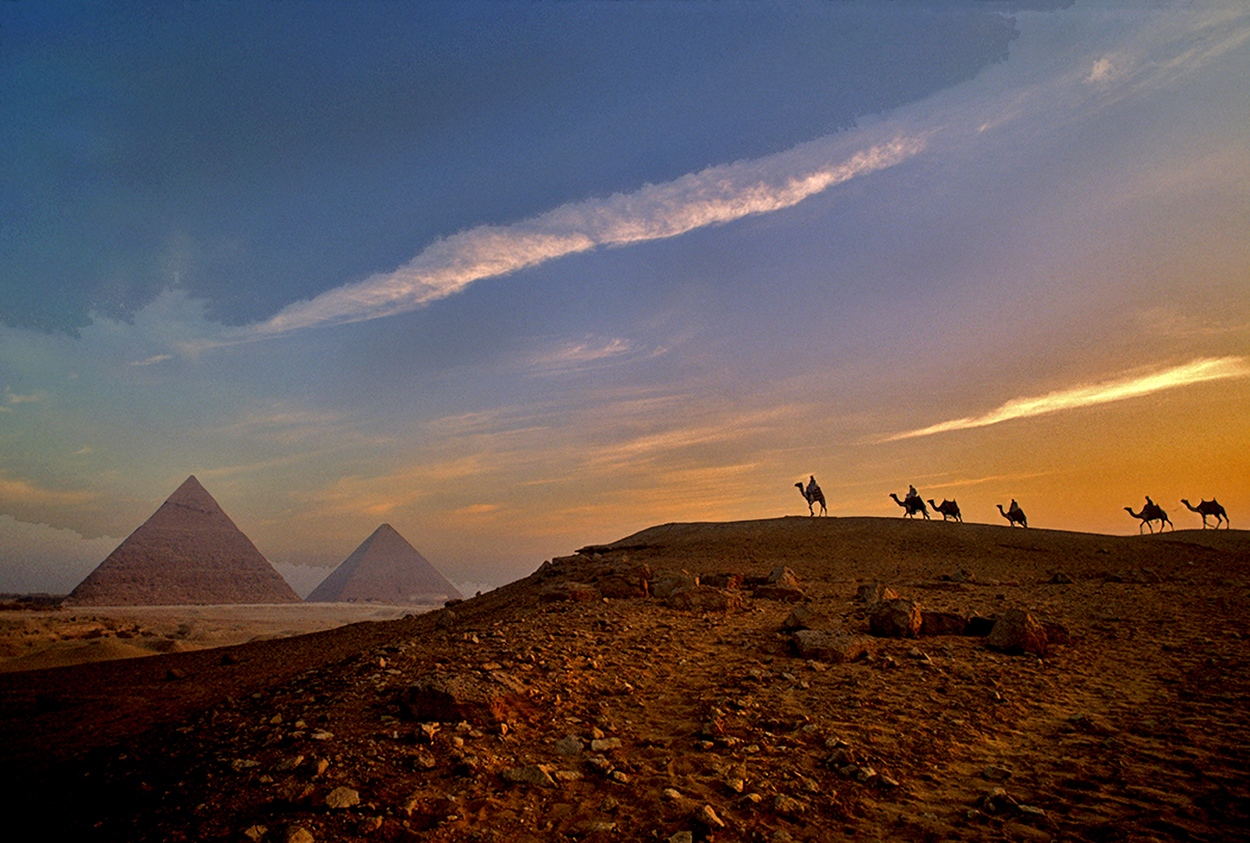
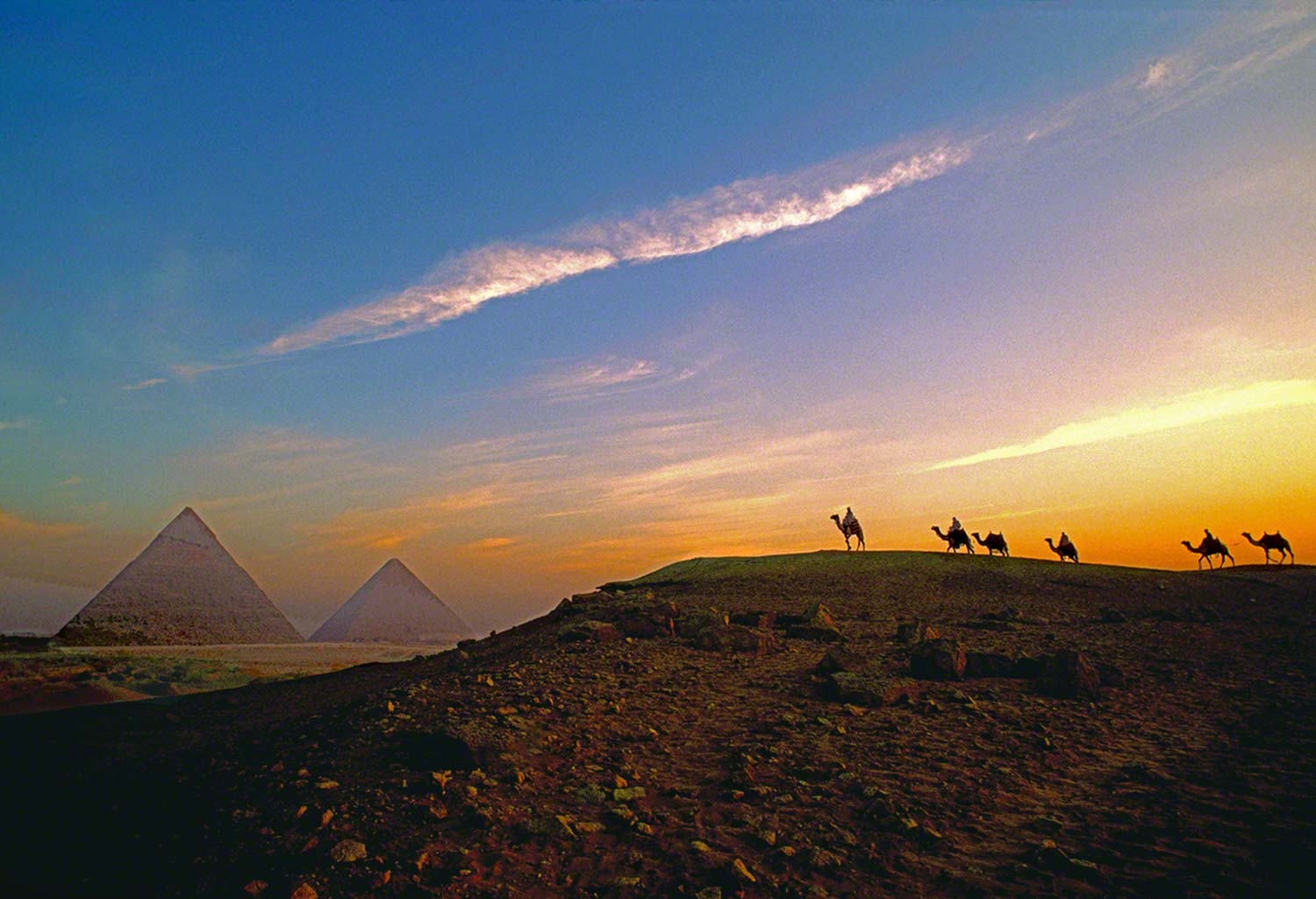
Years ago, one of the craziest projects I worked on was for Apache Oil and Gas Annual Report. They were in the process of partnering up with the Egyptian government to start drilling there, so they sent me over to photograph whatever I wanted provided it said something about the country and it’s history. What a great assignment. For a week, I basically had Carte blanche, backed by whatever expenses I saw fit to use in order to get the shot I wanted. As the above photo will show, Egypt is dripping with history.
The day before the above shoot, we were scouting locations to find a sunrise location where I could position the camel caravan I had just hired. We were scouting on camels, so when we found the right spot and returned to the stables I made a point in saying that it was going to be the very last time I would ever get on a smelly, dirty, obstinate, and very uncomfortable camel.
Before sunrise of the morning of the shoot, we headed out but this time the designer, my assistant and I were on Arabian Stallions instead of camels. Wow, what a difference!!! After a great morning shoot, we headed back racing down the huge sands dunes with the Pyramids of Giza looking right at us. It was a Cecil B. DeMille moment and one I’ll always remember.
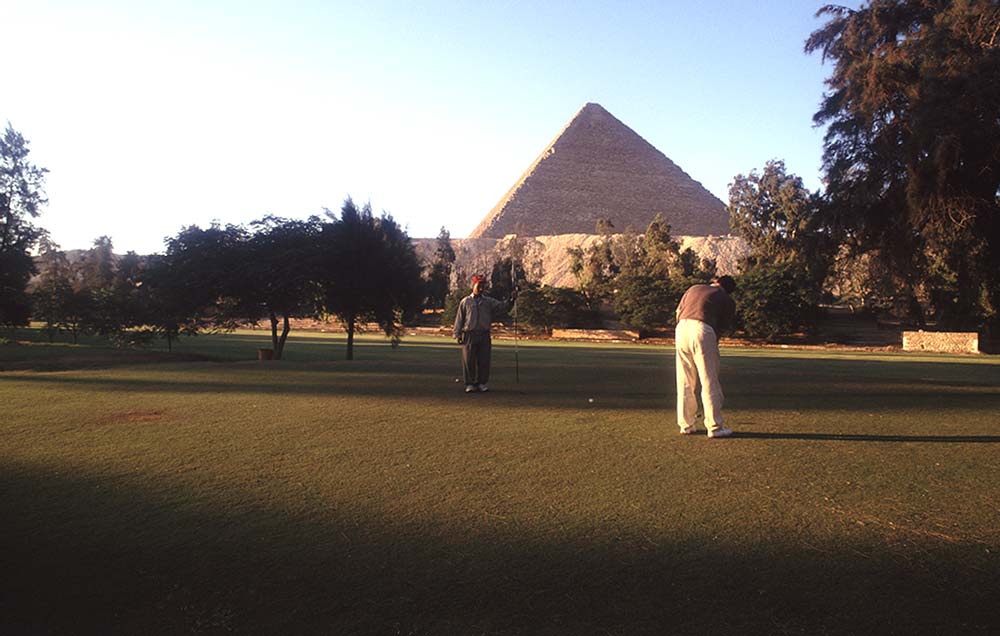
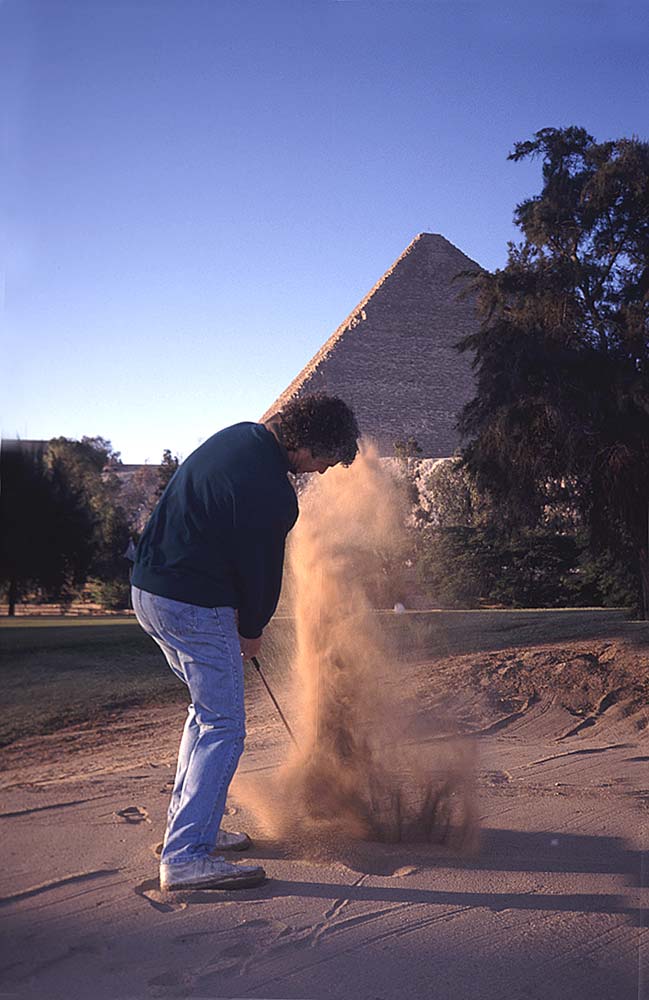
Ok, now for the funny part: For those of you out there that have never seen the pyramids, let me tell you that they’re not out in the desert; quite the contrary. Much to my surprise they’re just on the edge of Cairo, with a resort hotel and casino across the street ((actually where we stayed), a shopping center on one side where you could buy pyramid thermometers, and a golf course on the other.
Hard to believe? Well two photos are worth two thousand words. Here’s one with the client putting on a green ( with a caddy possibly a descendant from Pharaoh himself ) and the other is yours truly hitting out of the largest sand trap in the world!!!
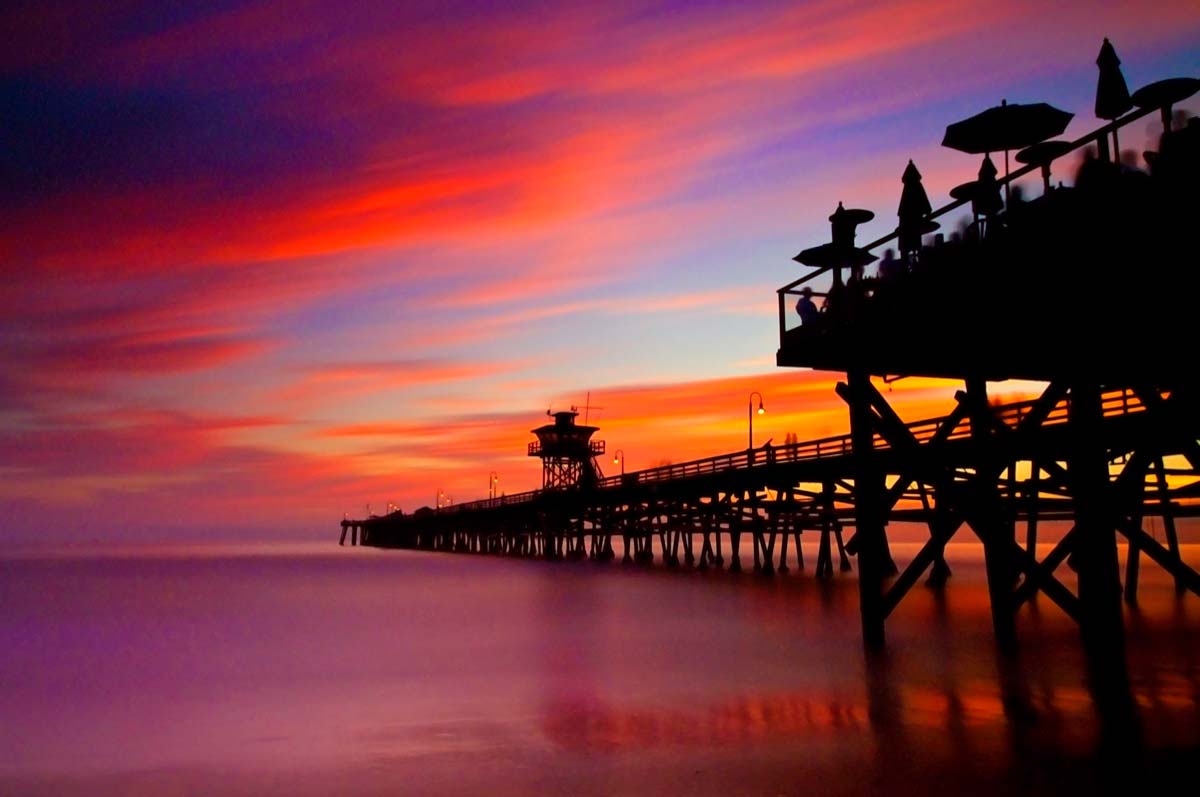
Valeriano submitted this remarkable photo and asked what I thought of it. Here is what he said when I asked him to explain what he did:
“Hi Joe,
The exposure was 4 minutes (I have used a 10 stops ND filter and a 2 stops ND Grad to hold back the sky).
I knew the pier would have been a silhouette and I wanted to catch the muted colors of the last rays of sun at sunset. Also I have chosen to go for such a long exposure in order to get the ocean really calm an some movement in the clouds, juxtaposing it to the fixed figure of the pier structure. What do you think?”
OK, I have to preface my answer to him by saying that Valeriano was an online student of mine with the BPSOP. With both my online class and my “Stretching Your Frame of Mind” workshop I conduct around the planet, I teach people how to use the elements of visual design and composition to take their photography what I refer to as “Up a Notch”. We also work on color as a way to communicate ideas and light as the single most important element found on my Artist Palette.
In Valeriano’s photo, he has used his new Artist Palette to create a wonderful photo; a photo that will be remembered. His use of Negative Space to define the posts in the water, the railing on the pier, and the people and umbrellas was no accident. We start working on Negative Space in the first week since it’s so important to strike a balance between the Negative and Positive Space. Valeriano knew exactly what he was doing!!!
In the second week of my online class, we work on using Vanishing Points to lead the viewer around the frame, as well as to the horizon. Valeriano, by placing himself where he did, created a wonderful Vanishing Point, and as you can see, it’s a wonderful way to keep the viewer an active participant in our photography. When we do that, he’ll stick around longer, and that’s exactly what we want him to do.
By framing the way he did, he created “layers of interest” by anchoring the sitting area in the foreground. This is also what we work on..Perspective and depth. His use of a silhouette is something we spend an entire week on in my BPSOP part II class
If I could do anything, I would have asked if I could open all the umbrellas and create a pattern with them using Negative Space to define each one…we also work on Patterns (an element of visual design) as well.
It takes a lot of work and thinking to create a photo like this, and Valeriano should be proud of his accomplishment.
Thanks for the submission, I enjoyed looking at it.
Visit my website at: www.joebaraban.com and follow me on Instagram: www.instagram.com/barabanjoe come shoot with me sometime. You’ll walk away with your own Artist Palette as a souvenir of your experience.
In my online class with the BPSOP and in my “Stretching Your Frame of Mind” workshops I conduct around the planet, we work on ways to take my students photos what I refer to as “up a notch”. So many of my students try to put way tooooooooooo information into one photograph.For some reason they think that the more elements they can stuff into their composition, it stands to reason that the better the photograph will turn out.
They believe in the old adage that “if more’s better, then too much is just right”. While that’s one of my favorite (unspoken) personal pearls of wisdom and I’m a firm believer in it, I have to draw the line when it comes to photography.
In my younger days when my medium of choice was a paintbrush, I would start out with a blank canvas on an easel and proceed to fill it in until I had the desired painting. Now, I start out with a camera on a tripod and everything is in the viewfinder. I have to keep subtracting elements until I have what I think is a finished photo. That’s why they call photography “The art of Subtraction”.
You don’t want to clutter up your frame with elements that the viewer would have a hard time understanding; especially when they’re completely un-related. Just because you know what it is does not mean that everyone else will. You won’t be around to explain what you were thinking to people looking at your photos, so they need to stand on their own…unless it was meant to be an abstract and you wanted the viewer to decide for himself what exactly it is that he’s looking at.
Strive for balance and simplicity. Use the Negative Space along with the Positive Space. The Negative Space being anything that doesn’t have mass. The space around your subject that defines it can be as important as putting in another elements for the sake of adding just one more thing that (you think) will improve your photo.
What you don’t put into a photo can be a lot more revealing than what you do put in.
I want to announce my next workshop “Autumn in France” to be next October 2nd. It will be in Bordeaux, Dordogne, and Toulouse. If you go to the top of my blog and click on the link, you can read the description. Join me for a great visual experience, seeing places that few people won’t ever be able to.
Of all the genres in photography, I personally think that street shooting offers the hardest challenge, kids and animals run a very close second…..why? Because “like a box of chocolates you never know what you’re going to get”….while shooting any of the above.
Landscape, portraiture, food, are three areas that immediately come to mind that gives you time to think ahead of time about your photo. You have the luxury of finding the location, looking for the best light, and as far as food photography you have total control in the studio.
When I’m walking the streets with any of my fellow photographers that are taking my “Stretching Your Frame of Mind” workshops, I’m basically looking for light. If I can find the light, chances are pretty good that I will find a shot somewhere in it.
I have had other photographers that take my online class with the BPSOP submit photos that lack visual interest and can’t stand the test of time. For example, a photo that’s showing someone talking on a phone leaning against a corner with a cigarette hanging out one side of the mouth is not going to stand the test of time; unless something extraordinary is happening. How about all those photos that show homeless people eating, begging, or sleeping on the sidewalk?
Having said that, when you do find some light…light that’s worthy of spending some time with, it’s important to find a comfortable spot and wait for some action; just the way Henri Cartier-Bresson did.
When you do see something or someone approaching the light you have settled in on, don’t be in a hurry to bring the camera up to your eye. Too many times I have seen a photographer do just that only to have the subject veer off. Sometimes it’s either because they’re polite and don’t want to “photobomb” your shot, or they just don’t want to be photographed.
It’s important (and hard to do) to wait for it...wait until the very last minute to bring up your camera.
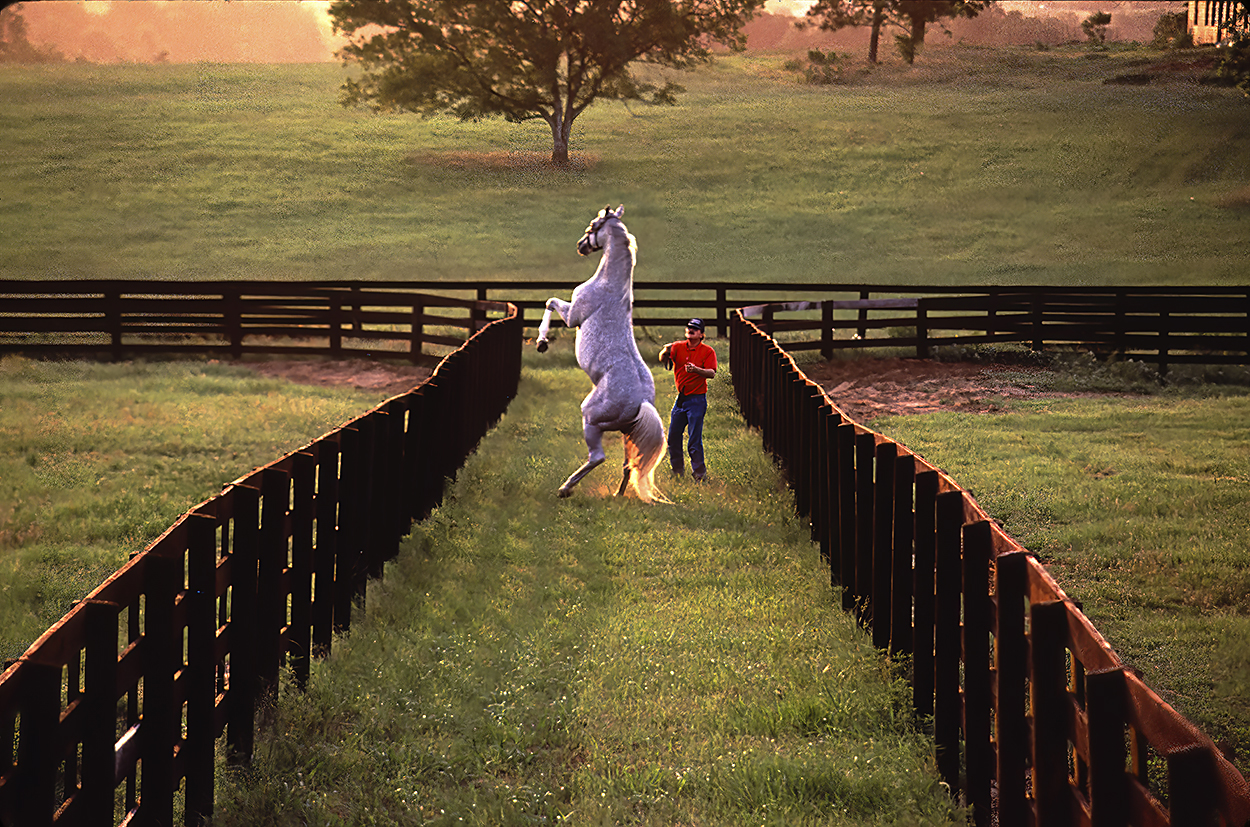
In the above image I fired off several exposures of the spot I wanted the horse and trainer to be in to get the exposure down, knowing I would probably get off one shot if something happened.
Well, the waiting paid off. Not only did I get the horse in the light, but I was lucky enough to have her rearing up on her hind legs….right in the middle of the fences.
Visit my website at: www.joebaraban.com, and check out my workshop schedule at the top of this blog. Come shoot with me sometime.
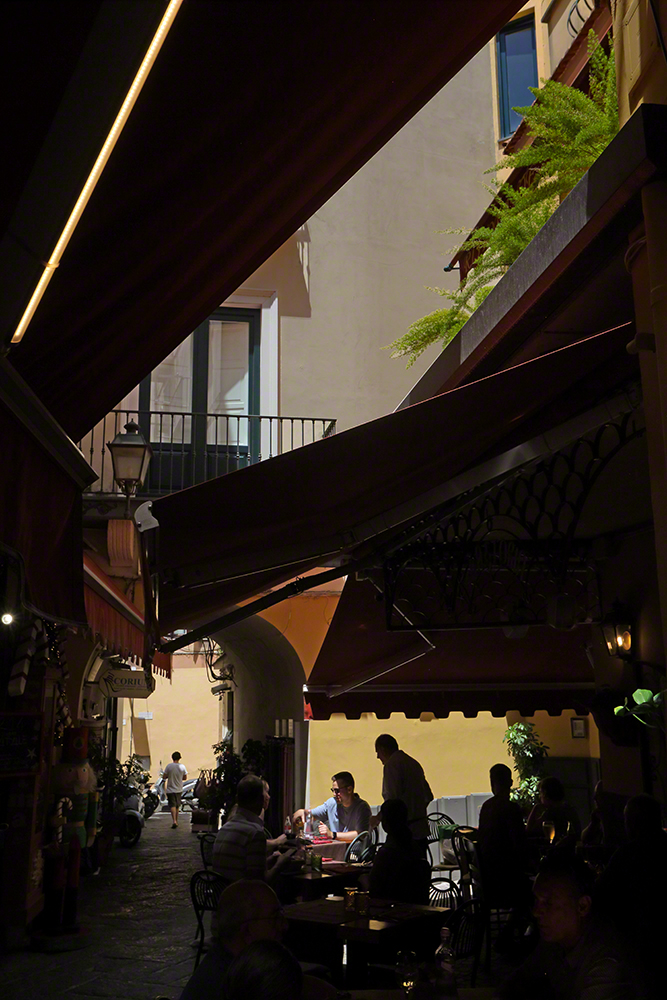
While waiting to order, I saw this and got excited.
I want to announce my next workshop “Autumn in France” to be next October 2nd. It will be in Bordeaux, Dordogne, and Toulouse. If you go to the top of my blog and click on the link, you can read the description. Join me for a great visual experience, seeing places that few people won’t ever be able to.
He once said, “Anything that excites me for any reason, I will photograph”. I often quote him to my online classes with the BPSOP, and also in my “Stretching Your Frame of Mind” workshops I conduct all over the place.
Of course that quote is predicated on the assumption that you have a camera somewhere on your body. If I’m walking around with my class in one of my workshops, I’ll have a Canon 5DMarkIII over my shoulder and my little Panasonic DMC-LX5.
If I’m by myself at home I Houston, then I always have my Lumix with me…why, you ask?
Because there’s so much that excites me out there, and I’m always seeing and thinking with the right side of my brain…the creative side.
That’s not to say that everything I shoot is a wall hanger. If I’m lucky, one out of fifty would be worth considering. It’s that one that I’m after, and at this point in my career it’s extremely elusive.
As I tell my fellow photographers, my mantra, is “more shots per hour.” For those of you coming from the film days, unless you had a client paying for your film and processing, photography was an expensive hobby.
For those of you that have fallen in love with photography in the digital age, film is cheap, as in those cards you stick in your camera giving you an endless amount of exposures. The more you shoot, the greater the chances in going home with that ‘wall hanger’.
So, that being said, if it excites you in any way, shoot it. You can always delete later if it’s one of those photos that winds up on the “cutting room floor”.
Visit my website at www.joebaraban.com, and follow me on Instagram. Look for upcoming workshops at the top of this blog. Come shoot with me sometime.
I want to announce my next workshop “Autumn in France” to be next October 2nd. It will be in Bordeaux, Dordogne, and Toulouse. If you go to the top of my blog and click on the link, you can read the description. Join me for a great visual experience, seeing places that few people won’t ever be able to.
In my never ending quest to show my fellow photographers that take my online classes with the BPSOP, or in my “Stretching Your Frame of Mind” workshops I conduct around the planet, what it was like way back when when Adobe was a type of house in the Southwest part of the country, and Lightroom referred to a room that was light. I present to you and them another in my series “Life Before Photoshop”.
It was tough times, although no one really knew it. It was just SOP (standard operating procedure) to create photos in the camera. I guess I’m lucky in that respect since I had a pretty good imagination, loved to solve problems, and was extremely savvy as far as the ‘light’ was concerned.
I often wonder what my work would have looked like had Photoshop and Lightroom were around. I can tell you that I’m sooooo glad they weren’t. The reason…because everyone could take really good photos with that kind of help, and as a result I just might have been lost in the shuffle…maybe!!!!!
🙁
That said, I love the fact that it’s around now because I tweak all my photo to a small degree…why not? However, I get as much in the camera as I can since I still after all these forty-four years of shooting still love the challenge. I still love the notion that I’m a good photographer because I use very little to no help after the fact.
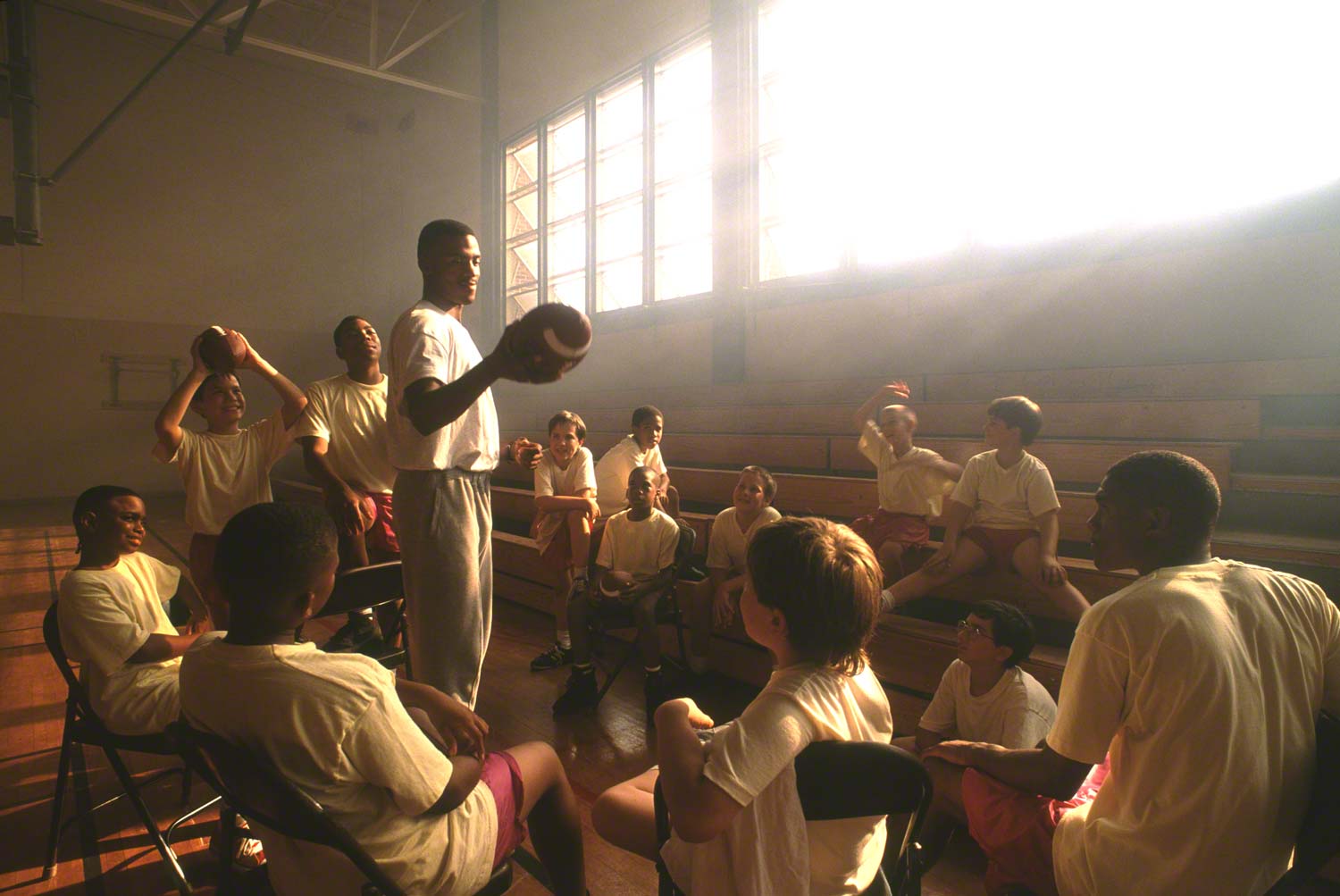
In the above photo, I was shooting an ad for Toyota. It was a mentoring program they had going where they used well known athletes to mentor kids that aspired to be like them; in this case high school football players.
The big problem to be solved was to get a good exposure on not only the college quarterback but on each one of the kids; no easy task without post processing since there were so many kids to direct. There were also too many first names to remember so I assigned each of the boys a number starting from left to right. The kid on the far left was number one…and so on. Looking through my viewfinder, I directed each boy separately by calling out his number.
So, as you can see, none of the boys are covering up each other, and each boy’s head is positioned in such a way as to get the maximum light on his face…using the white T-shirts to bounce light.
Visit my website at: www.joebaraban.com, and follow me on Instagram. Be sure to check out my workshop schedule at the top of this blog. Come shoot with me sometime.
 One of my students submitted this photo of Yosemite taken in the fog. His question was, “How I would compose this differently, and how would I deal with the exposure in the fog.”