AskJoeB:Four Minute Exposure

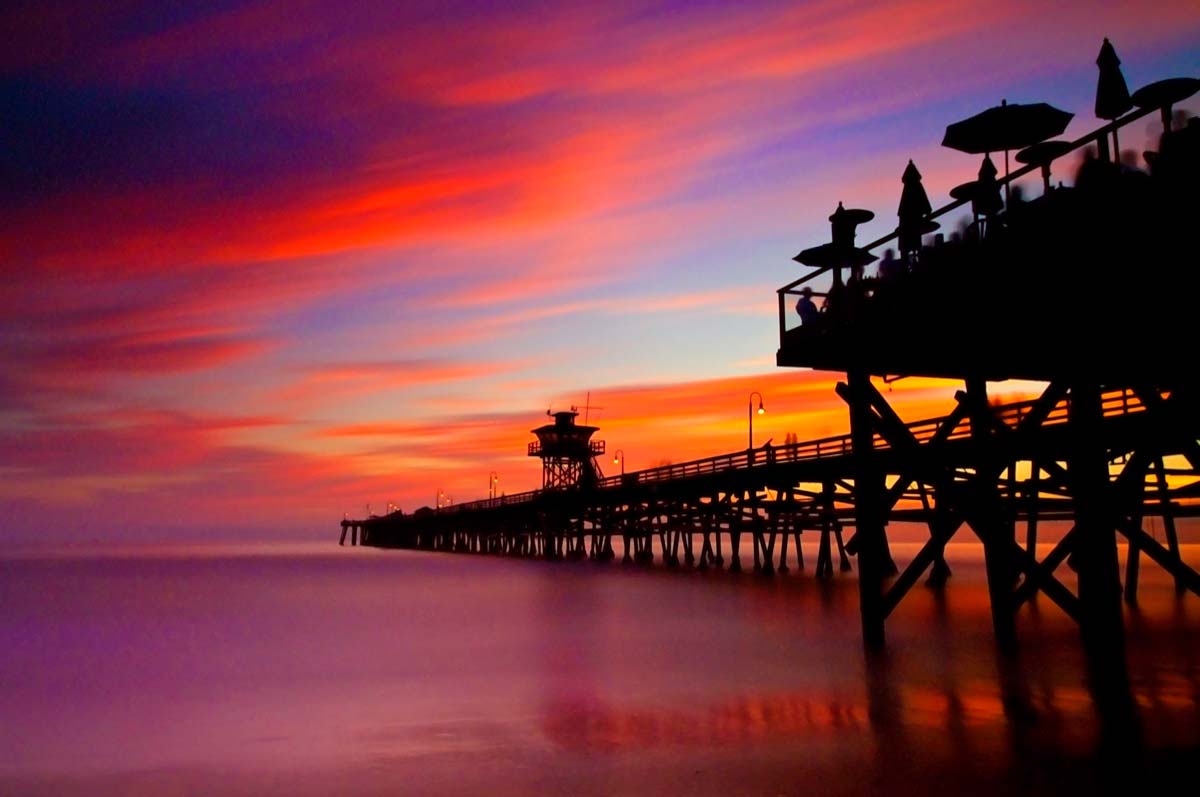
So many elements from her Artist Palette.

Valeriano submitted this remarkable photo and asked what I thought of it.  Here is what he said when I asked him to explain what he did:

“Hi Joe,

The exposure was 4 minutes (I have used a 10 stops ND filter and a 2 stops ND Grad to hold back the sky).

I knew the pier would have been a silhouette and I wanted to catch the muted colors of the last rays of sun at sunset. Also I have chosen to go for such a long exposure in order to get the ocean really calm an some movement in the clouds, juxtaposing it to the fixed figure of the pier structure. What do you think?”

OK, I have to preface my answer to him by saying that Valeriano was an online student of mine with the BPSOP. With both my online class and my “Stretching Your Frame of Mind” workshop I conduct around the planet, I teach people how to use the elements of visual design and composition to take their photography what I refer to as “Up a Notch”. We also work on color as a way to communicate ideas and light as the single most important element found on my Artist Palette.

In Valeriano’s photo, he has used his new Artist Palette to create a wonderful photo; a photo that will be remembered. His use of Negative Space to define the posts in the water, the railing on the pier, and the people and umbrellas was no accident. We start working on Negative Space in the first week since it’s so important to strike a balance between the Negative and Positive Space. Valeriano knew exactly what he was doing!!!

In the second week of my online class, we work on using Vanishing Points to lead the viewer around the frame, as well as to the horizon. Valeriano, by placing himself where he did, created a wonderful Vanishing Point, and as you can see, it’s a wonderful way to keep the viewer an active participant in our photography. When we do that, he’ll stick around longer, and that’s exactly what we want him to do.

By framing the way he did, he created “layers of interest” by anchoring the sitting area in the foreground. This is also what we work on..Perspective and depth. His use of a silhouette is something we spend an entire week on in my BPSOP part II class

If I could do anything, I would have asked if I could open all the umbrellas and create a pattern with them using Negative Space to define each one…we also work on Patterns (an element of visual design) as well.

It takes a lot of work and thinking to create a photo like this, and Valeriano should be proud of his accomplishment.

Thanks for the submission, I enjoyed looking at it.

Visit my website at: www.joebaraban.com and follow me on Instagram: www.instagram.com/barabanjoe come shoot with me sometime. You’ll walk away with your own Artist Palette as a souvenir of your experience.

JoeB

Personal Pearls Of Wisdom: Ok, Let’s Keep It Clean.

Keeping it clean.

In my online class with the BPSOP and in my “Stretching Your Frame of Mind” workshops I conduct around the planet, we work on ways to take my students photos what I refer to as “up a notch”. So many of my students try to put way tooooooooooo information into one photograph.For some reason they think that the more elements they can stuff into their composition, it stands to reason that the better the photograph will turn out.

They believe in the old adage that “if more’s better, then too much is just right”. While that’s one of my favorite (unspoken) personal pearls of wisdom and I’m a firm believer in it, I have to draw the line when it comes to photography.

In my younger days when my medium of choice was a paintbrush, I would start out with a blank canvas on an easel and proceed to fill it in until I had the desired painting. Now, I start out with a camera on a tripod and everything is in the viewfinder. I have to keep subtracting elements until I have what I think is a finished photo.  That’s why they call photography “The art of Subtraction”.

You don’t want to clutter up your frame with elements that the viewer would have a hard time understanding; especially when they’re completely un-related. Just because you know what it is does not mean that everyone else will. You won’t be around to explain what you were thinking to people looking at your photos, so they need to stand on their own…unless it was meant to be an abstract and you wanted the viewer to decide for himself what exactly  it is that he’s looking at.

Strive for balance and simplicity. Use the Negative Space along with the Positive Space. The Negative Space being anything that doesn’t have mass. The space around your subject that defines it can be as important as putting in another elements for the sake of adding just one more thing that (you think) will improve your photo.

What you don’t put into a photo can be a lot more revealing than what you do put in.

Visit my website at: www.joebaraban.com and follow me on Instagram www.instagram.com/barabanjoc. Check out my workshop schedule at the top of this blog. Come shoot with me sometime.

JoeB

Quick Photo Tip: Wait For It

I waited for it.

I want to announce my next workshop “Autumn in France” to be next October 2nd. It will be in Bordeaux, Dordogne, and Toulouse. If you go to the top of my blog and click on the link, you can read the description. Join me for a great visual experience, seeing places that few people won’t ever be able to.

Of all the genres in photography, I personally think that street shooting offers the hardest challenge, kids and animals run  a very close second…..why? Because “like a box of chocolates you never know what you’re going to get”….while shooting any of the above.

Landscape, portraiture, food, are three areas that immediately come to mind that gives you time to think ahead of time about your photo. You have the luxury of finding the location, looking for the best light, and as far as food photography you have total control in the studio.

When I’m walking the streets with any of my fellow photographers that are taking my “Stretching Your Frame of Mind” workshops, I’m basically looking for light. If I can find the light, chances are pretty good that I will find a shot somewhere in it.

I have had other photographers that take my online class with the BPSOP submit photos that lack visual interest and can’t stand the test of time. For example, a photo that’s showing someone talking on a phone leaning against a corner with a cigarette hanging out one side of the mouth is not going to stand the test of time; unless something extraordinary is happening. How about all those photos that show homeless people eating, begging, or sleeping on the sidewalk?

Having said that, when you do find some light…light that’s worthy of spending some time with, it’s important to find a comfortable spot and wait for some action; just the way Henri Cartier-Bresson did.

When you do see something or someone approaching the light you have settled in on, don’t be in a hurry to bring the camera up to your eye. Too many times I have seen a photographer do just that only to have the subject veer off. Sometimes it’s either because they’re polite and  don’t want to “photobomb” your shot, or they just don’t want to be photographed.

It’s important (and hard to do) to wait for it...wait until the very last minute to bring up your camera.

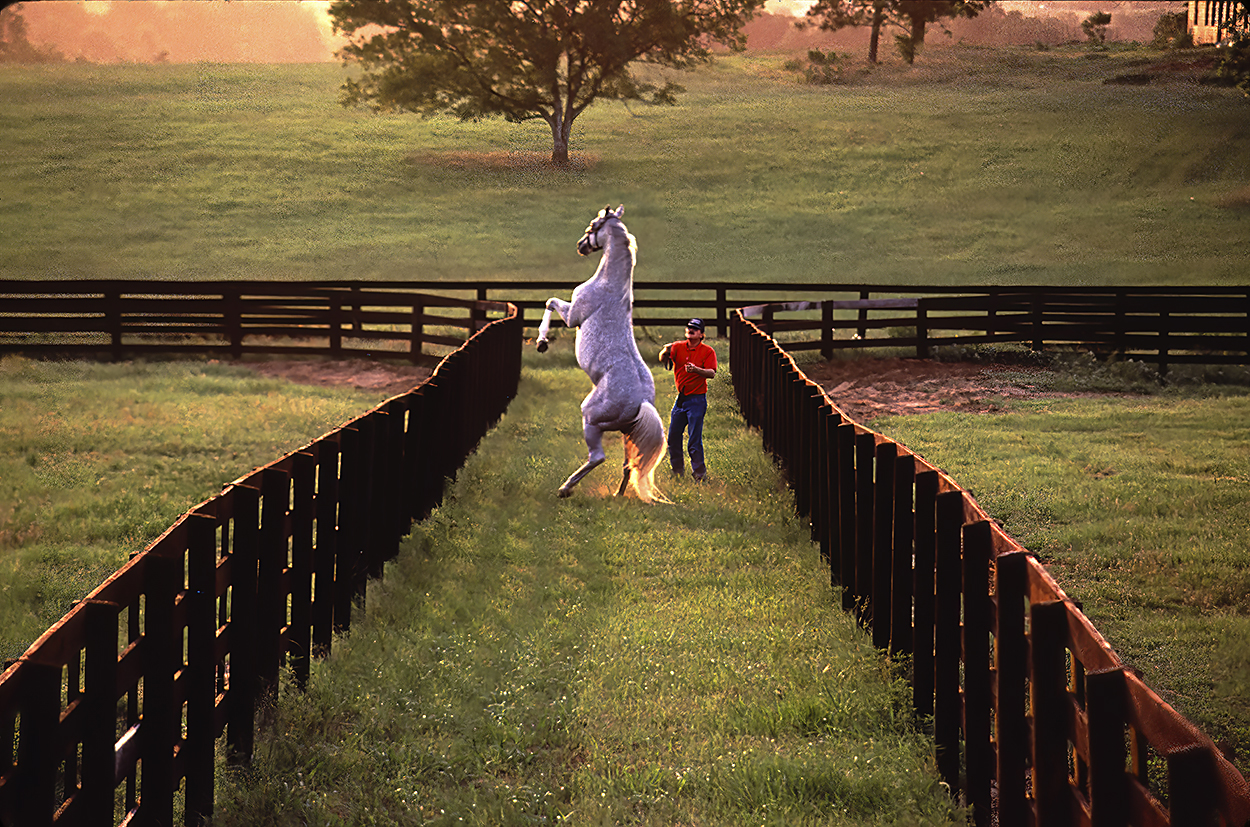
In the above image I fired off several exposures of the spot I wanted the horse and trainer to be in to get the exposure down, knowing I would probably get off one shot if something happened.

Well, the waiting paid off. Not only did I get the horse in the light, but I was lucky enough to have her rearing up on her hind legs….right in the middle of the fences.

Visit my website at: www.joebaraban.com, and check out my workshop schedule at the top of this blog. Come shoot with me sometime.

JoeB

My Favorite Quotes: Edward Weston

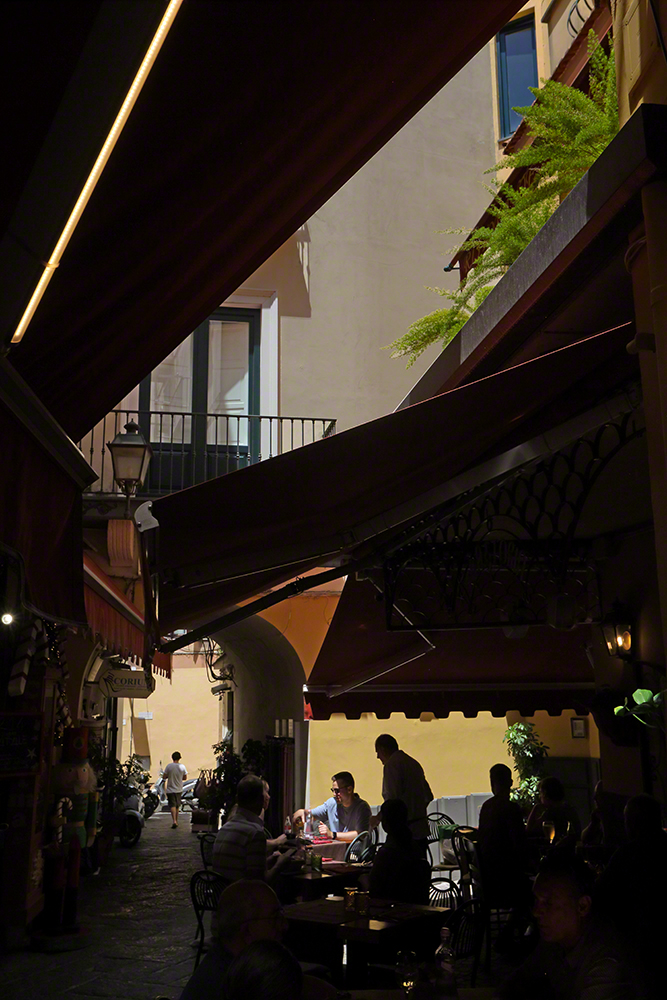
While waiting to order, I saw this and got excited.

I want to announce my next workshop “Autumn in France” to be next October 2nd. It will be in Bordeaux, Dordogne, and Toulouse. If you go to the top of my blog and click on the link, you can read the description. Join me for a great visual experience, seeing places that few people won’t ever be able to.

One of my favorite photographers that was part of the Group F/64 movement was Edward Weston…the movement that started in San Francisco. The book for those interested in how photography evolved is a must read: https://www.goodreads.com/book/show/20613662-group-f-64

He once said, “Anything that excites me for any reason, I will photograph”. I often quote him to my online classes with the BPSOP, and also in my “Stretching Your Frame of Mind” workshops I conduct all over the place.

Of course that quote is predicated on the assumption that you have a camera somewhere on your body. If I’m walking around with my class in one of my workshops, I’ll have a Canon 5DMarkIII over my shoulder and my little Panasonic DMC-LX5.

If I’m by myself at home I  Houston, then I always have my Lumix with me…why, you ask?

Because there’s so much that excites me out there, and I’m always seeing and thinking with the right side of my brain…the creative side.

That’s not to say that everything I shoot is a wall hanger. If I’m lucky, one out of fifty would  be worth considering. It’s that one that I’m after, and at this point in my career it’s extremely elusive.

As I tell my fellow photographers, my mantra, is “more shots per hour.” For those of you coming from the film days, unless you had a client paying for your film and processing, photography was an expensive hobby.

For those of you that have fallen in love with photography in the digital age, film is cheap, as in those cards you stick in your camera giving you an endless amount of exposures. The more you shoot, the greater the chances in going home with that ‘wall hanger’.

So, that being said, if it excites you in any way, shoot it. You can always delete later if it’s one of those photos that winds up on the “cutting room floor”.

Visit my website at www.joebaraban.com, and follow me on Instagram. Look for upcoming workshops at the top of this blog. Come shoot with me sometime.

JoeB

Life Before Photoshop: Toyota

Look ma, no Photoshop

I want to announce my next workshop “Autumn in France” to be next October 2nd. It will be in Bordeaux, Dordogne, and Toulouse. If you go to the top of my blog and click on the link, you can read the description. Join me for a great visual experience, seeing places that few people won’t ever be able to.

In my never ending quest to show my fellow photographers that take my online classes with the BPSOP, or in my “Stretching Your Frame of Mind” workshops I conduct around the planet, what it was like way back when when Adobe was a type of house in the Southwest part of the country, and Lightroom referred to a room that was light. I present to you and them another in my series “Life Before Photoshop”.

It was tough times, although no one really knew it. It was just SOP (standard operating procedure) to create photos in the camera. I guess I’m lucky in that respect since I had a pretty good imagination, loved to solve problems, and was extremely savvy as far as the ‘light’ was concerned.

I often wonder what my work would have looked like had Photoshop and Lightroom were around. I can tell you that I’m sooooo glad they weren’t. The reason…because everyone could take really good photos with that kind of help, and as a result I just might have been lost in the shuffle…maybe!!!!!

🙁

That said, I love the fact that it’s around now because I tweak all my photo to a small degree…why not? However, I get as much in the camera as I can since I still after all these forty-four years of shooting still love the challenge. I still love the notion that I’m a good photographer because I use very little to no help after the fact.

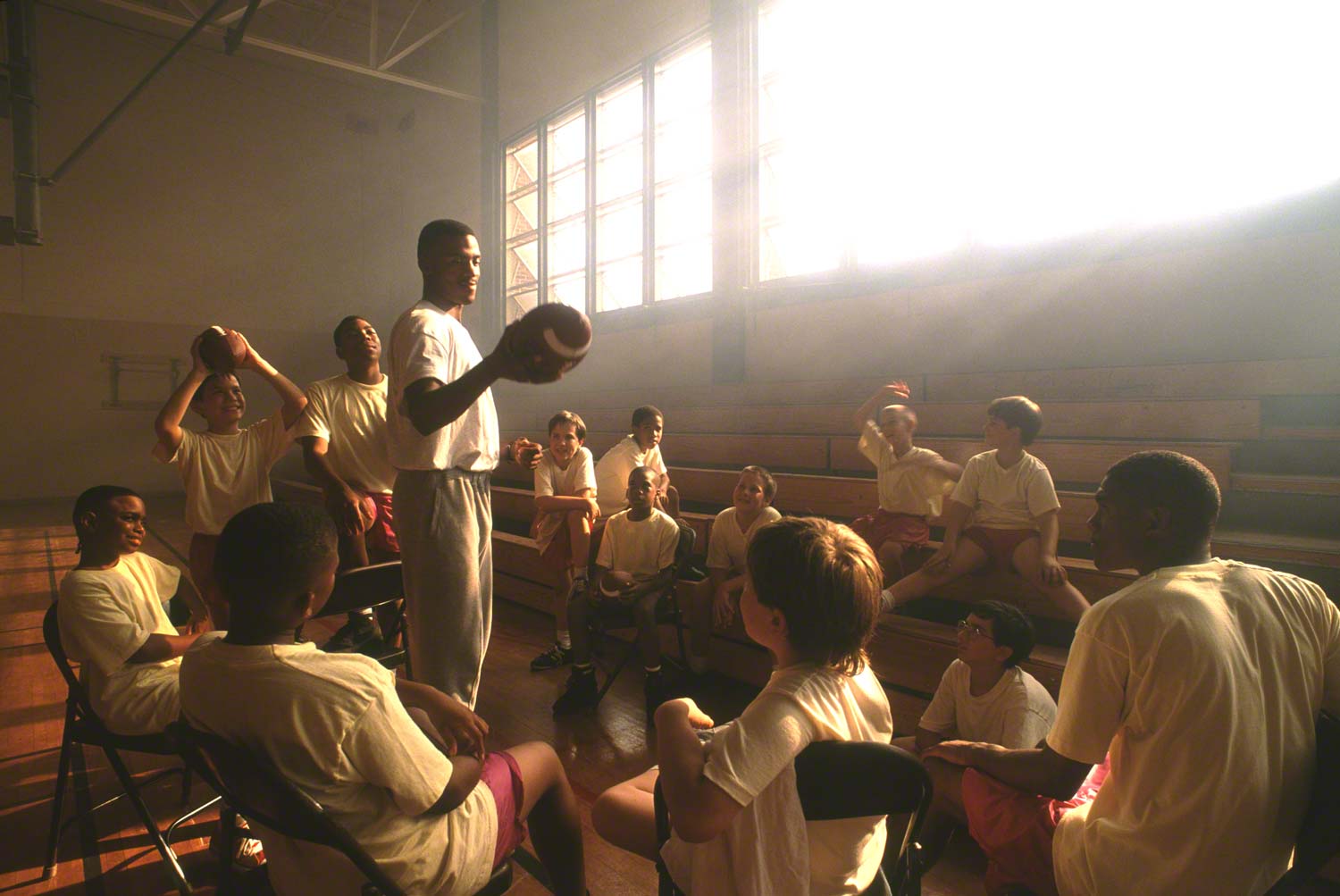
In the above photo, I was shooting an ad for Toyota. It was a mentoring program they had going where they used well known athletes to mentor kids that aspired to be like them; in this case high school football players.

The big problem to be solved was to get a good exposure on not only the college quarterback but on each one of the kids; no easy task without post processing since there were so many kids to direct. There were also too many first names to remember so I assigned each of the boys a number starting from left to right. The kid on the far left was number one…and so on. Looking through my viewfinder, I directed each boy separately by calling out his number.

So, as you can see, none of the boys are covering up each other, and each boy’s head is positioned in such a way as to get the maximum light on his face…using the white T-shirts to bounce light.

Visit my website at: www.joebaraban.com, and follow me on Instagram. Be sure to check out my workshop schedule at the top of this blog. Come shoot with me sometime.

JoeB

Autumn in France

Autumn in France

Hello to all,

I hope this email finds you healthy, wealthy, and wise.

This might seem a bit early, but as most of you know by now, time goes by incredibly fast and before you know it, you’ll be sitting at a café along the Garonne River having either a ‘café allonge’ or a glass of an exceptional Bordeaux from one of the many famous vineyards that are strewn along the West and East Bank of the Garonne River.

Remember how fast the future becomes the past.

Two reasons you are getting this now:

There are people out there that are still working (bless their souls) and must decide on their vacation time up to a year in advance.

Second, this period is in the timeframe of when the grapes are harvested, so as soon as we can book the hotel, the better off we will be.

It’s also possible (lately, ‘climate change’ will determine that) that we’ll be there when the leaves are turning which will allow for incredible photo opportunities.

If you’re not really doing anything else next October, I can’t think of a better way to write this workshop into your calendar.

That said, I want to introduce you to my next workshop that will start with the meet and greet in Bordeaux, France on October 2nd, 2023, and end in Toulouse on October 11th, 2023.

We’ll spend three full days and nights in Bordeaux, then go by private bus to Toulouse and spend three full days and night there.

Bordeaux, the “Elegant”, a world-renown city and UNESCO World Heritage Site, is considered one of the most beautiful cities not only in France but in all of Europe. https://duckduckgo.com/?q=Bordeaux+france+heritage+site&atb=v336-1&iax=images&ia=images

Bordeaux is a port city on the Garonne River, situated in the leading wine growing area of France, for which Bordeaux is the worldwide capital. However, not only is it famous for its vineyards, but the city is also (often referred as “the small Paris”) much more than that.

Experiencing the historical heritage, unique art de vivre, monuments, museums, and wonderful medieval buildings will have you falling in love with the city.

Bordeaux is also home to over sixteen hundred restaurants and is a playground for haute cuisine chefs. Indeed, a gastronomic paradise for those that enjoy great food…which would include yours truly, ‘moi’.

What I’m also really excited about is a location that was brought to my attention by a woman photographer that has taken several workshops with me, and she will be with me on this one as well.

Frankly I had never heard of it until Mary told me about a friend of hers that lives there. It’s where the people that live in Bordeaux go to spend summer weekends as it’s about an hour and a half from Bordeaux. It’s called Dordogne pronounced Dohr DOAN ya and you can see how magical the area is.

The different villages are absolutely amazing and we’ll be spending an entire day going from one to another.: https://duckduckgo.com/?q=dordogne+france&hps=1&atb=v336-1&iax=images&ia=images

Place de la Bourse and the Water Mirror will definitely be on our list to visit at sunset and the Blue Hour:

https://www.tripadvisor.com/Attraction_Review-g187079-d245765-Reviews-Place_de_la_Bourse-Bordeaux_Gironde_Nouvelle_Aquitaine.html

An afternoon shooting in Saint Emilion, with (hopefully) a tour of one of the wine chateaux and wine tasting. This medieval village is two thousand years old, and full of photo ops:

https://www.francethisway.com/places/saintemilion.php

Pont de Pierre: When you see the images, they will pretty much speak for themselves as far as a wonderful photo op. https://www.tripadvisor.com/Attraction_Review-g187079-d290953-Reviews-Pont_de_Pierre-Bordeaux_Gironde_Nouvelle_Aquitaine.html

City walking in Old Town or: https://www.bordeaux-tourism.co.uk/district/old-town.html

Rue Sainte-Catherine: https://www.bordeaux-tourism.co.uk/cultural-heritage/rue-sainte-catherine.html

Remember that the photos you see on this site with the mass of people were taken during the summer. In October, when we’ll be there, they will be back home.

Marche’ des Capucins: the largest market in Bordeaux:

https://www.europeanbestdestinations.com/travel-guide/bordeaux/march%C3%A9-des-capucins/

Sunset/Blue Hour on the Garonne River: https://www.google.com/search?source=univ&tbm=isch&q=sunset+on+the+Garonne+river+in+Bordeaux&client=firefox-b-1-d&fir=h4C1MsVSsxNF8M%252CWfVcrZ6SapLwWM%252C_%253Bp1BGXbBXgN3QhM%252CU_6bVS2R1wAzOM%252C_%253BytML6adtOYde0M%252C6vSRhNbC0Ed89M%252C_%253BLi_0BqBVuoPB_M%252CZ0bau6DrwhbeAM%252C_%253Bd3pqIHagNOpeEM%252C73cx8T4zDhrvrM%252C_%253BNBbE4mENKfS5DM%252C_SKaHzm00liN0M%252C_%253BEDLqQtQI0xf8bM%252CWCBnNLtucv73hM%252C_%253B75PE0SPW_LH1JM%252CQYTmNE0pS6OgOM%252C_%253BMAC-qBJs7ixz6M%252CG-Iwb4CNEve49M%252C_%253B30ZlsHVxY0GtxM%252Cwovq1nklAa9R1M%252C_&usg=AI4_-kRX6jxdDw58oo-C1ZAk-9-jNO7jaw&sa=X&ved=2ahUKEwjWx8nC-MH6AhV7IjQIHaB8CbQQ7Al6BAgCEEA&biw=1242&bih=729&dpr=2

For those interested in more of a beautiful quiet setting where the Impressionists might have painted, there is Jardin Public in the heart of Bordeaux: http://lemap-bordeaux.com/map-listing/jardin-public-public-park/

Now we’re off to Toulouse.

 Founded by the Romans, Toulouse, the fourth largest city in France, is often dubbed the “Pink City” due to the pinkish color of the terracotta bricks made since Roman times, from the red alluvial mud dredged out of the river Garonne – the red of Mediterranean roof tiles, a pinky red with all the warmth of southern Europe.

In Toulouse and the surrounding area, red brick is the traditional building material, and it is this red brick that has given the city its nickname.  It is the only large historic French city, apart from the industrial cities of the north of France, where brick has long competed with stone as a major building material.

You’ll see it in many of its older buildings, museums, and churches. As they say, one picture is worth a thousand words:

https://www.google.com/search?source=univ&tbm=isch&q=Toulouse&client=firefox-b-1-d&fir=fcbAvDGfMLW9UM%252CLaVc6Ps5c7L4xM%252C_%253BdWgZ-EH2rWKBBM%252C0lm4uBIVTF01qM%252C_%253BIczjODCOqbxaxM%252CbS3hEcyB0eeQWM%252C_%253BDhtfYmU1_WXIKM%252CKeXwaS33Tzu6QM%252C_%253B2Wh7S2Z3LlDrBM%252Cqk4vZp8rfa9mrM%252C_%253Bc9Y2Z_n5oGcdLM%252C4Y_HRRu2mdOlrM%252C_%253BsAwVPrLu8GrmtM%252CQkq3eRHC80gWuM%252C_%253BixGf-DkWygXm-M%252CsedJjFReypJnpM%252C_%253BUaVYcHIBMYhLXM%252CoBy_aJCBjRAD5M%252C_%253Bkz36Xvp8kGYCeM%252CJGqysci6CmxVDM%252C_&usg=AI4_-kSnXz3vNTP4UkrEkMeclK-VVU5LGw&sa=X&ved=2ahUKEwiOju2ZtsL6AhWVJX0KHX2sB-sQ7Al6BAg0EGw&biw=1440&bih=655&dpr=2

Toulouse is also situated on the Garonne River, and the Canal du Midi, another UNESCO World Heritage Site, links the river to the Mediterranean Sea.

A compact city, the central area is a maze of narrow streets, crossed as in Paris by a few wide boulevards. With its multitude of cafés, restaurants bars and boutiques, old Toulouse is a historic area with a wide range of photo ops that we would never be able to shoot them all. However, we just might give it a try and see most of them

Here are my top picks for Toulouse:

Famous for its extraordinary architecture, Toulouse, like Bordeaux is considered one of the most beautiful cities in Europe. One such building (a possible photo op) is the Basilica of St. Sernin, a UNESCO World Heritage Site. It’s stunning at night, lit up and seems to glow against the nighttime sky.

https://duckduckgo.com/?hps=1&q=basilica+of+st+sernin+toulouse&atb=v336-1&iax=images&ia=images

Canal du Midi: The Canal du Midi is a waterway that has linked Toulouse to the Mediterranean Sea for more than 300 years. Pierre Paul Riquet was its designer. In the XVII Century he managed to convince Louis XIV to carve out a canal in southern France to facilitate the movement of goods.

His idea was to capture the water that flowed off the Black Mountains in a reservoir before emptying it into the canal.

https://www.tripadvisor.com/Attraction_Review-g11038881-d241572-Reviews-Canal_du_Midi-Occitanie.html#/media-atf/241572/?albumid=-160&type=0&category=-160

A day trip to Albi: A fabulous commune an hour’s drive from Toulouse: https://duckduckgo.com/?q=albi&t=newext&atb=v336-1&iax=images&ia=images

It’s always fun to just walk around a city, and old town Toulouse is one of the best to do it in: https://duckduckgo.com/?q=old+town+in+toulouse&t=newext&atb=v336-1&iax=images&ia=images

Place du Capitole: The Capitol Square is the Center of Toulouse and is ideal for exploring the many churches, art galleries & museums: https://duckduckgo.com/?q=place+du+capitole+toulouse&t=newext&atb=v336-1&iax=images&ia=images

Walking along the banks of the Garonne River provides one the most beautiful views of the city that features the Pont Neuf, the Hôtel-Dieu Saint-Jacques, and the dome of La Grave: https://duckduckgo.com/?q=the+banks+of+the+garonne+river+in+toulouse&t=newext&atb=v336-1&iax=images&ia=images

Pont Neuf: A renowned bridge that spans the Garonne River was built over the course of several decades and finished in 1632: https://duckduckgo.com/?q=pont+neuf+in+toulouse&t=newext&atb=v336-1&iax=images&ia=images

Well, there you have it. As I said, it stands to reason that we can’t see them all in both cities. However, several are either adjacent to each other, part of the same location, or very close to each other.

I will be working with Katka (our producer from Prague) who’s onboard again working with me on the finished daily calendar and all transportation logistics. I will send it out to you sometime before the trip. We have plenty of time for that.

Rest assured, there will also be enough personal time for you to explore on your own. I will be in both locations several days ahead of time to scout all of them to make sure that as Dr. John would say we are in the right place at the right time: https://www.youtube.com/watch?v=W4PjWgiH-LQ

As previously stated, I wanted to get this out to you to give us time to book hotels in both cities. I will be researching the hotels and get back to you ASAP.

This workshop will be up there with my all-time favorites and promises to send all of you home with not only great memories, but great images to show for it; and maybe for those who want, a few bottles of vintage Bordeaux to share during your home slideshow…or maybe you don’t share!

The tourists will be gone so it’s going to be a hell of a lot less crowded than my last workshop in Italy, and the highs are around 70 degrees. What more could we ask for? Maybe some color in the leaves?

There will be ten spots open for ‘shooters’, plus spots those who want to bring a ‘non-shooter’. We’ll have our daily critiques, but I’m not sure how many days we’ll have for it. You can submit or not, it’s up to you.

However, the critiques are more interactive now, and closer to a forum where views and ideas are exchanged. It’s a great way to become a better photographer…even for me, and I’m already pretty good.

This is a longer photo workshop than usual to fit everything in. The cost of the workshop is $1900.00 for the shooters, and $900.00 for non-shooters. The non-shooters are involved with everything we do except for the daily critiques, this will include the ‘meet and greet’dinner, the (famous) final dinner, and private transportation to all the local locations and day trips. This will also include the private bus transfer from Bordeaux to Toulouse.

When you sign up, I will give you a list of travel insurance companies that I’m now recommending, and what the first deposit will be.

As always, I offer a first-class workshop and I’m also a ‘hands on’ fellow photographer who always makes himself available to shoot with you and answer any of your photo questions. Just ask these people:

I just finished taking Joe’s workshop. I simply cannot recommend it highly enough.  I cannot adequately express my gratitude to Joe for his approach to teaching and his willingness to share his tremendous wealth of knowledge.

 Learning about critical elements of design and the discovery of the artist’s palette has changed the way I make pictures, and the way I look at the world. This has been a truly outstanding experience with an outstanding teacher. Thank you, Joe!

 Alain

I recently completed my third workshop with Joe Baraban, and all I can say is that I will be coming back for more. All aspects of the workshop were fantastic. Joe’s approach to teaching, the shooting locations, the daily reviews, the accommodations, the planning and organization, and the communications were all at the highest level.

 From the “meet and greet” reception the first night, to the final dinner, Joe paid strict attention to every detail to make sure we were well taken care of…all the time. Joe’s selection of locations are always diverse and challenging and present many, many opportunities for great shots and learning.

 The daily reviews are a wonderful educational experience as you discuss your own work as well as the work of the other photographers. Joe teaches how to “make pictures”, not just take them. The quality and creativity in my images continue to ratchet up a notch with every workshop as I continue to learn from Joe.

 I highly recommend Joe’s workshops and online classes.

 Nick

I recently completed my 3rd photography workshop with Joe Baraban.  The location was Houston, TX.  All I can say is that I will be coming back for more!  All aspects of the workshop were fantastic: Joe’s approach to teaching; the shooting locations; the critiques; the individual attention; the accommodations; the planning and organization; and the great communications. 

 From the “Meet and Greet” reception the first night to the final dinner, Joe and Mikki paid strict attention to every level of detail making sure that were very well taken care, all the time.  And the photography was great too!  Joe’s selection of locations was diverse and challenging and presented many, many opportunities for great shots and for learning. 

The critiques are a wonderful educational experience as you discuss your own work as well as the work of the other photographers.  Joe teaches how to “make pictures”, not how to take pictures.  There was never a dull moment!  The quality and creativity in my photographs continue to ratchet up a notch as I learn from Joe.  I highly recommend Joe’s workshops as well his online courses.

 Knowing these critical elements of design have truly not only changed how and what I photograph but have changed the way I look at the world in a very real way.

 I cannot adequately express my gratitude to Joe for his caring and expertise and if you are considering taking a class or workshop with Joe think no more as I cannot recommend him highly enough. Just DO IT!!!

Shauna

Joe Baraban’s workshop is first rate and pitched at a level that in my opinion would provide a strong learning experience for any photographer, no matter their level or their primary area of photographic interest.

Joe is attentive, and his workshops are well prepared and illustrative of the concepts being put forward. Better yet, supplementary tips and advice were passed along to participants in neat little packages with titles like “The fifteen-point inspection plan”. His photo critiques are honest and very helpful. Several of us would take a second, third, and fourth workshop offered by Joe.

Murray

I attended Joe’s Paris workshop and received a lot of valuable information in less than a week.

 Joe’s workshops begin with an informal meet and greet where all the participants and spouses can meet each other with food and wine.

Usually, each day start before dawn with an air-conditioned private bus trip to a pre-scouted shooting location. Joe gives suggestions for shooting before and during each shoot. He moves around to each photographer during the shoots and gives “hands-on tips” and suggestions that are wonderful and instructive.

 Each day there is a very constructive critique of the work that was shot the day before. Joe has everyone involved and he asks people their opinions.

 I have not attended many formal workshops and I was happy that the comments of the other shooters and those from Joe were very helpful and allowed everyone to get real feedback so soon after shooting.

I can truly say that the workshop immediately helped me, and I believe that my photos have much improved. It was a wonderful experience and made me a better photographer. It also gave me a chance to make friends with the other photographers.

John B

I wanted to learn more about Joe’s approach to visual design and making great photos after taking one of his online courses.  As a former painter, I really relate to his focus on visual design elements as his artist’s palate and it all came to life in this workshop. 

 He is an excellent teacher, and it was wonderful to experience this with a group of very talented photographers who supported each other and did some great work.  The format of learning the design principles and discussing them in relation to Joe’s images and the work from the class was a great way to learn – I look forward to future workshops.

Cynthia

My Favorite Quotes: Anonymous

A simple idea can tell a big story.

Through the years, I’ve collected a lot of quotes that were said by an artist of some measure and how the quote relates to my way of thinking; especially how the quote fits into my three online classes with the BPSOP, and in my “Stretching Your Frame of Mind” workshops I conduct around the planet.

“ I always thought good photos were like good jokes. If you have to explain it, it just isn’t that good.”Anonymous

One of the many discussions I have at least once if not a hundred times in my four-week classes with my fellow photographers is about making sure you’ve left the viewer with a clear understanding of what message you were trying to get across. I call it a “quick read”, and unless your image is an abstract, in which case you’re leaving the viewer to decide on what the photo is saying. You don’t want him/her walking away scratching their heads.

There’s always the possibility you’ll be standing next to your print at some exhibit or maybe even your camera club’s annual show where you’ll be able to talk about it. Sometimes it’s interesting to hear the story behind the photo and see the photo in a new light. But in most cases, a photo shouldn’t need a story to back it up. It has to speak for itself….as I said, a quick read.

Right before I click the shutter I always ask myself if the viewer is going to see and feel it the way I was experiencing it when I finished my composition and was ready to click the shutter. It’s like taking an out-of-body experience and putting your mind in the mind of the viewer. Then I can step back and see if I’m getting my message across.

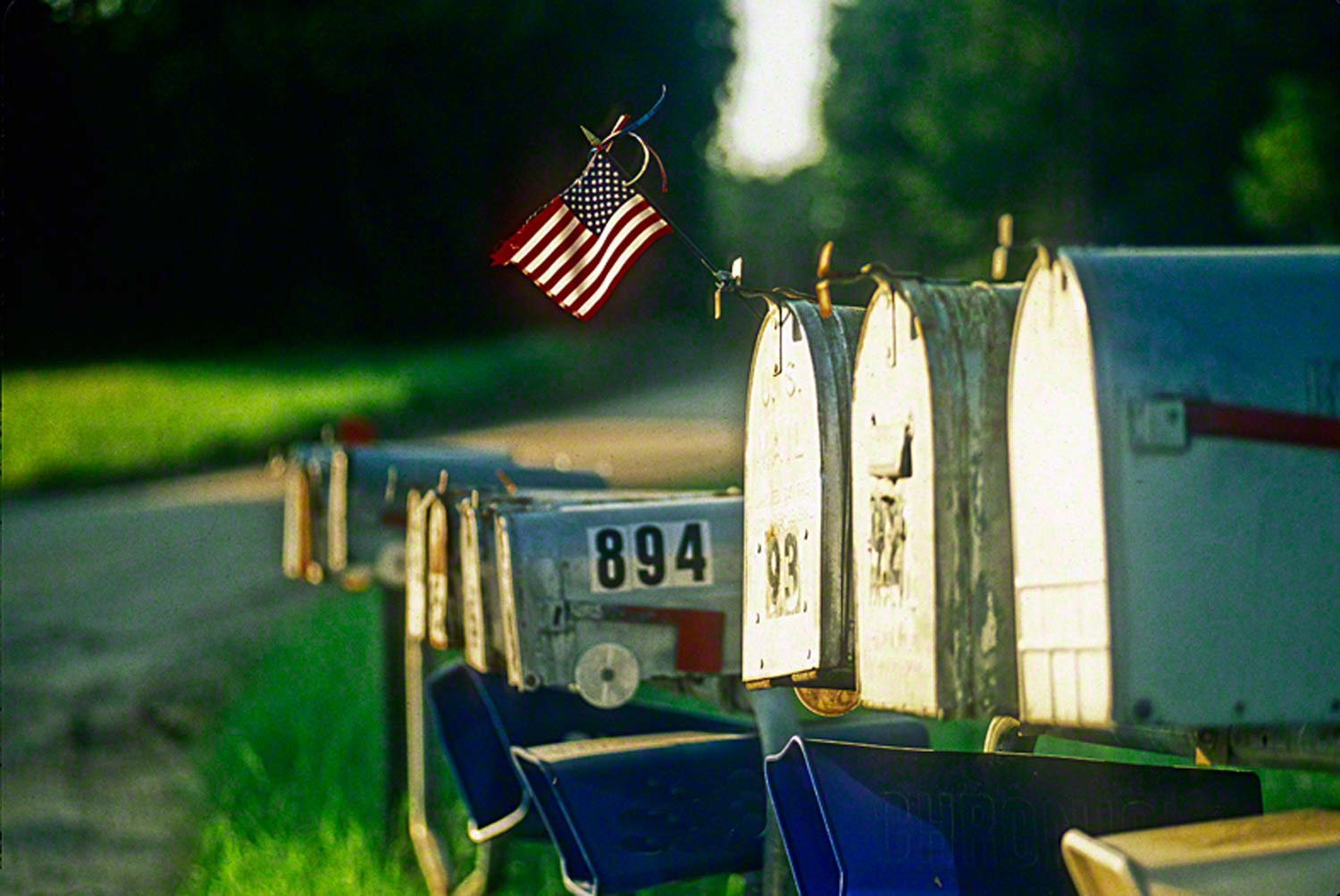
In the above photo, not very long after 9/11, I did a photo story on rural Texas, and how these people showed support for our country. In context with the other photos and subsequent text, I think the message came across as clear as day.

Visit my website at: www.joebaraban.com, and follow me on Instagram https://www.instagram.com/barabanjoe/. Check out my workshop schedule at the top of this blog. come shoot with me sometime.

JoeB

My Favorite Quote: Ansel Adams

Seeing what I’d like to see

There is a difference between looking at and looking into a picture . . . as Ansel Adams said.

It’s the difference between taking and making a photo, and as Bob Marley once said and I’ll paraphrase it ” Some people will just get wet when going out to shoot, while others will feel the rain while shooting in it.

I tell my online students that take my online classes with the BPSOP, and those that take my “Stretching Your Frame of Mind” workshops I conduct all over the place to take in the whole picture, from the foreground to the horizon.

Arranging your images this way will generate depth and by the use of a wide-angle lens, you can cheat the camera (by using all three dimensions) which has only one eye so it can only see in two dimensions.

This will initiate layers of interest, and by doing so, you keep the viewer around longer. I also speak of the importance of looking to the right, the left, and even behind you while walking. This way, you’ll be able to see in all four directions which will increase your odds of going home with a wall hanger by four.

When composing, I pre-visualize the composition before I ever bring the viewfinder up to my eyes. I don’t necessarily see what I want, sometimes I visualize what I’d like to see…but that’s another story.

So my fellow photographers, don’t just look at your picture which would constitute using the left side of your brain the analytical side, use the right side of your brain to compose, the creative side. This is the way to look into your photos and see what else is there.

Visit my website at www.joebaraban.com, and follow me on Instagram http://instagram.com/barabanjoe. Keep an eye out for my future workshops, come shoot with me sometime.

JoeB

Food For Digital Thought: Ask and Ye Shall Receive

When of the concepts I’m constantly talking about in my online classes with the BPSOP, and in my “Stretching Your Frame of Mind” workshops I conduct around Earth is that it’s better to ask someone to do something and as a result get the shot, or not ask and wind up with a snapshot.

I realize that it’s easier said than done, especially for those that for one reason or another find it difficult to approach someone. For some, it’s even hard to ask someone they know or along the ride with them.

My background is in part, that of a photojournalist so for me it’s very easy to ask. In my way of thinking, all they can do is to say no, in which case I move on. To a large extent, this is exactly what I say to my fellow photographers.

It’s all about getting over the hump, and there are numerous ‘humps’ that we try to get over. For example, the most common hump of them all is the hump that occurs on Wednesday…the proverbial hump day. Once you get past Wednesday, the middle of the week, you get to look forward to the weekend.

It’s the same thing in photography. Once you ask someone to do something for the first time, it gets easier and easier. Once you see the potential results, as in a good photo versus a snapshot, it really gets easier.

Sometimes it’s just having your subject look out of the frame, sit one seat over, or stand to the right or left. If you’ve ever seen the difference between asking something so simple, it will really build up your confidence.

One of the best ways to get what you want is to offer to send them a copy of the photo. I always ask for their email address so I can send a copy; sometimes they say yes, and sometimes no.

While we’re on the subject of asking, remember what I refer to as the cardinal sin, never, and I repeat never, take a picture of a child without asking permission. It can get you in a whole lot of unwelcomed trouble.

Visit my website at www.joebaraban.com and follow me on Instagram at https://www.instagram.com/barabanjoe/ Check out my workshop schedule at the top of this blog. Come shoot with me sometime.

JoeB

Anecdotes: Christina’s World Unplugged

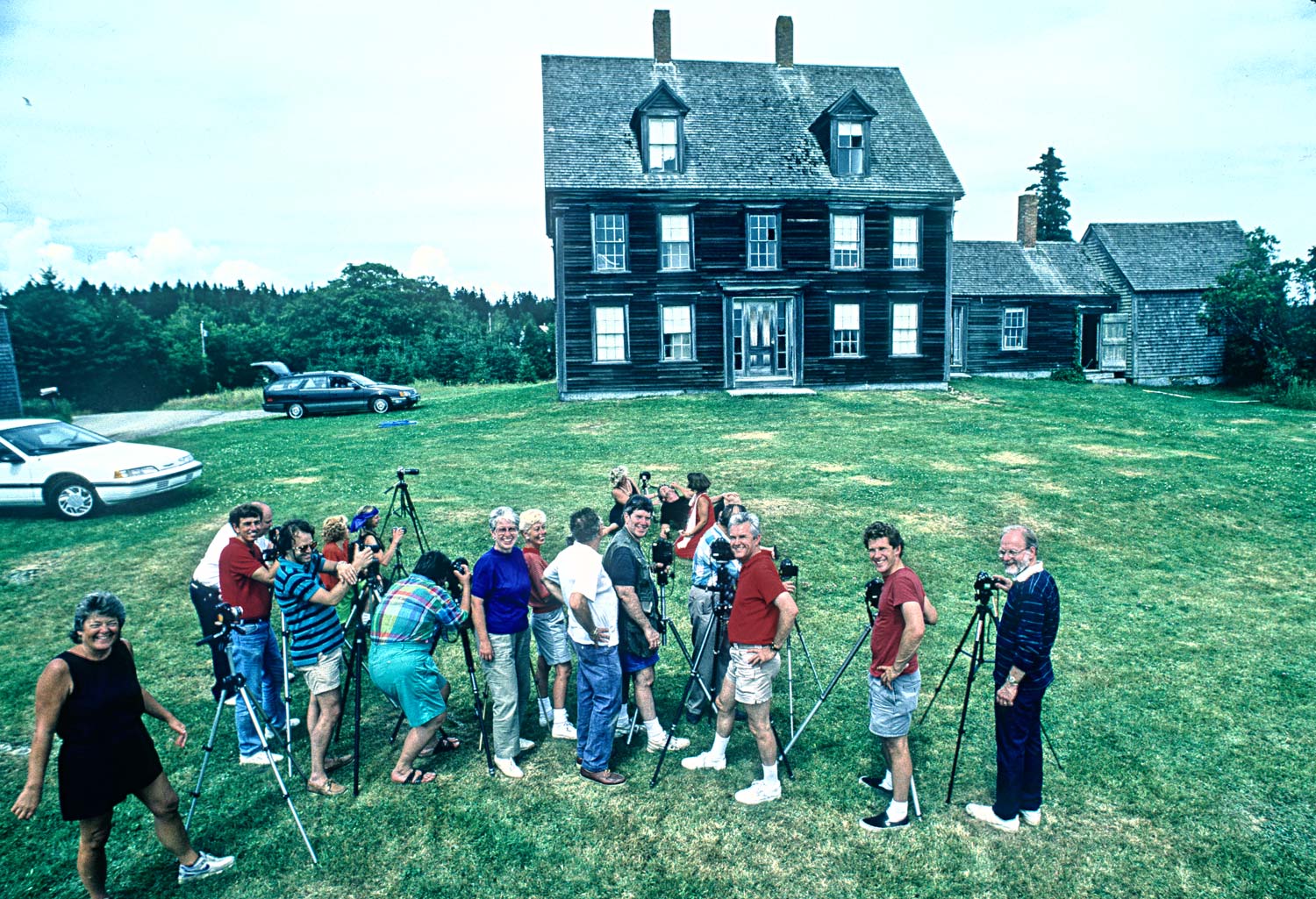
I'm the one wearing black and lying down in the middle.
I’m the one wearing black and lying down in the middle.

In my online classes I teach with the BPSOP, I teach my fellow photographers how to incorporate the Elements of Visual Design into their photography. I also conduct my “Stretching Your Frame of Mind” workshops with the same idea in mind. The first workshops I ever taught (1983) was at the Maine Media Workshops in Rockport, Maine.

In those days my workshop was called, The Poetry of Light, and while I covered the design elements, the main focus was on the Light. To this day I tell people that light is everything, except when street shooting where capturing the moment might supersede great light.

As I look back at the thirty-six years I’ve been teaching there, one week in particular comes to mind. From the first early morning shoot to the last sunset shoot of the week, we had overcast skies. The mornings were shrouded in fog, and when it finally lifted one could look up and enjoy a weeks worth of gray skies.

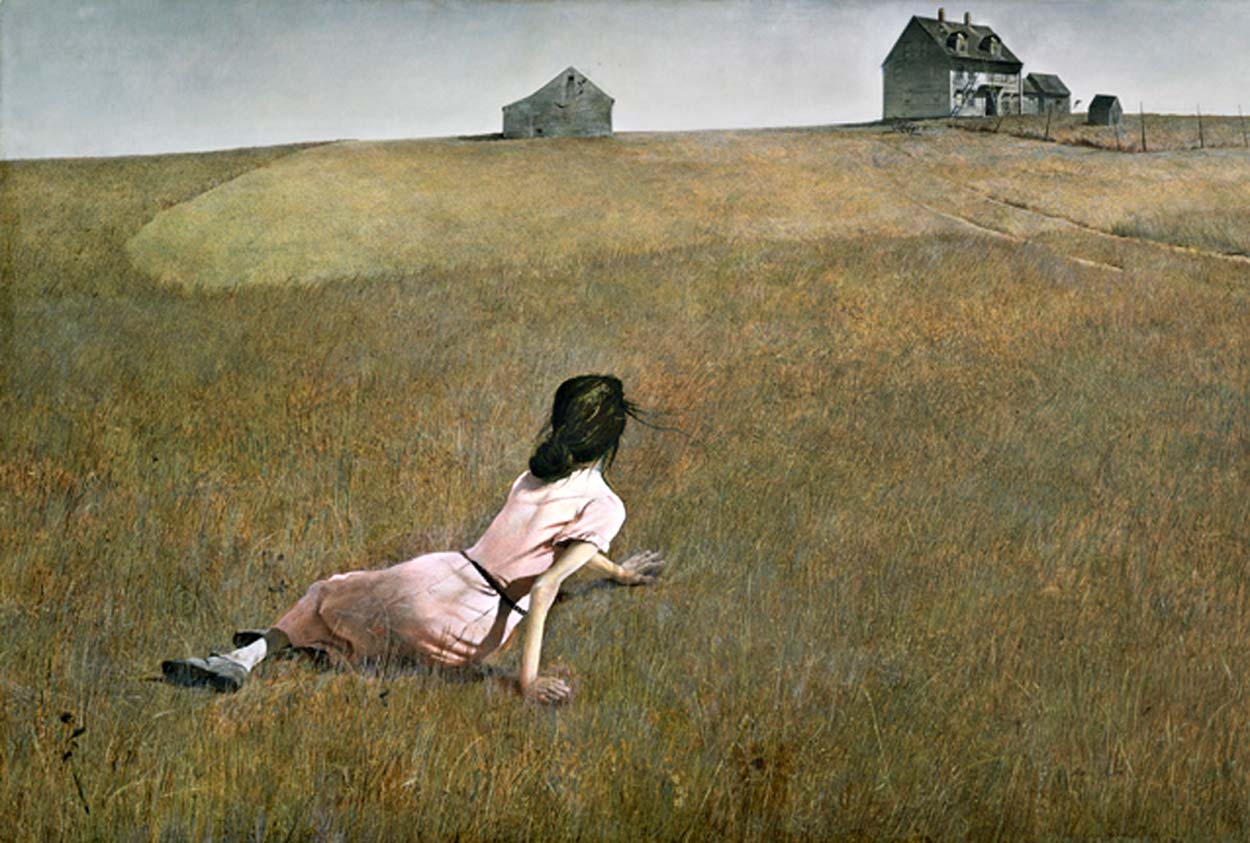
I was desperate to find some subject matter for my group; even if it was to be without any light. I had remembered that Andrew Wyeth had summered nearby and painted his famous “Christina’s World”, so I obtained permission to take the class there to have some fun, and after three days of overcast skies, the class was actually smiling…albeit just a little.

Christina's World by Andrew Wyeth.
Christina’s World by Andrew Wyeth.

The class and I decided to re-create the painting and I was elected (unanimously) to portray Anna Christina Olsen. We were then allowed to shoot inside the house, which was great since the light coming in from all the windows made for a great day of shooting. In those days, there was no limit as to the number of people that were in a class, and there were a lot of faces to create smiles on. Now the classes are smaller and a lot more intimate.

Btw, at the end of the week the class surprised me with a gift…a T-shirt that said, The Poetry of Fog with Joe Baraban.

Visit my website at: www.joebaraban.com, and follow me on Instagram: https://www.instagram.com/barabanjoe/

JoeB

Photo Ops: Window Light

Nothing like window light!

When I was starting my career almost fifty-four years ago, there wasn’t a lot of money for equipment, especially lighting equipment. That is if I even knew what to do with said equipment if I had the money to buy it. I relied on my training in Art to get me through any lighting scenarios. What I mean is that I used available light to paint and that often meant using window light. As a result, when I grew up I was confident enough to use the same available window light for just about any kind of job that walked in the door of my first photo studio.

In fact, in the early days, I had a small space that was the bottom floor in an old house. My lighting set-up was a large window in the front of the house that faced North. I lit everything there from portraits to still lifes. At the time, I didn’t realize that it was the best possible way to light people and by the way, during the last few years, it has made a huge comeback.

In my online class with the BPSOP, and in my “Stretching Your Frame of Mind” workshop I conduct around the planet, I always suggest available window light and at the same time stressing to avoid fill flash like it was the plague. Even on a gloomy day, there’s going to be enough light coming in from the outside to create a quality portrait. In the winter months, I tell the students that don’t think there’s anything to shoot until the thaw, to shoot indoors using the light from a window. Even when I could afford to take lighting with me on assignments, I would still look for available light from a window first since I was always tried to create it with my strobes and softboxes.

As is the nature of window light, side lighting is going to be the easiest way to light people. I prefer this light since it adds depth to the subject’s face. What I mean by “adding depth” is to make one side lighter than the other, and use a small white reflector to bounce a little light back on the dark side. This falls under one of the basic elements of visual design I teach in my classes called Form.

Form refers to the three-dimensional quality of an object and has but two dimensions: height and width. To create the third dimension, namely Depth, you have to side-light the object; otherwise, it will appear flat with no sense of shape and volume.

Look for rooms with multiple windows that will offer different kinds of lighting. one of my favorite ways to light a person ( as in the above photo) is to have them side lit with a window just out of the frame, and have windows in the background you can blow out. Ok, here’s a good time to tell you that whenever someone tells you that “clipping the highlights”  is not recommended, don’t walk away from them…RUN LIKE THE WIND because that person is going to have you take average, predictable photos; who wants that?

Take a look at this slideshow where the only source of light is a window somewhere usually out of the frame…but not always.

Visit my website at: www.joebaraban.com and check out my workshop schedule at the top of this Blog Come shoot available light with me sometime. Follow me on Instagram.

https://www.instagram.com/barabanjoe/

JoeB

Guest Post: Nick DePasquale

 Nick DePasquale sent me this post with an interesting quote that I wanted to share. This is the first time I have shared something with another photographer, but I found this to be pertinent to the way I see things.

“Film is cheap these days!”  That’s what I tell the students in my digital photography classes when I’m explaining concepts that Joe Baraban consistently talks about in his blog posts, online classes, and photography workshops around the world.  Sometimes it takes a few seconds for my joke to sink in, but I do get a laugh.  In the world of digital photography, we don’t have to think about conserving our shots as much as we did in the film days.   With typically 36 shots in a roll of film, I would be careful on how many shots I took not only because of the cost of the film and developing it but also because I did not want to run out of film at the most inopportune time.

Just imagine having to change out a roll of film just when your kid was scoring their first soccer goal!  With our digital cameras, we can easily make as many adjustments and variations as we care to; sometimes an adjustment by moving an inch to remove a distraction in the background or creating separation;  or a variation showing a subject from a different perspective or point-of-view.

Tom Watson, Jr., the second President of IBM, is quoted as saying:  “If you want to increase your success rate, double your failure rate”.   In digital photography, to me, this means to shoot, shoot, and then shoot some more.  Not haphazardly, but with discipline and intention.

We have the luxury of being able to experiment, stretching our creativity outside of the box, and coloring outside of the lines like Joe often says, because we are not limited as much by technology.

In this context, and as Mr. Watson was communicating, failure is good.  You learn much more from the photos that don’t work out than the ones that do.  I like to characterize it this way: there are no failed pictures, just lessons learned from the shots that don’t work out.

In the winter of 2021, I photographed an old truck in a field near my home in New England during a snow storm.  When I returned home, I was not at all happy with my images.  They were ok, but I did not have a “wall hanger”.   Instead of being disappointed, I thought about what I could do differently and returned this year, again during a snow storm.  I shot different variations based on my observations from the previous year and came up with an image that I liked.

Nick DePasquale: https://nickdepasqualephotography.com/

Quick Photo Tip: Verticals in a Vertical Format.

  A topic of conversation that always comes up in my online classes with the BPSOP, and in my “Stretching Your Frame of Mind” Workshops I conduct around the planet, to always shoot both horizontally and vertically. For one thing, it will give you choices.

The majority of the images that I look at are horizontal, mainly because that’s the easiest way to shoot; also because the camera is designed to shoot that way.

How easy it is to merely bring the camera up to your eye, no matter what the subject matter is. I can tell you that way of thinking is not going to be in your best interest.

Horizontals are calming, as they mimic the horizon. They should be thought of when your subject is wider than it is tall, and it will move the viewer across the frame.

Using lines, both leading and directional is a good way to do this, and usually works best when you have a lot of space to do it in…as in a horizontal….it’s the way we perceive and process information.

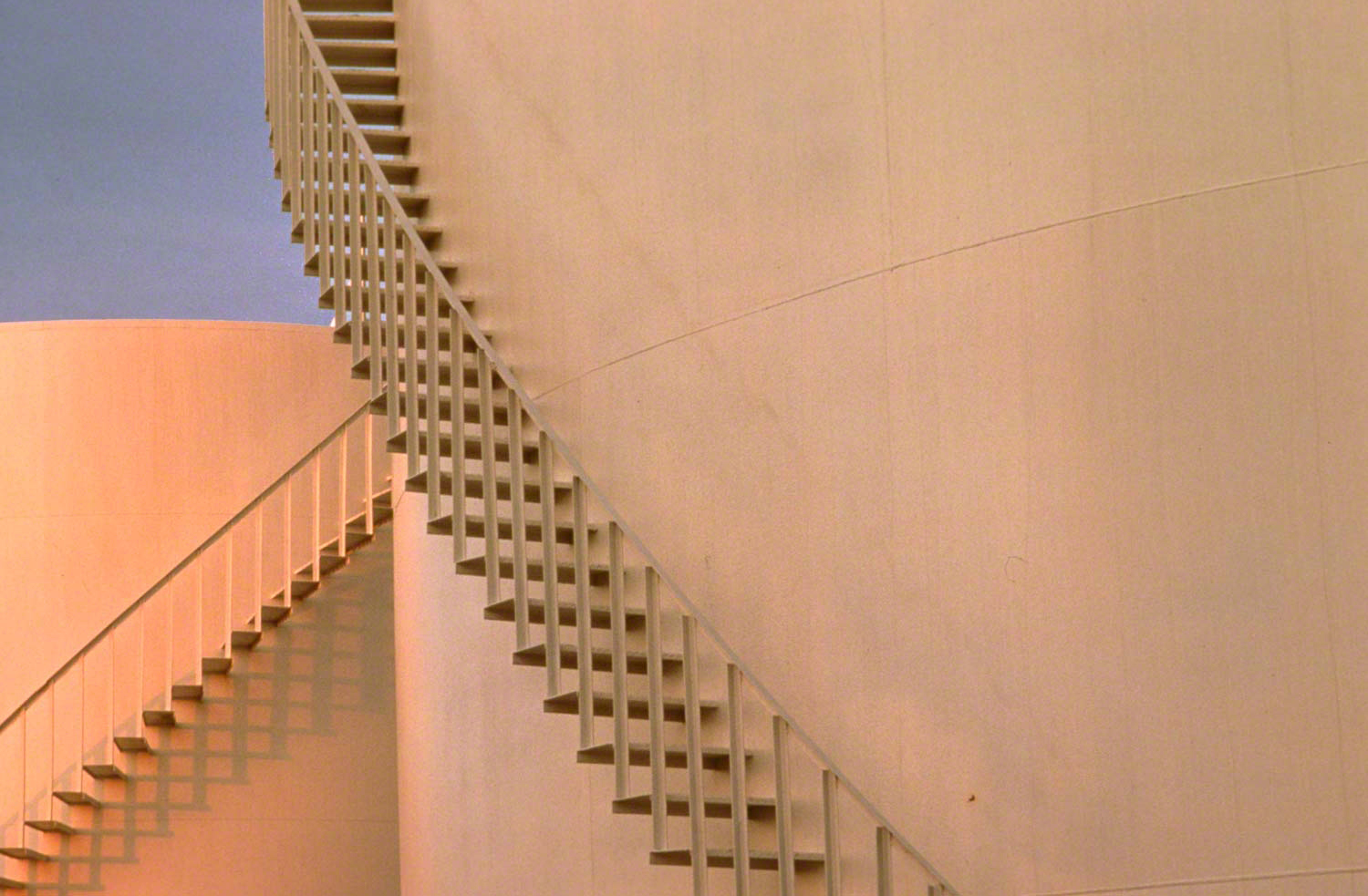
Line is the most important of all the elements of visual design, and nothing could exist without it. Planes, trains, and autos…you and I included all have an ‘outline’. When composing, consider the lines. Your longest lines might be the best way to determine whether you should shoot one way or another.Moving the viewer around is a good way to keep him involved in your composition, and when he is he will stick around longer

Verticals have more energy because it will take the viewer longer to look from the bottom of your frame to the top. That time is energy, and energy can be equated to tension. Tension gives your photos strength and intensity.

Verticals are best considered when the subject is taller than it is wide.   A vertical subject is going to have even more energy when composed in a vertical format. It will keep the viewer from sensing any extended peripheral vision that would be in a horizontal.

The best advice I can give you is to always try to shoot both ways, and compare them back home on your computer where you have time to really think.

Visit my website at www. joebaraban.com  and check out any upcoming workshops at the top of this blog. Come shoot with me sometime.

https://www.instagram.com/barabanjoe/

JoeB

Quick Photo Tip: Taking Pictures of People Taking Pictures.

friends taking pictures of friends in Tuscany.

Maybe it’s a touch of voyeurism and maybe I’m just a people watcher who likes to observe how people go about taking pictures of each other.  Either way, it offers up a great photo opportunity. Be honest, haven’t you stopped and watched people as they photograph their friends or family? It’s one of my favorite things to do, and I usually end up asking if they want me to take the picture so all the family can be in the photo…which I also love to do.

First place finish.
First place finish.

There’s something endearing about the way people take pictures of others. The way they try to direct, their body language as they compose, especially if the ones being photographed are giving them a hard time. It makes for great subject matter when families take pictures after someone has done something important, even if it’s just important to them. For example winning a trophy is a good one. Or families traveling together.

I’ve been lucky enough to catch that happening on several occasions.

A coach and his team.

As I tell my online students with the BPSOP, and in my “Stretching Your Frame of Mind” workshops I conduct around the planet you have to be an obsever of your surroundings. Pay attention all the time to what’s happening and you just might get lucky.

Visit my website at: www.joebaraban.com, and check out my workshop schedule at the top of this blog. Come shoot with me sometime.

JoeB