Whenever I write one of these posts it takes me back to the days when I was traveling two hundred twenty-five days out of the year, and loving it. I was fortunate enough to hook up with some of the very best graphic designers in the country if not the world, and a whole lot of them were working in Texas; Houston, Dallas, and Austin to be exact.
Working with graphic designers in corporate photography was very different that working with Art Directors in advertising in that with corporate work you had more freedom to shoot what you wanted, and in advertising you usually had to follow a layout…or at least high-comped sketch of what the client expected you to come back with.
I was hired by s designer, that in turn was hired by an oil company in London to travel throughout Asia documenting the countries that they were either doing work for or about to. I was allowed to shoot anything I wanted as long as it represented the country in a positive way.
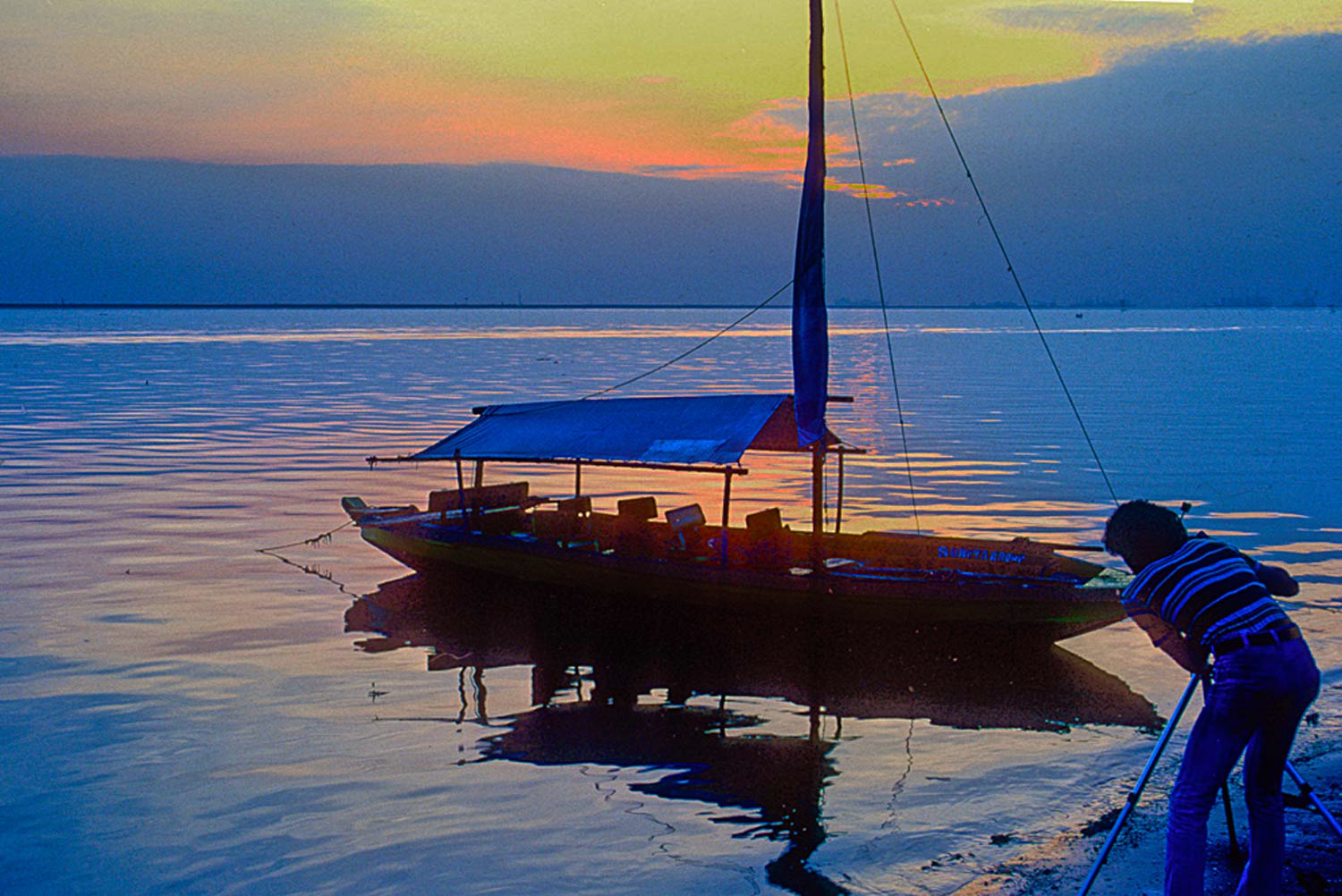
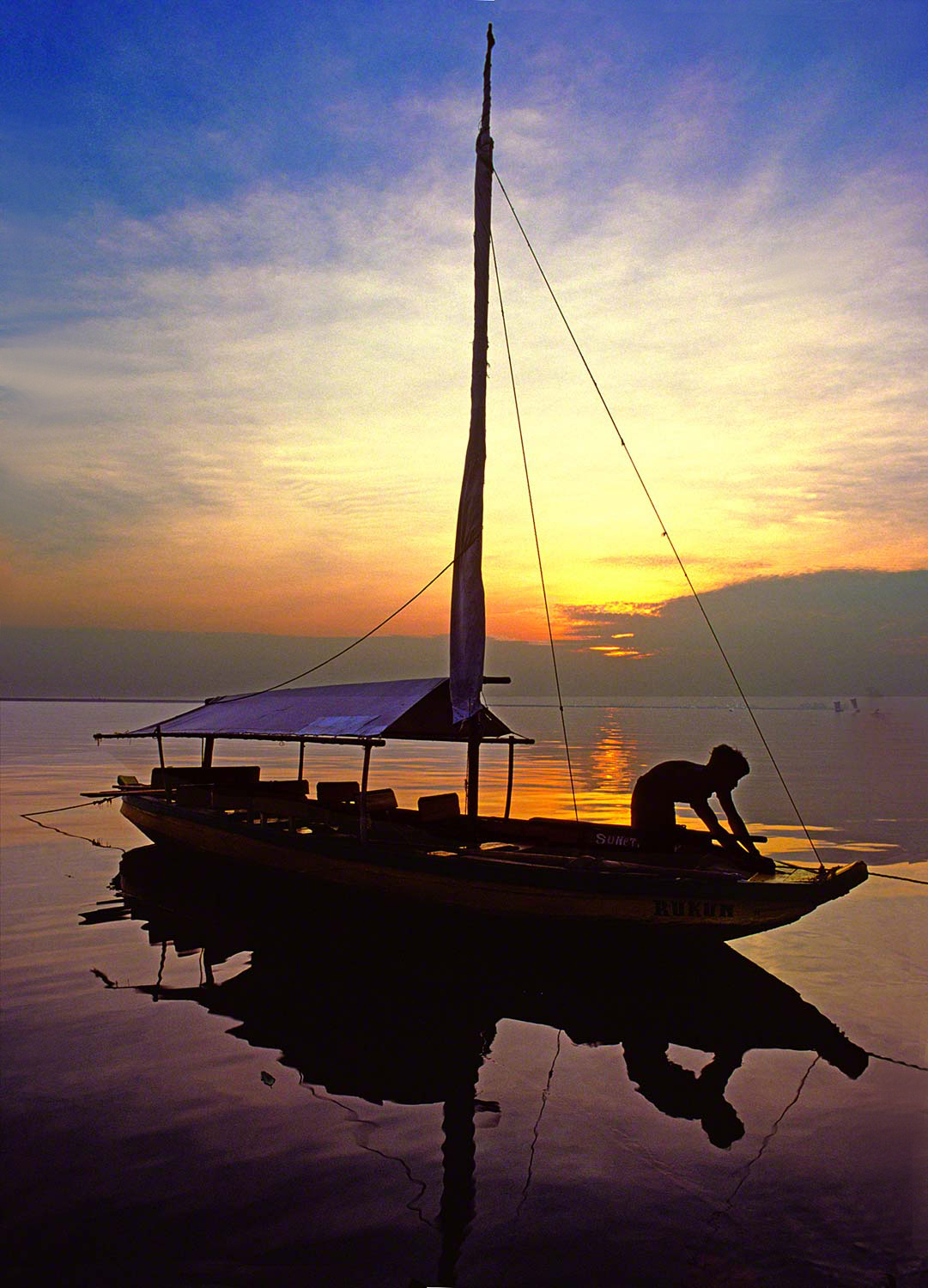
We were in the Philippines for several days with one of their employees as our guide and interpreter and one sunrise we found ourselves at a place somewhere in Manila Bay. It was a gray day and I was about to call it a morning when we saw this small boat anchored on the shore. The sky was opening up a little so I thought I would shoot the boat against what I was hoping for something dramatic to happen in the sky.
As I tell my online students with the BPSOP, and in my “Stretching Your Frame of Mind” workshops I conduct around the planet that Eddie Adams ( a well known Pulitzer prize winning photographer) once said, “When you get lucky, be ready”. As is usually the case, sunrise shooting is very quiet since there’s no one around that time of morning, and especially when you’re far away from the cacophony of morning sounds given off from a large city.
I was beginning to compose my photo, when all of a sudden a teenage boy jumped up from inside the boat and proceeded to scare the morning daylights out of us, while at the same time those same daylights had been scared out of him.
With the help of an idea, I quickly ( as in losing the light) regained my composure and had our guide ask him if he would pose for me. I had the young boy trade places with me (it’s a great way to show your subject what you want him to do). As I started to shoot the silhouette of the boy, the sun was rising creating this wonderful sky.
I got the shot (without any post processing) and gave the boy a five dollar bill for his time. He looked at it, smiled, then laid back down in the bottom of the boat and went back to sleep. As we were leaving, our guide told us that the five dollars we gave him was more than he made in a month. Wow, talk about making someone’s day…or month.
Visit my website at: www.joebaraban.com, and follow me on Instagram….www.instagram.com/barabanjoe Check out my 2023 Workshop schedule at the top of this blog. Come shoot with me sometime.
I made a new photo friend, and drank Grappa with him.
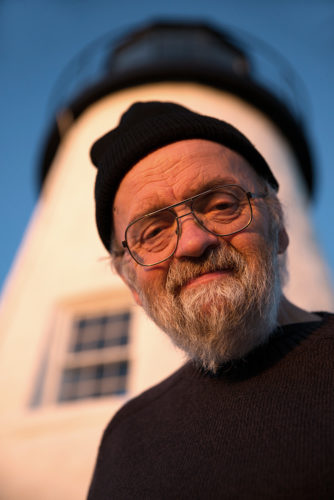
When I was an active advertising and corporate photographer, one of the areas of photography I was and still am known for was/is my environmental portraiture. What I like the most about this genre is what I tell my online students with the BPSOP, and with my fellow photographers that take my “Stretching Your Frame of Mind” workshops..and is one of my many personal pearls of wisdom…”Make a new photo friend”. I tell them that for me, talking to my subject before I ask to take their picture is as much fun as the actual process of composing it.
Whether it be a random person I’ve met on the street or a worker at some manufacturing or industrial plant, I’ll start a conversation with them from asking about their job to their kids (especially if they look like grandkids), to what brought them to the place we just met.
I do this for a couple of reasons: I’m curious by nature, and it loosens them up. The last thing I want to do is stick my camera in someone’s face because it will either put them off or frighten them. Either way it can’t or won’t lead to a successful portrait; one that appears as if they knew me long before I started shooting.
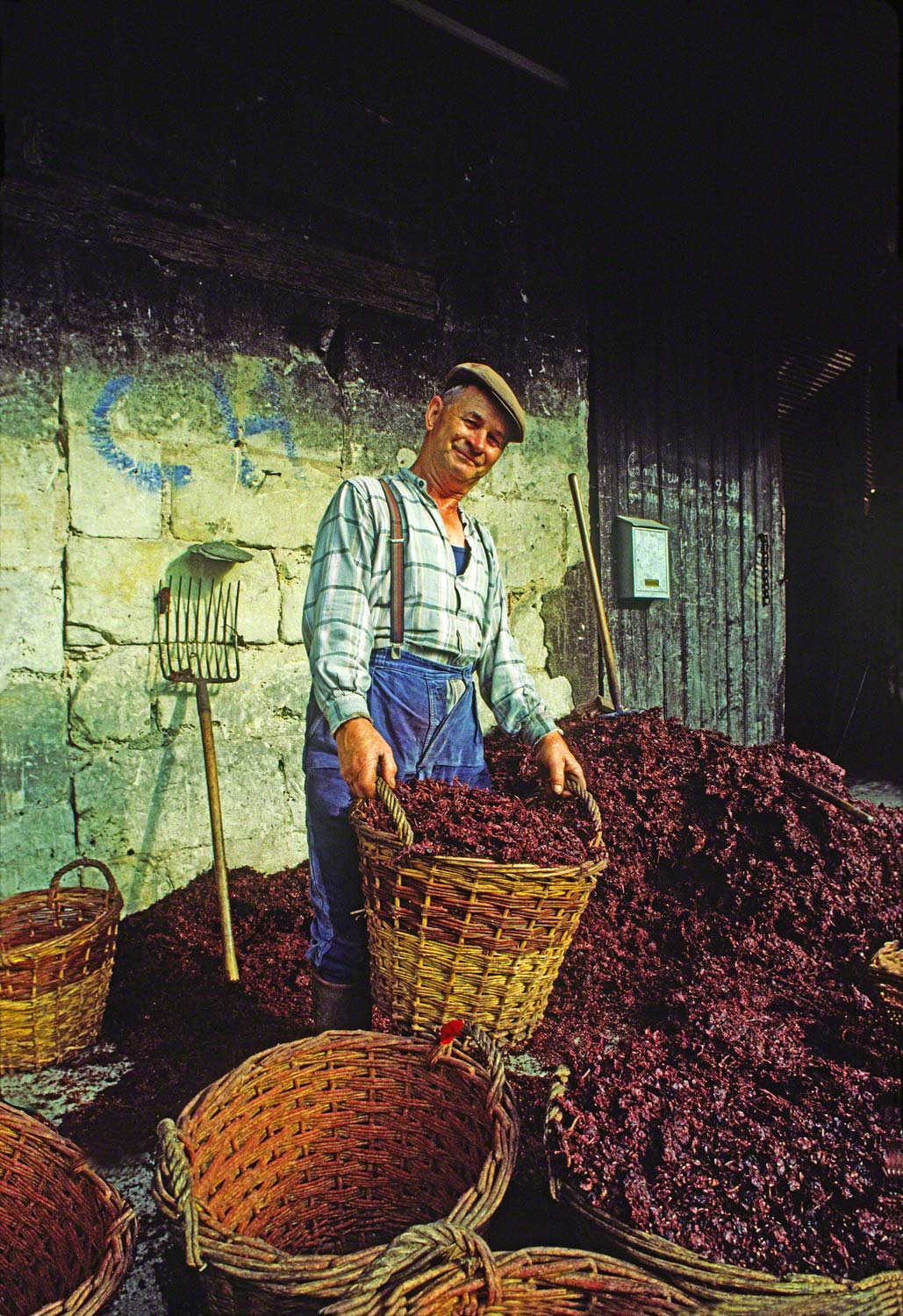
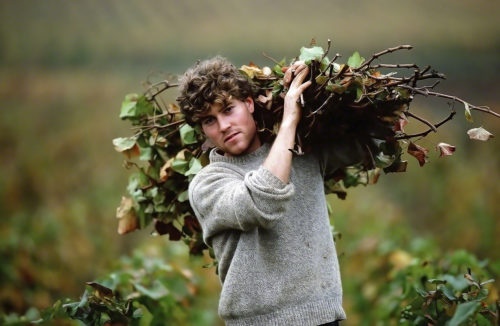
We were driving down the road in Provence when I saw this man moving baskets around a small building. I couldn’t tell what was in the baskets so we pulled over to find out. I was hoping that he spoke even a little English so I could talk to him without our French driver to translate. As it turned out he did speak enough English to communicate with me.
We started a conversation and it turned out that he was making Grappa, which is a grape based Brandy that originated in Italy. Grappa is made by distilling the skins, pulp, seeds, and stems, and can be very strong. The proof was when he gave us some to drink from a spigot at the end of a pipe…aged two hours!
It was a most enjoyable conversation and I walked away with a new photo friend. Btw, it’s always a good thing to send them a print, and these days it’s become so easy to e-mail a copy.
Visit my website at: www.joebaraban.com, and follow me on Instagram...www.instagram.com/barabanjoe/.Be sure to check out my 2023 workshop schedule at the top of this blog. Come shoot with me sometime.
In my six month Mentoring program, I often work with photographers that feel that they have run out of ideas and things to shoot…tired eyes!!! They need a little pat on the old Caboose if you know what I mean. Besides working on the elements of visual design and composition on their Artist Palette, we’ll work on a self help photography project (another name for a photo essay). I’ll offer several ideas based on their main interest and off they go with new found energy and a higher kick when placing one foot in front of the other and moving forward.
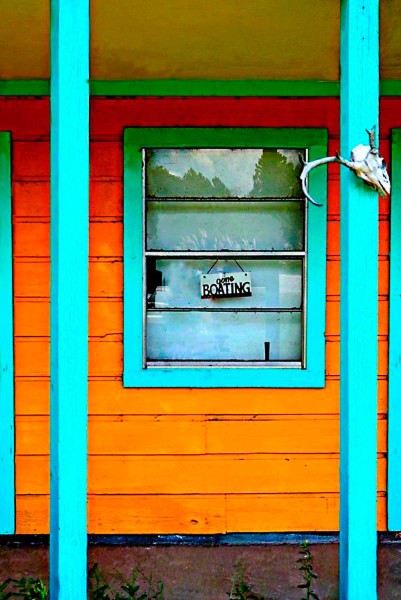
I’ve been able to motivate my students by talking about my personal project I’ve been working on for the past three years, and showing some of the results. I call my project “Window Dressings”. Here’s my essay and how it started:
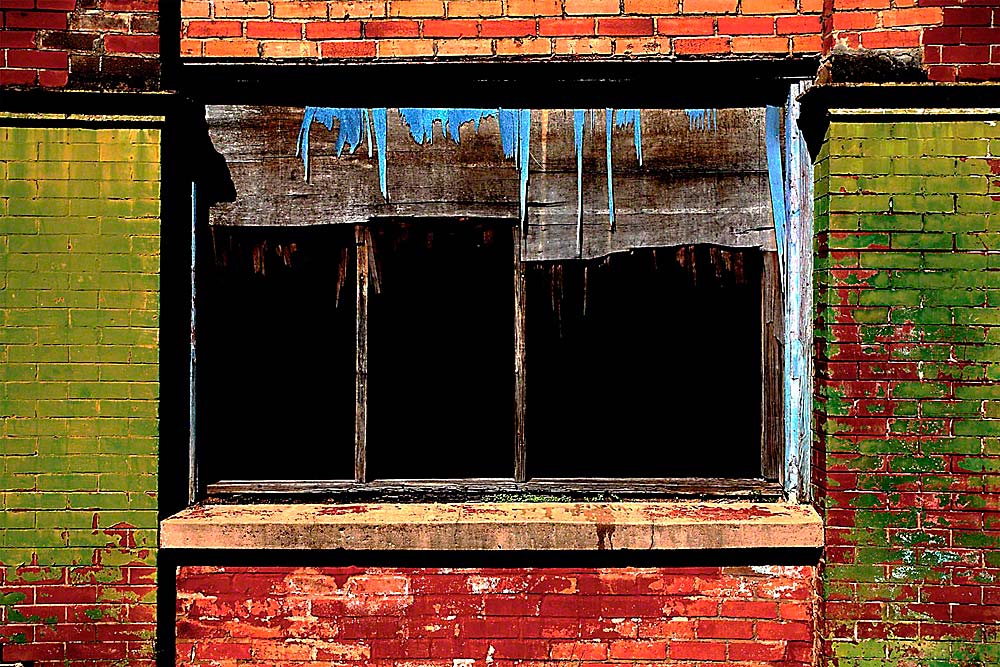
I started my series of windows three years ago quite by accident. I was driving to Nashville from Houston because my all-natural Bloody Mary Mix was included in the gift basket that was to be given to the presenters and award winners at the 2008 Country Music Awards. I had decided to drive to Nashville to take some extra time photographing the countryside. On the return, I drove through a small town in Mississippi looking for any interesting subject matter. As I was leaving town, I decided to take one final left turn before getting too far away from what was left of the downtown area. It was the face of serendipity screaming at me to pull over when I noticed an old deserted building that had an interesting front door.
It was enough to make me get out of my car and set up my equipment. Halfway through my setup, I became bored with the light since the door was in shadow and walked around the side where I saw several old and interesting windows that were in bright sunlight. I settled on one particular window, and even though it had weathered poorly through the years, there was something almost mystical about it; I knew I was onto something. It was one of those feelings you get when something affects you in such a way that it would wind up consuming the better part of your next three years…and still counting!
I finished and was breaking down my equipment when I noticed an old man, whose tattered clothes suggested that of a homeless person. After watching for a time, he approached me and asked if I would tell him why I was taking a picture of the windows. I said that I found them to be beautiful in their own way, and I wanted to make prints some day. He looked at me then the window, nodded and walked away. I called out to him and asked if he knew what this building use to be.
He stopped, turned around and with a mouth filled with a few remaining teeth said, “Sure, it was the bank. It’s where I kept all my money.” With that, he walked away.
Now when the urge hits me, I gather up my equipment and my dog Gertie, and we hit the road and begin “Window Shopping”. I rarely see anything worthwhile on the Interstates, but I use them to get to the small cities and smaller towns. There’s no rhyme or reason as to which exit I’ll take, and as far as which direction to turn once I’m off the Interstate it’s pretty much Eeny, Meeny, Miny Moe.
In just about every small town in Texas there is a square where all the roads coming in from each direction end up, and that’s where I head first. Starting from the square, I pick a direction and follow the road until I’ve been out of the town for several miles. Then I turn around, head back to the square and pick another direction. I keep doing that until I’ve exhausted every possible way in and out. This is usually where I have the most luck. That and the roads in-between each town usually affords the best chances to find that illusive window…that one in fifty, strong enough to make it onto my Canon 5D Mark II’s CF card.
So what’s my criterion for a keeper? It has to have at least six attributes going for it: Light, Color, Texture, Pattern, Shape, and Line.
As I always say to my online students with the BPSOP, and my “Stretching Your Frame of Mind” workshops I conduct around the planet, Light is everything. Unfortunately, I can’t always shoot at Golden Hour since I’m continuously driving to get as miles as I can in a day. A lot of the time I’m shooting in the middle of the day when the light is harsh. The key to this is to not show the sky and underexpose a lot, which isn’t much of a problem.
The Texture is important as I want the viewer to want to touch the windows. Patterns within the window are also important, and has the rhythm of the patterns been broken. Line is the most important of all the elements of visual design, so how the windows use line to take the viewer around the window, and the different types of lines are critical. Color is obviously the most important quality, and it takes more than a painted window against a painted wall for me to stop. How time has affected the color, if additional color was applied over the existing color, and how the different colors compliment one another are considered. The Shape of the window is also important. It’s amazing that when you start looking, how many sizes and shapes windows come in.
All I can think of after all these years is that I’m involved with some kind of weird and peculiar courtship with these windows. Each window has its own personality and winds up the way it does when all the criteria falls into place. Father Time aided by the elements, does its thing in transforming the windows into a cacophony of colors, shapes, lines, textures, and patterns.
The direction the window faces, how much of the day it’s in bright sun, is it exposed to the wind, all are important pieces of the puzzle in determining the final look of a window when I photograph it; result can be incredibly alluring. The decaying charm of a window that’s morphed into a “work of art” has a certain persona that needs no further explanation than to say that its beauty lies in the eyes and minds of the beholder.
Now as I travel throughout the states “window shopping”, I always try to imagine what the windows I photograph could tell me if they could speak. Did they look out at a backyard filled with the shrieks’ of children at play? Or the manly hoots and howls coming from a periodic family reunion, or birthday party?
The large majority of structures have long since been abandoned, and I can only wonder who the last person was to look out this particular window, and what they might have seen and thought before they left for good.
As is usually the case when I’m taking photographs, I am always searching for a unique angle or height when I’m out shooting; not this time as there is a voice that tells me not to distort the integrity of these amazing windows. Perhaps it’s the spirit of better days gone by.
These windows are photographed as they exist today, and use virtually no help from Photoshop. Three of my windows have made it into the permanent photography collection at the Museum of Fine Art in Houston, Texas.
Here are just a few of my windows. If you would like to see the entire collection of one hundred and sixty, you can go to: http://www.flickr.com/photos/78440307@N06/sets/72157629317463102
Prints of these windows are numbered and there’s only an edition of twenty-five. For more information, you can contact me at: joe@joebaraban.com.
Visit my website at: www.joebaraban.com, follow me on Instagram www.instagram.com/barabanjoe/, and check out both my mentoring program and my 2023 workshop schedule at the top of this blog. Come shoot with me sometime.
In my online class with the BPSOP, and in my “Stretching Your Frame of Mind” workshops I conduct around the planet, I’m always showing examples of my work to make a point or to illustrate one of the elements of Visual Design that we work on from day to day.
A lot of my examples were shot in the days of film so most of the time there wasn’t any post processing done to them. Since the majority of my students started shooting in the digital age where everyone thinks Lightroom and Photoshop are part of the photographic process, I get a lot of “WOW you’re kidding, these were all shot without any post processing?” I just love it when that happens!!!
Don’t get me wrong, I use Photoshop all the time. I probably do something to every photo I take now. However, I would much rather create my photos in the camera. to me that’s about being a good photographer and not a good computer artist or digital technician. I love the challenge, and when things are working out and I’m about to click the shutter having done everything (or most everything) beforehand, I get a pretty damn good feeling inside.
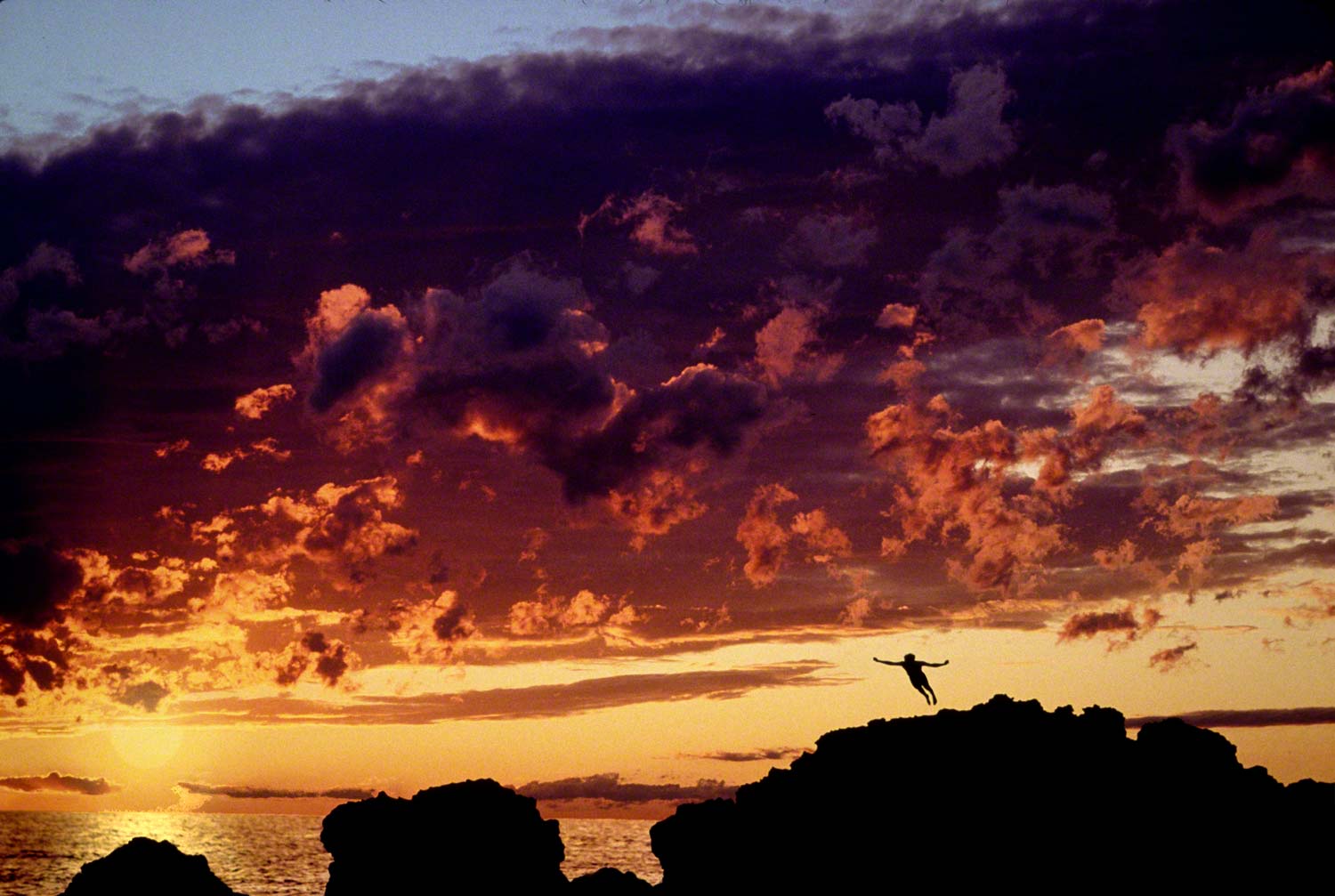
In the photo above, I was in Hawaii for five weeks shooting whatever I wanted for United Airline’s new advertising campaign. There was a template that had been approved ahead of time for the design of the ad, so I had to shoot photos that would fit into that template. Needless to say a dream project!!!
It was so long ago that I can’t remember what Island we were on (we shot on all of them), but we found a couple of divers that would work for us for a fee. I was set up on some rocks across this small area of water. It wasn’t very high up, it just appears that way.
My assistant was behind the rocks right nest to the divers. We each had walki-talkis so I could tell him when I was ready for one of them to dive. I would also have him direct the divers, for example having them keep their feet together and their hands spread out straight so they would be equal on both sides.
I saw this cloud moving fairly fast across the water from right to left, and became worried that it would finish the shoot by blocking the sun; I knew it was going to be close. I was hoping that the sun would drop enough to be under the cloud formation and not stop the shoot. What I didn’t realize is that when the sun did do as I was hoping, and fell below the cloud, it lit up the underneath like something I had never seen before.
I had my assistant tell these guys to dive as many times as they could, climb back up to the top and dive again. I was able to get two more dives apiece before the sun and the incredibly light was gone.
Needless to say I was worried. In the days before you could just look at the back of your camera, you had to have the perfect exposure and wait until you could send the film off to the lab. It sometimes became a nail biter. Sometimes you had to fly out not knowing you had captured it or not.
When I was able to go through all the film, I saw it…drinks were on the house!!!!
As one of the most famous photographers named Eddie Adams once said, “When you get lucky, be ready”.
Since I’m from the old School of Photography (you know the one, the school where you learned to do things “in the camera”, and as a result became a good photographer), I do my own ‘bracketing’.
Now, in the digital age of Photography, the ‘powers that be’ decided to help out and made it so that their cameras could do the work for you. The problem with that is that it’s not always in your best interest. Notwithstanding the important fact that you won’t have a clue as to what your camera is doing, and if it’s doing the right thing at the right time.
But I digress!!!
First, let me go back to the very beginning, as in the definition of ‘bracketing’. I know a lot of you will find it hard to believe, but there’s a lot of photographers out there that have no idea what I mean by ‘bracketing’. I know this because I conduct my “Stretching Your Frame of Mind” workshops around the planet, and also with a top online school called the BPSOP, so I periodically get this question.
Without further qualifications, Wikipedia’s definition of ‘bracketing’ usually refers to exposure bracketing: the photographer chooses to take one picture at a given exposure, one or more brighter, and one or more darker in order to select the most satisfactory image. Technically, this can be accomplished by changing either the shutter speed or the aperture. That is, if you’re shooting a subject or a landscape where the Depth of Field isn’t critical.
If the Depth of Field is important, you just want to bracket the shutter speed, and if the shutter speed is important, then you bracket the aperture. The point is to give yourself exposure options.
Ok, here’s an example:
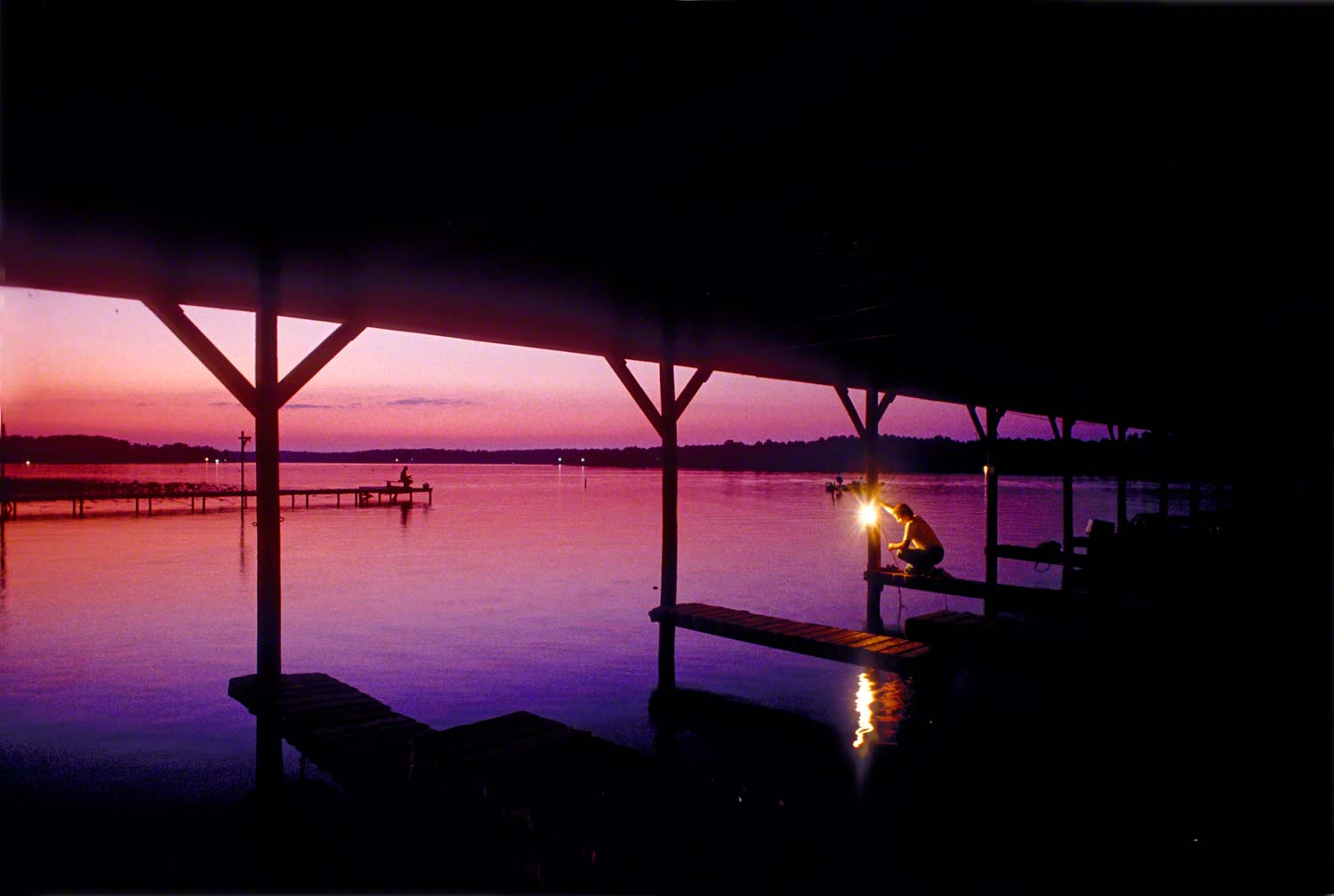
Knowing exactly (to the degree) where the sun was going to rise by using the combination of my Sunpath readings and my Morin 2000 Hand Bearing Compass, I set up beforehand to take a photo of a boy looking for something using a Coleman lantern. It was a few minutes after sunset when I began shooting, the light coming from the direction where the sun set was very soft and delicate. My Minolta One Degree Spot Meter (you can find them on e-Bay) told me that the exposure on the boy’s face lit by the lantern was 1/30th of a second at F11. If I had taken that one exposure, the odds of my picture looking good was very small. Vegas wouldn’t have taken that bet. So to make sure I had it “in the can”, I ‘bracketed’ the exposure the meter gave me. I took one photo at 1/30th at F11, and then I shot one at:
1/30th at F8
1/30th at F5.6
1/30th at F4
130th at F16
These were the settings to overexpose (brighten) the picture to make sure it didn’t come out too dark. If you notice, there is only one bracket that’s underexposed from the reading of F8; that would be F16. The reason is that because the light was so low and delicate, one stop under was more than enough to cover me.
Ok, another scenario:
If I had been there later in the afternoon when the sun was higher in the sky, and the light was much harsher I didn’t need to worry about my photo coming out too dark. I would have worried about it being too bright and washed out.
Then, my meter might have said something like 1/250th of a second at F8. In that scenario, I would want to bracket more on the underexposed side of F8, so my brackets would have been:
1/250th at F11
1/250th at F16
1/250th at F22
And one stop underexposed at 1/250th at F5.5, because more than likely I wouldn’t have to worry about my photo being too dark, only too bright.
The reason I do this manually, and with a hand held meter is because the meters in digital cameras are not accurate and not as precise.
A lot of my students set the meter in their camera to bracket automatically, but when you do that, it won’t consider the softness of the light. It’s going to bracket the same way all the time. Not the best way to take photos.
Over the years of bracketing, I can feel, sense, see, and read the light and know instinctively what to do. It’s about being a well-rounded photographer that understands the light, because in all my classes, I always tell people that “LIGHT IS EVERYTHING”, and when you find the Light you’ll find the shot.
BY THE WAY, The last thing you want to do is to change the bracketing sequence all the time. Especially when you have only seconds left of that “drop dead gorgeous light”.
That’s just not a good idea. Do you really want your camera to be in charge of how your photos turn out? I recently had a student tell me that she could only bracket three exposures because that’s what her camera would allow.
“YIKES”, I said to her. “Are you hearing yourself”, I continued. “What the camera allows? Do you have a place at the dinner table for your camera? I hope it’s at the head”.
If you ever want your photography to jump “up a notch”, I would strongly suggest that you take control.
Through the years, I’ve collected a lot of quotes that were said by an artist of some measure and how the quote relates to my way of thinking; especially how the quote fits into my three online classes with the BPSOP, and in my “Stretching Your Frame of Mind” workshops I conduct around the planet.
“ I always thought good photos were like good jokes. If you have to explain it, it just isn’t that good.” – Anonymous
One of the many discussions I have at least once if not a hundred times in my four-week classes with my fellow photographers is about making sure you’ve left the viewer with a clear understanding of what message you were trying to get across. I call it a “quick read”, and unless your image is an abstract, in which case you’re leaving the viewer to decide on what the photo is saying. You don’t want him/her walking away scratching their heads.
There’s always the possibility you’ll be standing next to your print at some exhibit or maybe even your camera club’s annual show where you’ll be able to talk about it. Sometimes it’s interesting to hear the story behind the photo and see the photo in a new light. But in most cases, a photo shouldn’t need a story to back it up. It has to speak for itself….as I said, a quick read.
Right before I click the shutter I always ask myself if the viewer is going to see and feel it the way I was experiencing it when I finished my composition and was ready to click the shutter. It’s like taking an out-of-body experience and putting your mind in the mind of the viewer. Then I can step back and see if I’m getting my message across.
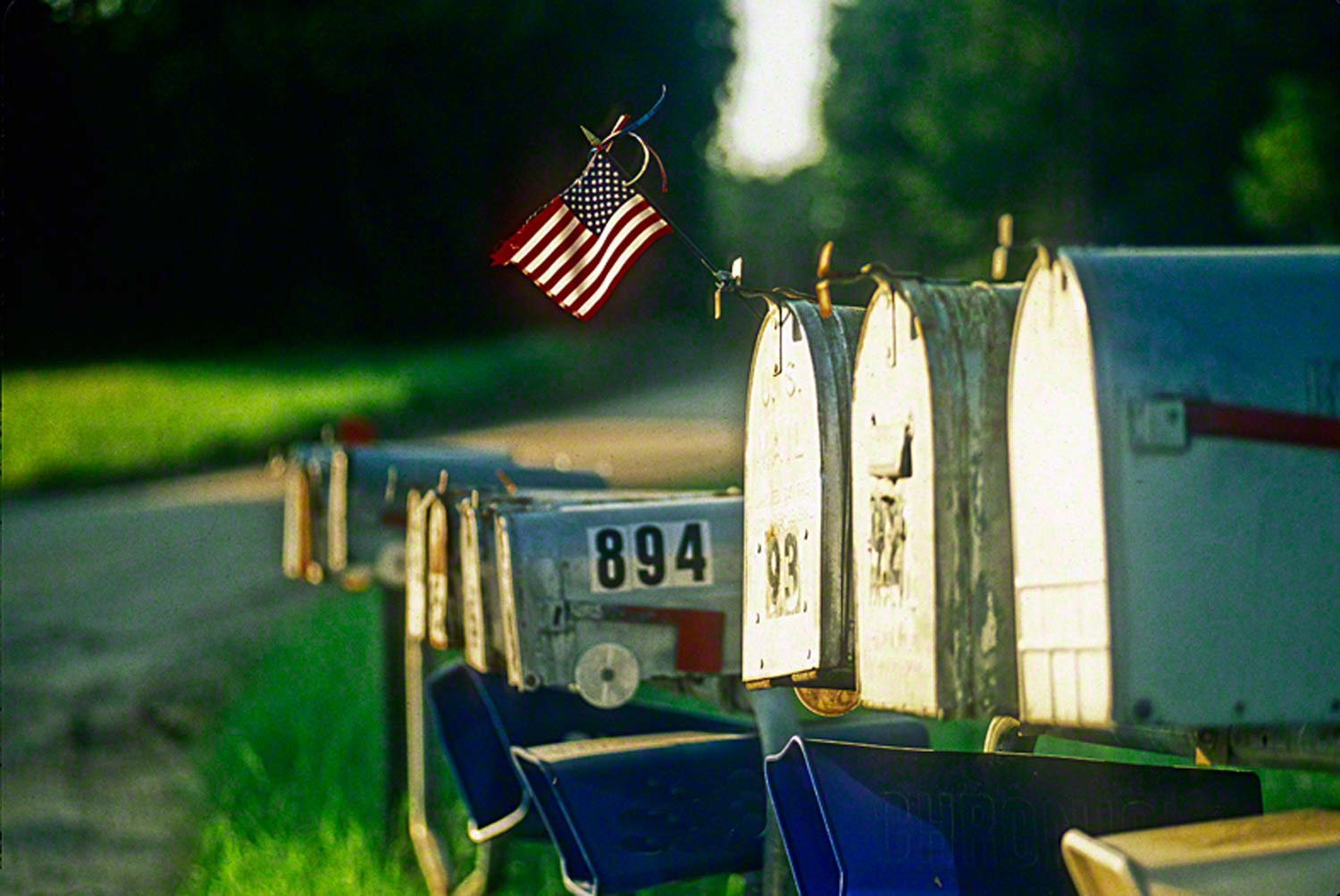
In the above photo, not very long after 9/11, I did a photo story on rural Texas, and how these people showed support for our country. In context with the other photos and subsequent text, I think the message came across as clear as day.
I teach three four-week classes with the BPSOP, and I also conduct my “Stretching Your Frame of Mind” workshops around the planet. Mostly in my online classes, I’m always telling my fellow photographers that just because it’s cold, gray, and sometimes raining when you want to shoot outdoors, that doesn’t mean you have to put your camera away until the sun comes out.
Think of locations that are indoors, for example, museums, churches, antique barns nearby, the lobbies of interesting buildings, historical homes, old train stations, etc. If you live in or just outside a big city, Google up the city or state’s Film Commission and or Tourist Bureau, and you’ll get a list of places that might just be the answer to your photographic woes.
Btw, Museums usually won’t let you take in tripods, so to get low light photos take a friend (another photographer) ) and use his/her shoulder to rest your camera on…works like a charm!!!
What about a farm nearby that you could get permission to shoot at. An old barn just might be a great place to spend some time in while you’re waiting for better weather. In fact, it would be a good place no matter what the light might be.
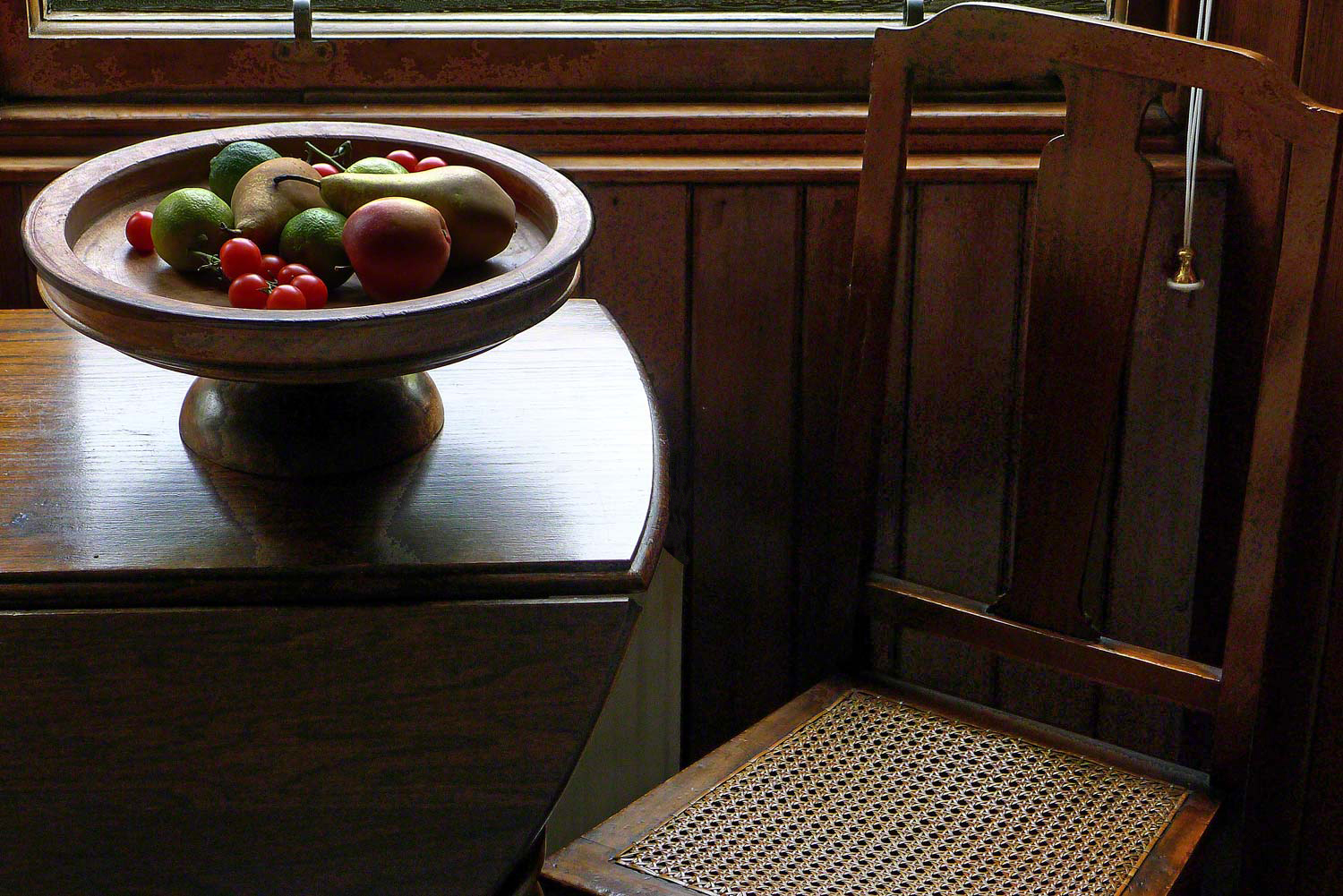
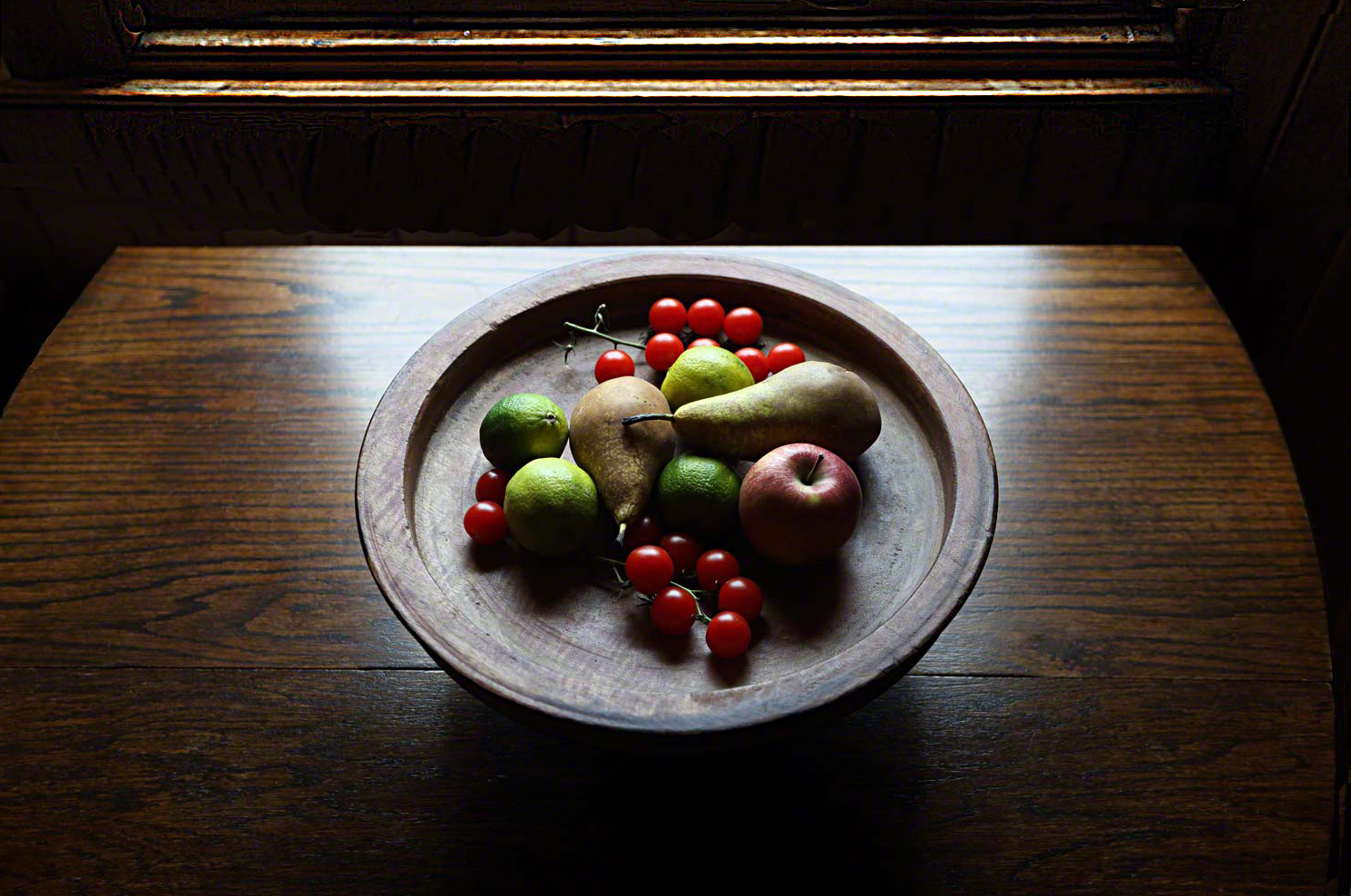
Sitting up a still life next to a window is always a good idea to pass the time; especially if it happens to be in an antique store or a house in a historical part of town. In the photo above, it was cold, gray, rainy, and all-around dreary outside of an old house in Scotland I happened to be in. I saw this bowl, then I happen to see a bunch of fruit in the corner of the kitchen. I put the two together by a window and the two hours I spent playing around with different compositions was a lot of fun…and took my mind away from the gloom outside the window; the glass of wine didn’t hurt!!!
There is a difference between looking at and looking into a picture . . . as Ansel Adams said.
It’s the difference between taking and making a photo, and as Bob Marley once said and I’ll paraphrase it ” Some people will just get wet when going out to shoot, while others will feel the rain while shooting in it.
I tell my online students that take my online classes with the BPSOP, and those that take my “Stretching Your Frame of Mind” workshops I conduct all over the place to take in the whole picture, from the foreground to the horizon.
Arranging your images this way will generate depth and by the use of a wide-angle lens, you can cheat the camera (by using all three dimensions) which has only one eye so it can only see in two dimensions.
This will initiate layers of interest, and by doing so, you keep the viewer around longer. I also speak of the importance of looking to the right, the left, and even behind you while walking. This way, you’ll be able to see in all four directions which will increase your odds of going home with a wall hanger by four.
When composing, I pre-visualize the composition before I ever bring the viewfinder up to my eyes. I don’t necessarily see what I want, sometimes I visualize what I’d like to see…but that’s another story.
So my fellow photographers, don’t just look at your picture which would constitute using the left side of your brain the analytical side, use the right side of your brain to compose, the creative side. This is the way to look into your photos and see what else is there.
When of the concepts I’m constantly talking about in my online classes with the BPSOP, and in my “Stretching Your Frame of Mind” workshops I conduct around Earth is that it’s better to ask someone to do something and as a result get the shot, or not ask and wind up with a snapshot.
I realize that it’s easier said than done, especially for those that for one reason or another find it difficult to approach someone. For some, it’s even hard to ask someone they know or along the ride with them.
My background is in part, that of a photojournalist so for me it’s very easy to ask. In my way of thinking, all they can do is to say no, in which case I move on. To a large extent, this is exactly what I say to my fellow photographers.
It’s all about getting over the hump, and there are numerous ‘humps’ that we try to get over. For example, the most common hump of them all is the hump that occurs on Wednesday…the proverbial hump day. Once you get past Wednesday, the middle of the week, you get to look forward to the weekend.
It’s the same thing in photography. Once you ask someone to do something for the first time, it gets easier and easier. Once you see the potential results, as in a good photo versus a snapshot, it really gets easier.
Sometimes it’s just having your subject look out of the frame, sit one seat over, or stand to the right or left. If you’ve ever seen the difference between asking something so simple, it will really build up your confidence.
One of the best ways to get what you want is to offer to send them a copy of the photo. I always ask for their email address so I can send a copy; sometimes they say yes, and sometimes no.
While we’re on the subject of asking, remember what I refer to as the cardinal sin, never, and I repeat never, take a picture of a child without asking permission. It can get you in a whole lot of unwelcomed trouble.
Here’s yet another in my series I call Life Before Photoshop. These images are from years of shooting when the word Adobe referred to a type of house in the Southwest; years before Photoshop, Lightroom, and any other software or plug-in you can readily find in the annals of those beloved magazines called Popular and Modern Photography. I’m hoping that they’re not the only source one has for important information.
As I often tell my online students with the BPSOP, and in my “Stretching Your Frame of Mind” workshops I conduct around the planet, I’m here to tell you that I’m far from a purist. I often use Photoshop to tweak an image of mine if I couldn’t achieve what I wanted “in the camera”. The majority of my fifty-plus years as a corporate, advertising and editorial photographer were spent without any help from a computer. For me, the challenge comes in creating an image that originated in my imagination and was transposed into a photograph before I clicked the shutter…not after. I want to be a good photographer, not a good digital technician; but that’s just me.
Over the past few years, I’ve come to realize that the digital world has made my fellow photographers lethargic and apathetic; in other words lazy. “Why worry about it now when I can fix it later” is a statement I’ve heard way too many times. I always thought photography was the art of making pictures, not being a very good computer artist??????? Go figure.
I digress again!!!
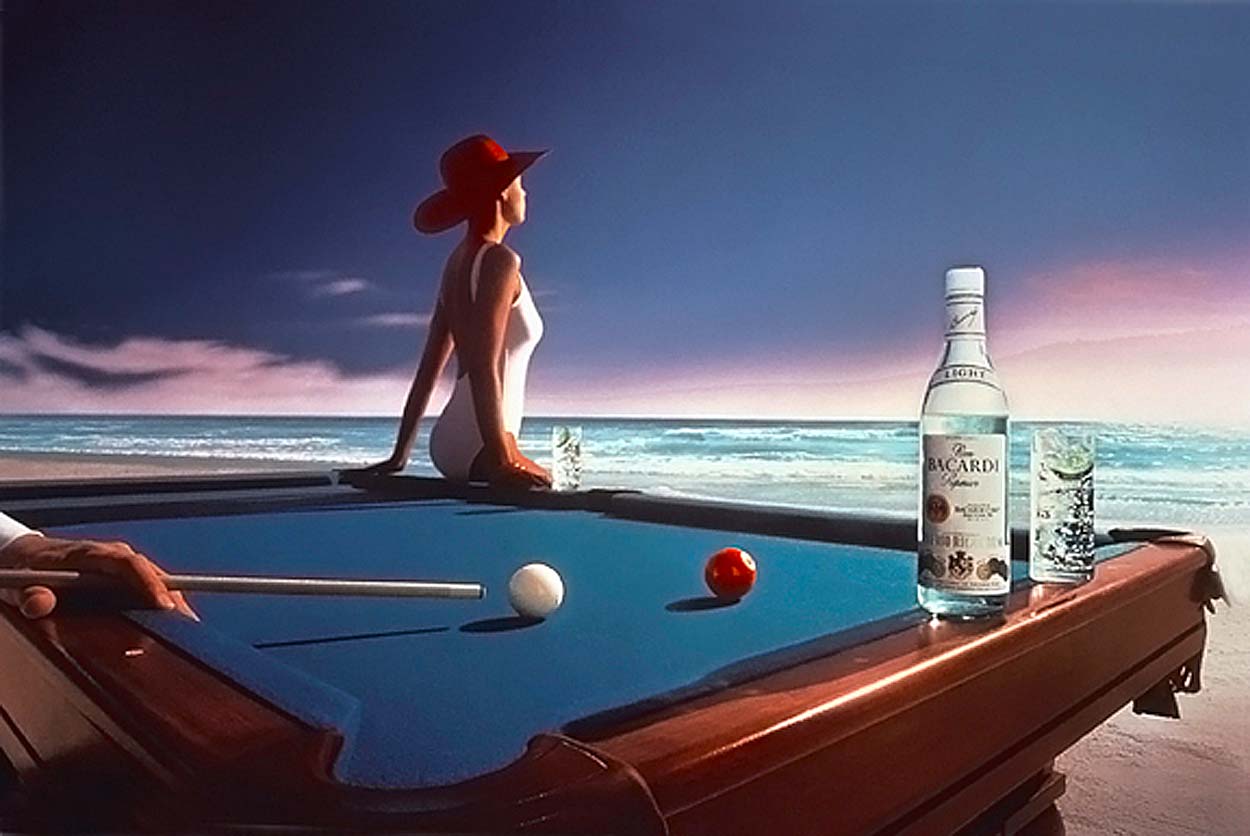
The above photo was taken for Bacardi Rum…unfortunately before a lot of my readers were born.
🙁
After an initial conversation with the Art director, I decided on shooting in Sarasota, Florida. I did this for the white sand and beautiful water. We started out early in the morning, and had the company transport the pool table and set it up on the beach. As you can imagine, this took several hours to set up, while about a hundred onlookers watched in disbelief. After determining where the sun was going to set with my Sunpath program and Morin2000 (hand-bearing compass), we started setting up the shot. Right as the sun was setting we started shooting and stopped when the last rays of sun slipped into the Gulf of Mexico. Everything you see was created in the camera.
The art director checks out the composition with Rum and coke as well as Rum and soda.
Btw, the model was Miss Bacardi for the year and was flown in from LA. Great looking but apparently dead from the neck up.
I constantly see my online students with the BPSOP and those that attend my “Stretching Your Frame of Mind” standing too far back from their subject. Most of the time it’s because they just don’t think about it. I’ve also been told that they are afraid or intimated to get too close. Then there are those that have admitted to being a touch on the lazy side.
There are two ways to look at it: If you’re content in making your goal to become a “halfway decent photographer” (as is the case of one of my students I talked to), then by all means continue on the path you’re currently on; you’ll be fine! On the other hand, if you’re goal is to become the best photographer you can be and work hard at taking your photos “up a notch”, then you’re going to have to get over the ‘hump’ concerning getting toooooo up close and personal.
Here’s what it can do for you: first, by getting up close and personal, you’re anchoring your subject in the foreground which in turn will create “layers of interest”. This is a key ingredient in Perspective by creating Depth. This is just one of the items you’ll find on the Artist Palette that I share with my students.
Second, by getting up close and personal, you can generate Visual Tension (another item on my Artist Palette) in one of two ways: Putting your subject close to the edge of your frame and minimizing the Negative Space between the subject and the edge of the frame. And last but certainly not least, by getting up close and personal you can hide the fact that you might be shooting on a gray day.
All these suggestions will keep the viewer looking at your photos longer by taking control of what he or she processes and perceives while they’re hanging around.
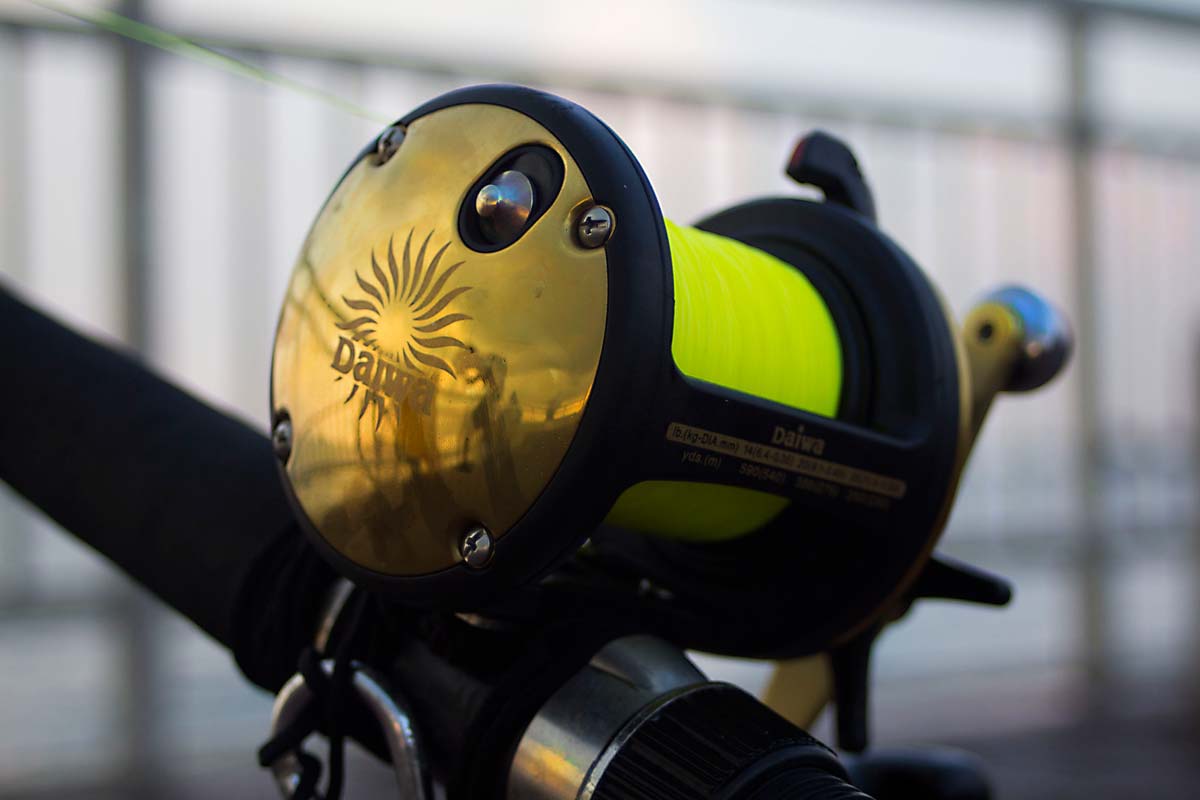
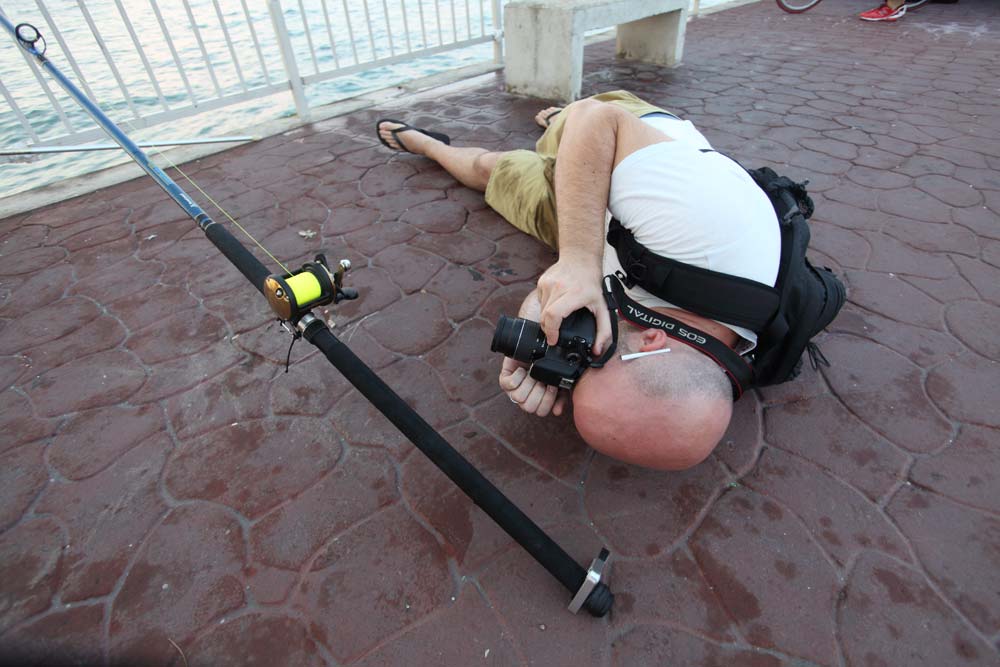
Andy, one of the students that took my workshop was shooting along with the rest of the class on a fishing pier, It was right after sunrise and the light was not very strong as it was hidden by clouds filled with water vapor. The water vapor that makes up the humidity is usually not a photographer’s friend.
Andy was taking a photo of a fishing rod and reel, but was too far back to create anything worthwhile…by his standards, not mine! Just too much gray and uninteresting environment. I walked up to Andy and reminded him of our discussion back in the classroom about getting close to his subject. He took my advice and was able to walk away with a fairly interesting photo. By getting close he was making pictures, not taking them.
The greater the conflict, the greater the tension.
As I tell my fellow photographers that either take my online classes with the BPSOP, or participate in one of my “Stretching Your Frame of Mind” workshops, we want our viewers to stick around as long as possible. The goal is to make them active participants when looking at our images.
I tell them that the greater the conflict, the greater the tension. Tension as in Visual Tension.
In my class on Gestalt, one of the six concepts is Figure-Ground. This is the way to separate the Figure, the subject, from the Ground, the background. If both the figure and the background each carry the same visual weight, it can create tension; as each threatens to overtake the other.
This happens the most when either the subject is dark against a lighter background, or the subject is light against a darker background. A great way to achieve this is to have the negative space as important as the positive space.
Contrast is also one of the ways. Putting bright highlights adjacent to the shadow area. Bright areas against very dark areas.
Diagonal lines have more energy than horizontal and vertical lines. The conflict is in the fact that diagonal lines are perceived as less stable and the feeling of the lines falling forward.
Having the subject either very close to the edge of the frame or partially out of the frame. It creates an uneasiness and draws the eye to it. When we generate Visual Tension, the viewer feels like there’s something going to happen.
As I said, all these examples will make the viewer stick around longer…exactly what we want him to do.
No, I’m not talking about the song Carly Simon sang in 1971…for those old enough to remember it. I’m talking about how the word anticipation plays a key role in “Street Shooting”.
In my online class with the BPSOP, and in my “Stretching Your Frame of Mind” workshops I conduct around the planet, I often talk about being aware of your surroundings at all times. This is when it will happen…that shot that could make your day!!!
I’m usually talking about keeping an eye out for the light, and how important it is in coming home with that elusive OMG photo. That keeper that will either go on your wall or in your portfolio…or both.
But in this post, I’m talking about anticipating the action. The action that can occur at any moment when you’re walking down a street looking for photo opts.
A good sports photographer knows the sport he’s covering backward and forwards. He knows it well enough to be playing in it, and at some level sometimes does. A good street shooter has that same instinct, or he at least should if he’s going to be successful.
I watch everything when I’m walking, and even have those proverbial “eyes in the back of my head”. If I see someone that’s sticking out of the environment around him for one reason or another, I’ll watch him/her for several minutes…with my camera halfway up my chest. If nothing happens, I’ll move on to someone else. Sooner or later I’ll see something that makes me focus in tight. I’ll watch and anticipate their next move. A move that I would maybe make myself. It’s people watching at its finest.
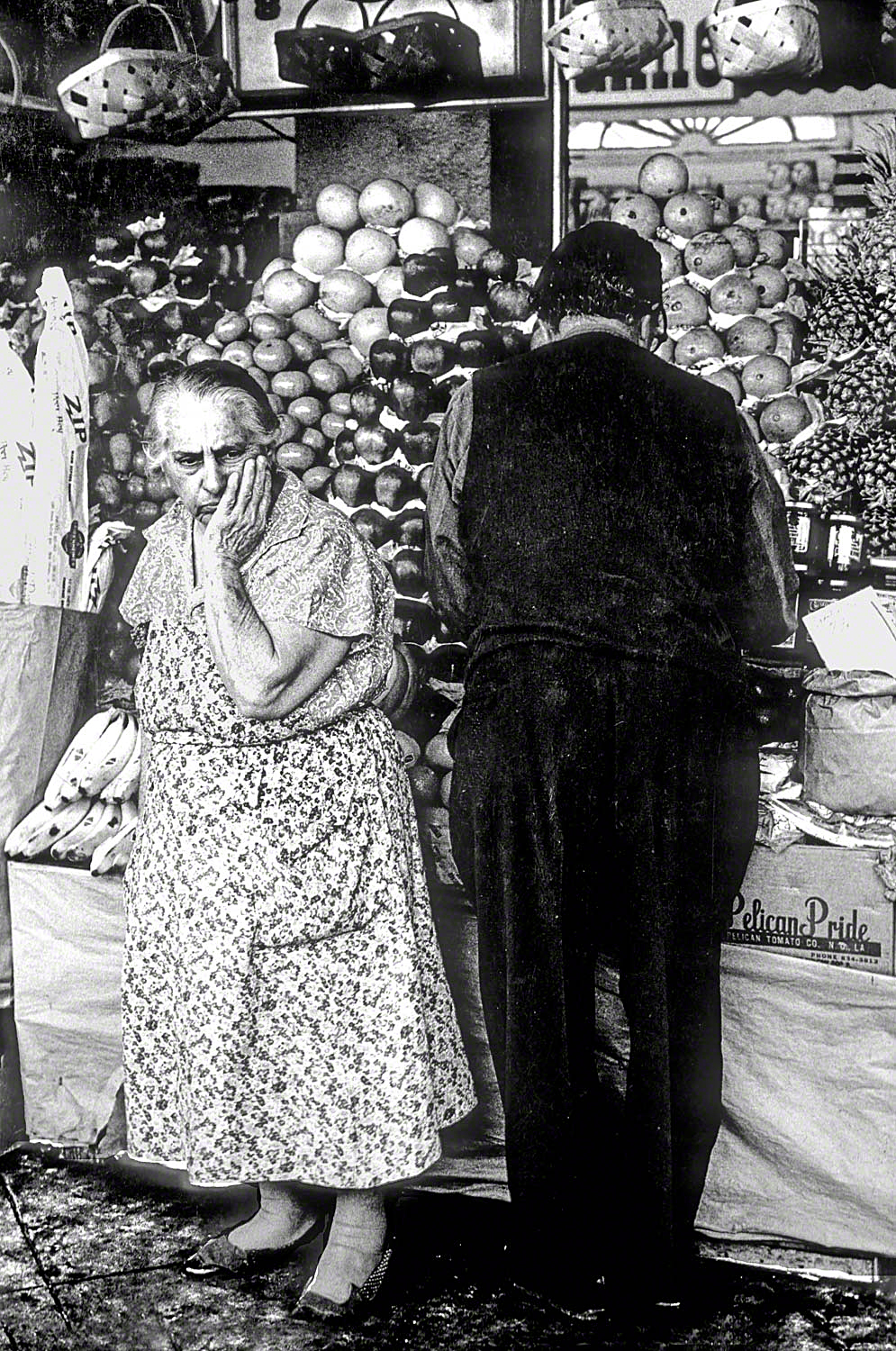
When I was younger and shot primarily B/W on the streets, I was always looking for that one shot, and if I was very lucky, and I mean very lucky, I might capture someone in a moment where they are expressing their thoughts in some form of body language or gesture. In the above photo, that’s exactly what happened. I was shooting and writing a story for a local Sunday supplement on Mardi Gras day and what the locals had to deal with as far as the crowded streets and sidewalks were concerned. I watched her for some time and just had a feeling that something was going to happen. In a brief moment she had summed up her day to me and because I had waited and anticipated I got the shot.
Btw, this photo is now in the permanent photography collection at the Museum of Fine Arts in Houston.
One of my favorite things to do is to put on my longest lens and then put the camera on a tripod. I’ll position myself in a crowded area and in a 360-degree movement I’ll pan the people. An analogy for you old movie buffs is watching Robert Mitchum in The Enemy Below when he’s in a submarine panning the horizon at periscope depth looking for targets…Ok, not actually an analogy, but for me, it’s mighty close.
I could literally do that for hours, and on occasion have come close.
Visit my website at: www.joebaraban.com, and follow me on Instagram… www.instagram.com/barabanjoe. Check out my workshop schedule at the top of this blog, and come shoot with me sometime.
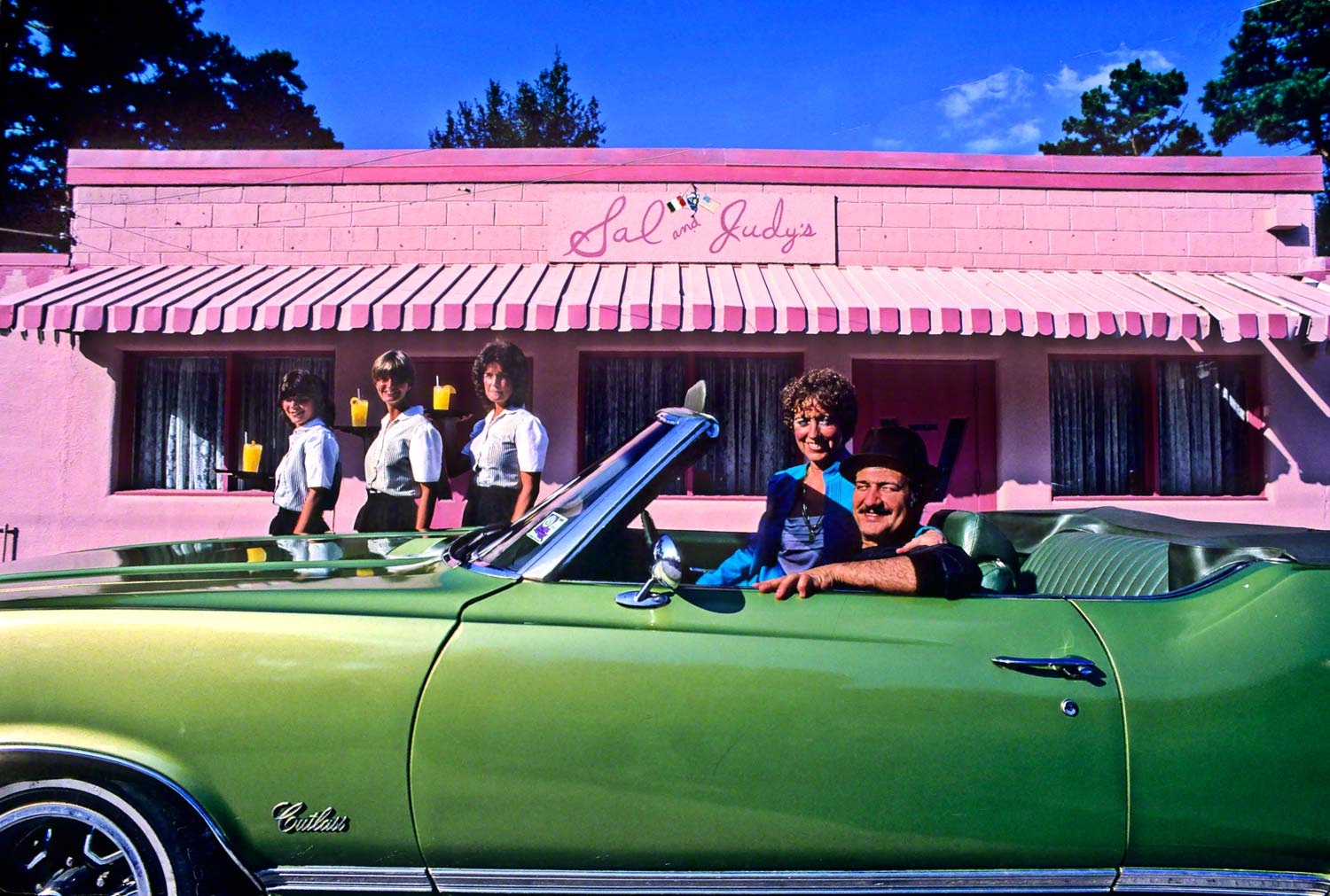
Years ago, I was asked to shoot a brochure for a printing company in New Orleans. The theme of the brochure was “something’s cooking at Upton”. The designer had me go to five of the best-known restaurants in and around the city; best known not to the tourists, but to the locals. I was to take a portrait of the owners and had received a free hand to approach the portraits in whatever manner I wanted.
As I tell my online students with the BPSOP, and in my “Stretching Your Frame of Mind” workshops I conduct around the planet, if you want to take your photography what I refer to as “up a notch”, scout your locations ahead of time. Know where the sun is going to be so you’re not somewhere at sunrise when you should have been there at sunset.
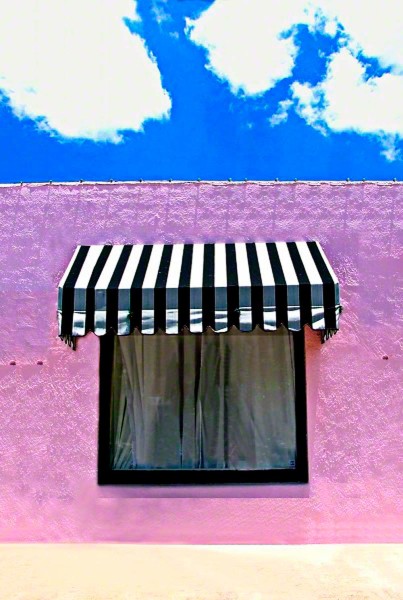
The fourth restaurant on my list was Sal & Judy’s Restaurant on the Southside of New Orleans. I went there the day before to meet the owners and to determine when the best time to shoot was going to be. I pulled up in front and the pink building hit me in the face. I was ecstatic!!! A pink building…wow!!! That faced West!!!
As I stood there an idea started to form in my mind. I tell my fellow photographers that if I can visualize a photo in my mind, given the time I can re-create it on film.
As I stood there I saw in my mind three bands of color spreading across the frame from left to right. I saw a band of blue (the sky), a band of pink (the building), and I needed a third band of color. something that would tie it all together…including the portrait of Sal and Judy…an idea leaped out from my mind.
I introduced myself to Sal and told him I was the one sent to take his and his wife’s portrait. I asked him if he knew anyone that had a green convertible, thinking that the odds were not in my favor. He looked surprised and said, “Well hell yes, I have one”. This was way tooooo good to be true I said to myself.
“What do you own?” I said to Sal. “A 1966 Oldsmobile Cutlass Convertible”, Sal replied. I thought I was hearing things!!! I asked him if he would bring it the next day, and explained my idea. I told Sal what to wear and to have his wife wear something that would go with the green car. When they showed up driving the car, I knew I had struck pay dirt…a portrait for my portfolio.
As I started shooting, one of the waitresses came out to tell Judy something. I immediately saw her black and white striped uniform and knew what I had to do …to add a “layer of Interest”. I had all three women come out with a screwdriver on their trays to add yet another splotch of color.
It was great fun and it reminded me of the days before photography when I was an art major studying painting and design. I was still painting, only I had changed the medium from a paintbrush to a camera.
🙂
Visit my website at: www.joebaraban.com, and follow me on Instagram. check out my workshop schedule and come shoot with me sometime.
 Whenever I write one of these posts it takes me back to the days when I was traveling two hundred twenty-five days out of the year, and loving it. I was fortunate enough to hook up with some of the very best graphic designers in the country if not the world, and a whole lot of them were working in Texas; Houston, Dallas, and Austin to be exact.