famous photo quotes

My Favorite Quotes: Christine Lavin
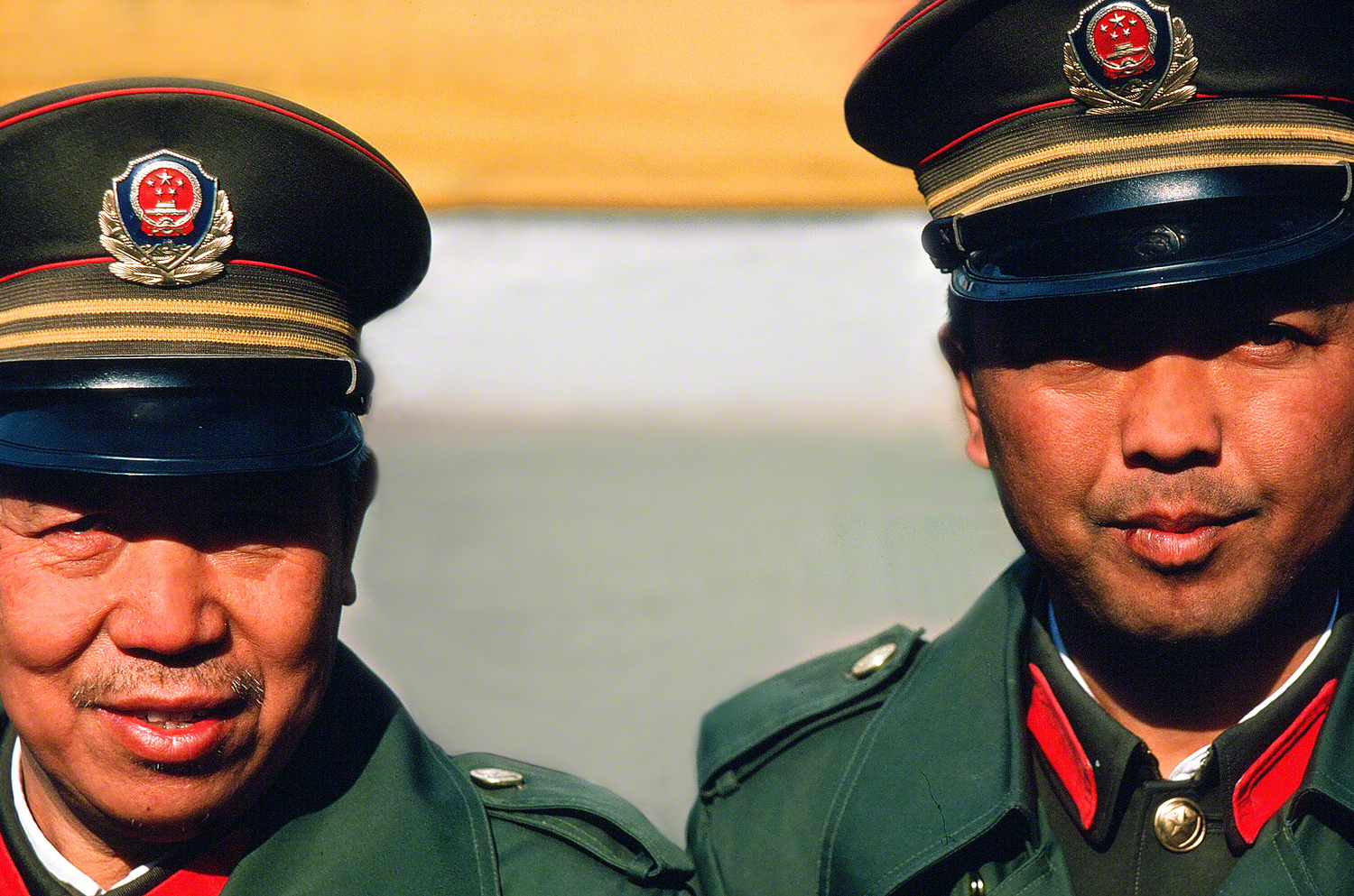
Unusual portrait compositions keep me from falling into a rut.

First I wanted to let some of you know that originally had an interest, because of a family issue my completely full workshop with William Yu photographing the flooded rice terraces in China has two openings. This is a once in a lifetime opportunity to see places you only see in National Geographic and shoot with me. Check it out: Yunnan China with William Yu

Ok, Christine Lavin is a New York City based singer songwriter best known for her contemporary folk music. Christine once said, ” There’s a fine line between a rut and a groove”. So how does this translate to the Art of Photography? The best way to explain is through real life examples, and I’ve heard maybe not all of them, but a good many.

For the past six years I’ve taught a couple of classes for the BPSOP, and since 1983, I’ve been conducting my “Stretching Your Frame of Mind” workshops around our ever changing ( 🙁 ) planet; critiquing lots of photos.

Some of my fellow photographers insist in only shooting either one way or one particular subject. For example, shooting everything with a 50MMF/1.4 prime lens, or taking pictures of nothing but dead flowers…yes, dead flowers!!!

That’s all well and good, but what might happen is that the groove you think you’re in suddenly becomes a rut, and because of the comfort level you’ve created and the security you think surrounds you it’s had to break out of it.

That prime lens I just mentioned is difficult to use, in the sense that most people shoot on a program and your photos wind up having the same look…sharp on the subject ( not all the time), and everything else out of focus; one of many reasons I don’t own one.

Don’t get me wrong as I like that look, but just not all the time. I can tell you from years of looking at photographer’s photos, most of the time they don’t even know what’s going to be in focus and what won’t be.

Btw, this happens because a friend has talked someone into buying this lens and that someone has no idea how it works; thus perpetuating the rut.

A groove is a good thing as long as that same someone realizes when to implement that 50mm lens or when to include dead flowers into their composition. As they say, there’s a time and place for everything.

Don’t fall into that trap. Shoot with different lens, at different F/stops. Broaden your visual horizon, open your eyes to the incredible amount of subject matter that is in front, on either side, and behind you: don’t forget my 25X4=100 rule!!!

Visual input is a part of our everyday life, and as photographers we need to embrace what we perceive and translate it into to images that will keep the viewer asking for more.

Visit my website at: www.joebaraban.com, and check out my workshop schedule at the top of this blog. Come shoot with me some time. This coming January Along with William Yu, I’ll be taking a group to China to photograph the flooded rice terraces and also the tribal villages. Next February in conjunction with the Santa Fe Workshops, I’ll be returning to Cuba for the fourth time. My next springtime workshop will Berlin next May; an incredibly beautiful city.

If you send me a photo and question, I’ll create a video critique for you: AskJoeB@gmail.com.

JoeB
My Favorite Quotes: A Photographer’s Creed

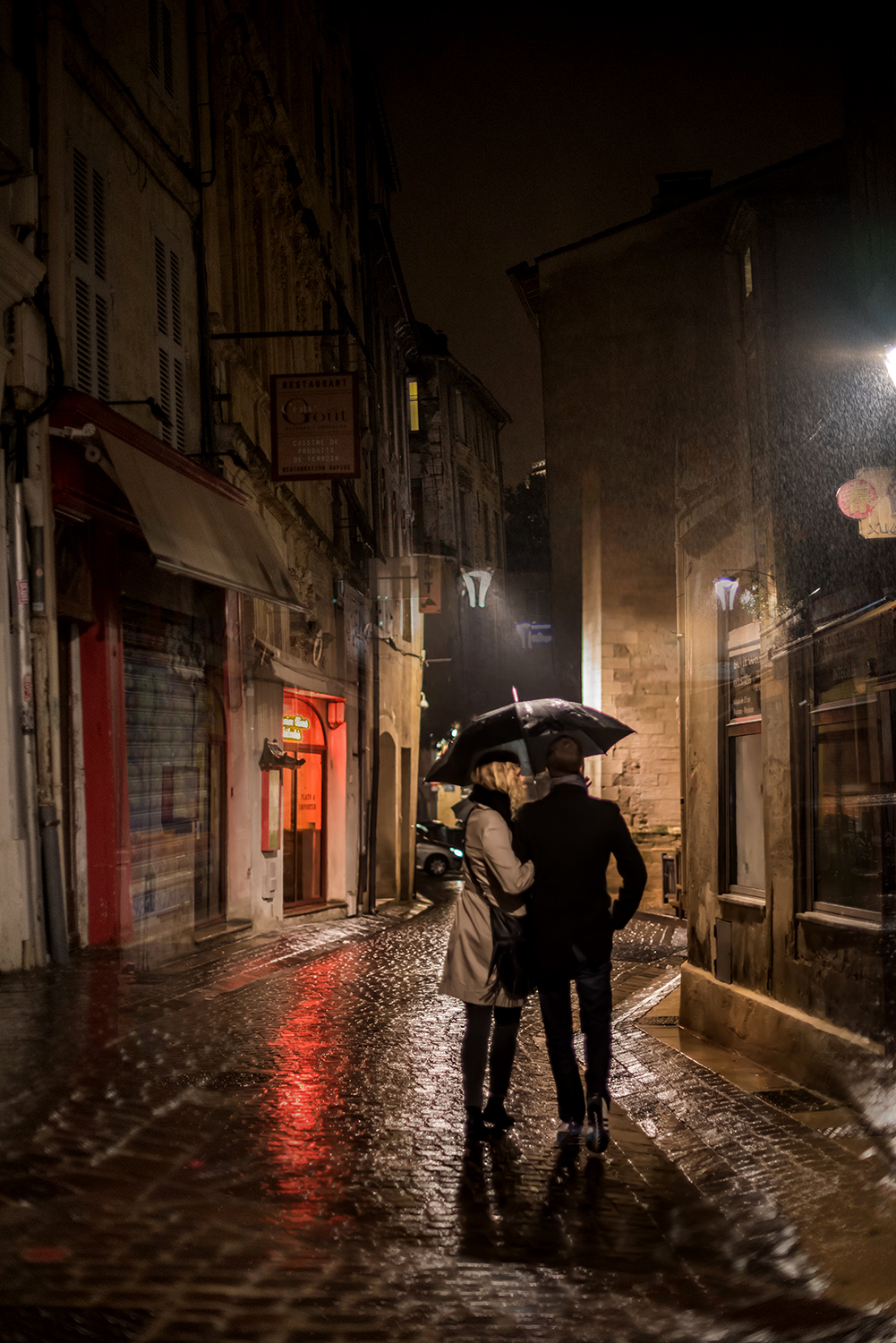
A rainy night in Paris.

“Neither rain, nor snow, nor sleet, nor hail shall keep the photographers from their appointed shoots”.

You might have heard something similar before?? Maybe something like this, “Neither rain, nor snow, nor sleet, nor hail shall keep the postmen from their appointed rounds”.

No matter, I still like it the way I say it; it certainly has more meaning this way…why you ask?

I teach online classes with the BPSOP, and I also conduct my “Stretching Your Frame of Mind” workshops around the planet. If I’ve heard it once, I’ve heard it a thousand times…”It was raining so I didn’t go out”…or “too cold and snowing so I figured there was nothing to shoot”. How about this one, “It was too hot and sunny to get anything good”…I won’t even spend time on that one!!!

I’ve had several photographers do as I have suggested, and as a result have dried out (hopefully in some bar) while looking back at all the great images they shot; and can pat themselves on the back for taking. The above photo for example that was taken in France by a friend, student, and very good photographer. She put on a rain coat for the camera and for herself then went out in the rain. As you can see from the photo above, it was well worth it. It shows desire…a desire to take great photos!!

Btw, sleet, hail, lightening, Hurricanes, and last but not least tornadoes just might be five good reasons to stay indoors…and shoot pictures!!!

I digress.

Rain (misting, drizzling to light) and snow (any type) are great reasons to go out because they can provide you with opportunities that you could never get otherwise. When I think of rain, I think of reflections.I think of going somewhere where there’s a multitude of colorful lights so I can get them reflecting in the wet streets; one of the ways to generate Visual Tension is to show a subject and it’s reflection.

I think of taking a big black umbrella and a volunteer to walk along, holding it while I shooting her or him. This usually will cost me a nice dinner in a warm, cozy restaurant. You can also save the money for dinner by shooting in a city that’s meant to be walked in, i.e. New York, San Francisco, Charlotte, New Orleans, Paris, London. I’ve shot in these cities when it was either cold and raining, day or night; people are still out and about…don’t forget about dense fog for a great way to come back with a wall-hanger.

If you want to create images that have lots of visual interest, these are certainly some of the times to go out. Put on a raincoat, put your camera in a rain pouch and go out. Or to save some money get a large zip lock storage bag, cut a hole to put your lens through and go out.

Some of the best images you’ll ever take will be under these conditions, so do yourself a huge favor and give it a shot!!!

Neither you or your camera will melt.

Btw, it’s really not the mailman’s creed, nor does it have any official status.

Visit my website at: www.joebaraban.com, and check out my workshop schedule at the top of this blog. Come shoot with me sometime. On July 30th I begin my 29th year at the Maine Media Workshops. I’ve had the same week since the beginning. It’s the week of the Lobster Festival down the road in Rockland. It offers a completely different set of photo ops than one would expect when coming to photograph the coastline, lighthouses, and fishing villages of Maine. Come join me and spend a week completely immersed in your love for photography.

Send me a photo and question to: AskJoeB@gmail.com, and I’ll create a video critique for you.

JoeB

My Favorite Quotes: Three Dog Night

One is a lonely number.

Coming back from a road trip to Dallas, I was listening to a classic hits channel on Sirius-XM. One of my all time favorite bands played one of my favorite songs. It was Three Dog Night and they were playing, “One is the loneliest number”.

As is usually the case (I was not driving) I closed my eyes and listened, but this time I was conjuring up past photos that I’ve taken as I was singing along in my mind. It’s a great way to produce ideas that I can write about on my blog, and also show the way I like to send out messages via photos to the viewer.

I’m a firm believer in the psychology of Gestalt, and in my online classes with the BPSOP, and in my “Stretching Your Frame of Mind”, I often show photographers how to incorporate these concepts into their imagery.

It’s so important to think about how we manage what the viewer perceives and processes when looking at the visual information we lay out to him in the form of a photograph. One of my favorite ways to manage said information is through one of the six concepts called Figure-Ground, and I’ve talked about several ways in past posts.

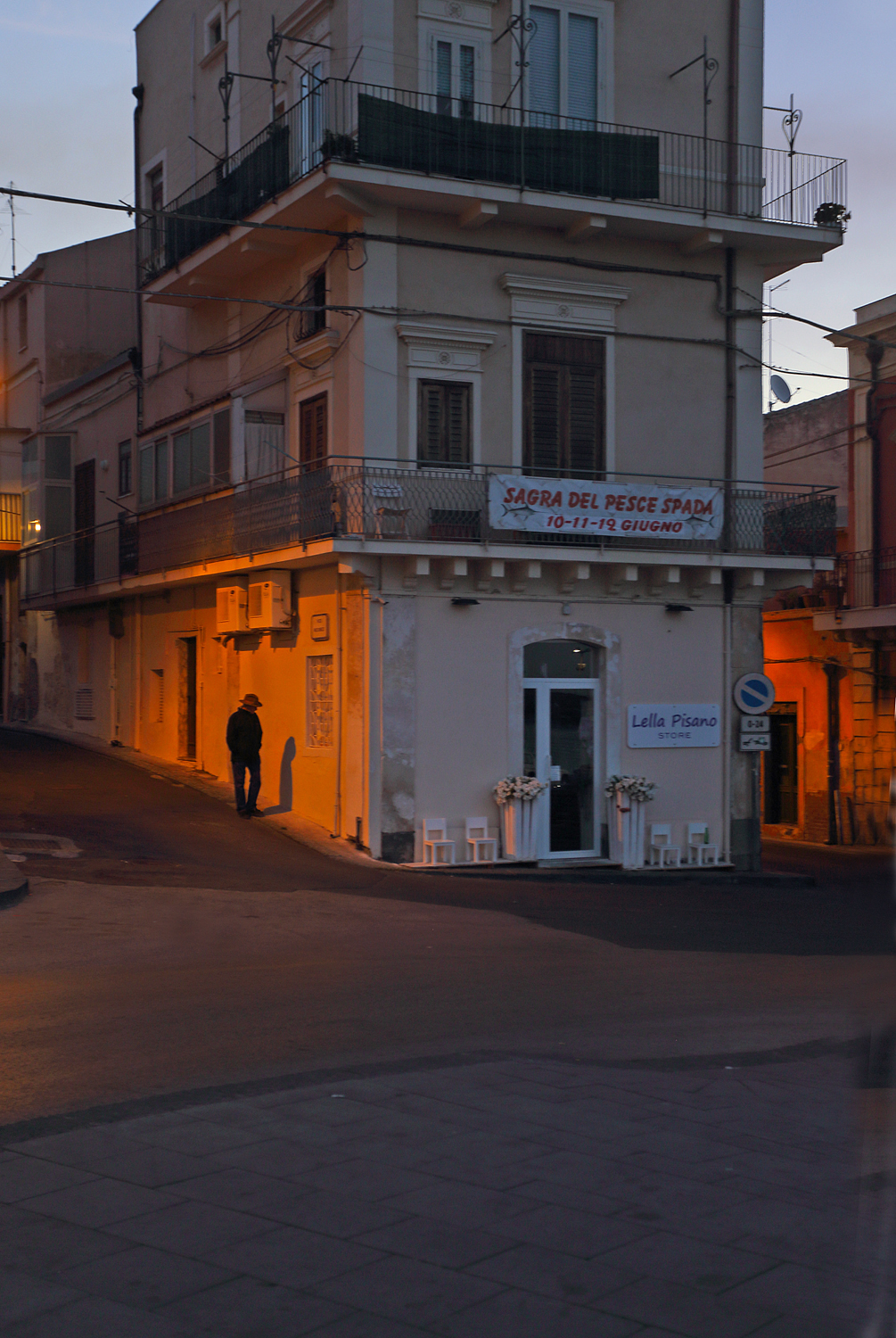
People like to see people in photographs, and I like putting them in to also show scale. I also like to create a mood, and there’s nothing better to do just that as to use the light to your advantage and to isolate one individual; creating the feeling of the Figure (the subject) being small and lonely…or being alone. By making the Ground (the background) the overwhelming part of your composition, this message will come across to the viewer.

Btw, by definition, Figure-ground refers to the relationship between an object or subject and its surroundings.

As far as the photo above, one morning I took my fellow photographers that joined me for my “Springtime in Sicily” to Acitrezza, a small fishing village north of Catania. It was before sunrise so we were looking around for silhouettes to put against the sky that had not yet seen the morning sun; one of my favorite ways to spend the pre-dawn moments.

I noticed this intersection and the unusual light cast on the streets from above. I immediately visualized one lonely person walking under the street lights before people came out to start their daily routines; I thought about my song, “One is the loneliest number that you’ll ever do”.

Since I rarely see what I want, I photographed what I wanted to see by having one of the non-shooting spouses go over and slowly walk down the street for me. As you can see it worked perfectly, and sent the message I wanted to the viewer.

FYI, for those that also love the song, here it is: One is the loneliest number.

Visit my website at: www.joebaraban.com, and check out my workshop schedule at the top of this blog. Come shoot with me sometime. On July 30th I begin my 29th year at the Maine Media Workshops. I’ve had the same week since the beginning. It’s the week of the Lobster Festival down the road in Rockland. It offers a completely different set of photo ops than one would expect when coming to photograph the coastline, lighthouses, and fishing villages of Maine. Come join me and spend a week completely immersed in your love for photography.

Send me a photo and question to: AskJoeB@gmail.com, and I’ll create a video critique for you.

JoeB

My Favorite Quotes: Oscar Wilde

Not what I saw, but what I wanted to see.

I just love this category since it affords me time for research as well as just keeping my ear to the ground to pick up bits of valuable information.

A lot of my research comes from the fact that I read, and I read everything from fiction, non-fiction, biographies, history, and just about anything and everything that strikes my fancy.

Years ago I first got acquainted with Oscar Wilde while reading his only novel, The Picture of Dorian Gray. He once said, ” No great artist ever sees things as they really are. If he did, he would cease to be an artist”.

I teach online classes with the BPSOP, and I also conduct my “Stretching Your Frame of Mind” workshops around out planet. I tell my fellow photographers that we are all artists, and that instead of a paintbrush we use a camera to create our works of art.

A camera on a tripod is very much like a blank canvas on an easel, with one big difference. Photography is the art of subtraction, and when your camera is on a tripod you eliminate things in your composition until your satisfied enough to click the shutter. A blank canvas on an easel allows you to keep adding pigment until you’re satisfied enough to seek out a mat and frame.

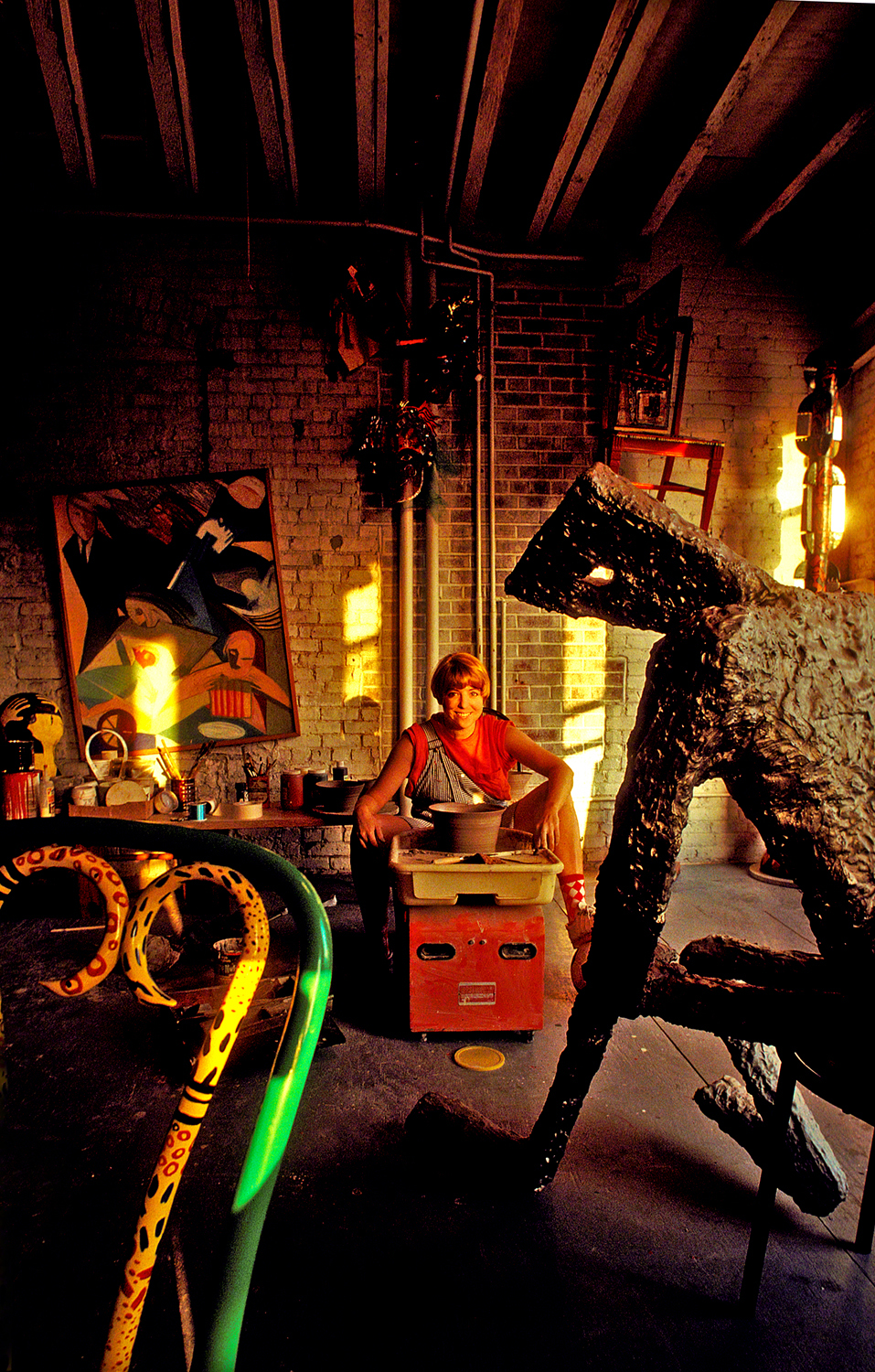
In the above photo, I was sent to take a portrait of this woman who at that time was a big time player in computer software and was the go-to person for many of the Fortune 500 companies. The advertising campaign was about what several of these well-known people did in their spare time; being involved in their hobby. In her case she was a fairly well-known artist in her own right and the powers that be wanted an environmental  portrait taken in her art studio.

When I got there I discovered that she was in the middle of a major cleaning so her art and furniture were literally mixed together and piled on top of one another; pushed against the far side of her space. The only window in the studio, where I wanted to put her, was on the other end and surrounded by empty space…as in nothing there at all.

I stood there and envisioned something entirely different than what I was really seeing. I put my camera on my tripod as if it was a blank canvas on my easel and began to paint. I carefully moved pieces over and as I looked threw the camera’ viewfinder arranged them in front of the camera to the chair, s well as on the wall. The chair I put against the wall and next to the window where she was going to be seated.

I can tell you that the end results would have looked a lot different if I had seen things as they really were. I don’t take pictures of what I see, I take pictures of what I’d like to see. It’s not ‘what is’ to me, but what could be.

Visit my website at: www.joebaraban.com, and check out my workshop schedule at the top of this blog. Come shoot with me sometime. On July 30th I begin my 29th year at the Maine Media Workshops. I’ve had the same week since the beginning. It’s the week of the Lobster Festival down the road in Rockland. It offers a completely different set of photo ops than one would expect when coming to photograph the coastline, lighthouses, and fishing villages of Maine. Come join me and spend a week completely immersed in your love for photography.

Don’t forget to send me a photo and question to: AskJoeB@gmail.com, and I create a video critique for you.

JoeB

My Favorite Quotes: Helen Keller

It was 1899 and I was Edgar Degas

As the people that follow my blog know by now, not all my favorite quotes have been said by photographers. There have been several that have been said by painters, writers, and musicians, all artists in their own right.

After recently reading an article about the work Helen Keller did, I started reading some of her quotes, and one in particular stood out to me as having a profound effect on not only my photography but in my teachings as well.

First, it’s important to give you the true meaning of the word Vision since several of my online students with the BPSOP, and my “Stretching Your Frame of Mind” workshop participants can sometimes confuse a word that actually might mean something else; something I have done from time to time.

[vizhuh n]

noun

1. the act or power of sensing with the eyes; sight.

2. the act or power of anticipating that which will or may come to be.

3. an experience in which a personage, thing, or event appears vividly or credibly to the mind, although not actually present, often under the influence of a divine or other agency: a heavenly messenger appearing in a vision.

4. something seen or otherwise perceived during such an experience: The vision revealed its message.

5. a vivid, imaginative conception or anticipation.

Btw, I like number three, but so far after nearly fifty years of being a photographer, I’ve never had a heavenly messenger appear in my composition as a vision; which is unfortunate.
🙁

Helen Keller said, “The only thing worse than being blind is having sight but no vision”.

One would have to agree that vision is imperative and what fuels the engine that pushes creativity forward. The sad part is that with the coming of the digital age, some of my fellow photographers don’t rely on their personal vision, instead they count on their computer to create their imagery which over time will make them really good computer artists…and if that’s your thing, to each his own.

What the computer can do is important to this new age, and it should never be said that I don’t appreciate it, but to me it should be used to add the finishing touches, i.e., contrast, lighten or darken,  occasional sharpening, etc.. Those things that can enhance an already strong photo made before the shutter is depressed.

This is where vision comes into play, and what you can do to create strong images before the fact. This is all about definition number two, and what I want to write about: the act or power of anticipating that which will or may come to be”.

There are photographers (great photographers) out there, many of them teaching that photograph what they see and never looks for anything else. In other words what is will always be just that. To add or alter anything when composing is strictly against their beliefs, and to that they call themselves purists.

The funny part is that they have no compunction when it comes to sitting in front of their computers and altering the light, color, saturation, shadows, and some even apply some weird trick they picked up in one of the thousands of plug-ins available to them; and then there’s the crop and straightening tools!!!!!

Since I’ve never cropped one of my photos in nearly fifty years I can’t even or don’t ever want to think about that…but I digress.

Don’t photograph what is, photograph what could be, and that’s what my definition of vision is all about. I’m not talking about vision in Fine Art photography in this context, which I plan on talking about in upcoming posts. I’m talking about images that exist in nature and are readily available for all to see if you set your mind to seeing them. This is the kind of vision I’m talking about.

You can actually practice in your spare time!!! How???

Suppose you’re walking down a pier very early one sunny morning and you immediately stop to take a photo of a Vanishing Point created by the converging lines of the two sides of the railings extending out from either side of you.

Without any hesitation you quickly take the shot and now you have created a photo that via a Vanishing Point, leads the viewer down to the end where the two lines meet on the horizon exactly where the sun is coming up; a great photo by all accounts.

Now, you’re standing there and if you’re like me you wish that there had been a fisherman at the end of the pier, silhouetted against a warm, soft, and beautiful sun minutes after breaking the horizon.

Or what if you were walking in a park late one Fall afternoon and you noticed a bench next to a winding path covered with leaves painted by mother nature with every color known to happen during the peak days of Autumn. You bring your camera up to your eye and take a picture; another good photo albeit fairly predictable.

Again, if you were like me and were on your knees up close and personal to the texture and patterns of the leaves, you might have wished there was an elderly couple sitting at the other end of the bench feeding a group of pigeons that were milling around next to their feet.

These are the thoughts that are always running through my imagination when I’m out shooting. I think of various scenarios because it’s a way of exercising my mind, because you just never know when an opportunity might come up. An opportunity that will change a good photo into a special one.

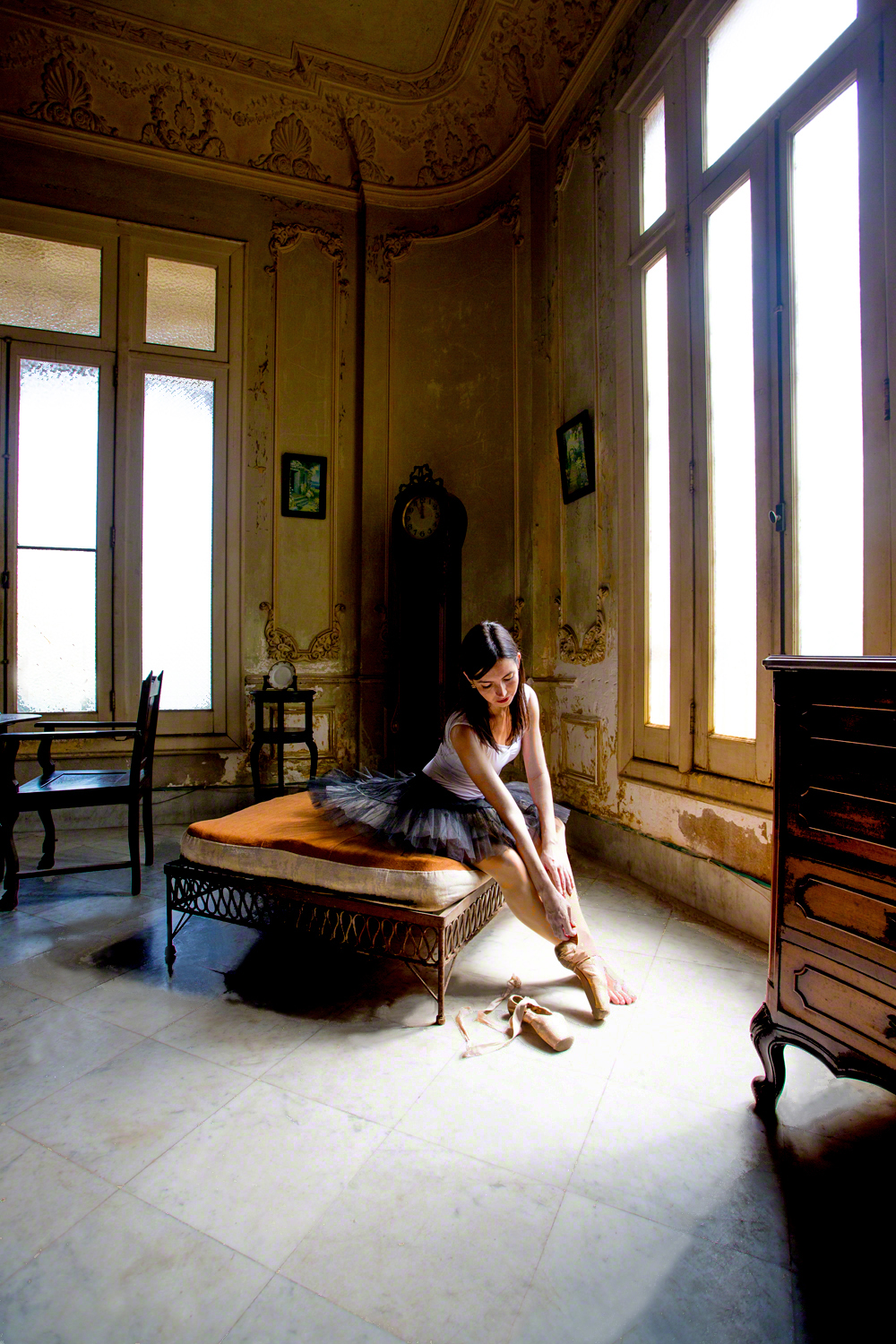
In the above photo, While shooting in Cuba I saw this woman just finishing up posing for other photographers in an old house. I immediately envisioned Degas paintings of the ballerinas. At that memorable moment I led her into another room, had her sit and take off her slippers; it was 1899 and I was Edgar Degas.!!!

Give it a try sometime. Think of yourself as a painter instead of a photographer. Your camera on  tripod is a blank canvas on an easel; use it to color outside the lines.

Come join me this coming July 30th at the Maine Media Workshops; for my twenty-ninth year. It’s a great way to completely immerse yourself for a week.

Visit my website at: www.joebaraban.com and check out my 2017 workshop schedule at the top of this blog. Come paint with me sometime.

Send me a photo and question to: AskJoeB@gmail.com, and I’ll create a video critique for you.

JoeB

My Favorite Quotes: Henri Matisse

Coloring outside the lines takes courage.

I’ve enjoyed writing poss for this category for some time, the first one going back three years. As my fellow photographers that follow my blog know, I don’t limit these quotes to just photographers. Artists of all types and genres are my sources, and as long as their quotes make an impact (as it relates to teaching) on me, then I want to share it with everyone.

My background is in painting and design, so part of my education was spent in Art History; specifically in the study of painting. Among my favorites was the French painter Henri Matisse. Not only known for his use of color, but he was also a printmaker and sculptor. Matisse once said, “Creativity takes courage”.

Until the death of Bryan Peterson, the founder of BPSOP, (the Bryan Peterson school of photography) of which I taught at since 2011, I had often talked to photographers that took my online classes, and my “Stretching Your Frame of Mind” workshops I still conduct around our planet, about stepping out from the coattails of photography past and present and those that would lead you down the path to mediocrity; and photographic purgatory.

I’m talking about those that follow (with the strictest regularity) rules meant to hinder any chance to being creative; they are the shackles of any original artistry. Creative in the sense of following your own path instead of those others have blazed a million years before..at least during the onset of camera clubs…and now the ruts are are beginning to be too deep to climb out of.

Coloring outsides the lines instead of listening to bad advise offered by those that are too afraid to do so themselves takes courage. We have become a  nation of sheep, and find it easier to go with the flow than follow the beat of a different drummer.

For the most part, I’ve found that photographers want/need  to be safe in their approach to creativity and strive for that first, second, or third place ribbon awarded to those that follow the rules laid out in their respective clubs; or perhaps a big smile and gentle pat on the back from friends or family members…that love you unconditionally.

Without the revolution started by these influential impressionist painters: Pisarro, Monet, Degas, Renoir, and Bazille, art may have never been so radically changed; they challenged the art world and although scorned at first finally won. As photographers we should consider ourselves as painters who have chosen a camera as our medium; our cameras on a tripod is the same as a blank canvas on an easel.

Break all those silly rules that I’m sure all of you at one time or another have either read about or someone has been whispering in your ear; for the most part it’s really bad advice.  If your photos are constantly being degraded from fellow photo club members because they don’t follow their rules…start your own club and enlist only those that dare to be courageous.

FYI, I know of people that have done just that.

Visit my website at: www.joebaraban.com and check out my 2016-17 workshop at the top of this blog. Come shoot with me sometime and we’ll be creative together.

Don’t forget to send me a photo and question to; AskjoeB@gmail.com and I’ll create a video critique for you.

JoeB

My Favorite Quote: Dr. John

At the right place at the right time.

I just love working on this category, and when I hear, see, or read something that directly relates to information I’ve been sharing  with my fellow photographers that take my online class with the BPSOP or my “Stretching Your Frame of Mind” workshops I conduct around our planet, it really makes me smile!!

One of my all time favorite singers is Dr. John, a Rock and Roll Hall of Fame legend from New Orleans. One of my all time favorite songs he wrote is “Right Place Wrong Time”, and of all the quotes I’ve been sharing with all of you this one probably means the most to me.

It hits home because of the one and only time (a million years ago) I showed up at a location at sunrise all ready to shoot, only to discover that the location only received light at sunset. It wouldn’t have been quite so bad had I shown up alone with my assistants but noooooooooooo…the Art Director, agency account executive, and last but certainly nor least was the client!!!!

We were at the right place at the wrong time!!! What did I do you ask? With my tail between my legs we all got back in our cars went back to the hotel and waited until sunset. It was a bummer extraordinaire.

🙁

From that moment on I made a promise to myself that it would never happen to me again, and to this day ( a million years later) it hasn’t.

Right place, right time

There’s two different way I approach photography: The first is if I’m just walking around a city in the US or some village in Europe or Asia either by myself or with a group from one of my workshops. If I was able to scout the locations ahead of time to see when it received the best light for the longest time all the better; if not I just showed up and just made do with the light we had.

A lot of the time we were there mid morning to mid afternoon when the sun was at it’s zenith, and for the most part it was fine as most of these old medieval towns or Asian villages had narrow streets with tall buildings surrounding them. The best advice I had at that point was to look for areas in shadow and use the contrast between light and dark to their advantage.

The second approach is the more serious approach and that is to scout all my locations ahead of time to determine exactly where the sun will come up and go down to the degree; as well as knowing where it will be all day.

For as long as I can remember I’ve been using a program called Sunpath, and a hand bearing compass called a Morin2000. It’s a far better combination that one of those apps you put on your phone…far more accurate and it’s great when shooting indoors with window light.

I don’t want to be at a location at sunrise when I should have been there at sunset. Depending on the subject matter, the idea, and the location, I might want to backlight, but on the other hand side light might be the best way to achieve what I want. If I’m really lucky, I might be able to do both.

Scouting ahead of time will also enable me to develop a shot list. Let’s say for example I’m at a large marina that’s nestled into the side of a small group of hills. My first shots would be as close to those hills as possible, then as the sun began to drop behind those same hills I would want to get as far away from the hills as I could which would by me some more time before losing the light altogether.

Always at the right place ,at the right time.

Let’s also say that the mega-yacht I’m suppose to shoot is moored close to the end of the marina and even closer to the hills. If the sun is coming up right behind the hills, early morning light won’t be hitting the vessel until mid morning. I don’t want to be there at sunrise, I need to be there at sunset so that late afternoon light (golden hour) will be hitting the yacht.

So, my fellow photographers the best advice I could give you is to make sure you don’t show up all excited and ready to shoot great photos only to discover that your morning has been a waste of time…be prepared!

For those of you that would like to see where my epiphany, my sudden insight into this post came from, click on this link: https://www.youtube.com/watch?v=Y6RtVmc5dSE

Visit my website at: www.joebaraban.com and check out my upcoming workshops at the top of this blog. Come shoot with me sometime.

I have added a new workshop to my 2016 schedule. On September 21st, ten photographers will get together with me at my evening “meet and greet” to begin a fantastic five-day workshop in New York, New York. Check out my description at the top of this blog. Come shoot with me.

Keep sending in your photos and questions to: AskJoeB@gmail.com and I’ll create a video critique for you.

JoeB