famous photo quotes

My Favorite Quotes: Unknown

Try looking at what's above you.
Try looking at what’s above you.

Every so often, I like to submit a quote to all my fellow photographers out there. These are quotes I’ve written down over time that I find from all different sources, and don’t necessarily come from photographers. It’s kind of a library of thoughts I’ve accumulated that were said at one time or another sometimes going back at least a hundred years. By now I know most of these quotes from memory and I’ll refer back to one when the timing is right.

It’s a pity that this author is unknown since it’s one of my all time favorites. At some point in time, someone once said, “If you always do what you did, you’ll always get what you got”.

In my online class with the BPSOP, and in my “Stretching Your Frame of Mind” workshops I conduct around our planet, I’m constantly working with people that have a particular way of looking at things. A particular way of composing, and a whole lot of them live by the rules laid down by people that only require you to  achieve mediocrity.

It’s all about coloring outside the lines, and looking at new ways of seeing things. It’s  about going out and forgetting about putting your subject in one of the intersections required by the Rule of Thirds. It’s about not worrying that your subject is leaving the frame instead of making sure there’s plenty of room for your subject to walk into.

When you go out shooting. leave the left side of your brain at home. That’s the analytical side that only sees a tree. Go out with the right side of your brain turned on, that way you’ll see a tree but you also see the texture of the bark, the shapes created by the leaves, the Negative space between the leaves that defines them. Study the way the light falls on the tree, whether front, side or backlit.

Off a car’s hood

If you’ve always brought the camera up to your eye and composed from that height, try getting on your knees. Lay on your stomach and get some dirt on your shirt. Follow the light and let it be your guide as far as where to stand in relation to the subject.

Stop fearing shadows, instead embrace them because they are your best friend. Don’t leave just because the sun has gone down. Shoot in the blue hour, using silhouettes as your center of interest.

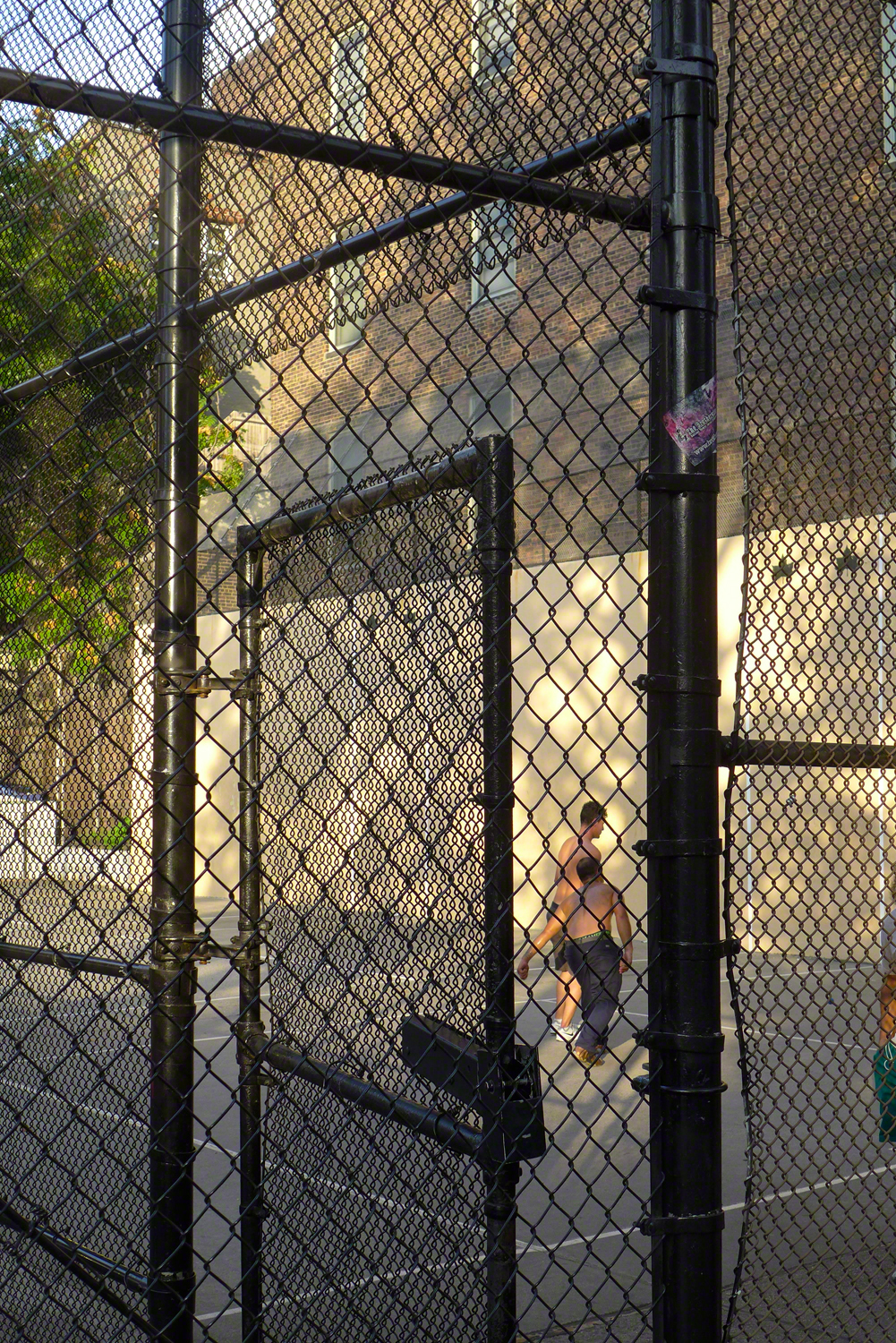
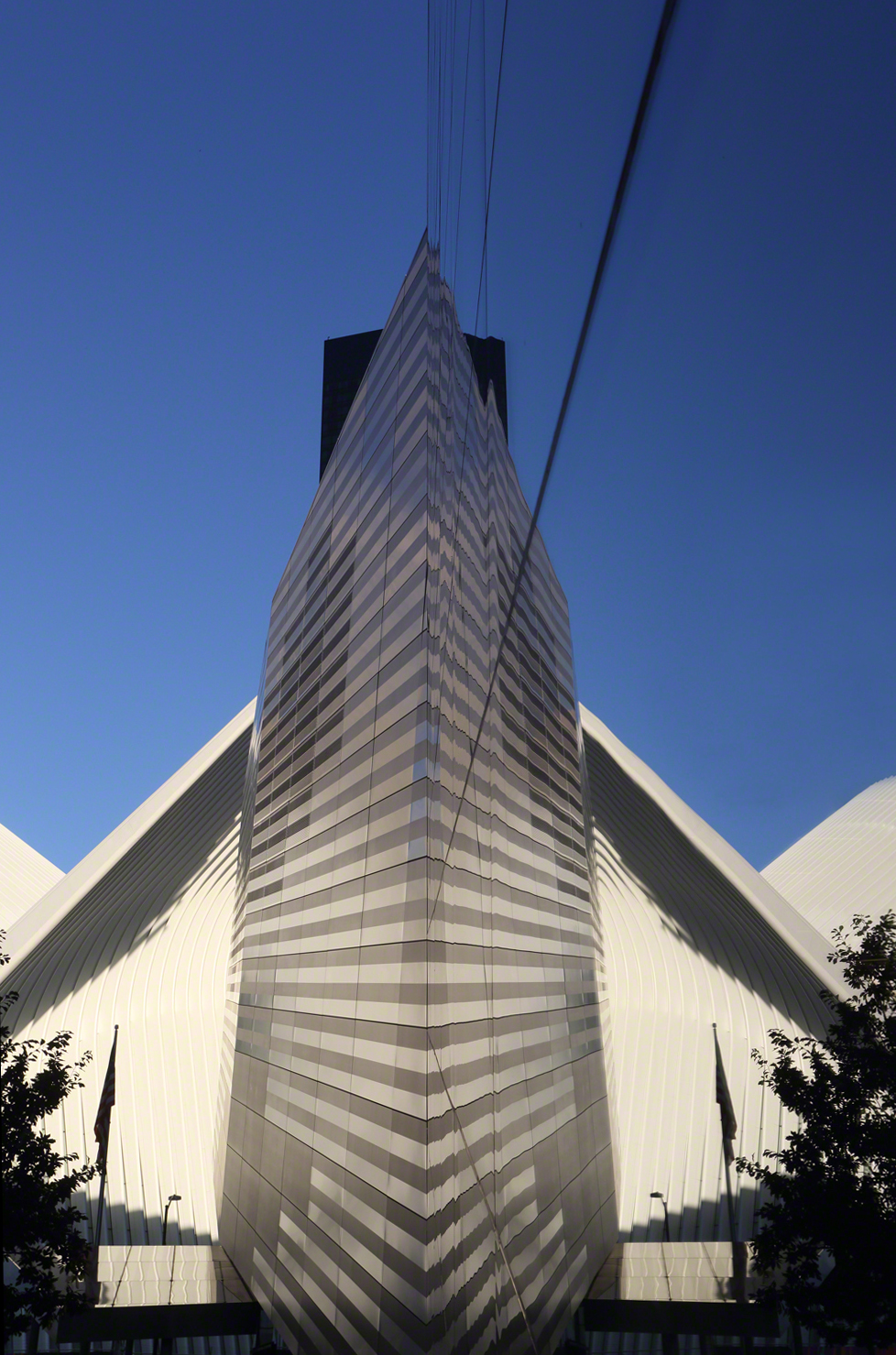
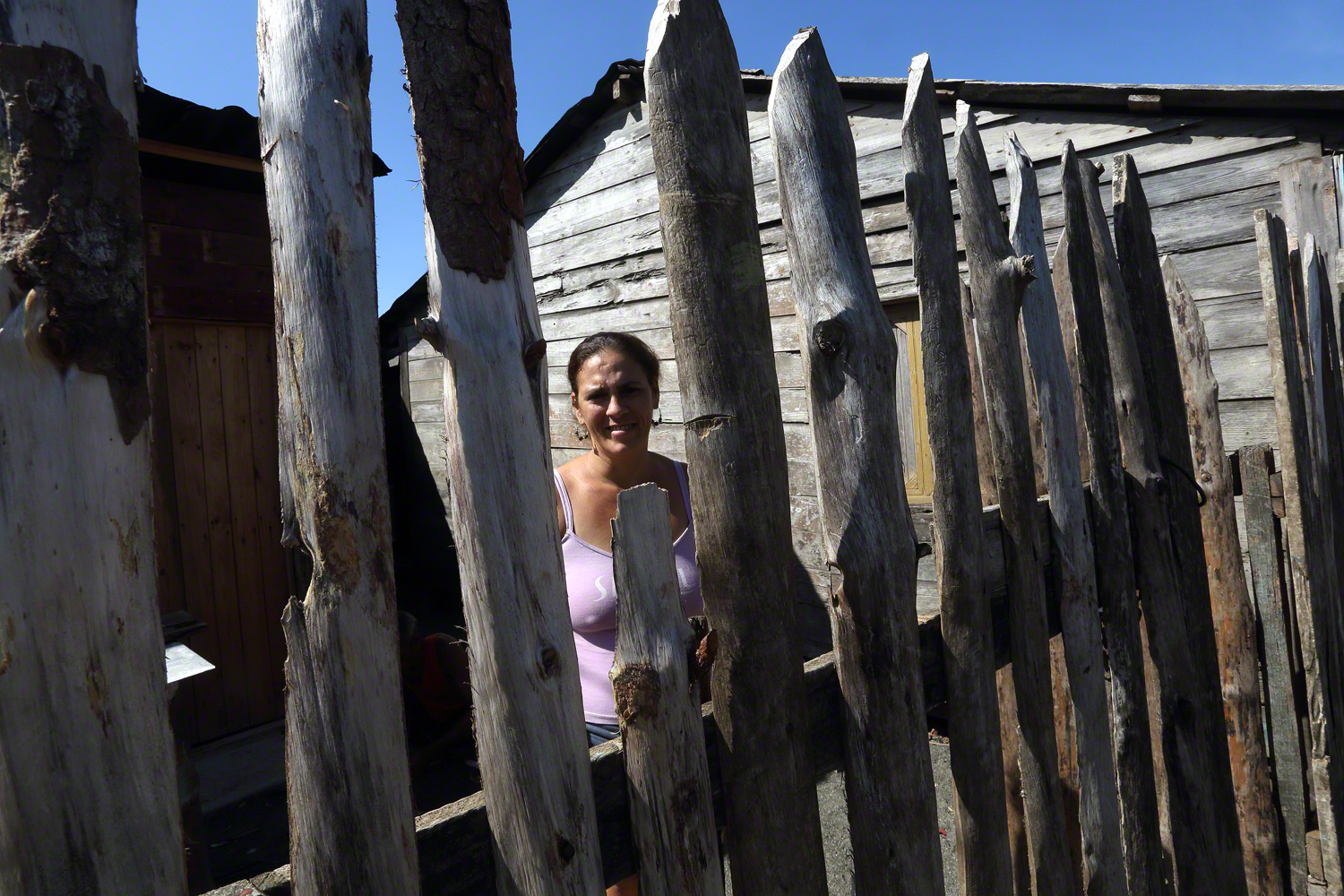
Try shooting through things, or shooting the reflections coming off buildings or glass. When you’re walking around looking for subject matter, don’t just look straight ahead; make your field of vision 360 degrees. Look from the ground in front of you to the sky above you because you just never know what you might see happening.

Instead of going out shooting after breakfast or before dinner, go out before breakfast and after dinner. This is when the light is the best.

If you try some of these ideas, I can guarantee you that your images will begin to go (what I always refer to) up a notch. Stop doing what you’ve always done so you can stop getting what you’ve always got.

Visit my new website at: www.joebaraban.com, and check out my workshop schedule at the top of this blog. I have added a new workshop to my 2019 schedule. On September 17th, ten photographers will get together with me at my evening “meet and greet” to begin a fantastic workshop in New York shooting in all the five boroughs. Check out my description at the top of this blog. Come shoot with me.

JoeB
My Favorite Quotes: Claude Monet

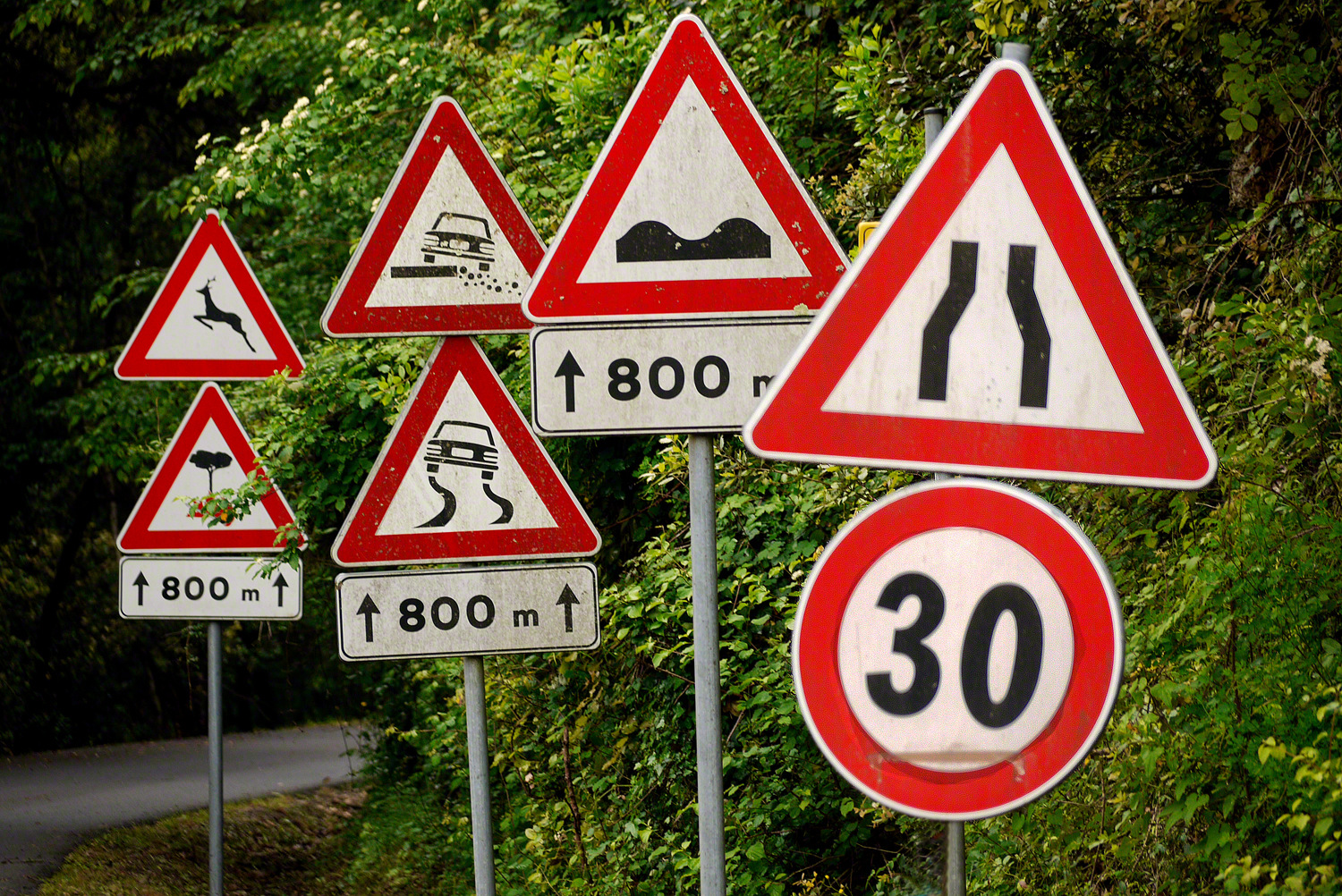
Signs or Triangles…and one circle?

Since my background is in art and not photography, I studied Art History; among other areas in this field. My favorite painters were the Impressionists, and one of my favorite painters was one of the founders of that movement named Claude Monet. Actually, I really loved all of the Impressionist painters mainly because they saw things differently than the painters that preceded them, and as a result were not accepted for quite a while.

They broke all the rules and as I now tell my fellow photographers that I teach or mentor to.learn all the rules of photography, then as fast as you can… forget about them as they will most certainly lead you down the one way, one lane path to mediocrity…why you ask???? Because rules are impediments that will block your chances of ever observing the environment around you through better vision.

Monet said, ” In order to see, we must forget the name of the thing we’re looking at.”

In my online class with the BPSOP, and in my “Stretching Your Frame of Mind” workshop I conduct around the planet, I talk a whole lot on being able to “see past impressions”. In fact, it’s one of my many mantras and it can be so hard to do for people that have spent the majority of their life seeing and doing things with their left brain.

First, a disclaimer: There are those out there that suggest that this is a distorted myth…psycho babble. However, most psychologists agree that there’s enough basis in facts to accept it.

You see, the left side of your brain is the analytical side. Left-brained people tend to be more logical and objective, and rarely see any artistic content. Their photos will tend to be those that are “for the record”. It’s the linear way or the highway for them!!! The right-brained person tends to be more creative, expressive,  and intuitive. Ok, just how does this have anything to do with Monet or my approach to teaching people how to see past their first impressions?

In the photo above, a left-brainer will look up and see a group of traffic signs directing you to either go, avoid, or do something. When I first looked up I immediately saw shapes, as in triangles and one circle. I saw these shapes beause for years I’ve trained my eye to “see past my first impression”. As a result I composed my photo to accentuate these important shapes…since Shape is a basic element of Visual Design.

The next time you go out don’t just look at the labels, be sure to taste what’s inside…see past your first impression.

Visit my website at: www.joebaraban.com, and check out my workshop schedule at the top of this blog. Come shoot with me sometime. I just announced my New York, New York Workshop beginning September 17th, 2019 and ending at noon on the 23rd. This will be my second workshop there and this time we’ll be shooting in all the five boroughs.

JoeB

My Favorite Quotes: Ralph Waldo Emerson

I break rules

Ralph Waldo Emerson was someone I studied  in my English Literature class in college. I wasn’t a fan of poetry, so most of what we read was a tad on the boring side. He did write some interesting essays, and was considered an “American Transendentalist”. In a couple of words, they believed that each individual could transcend or move beyond the physical world; I was a hippie wannabe back then so I sorta dug it!!!

I digress.

I’ve pretty much been someone that always ‘colored outside the lines’, and have always promoted this thought process to my online students with the BPSOP, and to those that have signed up for my “Stretching Your Frame of Mind” workshops.

That’s the reason I specifically remember this quote that Emerson once said, “Do not go where the path may lead. Go instead where there is no path and leave a trail.”

How I can relate this quote to photography is relatively easy, especially when you’ve had to defend it countless times to those that prefer to travel the safe road; the road most traveled.

These are the photographic naysayers that resist anything that deviates from what they learn at camera club meetings, while shooting with friends, or what they read in photography magazines.

More broken rules

I’m talking about those pesky rules that are the shackles that hinder creativity. You all know them in one form or another: The Rule Of Thirds, The Leaning in Rule, shooting into the sun, The Rule of Odds, The left to Right Rule, and here’s a couple a student told me: Avoid the color red, and never shoot a building straight on…YIKES!!!!!

In my opinion these rules can only do one thing, and that is to take you down a one way road to mediocrity. Ansel Adams once said, “There are no rules for good pictures, there’s only good pictures.

So my fellow photographers, the next time you grab your camera and head out, give yourself an assignment. Study up on all the rules (just in case they haven’t already been hammered into your brain) and do exactly the opposite of what you read.

You just might be surprised with what you comeback with. I for one would love to see the results. Take the road less traveled and leave a trail for others to follow.

Visit my website at: www.joebaraban.com, and check out my workshop schedule at the top of this blog. Come shoot with me sometime.

JoeB

My Favorite Quotes: Jimmy Jones

It was all about “good timin”.

Okay, so you’re looking at the title of this post and you’re scratching your heads wondering just who in the hell Jimmy Jones was; certainly not a famous photographer.

As I’ve stated before, the quotes in this category are not necessarily written by well known photographers or even painters. That said, they are quotes from artists in their own right.

I realize that I might be showing my age, but in 1960 a man named Jimmy Jones wrote one of my favorite songs…”Good Timin”, and it’s one of the concepts I’m always mentioning to students in my BPSOP online class, and to those that signup for my “Stretching Your Frame of Mind” workshops I conduct around the planet…why you might be asking yourself?

When I was recently walking around with my fellow photographers on the streets in Berlin, I noticed that they were usually too quick or sometimes too late to click the shutter; missing the peak of the action. Btw, Berlin is not the only time I’ve seen this happening.

In the case of being too quick, I watch people bring their camera up to their eye when they see something they want to photograph and just start clicking away. Needless to say I’m talking about something that moves i.e., a person, car, animal,  etc., and not some stationary subject.

There’s always the chance that your timing might be perfect, but I’m here to tell you that the odds are that you’ll be too early or too late. Okay, so now you say why not start shooting right away so you’ll be sure to get it.

The answer (based on fifty years of shooting) is that in the case of a person, once they see you they won’t continue any action for one reason or another; in other words you might just have one shot at it…literally!!!

The solution? What I do is have my camera down at my side and slightly behind me (being un-obtrusive as possible) with my finger on the shutter release. Once I see where it’s going, I quickly bring my camera up and take the shot and at least get it “in the can”. Then I continue until I feel that whatever it was that made me bring my camera up was over.

As far as being too late, the same sort of applies. I have the same camera down at my side and (always) at the ready. If I’m on time, then being too late is moot. I’m looking for that moment in time when I’m able to stop an action leaving it un-completed; one of the ways to create visual tension. It’s all about being aware of your environment and constantly looking all around for posible ‘keepers’.

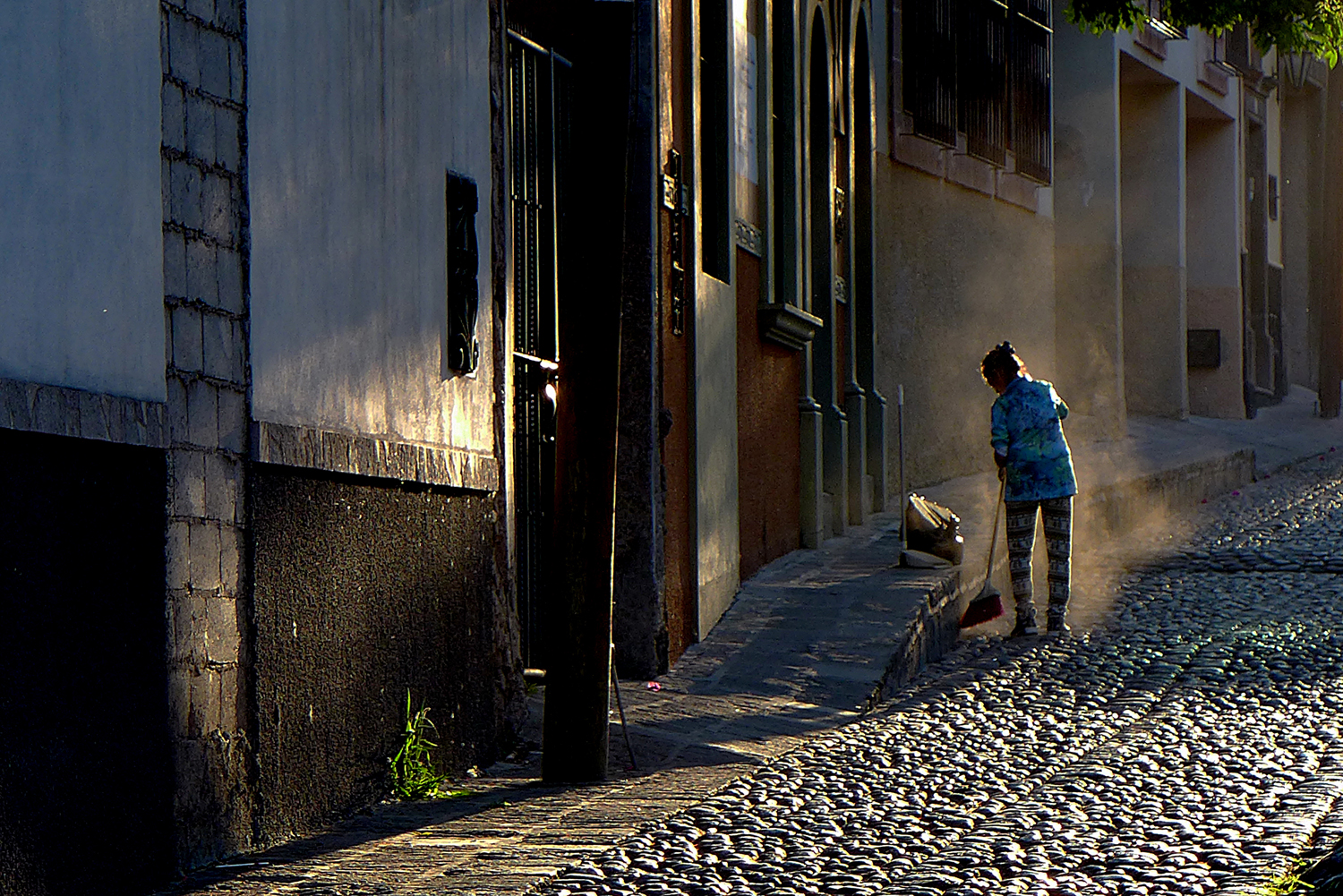
In the above image taken during my workshop in San Miguel, I was stading outside my house early in the morning and saw this woman cleaning the sidewalk. The sun was coming up right down the small cobblestone street, and as she was sweeping she was kicking up a little dust. Because it was backlit it seemed to glow, so I waited until I could get the most dust…with my camera at my side with my finger on the shutter release.

She looked at me and since I was not theatening she lost interest. For one brief moment she stepped into the street and began sweeping. I was able to get off one shot before she saw me and ducked back into the doorway.

Here’s the link to my song: https://www.youtube.com/watch?v=modfq47onwU

Visit my website at: www.joebaraban.com, and check out my workshop schedule at the top of this blog. Come shoot with me sometime. I just announced my New York, New York Workshop beginning September 17th ,2019 and ending at noon on the 23rd. This will be my second workshop there and this time we’ll be shooting in all the five boroughs.

JoeB

My Favorite Quotes: Sir Winston Churchill

This is what they missed.

This is a category that I usually reserve for artists, whether they be photographers, painters, writers, or musicians…until now.

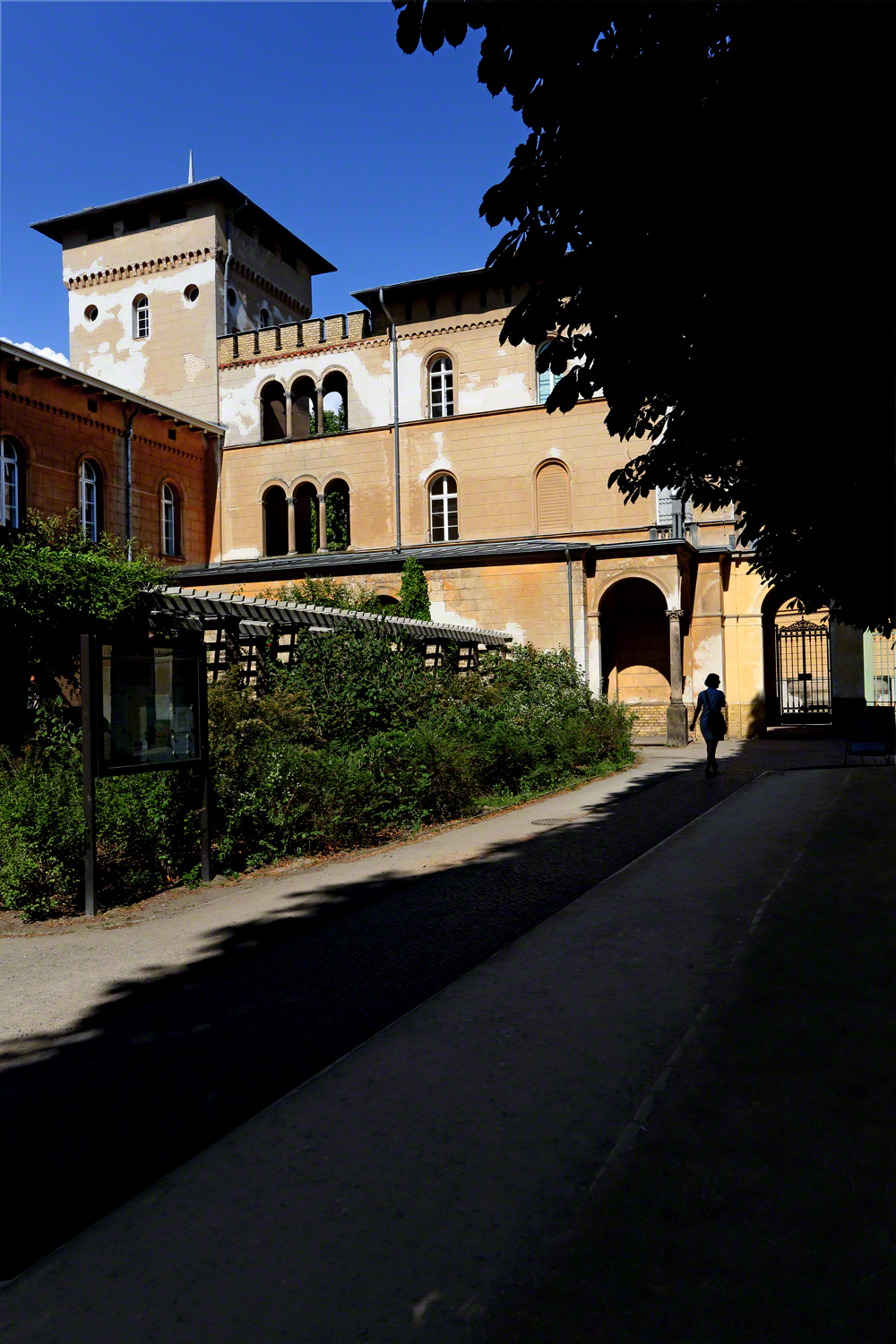
Although I teach an online class with the BPSOP, I’m actually writing about my recent workshop in Berlin. We were heading to a village near Potsdam to shoot in the late afternoon light, a location I had scouted several days ahead of time.

FYI, I always go a few day ahead of time to check out all the locations, so there’s no surprises when I take my fellow photographers to shoot there; therefore I know the best areas.

I don’t have mention the old adage that Time is of the Essence, but in case you’ve never heard it before, I’m saying it now….Time is of the Essence, especially when it comes to photography.

Ok, here’s a good time to interject the quote: Sir Winston Churchill once said, ” You’ll never reach your destination if you stop and throw rocks at every dog that barks.” So, how does this have anything to do with Potsdam and the location we were going to…you might ask?

As we were walking down the sidewalk on our way to the area that was going to get the best late light, several people were stopping to take pictures of anything they saw, whether it was worth the effort or not.

Now I realize that these people had never seen this village and wanted to record it for posterity, but the pictures they were taking could have been taken just about anywhere in cities in the USA.

I’m talking about window dressings made up of jewelry, clothing, shoes, etc., all of which you could see when you visit Amazon.com; merchandise not even indigenous  to Germany…past or present.

It got to the point where I just marked the area on a local tourist map and told those photogrphers to meet the rest of us there.

Sure enough, there were some stragglers that showed up too late to really have the time to spend on a truly fabulous location…straight out of a movie set.

If you’re heading to a location that you either know to be worthwild, or you’ve seen it in pictures, or a friend that has been there and highly recommended it, don’t stop and shoot just to be shooting…don’t throw rocks at every dog that barks.

Visit my website at: www.joebaraban.com, and check out my workshop schedule at the top of this blog. Come shoot with me sometime. I just announced my New York, New York Workshop beginning September 17th ,2019 and ending at noon on the 23rd. This will be my second workshop there and this time we’ll be shooting in all the five boroughs.

JoeB

My Favorite Quotes: William Shakespeare

What does her eyes say?

William Shakespeare once said, “The eyes are the window to your soul”.

In both my online class with the BPSOP and my “Stretching your Frame of Mind” workshop I conduct around the planet, we work on the elements of visual design and composition. One of the most important elements if not the most important is LINE.

Briefly, a line is a mark made by a continuously moving point across a surface. There are horizontal, vertical, diagonal, round, curved, parallel, zigzag, and wavy lines…not to mention dotted lines and dashes. All these lines have the same thing in common: direction, length, and thickness.

All the above-mentioned lines are straightforward and easy to grasp, but what about ‘implied lines’? What about those lines that are more of an ambiguous nature? For example, all the edges around ‘Form’ are implied lines. A statue of Abraham Lincoln is Abraham Lincoln because his outLINE shows him to be. What about the ‘horizon’ line that people are always forgetting to straighten?

But that’s a whole other issue!!

There’s one more implied Line that most photographers usually don’t consider. It’s that line that runs from the subject’s eyes to the lens.  To my way of thinking, it’s a very important line that connects the photographer to the subject, creating an intimate bond of sorts that also generates a kind of energy field.

Personally, I love that bond and the majority of photos I’ve shot in my career has, for the most part, had my subject looking directly into the camera.

The hard part about having the subject look into the lens is keeping his or her look fresh. It’s very much like asking the subject to smile. If you don’t shoot immediately, the smile starts to lose the freshness.

Since I’ve been shooting people for fifty years, I can tell you that the eyes can talk to you and can portray emotions and feelings as quick as one blink to another.

If you have clicked on the link and read the post that I sent on one click, one smile, you can adapt that thought process to this current post on having eye contact. Remember that the eyes are indeed, the windows to the soul.

Visit my website at: www.joebaraban.com, and check out my workshop schedule at the top of this blog. Come shoot with me sometime.

JoeB

Personal Pearl of Wisdom?

I just love diamonds, don’t you?

Ok, I’m not sure what category this fits into so I’m thinking three of them: My Favorite Quote since there’s a little of that, Food for Digital Thought since there’s some of that, and a Personal Pearl of Wisdom since there’s also a touch of that.

What am I getting at? Well I was talking to a friend that has a kid whose age is just right to let her watch The Wizard of Oz. He said that they were singing some of the songs together and reciting some of the dialogue.

As soon as they said, “lions and tigers and bears! Oh my!” a thought hit my eye like a big Pizza Pie! “squares and circles and triangles! Oh my! Btw, I left out rectangles since it just didn’t have the same flow.

Where in the world am I going with this you ask? Well, I show people how to use the elements of visual design in their photography. I do this in my online class with the BPSOP, and I often remind people during my daily critiques in my “Stretching Your Frame of Mind” workshops I conduct all over the place.

Shape is one of these elements and if used to enhance your composition, you will definitely be on your way to creating stronger photos.

There are four basic shapes, hence the inclusion of three of them in my adjusted quote for any upcoming remake of the iconic movie. Although shapes are all around us there are four basic ones: circles, squares, triangles, and rectangles.

Whether the viewer knows it or not, he’ll see them and react. When you begin to see with the right side of your brain, the creative side, you’ll be able to use shapes in your imagery. They will provide a sense of structure and unity to your composition, and will be perceived by the viewer as systematic, stable, and symmetrical.

The shapes that are similar but are more irregular such as an isosceles triangle or a trapezoid have more energy. Besides those that are more prevalent in our world, the diamond is a great shape, filled with a great deal of energy and evokes a sense of motion; not to be overlooked.

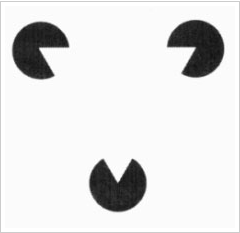
There are even implied shapes that one can perceive through the use of Closure; one of the six concepts in the Psychology of Gestalt; For example, in this diagram the viewer will fill in the triangle:

I saw a triangle

Shapes live among us and once you begin seeing past first impressions you’ll be able to not only see the positive shapes, the implied shapes, but the negative shapes as well. When we think of shapes, we think of the kind that has mass and therefore considered as positive space.

However, a shape can be the negative variety that’s created by the positive space that surrounds it. Imagine an ornate fence that has a row of wrought iron circles at the top and running the length of the fence. The circles are positives shapes and have mass, but what about the area inside the round wrought iron? Those are also circles, but they have been created by the positive shape and have no mass. They are the negative shapes.

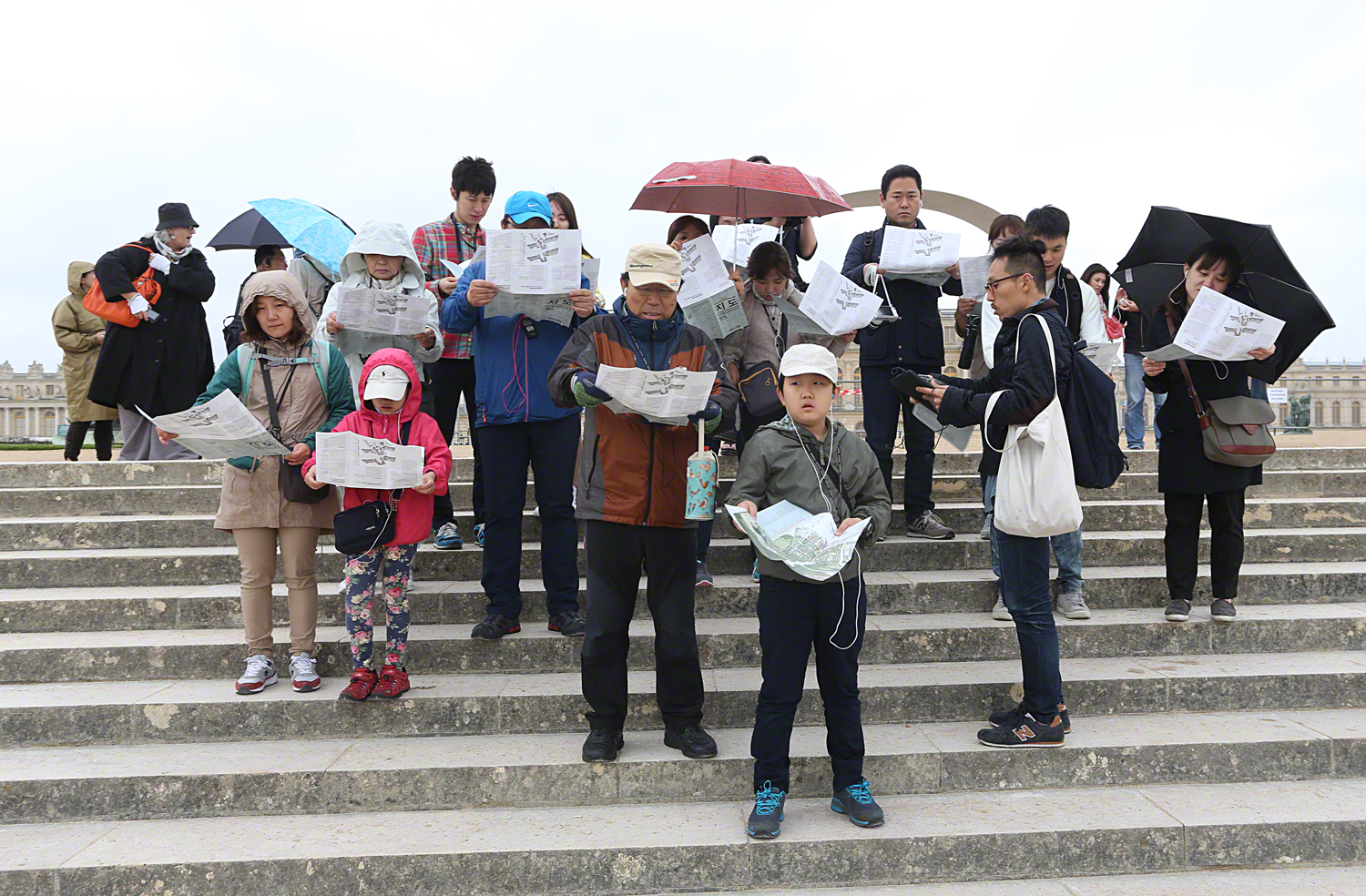
As I was talking about seeing past first impressions and using the right side of your brain, this certainly came in handy during my springtime in Paris workshop. The group went to the Palace of Versaille one cold and gray day so I was walking around looking for something else to shoot.

I noticed a group of Asians standing on the steps, all of them looking at the map of the entire grounds. What I saw was not a group of Asians all looking at maps, what I saw was a triangle made up of Asians all looking at their maps. I laughed and quickly took their picture, and as I always say, humor is the one thing that can work even with bad light.

Visit my workshop at: www. joebaraban.com and check out my workshop schedule at the top of this blog. Come shoot with me sometime.

JoeB

My Favorite Quotes: “What a Difference a Day Makes, Twenty-Four Little Hours”

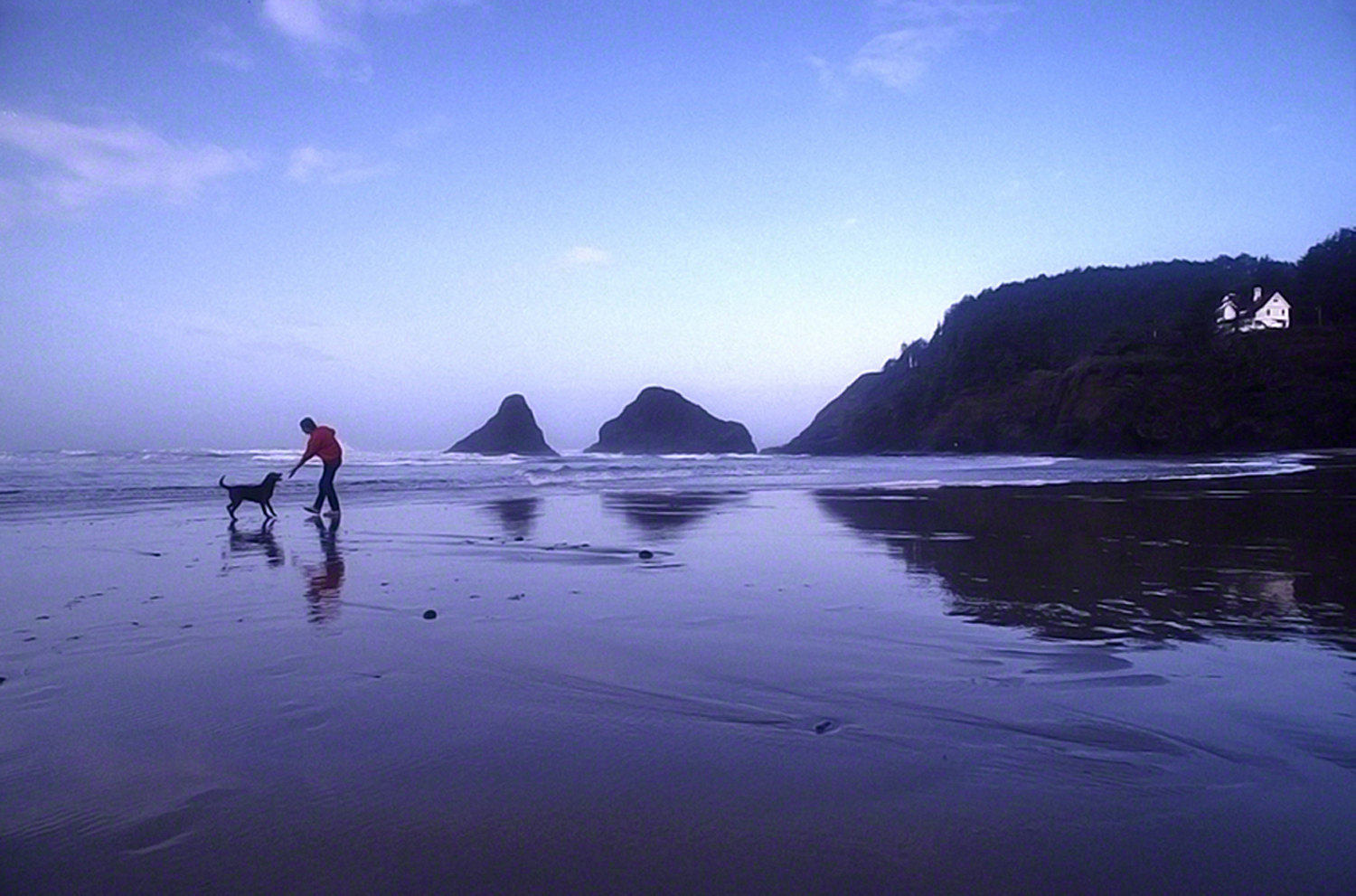
A typical day on the Oregon Coast

In 1959, Dinah Washington won a Grammy for her rendition of this Rhythm and Blues favorite, and I remember my mother use to love listening to it…I was fourteen!!

While going through some old images I stumbled upon a couple that were taken while on an assignment in Oregon, and all of a sudden this song popped into my head and bingo, I had the basis for an interesting post.

I say interesting because what I’m talking about occasionally happens to some of my students that take my online classes with the BPSOP. I’ve also personally encountered this in my “Stretching Your Frame of Mind” workshops I conduct arount the planet.

What I’m getting at is the fact that over that past fifty years of shooting, I have had to shoot whatever the weather and light brought me on any particular day…sometimes no matter what; but sometimes I could do something about it.

The students taking my online classes will have the opportunity to go back to a location and go for it again, and I encourage this all the time. If the location, time, and circumstances warrent during one of my workshops, we’ll go back either at the same time or if we were there in the morning we’ll go back in the afternoon if logistics dictates.

In the two photos that I’ve have submitted, the one at the top was shot on a very gray/blue overcast/foggy afternoon at a location somewhere on the Oregon coast. We had a man and his trained dog with us and we were looking for some great light; which we didn’t get… as you can obviously see.

I shot it anyway just to have something in the can and it came out pretty good , actually depicted Oregon’s coast as it usually looks; but I was determined to shoot in better light.

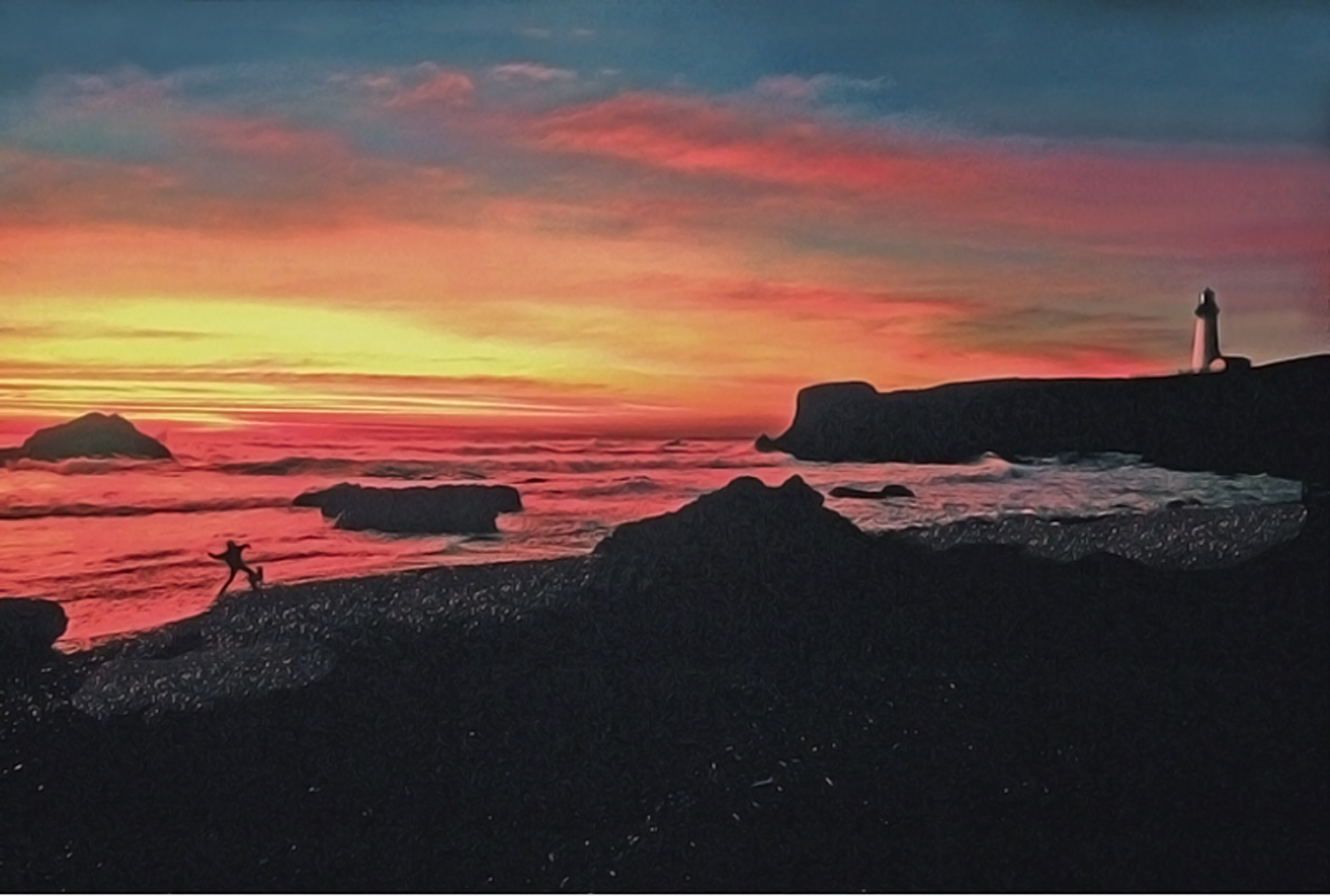
What a difference a day makes, 24 little hours.

We came back the next day at the same time but on our way to the same location a little further down I was welcomed by this incredible sky, and what a difference a day made. Knowing how fleeting the light is we all jumped out of the car and shot this in less than a minute; which is about all the ‘powers that be’ intended to give me.

So my fellow photographers, never give up a potential ‘keeper’ if you possibly can. Go back the next day and try it again because as Eddie Adams once said, “When you get lucky, be ready”.

In case you’re interested, here’s Dinah singing it: https://www.youtube.com/watch?v=OmBxVfQTuvI

Visit my website at: www.joebaraban.com, and check out my 2018 workshop schedule at the top of this blog. Come shoot with me sometime.

This coming July 29th will be my 30th anniversary teaching at the Maine Media Workshop. I’ve always picked this time as it’s the week of the Lobster Festival down the road in Rockland. This ofers a unique set of photo ops, different from the Maine Coast, fishing villages and lighthouses. The Lobster Festival is all about color, design, light, energy, people watchng and environmental portraits everywhere you look; some people are there in costumes and loved to be photographed.

In conjunction with The Santa Fe Workshops, on October 2nd I’ll be leading a group in San Miguel de Allende. A beautiful oasis and artist colony, and the entire city is a UNESCO site.

Come join me for a week of fun and photography…what could be better?

JoeB

My Favorite Quotes: Minor White

 Minor White was an American photographer whose work I have followed since the beginning of my career. Most of his images are not my style or ways I look at subjects, but enough were to keep me interested.

In any event, he did say something that I do agree with and have “spread the word” to all of my students that have signed on for my online classes with the BPSOP, and those photographers that have joined me in one of my “Stretching Your Frame of Mind” workshops I conduct around our planet. Minor White once said, “One does not photograph something simply for what it is, but for what else it is.”

Think about that for a moment. What does that mean to each of you? What do you think about when composing your subjects or centers of interest? I would love to hear from you. If it’s simply a tree you’re about to take a picture of, do you merely look at it with the left side of your brain (the analytical side) or do you use the right side of the brain…the creative side?

The analytical side will see a tree of some species. Perhaps it’s an Aspen and you love the fact that the bark is white, and a reminder of the days of skiing through a stand of them. Maybe it’s a willow tree and when you were young you use to take the branches and make whips to beat your brother or sister with.

What if it’s a Sycamore and the huge leaves and fruit hanging down remind you of the well spent days of your youth when during the Autumn you use to throw the small round round fruit at your other brothers and sisters.

These are all good reasons to take pictures but I doubt they will stand the test of time as far as a photograph worthy of matting, framing, and hanging on a wall; unless you’re always going to be around to explain to people just why you took the photo in the first place.

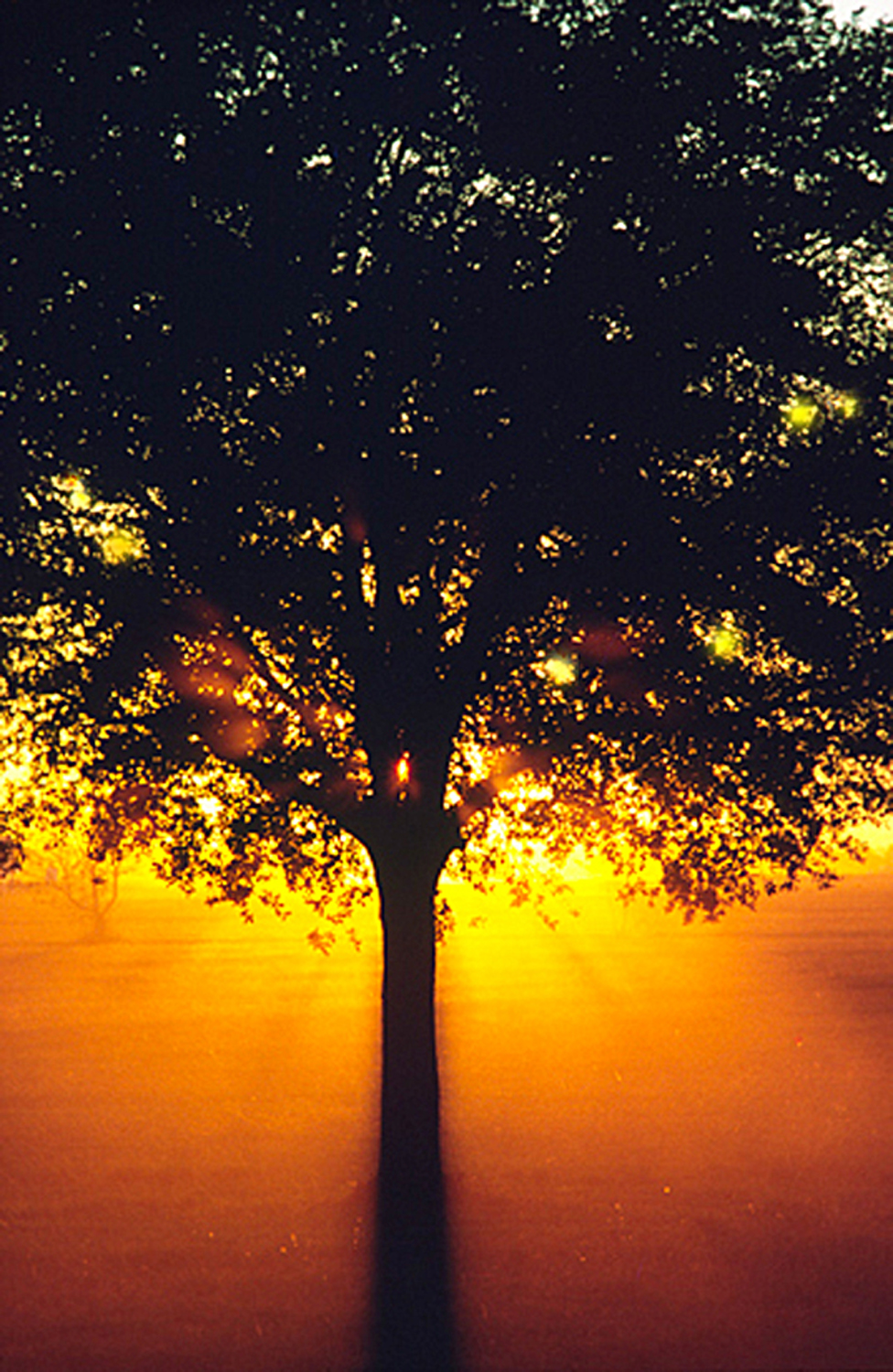
When I look at a tree I’m about to photograph I look at it with the right side of my brain…the creative side. This is the side that will see patterns and texture in the bark and leaves. The shape of the leaves and the side that will notice anything that might be a little peculier, as in the direction of the light, i.e. front, side, or back, and the color of the tree. I will also notice how it works in the surrounding environment as far as how well it’s balanced between the negative and positive space in the composition; and the visual weight it projects.

To me these are the most important things I look for, and they all happen to be the elements of visual design that I show my fellow photographers how to incorporate them into their imagery.

Visit my website at: www.joebaraban.com, and check out my 2018 workshop schedueat the top of this post. Come shoot with me sometime.

This coming July 29th will be my 30th anniversary teaching at the Maine Media Workshop. I’ve always picked this time as it’s the week of the Lobster Festival down the road in Rockland. This ofers a unique set of photo ops, different from the Maine Coast, fishing villages and lighthouses. The Lobster Festival is all about color, design, light, energy, people watchng and environmental portraits everywhere you look; some people are there in costumes and loved to be photographed.

In conjunction with The Santa Fe Workshops, on October 2nd I’ll be leading a group in San Miguel de Allende. A beautiful oasis and artist colony, and the entire city is a UNESCO site.

Come join me for a week of fun and photography…what could be better?

JoeB

My Favorite Quotes: Van Gogh

A matter of pre-visualizing.

Vincent Van Gogh is one of my favorite painters and I’ve studied and seen his work throughout my career, including during a workshop I conducted in Provence a few years ago; we actually shot at the asylum where he committed himself in Saint-R’emy de Provence.

Van Gogh one said, “I dream my painting then I paint my dream”.

For me this is all about pre-visualization. Having said this, I realize that a painter can paint anywhere so this (dreaming) comes naturally to the medium. The photographer must be in the presence of his subject, but pre-visualization is still possible and actually very important as far as making pictures is concerned.

I teach two classes with the BPSOP, and I conduct my “Stretching Your Frame of Mind” workshops all around our planet. In my online class I send to my students what I call my Did It Do It list for making strong photos; if you have the time to check out that category on my blog you’ll be that much ahead of the game.

One of them and perhaps the most important is “did you pre-visualize”. This is about seeing the image framed in your mind before bringing the camera up to your eye. Clicking the shutter is the easiest part of photography when you know ahead of time what it’s going to look like. For me this will often include moving things around, add or take away objects that either fit or don’t fit, or ask people to be in my shot. Bottom line is that I’m an artist whose medium is a camera instead of a paintbrush…I paint pictures with my camera.

As an advertising and corporate photographer for forty year the term pre-visualize referred to commercial photography. I would be given a rough layout by an art director or graphic designer and my assignment was to create the layout in either a natural outdoor environment or in my studio. After a brief discussion I would begin to visually assimilate some ideas in my mind and I always knew that if I could picture it in my mind I could replicate it on a piece of film.

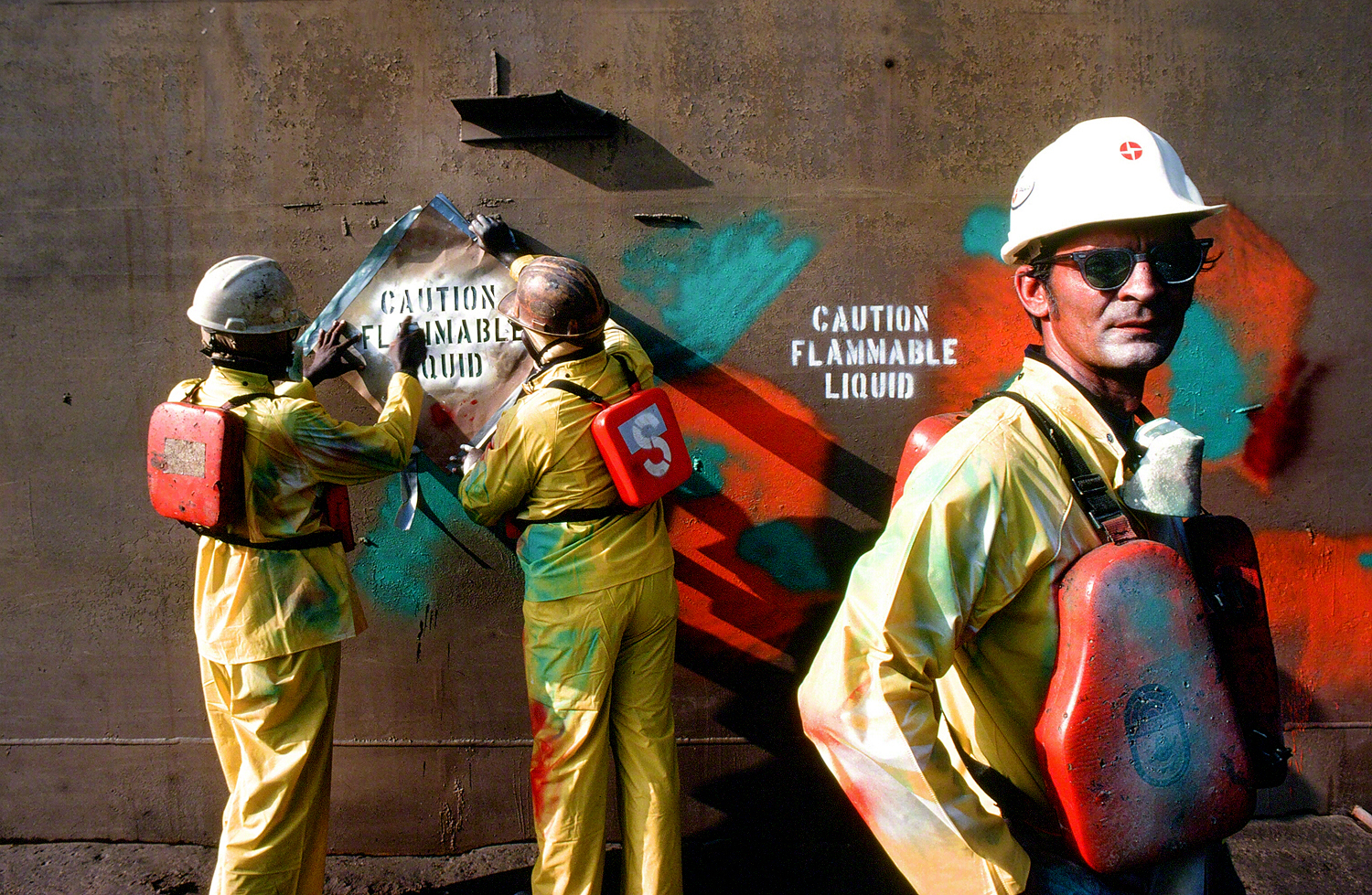
In the above photo, I was shooting a brochure for a barge company on the Mississippi River. While sitting in this large office I saw the yellow slickers, the template, and several cans of spray paint. I immediately began conjuring up images in my mind and had this photo laid out in my imagination within a minute. After asking the powers that be if my idea was something that could happen, and getting a ‘yes’, I proceeded to transfer my idea to reality.

I found three men to wear the slickers, and spray painted them and the wall while having my camera on a tripod; it was just like painting my dream.

The term pre-visualization dates back to the photographer Edward Weston who first coined the phrase in 1921. He thought why limit yourself to what your eyes see when you have such an opportunity to extend your vision?” Weston spent a great deal of time in Mexico along with his son Brett who he took along to keep him out of trouble.

In Mexico he strengthen his practices and in so doing helped Brett  become a great photographer in his own right. Weston believed very strongly in the process of pre-visualization and by the way thought that cropping an image was tantamount to failure.

Another photographer in that era who became quite popular was Ansel Adams who had his own take, “The visualization of a photograph involves the intuitive search for meaning, shape, form, texture, and the projection of the image-format on the subject.

This notion is exactly what I teach in my classes and workshops, that is, using the elements of visual design; Shape Form, and Texture mentioned by Adams are three of them along with Line, Balance, Pattern and Color.

Alfred Steiglitz, the most important photographer of his time also believed in the concept of pre-visualization. “ I see the photograph in my mind’s eye and I compose and expose the negative. I give you the print as the equivalent of what I saw and felt.

So, my fellow photographers, pre-visualization has long been the cornerstone of creative thinking and there’s no question that it will absolutely enhance your images. The next time you go out shooting take some time to see the image in your mind before bringing the camera up to your eye.

Decide on what’s your message, and what reaction you want the viewer to feel. Then get the lighting and exposure correct and do as much as possible before the easy part comes…clicking the shutter.

Visit my website at: www.joebaraban.com, and check out my 2018 workshop schedule at the top of this blog. Come shoot with me sometime.

This coming July 29th will be my 30th anniversary teaching at the Maine Media Workshop. I’ve always picked this time as it’s the week of the Lobster Festival down the road in Rockland. This ofers a unique set of photo ops, different from the Maine Coast, fishing villages and lighthouses. The Lobster Festival is all about color, design, light, energy, people watchng and environmental portraits everywhere you look; some people are there in costumes and loved to be photographed.

In conjunction with The Santa Fe Workshops, on October 2nd I’ll be leading a group in San Miguel de Allende. A beautiful oasis and artist colony, and the entire city is a UNESCO site.

Come join me for a week of fun and photography…what could be better?

JoeB 

My Favorite Quotes: Daguerre


Side light for depth

  Louis Daguerre was a painter and Physicist, but he was better known for inventing the Daguerreotype; the first process for making photographs. Actually it was Nie’pce that was the first, and later they both actually became partners working on it together.

One of my all time favorite quotes was made by Daguerre. He said, ” I have captured the light and arrested its flight. The sun itself shall draw my pictures.”

When I first read this quote I was instantly struck by my own thoughts I’ve been carrying with me for the past fifty years of being an advertising and corporate photographer and now that I’m retired those same thoughts are with me when I show my fellow photographers how to  “make pictures”, as well as using the light and sun effectively. That is, how critical light is and should be to them when they’re out shooting and more importantly, how the sun affects every aspect of a photographer’s thought process as it relates to his or her imagery.

Back light for energy

I’m constantly advising my online students with the BPSOP, that shooting when the sun is no more than 15 degrees off the horizon offers the optimum light as far as the quality and softness is concerned; known as the Golden Hour. As far as as my “Stretching Your Frame of Mind” workshops I conduct, we might be street shooting midday, but we’re always out there early in the morning and late in the afternoon as well.

If you’re a student of light, you think about the sun and where it is any time you’re holding a camera. I have talked for years about my clock and how I determine what the subject will look like under various conditions. In other words I always let the sun draw my pictures.

Front light for contrast

Where I place myself in relation to the sun will create different visual interest and tension. For example, if I want to add the third dimension to my subject, the illusion of depth, I’ll use light coming in from the side. If I want the feeling of energy and make my subjects seem to be glowing, I’ll back light them. If I’m looking for extreme contrast I’ll place the sun at my back and front light, providing I can get the area behind the subject dark.

So many photographers just don’t give the light and the sun much credence. For them if the sun is out nice and bright and right above their heads that means that it’s beaming down enough to “take pictures”…albeit hot and harsh.

If I had a dollar for every time I saw a photographer look up to make sure the sun was shining as much as possible on their subject, I would be writing this from a lounge chair next to a pool on some Island; a blue and frothy cocktail with an umbrella hanging down on one side, sitting on a table very close to me.

Here’s what I can promise you…if you become cognizant of the light and where the sun is at any time you’re out shooting, and let it draw your pictures, you’re photography will move up at least one notch.

Visit my website at: www.joebaraban.com and check out my 2018 workshop schedule at the top of this blog. Come shoot with me sometime. I’ve a couple of openings in my Springtime in Berlin workshop next May 23rd. A fantastic city with so many great locations we’re going to be shooting.

This coming July 29th will be my 30th anniversary teaching at the Maine Media Workshop. I’ve always picked this time as it’s the week of the Lobster Festival down the road in Rockland. This ofers a unique set of photo ops, different from the Maine Coast, fishing villages and lighthouses. The Lobster Festival is all about color, design, light, energy, people watchng and environmental portraits everywhere you look; some people are there in costumes and loved to be photographed.

In conjunction with The Santa Fe Workshops, October 2nd I’ll be leading a group in San Miguel de Allende. A beautiful oasis and artist colony, and the entire city is a UNESCO site.

Come join me for a week of fun and photography…what could be better?

JoeB

My Favorite Quotes: Rod Stewart

Certainly tells a story, don’t it?

Rod Stewart has always been one of my favorite singers, having most of his music. I happened to be listening to one of his old hits when an idea for a post popped into my head; as is usually the case. The title of the song  that was playing was, Every picture tells a story, don’t it?

The phrase is an idiom and refers to the fact that when something is happening in a situation it’s clear because of the way something look, or what has taken place.

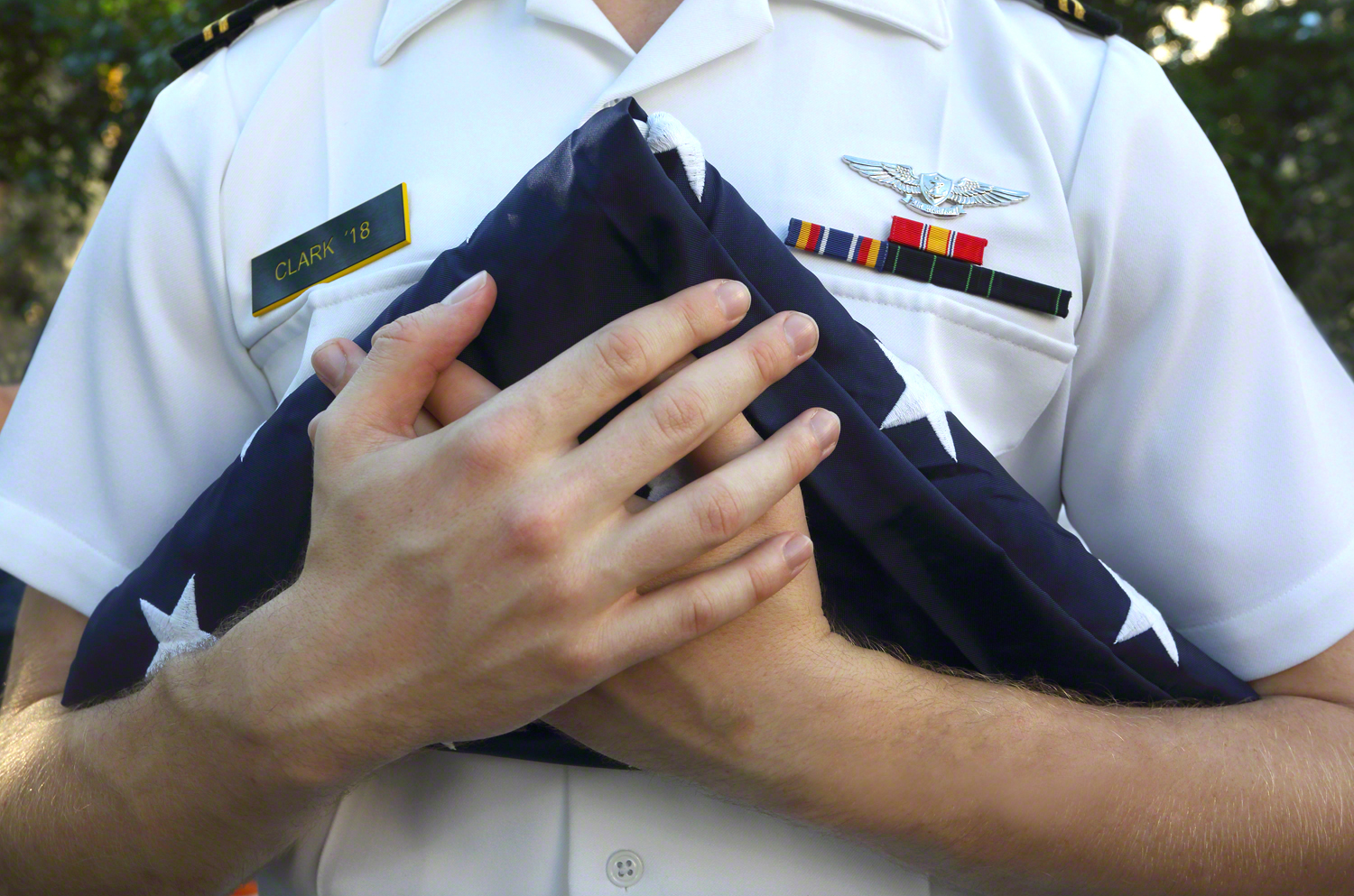
I had recently conducted one of my workshops in New York and we were shooting at the 9/11 memorial while a group of Navy men were also there to honor someone. What I saw happening was like a visual reminder of Stewart’s message.

In this song, the title… Every pictures tells a story don’t it doesn’t appear in the lyrics until the very end when it’s repeated twenty-four times. That said, seeing this happening in front of me sent a crystal clear message of the title to Stewart’s song.

When composing my photo It was also clear to incorporate one of the six concepts in the psychology of Gestalt, namely Closure. It seemed that coming in tight on just the hands and folded flag, was all the viewer needed to get the message; the viewer would fill in the rest.ure

I’m always mentioning Closure to the students that sign up for my online classes with the BPSOP, as well as working on it one on one to those that take my “Stretching Your Frame of Mind” workshops I conduct around our planet.

Telling a story in your photographs is not always necessary, although even the simplest landscape tells a certain kind of story to a particular type of viewer. It’s just that storytelling is a great way to keep the viewer around longer, and if you’re at all like I am, you like for people to look at and admire your photos.

FYI, the flag is folded into a triangle to represent the shape of the hats worn by colonial soldiers in the war for independence.

Btw, if you’re interested, here’s the link to Every picture tells a story, don’t it.

Visit my website at: www.joebaraban.com, and check out my workshop schedule at the top of this blog. come shoot with me sometime.  My next springtime workshop will be in Berlin next May; and incredibly beautiful city. check out the description above. Next October 2nd in conjunction with Santa Fe workshops I’ll be doing a photo workshop in San Miguel de Allende. A fantastic city in central Mexico and home to a huge artist colony filled with ex-pats. The description and link will be coming out soon so stay tuned. If you have questions beforehand let me know.

If you send me a photo and question to: AskJoeB@gmail.com, I’ll create a video critique for you.

JoeB

My Favorite Quotes: Alfred Eisenstaedt

My Lumix

In my early days, somewhere around the time Moses parted the seas, I worked for UPI (United Press International), AP (Associated Press), and I was a Black Star photographer. I was a photo-journalist in the making and one of my favorite photographers was Alfred Eisenstaedt, who at that time (and probably still is) was considered the father of modern photo-journalism.

I’ve always enjoyed looking at his Life Magazine covers and he was the leading contributor with ninety covers and twenty-five hundred photo essays; pretty impressive by all accounts.

Over the years I’ve read articles about him and one of his quotes I’ve always loved was, “The important thing is not the camera, but the eye”.

During my online classes with the BPSOP, and in my “Stretching Your Frame of Mind” workshops I conduct all over the place, I often have my fellow photographers tell me that it’s time to move up to a better camera…“so I can take better pictures”!!!

My response is always the same. It’s not about fancy expensive cameras, they will NOT get you to take better photos; it’s that eye that’s part of the head that has a brain in it that counts. It’s all about perception, and as Henry David Thoreau once said, “It’s not what you look at, it’s what you see”.

If you would spend the same amount of time as you do piddling around with all that stuff on your camera, observing the environment around you not with the left side of your brain (the analytical side) but with the right side (the creative side), you just might find that the camera you have now will work just fine.

Camera stores are full of expensive equipment that the previous owners bought on the assumption that just like that they would wake up one morning and be who they wanted to be…really good photographers. I’m here to tell you that it just ain’t so.

Because of rapidly changing technology photographic equipment, specifically cameras, has become smaller, faster, more powerful, more everything, and it will get to the point where you won’t even have to go out with it to shoot. You’ll be able to program it to do anything…which it actually does now…and more’s the pity.

Camera manufactures have duped the public into believing that their camera will make you a much better photographer. I’m thinking, based on experiences with my fellow photographers, that the more buttons, dials and programs there are on a modern digital DSLR, the better the photo it will take. If you believe that then I have a bridge in NYC  that I’m willing to sell to you.

My Canon

Here’s the way I see it. When I’m walking with others in my workshops I carry two cameras. My Canon Mark III with a  17-40mm zoom over my shoulder and my Lumix DMC-LX7 around my neck. My very small Lumix has a 24-90mm zoom lens, in a ten megapixel camera which gives me a range from 17-90mm without having to carry two big cameras.

The Canon is an F/4 and the Lumix is a F/1.4-2.3 so when I’m in a very low light situation, or if I need a medium telephoto I’ll grab my Lumix. When I want a wide angle I use my Canon. Both these photos were taken during my New York workshop on the same day, the same location, about an hour apart from one another. One was taken with my Lumix DMC-LX7, and the other with my Canon Mark III.

To me it doesn’t matter which camera I decide to use…why? Because ” The important thing is not the camera but the eye”.

Visit my website at: www.joebaraban.com, and check out my workshop schedule at the top of this blog. Come shoot with me some time. This coming January Along with William Yu, I’ll be taking a group to China to photograph the flooded rice terraces and also the tribal villages. Next February in conjunction with the Santa Fe Workshops, I’ll be returning to Cuba for the fourth time. My next springtime workshop will Berlin next May; an incredibly beautiful city.

Send me a photo and question to: AskJoeB@gmail.com, and I’ll create a video critique for you.

JoeB

My Favorite Quotes: Arnold Newman

Symmetry, a sense of order and balance in chaos

When I first started doing my “Stretching Your Frame of Mind” workshops that I conduct around our planet, the year was 1983 and it was for the Maine Workshop; now called the Maine Media Workshops.

In those early years I had the great pleasure and honor to be teaching there (on several occasions) the same week as did Arnold Newman. As a result, we got to be friends and I was actually friendly with his wife Augusta as well.

He wasn’t a fan of rules and would often say so and if you knew Arnold, he often said what was on his mind…no matter what; even to the point of intimidating very young photographers.

One of the points he always talked about were rules, once saying, ” There are no rules nor regulations for perfect compositions”.

Truer words have never been spoken, and because of the latest conversation with yet another one of my fellow photographers seemingly lost in a sea of fake truths, I’m now writing this post.

I recently had a student enrolled in my online class with the BPSOP tell me and I quote, ”  I tend to put more space around my subjects and I must admit every other course I’ve done or book I have read, the instructors will emphasize not going close to the edge. I am a bit confused about this issue.”

MORE’S THE PITY!!

What those so called experts, (and I say experts loosely),  are doing is to get you to walk down a one way path to mediocrity only to be able to rise up out of the mire to take “half-way decent” pictures. If those are the types of images you’ll be satisfied with until the day comes when they pry your cold dead fingers off the shutter release, then to each his own.

If you’re interested in taking photos that transcend conventional, uninspiring, and dare I say mainstream photographs, then I ask you to heed  the words of Arnold Newman and take the path less traveled; forget about rules as they are the shackles that bind creativity.

When arranging the elements to create your perfect composition, remember that balance is important enough to be considered one of the basic elements of visual design; the balance between positive and negative space

Positive space is that which has mass; which is usually your subject. Negative space is everything else, so think about it as well while trying to strive for balance between the two. A great way to check for balance is to turn your camera upside down and look at your photo that way. When you do that you’re looking at it with the left side of your brain, the analytical side so all you’ll see is shapes and relationships between positive and negative space.

The difference between a photo that is composed well can be the difference between a photo that has a sense of order or one that is off balanced and chaotic; that said, chaos can be a good thing if used correctly.

Color outside the lines, take some chances. Try things you’ve never done before. Try putting your subject closer to the middle of your frame, then closer to the edge of your frame, and have him about to leave it and/or look outside it. This will not only imply content outside the frame, making him think about it (which will keep him around longer) but it will also generate visual tension; then compare the two side by side on your monitor.

Above all, stop following and listening to those that think rules are important. Most of the time they don’t know anymore than you do. Writing a book is not necessarily a criteria for knowledge.  Knowledgeable people will tell you that a tomato is a fruit. You have to decide whether you’re going to put it in a fruit salad.

Visit my website at: www.joebaraban.com, and check out my workshop schedule at the top of this blog. Come shoot with me some time. This coming January Along with William Yu, I’ll be taking a group to China to photograph the flooded rice terraces and also the tribal villages. Next February in conjunction with the Santa Fe Workshops, I’ll be returning to Cuba for the fourth time. My next springtime workshop will Berlin next May; an incredibly beautiful city.

Send me a photo and question to: AskjoeB@gmail.com, and I’ll create a video critique for you.

JoeB