Life Before Photoshop: Saturn Car Campaign

Look ma, no Photoshop!

Before reading this post, for all of you that have taken my part I and II classes, the school is bringing back my Gestalt class for a month, starting the first week in May. Here’s the link: https://bpsop.com/courses-1/

In my ongoing quest to enlighten those photographers that started in the digital era, I like to explain to people that there was actually a time when you had to create your image in the camera without any help from Photoshop; mainly because it wasn’t born yet. I know it’s scary to a lot of you because we talk about it in my online class with the bPSOP and in my “Stretching Your Frame of Mind” workshops I conduct around the planet. The thought of not being able to fix it later in front of a computer is chilling to say the least. YIKES!!!

I’m not opposed to using my Adobe CS5 program, because I tweak all my photos to some degree, but to me, the challenge is taking my visual idea and shooting it in the camera. The digital age has made photographers lazy. Why move a step to the right to take the telephone out of someone’s head when you can just use the Content Aware tool to remove it later? Why concern yourself with learning that 1/60th of a second at F/8 is going to look a stop darker than 1/60th of a second at F/5.6. there’s Lightroom to take care of that mistake.

To me, shooting on manual will make you a better photographer than setting your camera to one of many program modes. It’s a good way to learn exposure and shutter speed combinations.

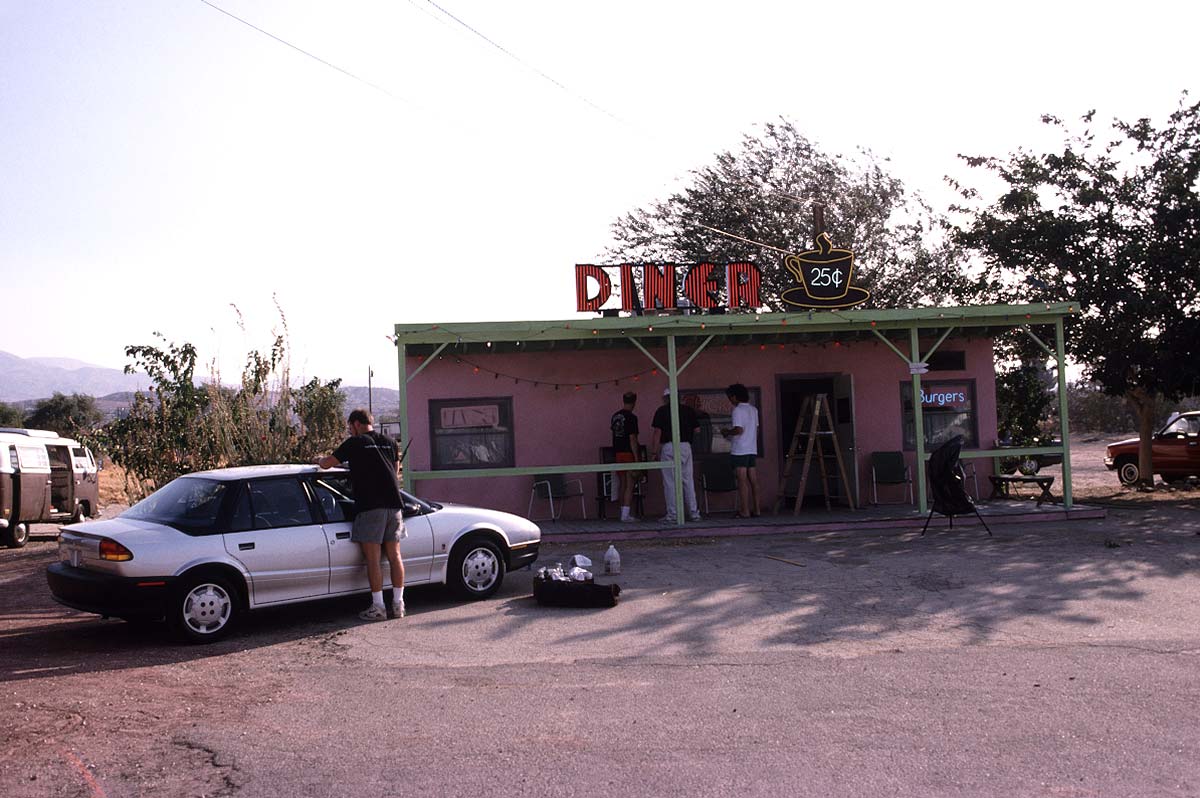
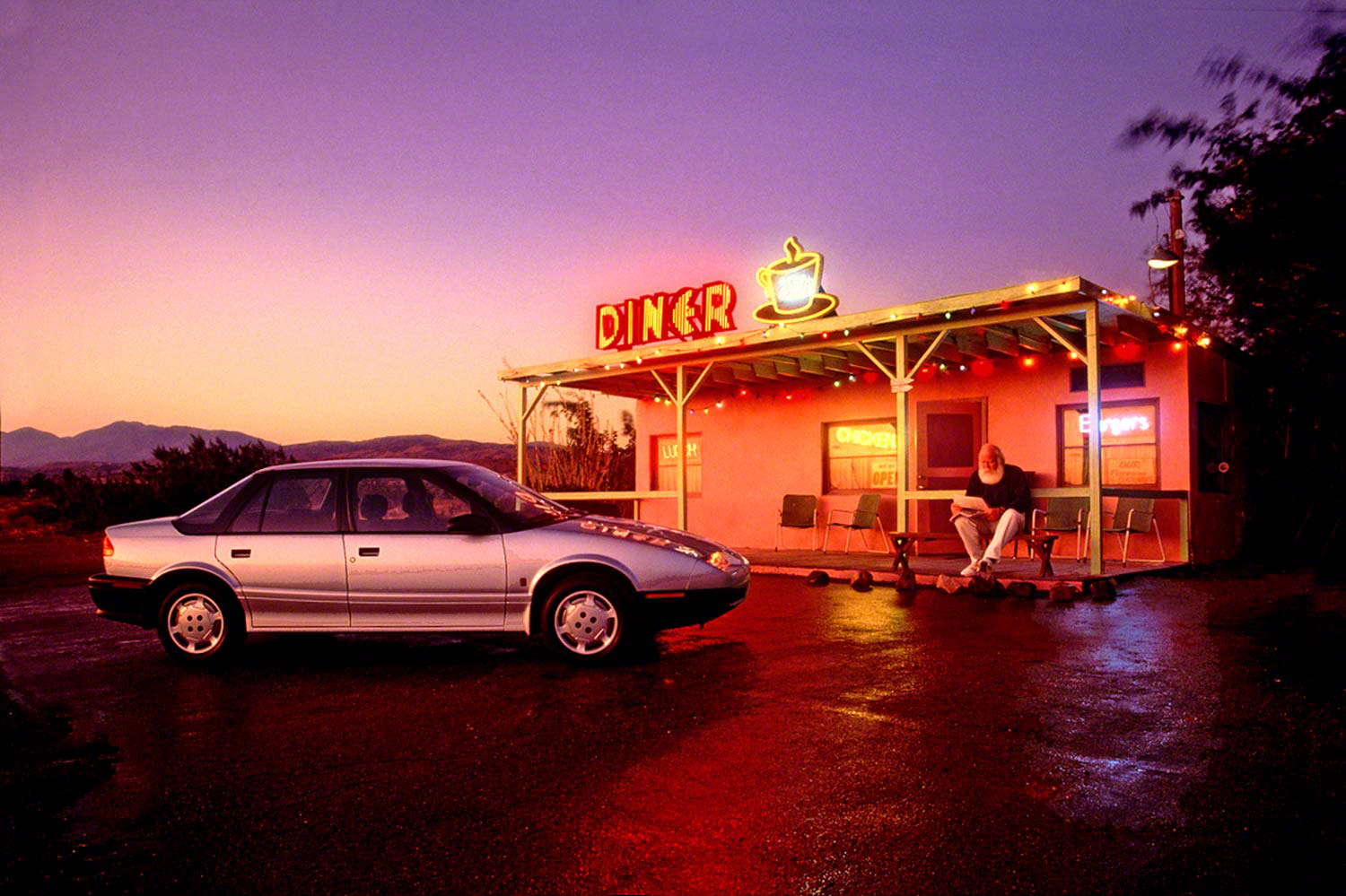
In the top photo of the Saturn, everything was done in the camera. The color silver was chosen so it would reflect the ambient light of the sunset evenly without adding any additional light. My instruction to the location scout was to find a diner where the sun would set or rise directly behind it. Using my Sunpath software and my Morin 2000 hand bearing compass, I was able to know ahead of time if this location would work. Shooting close to Hollywood was always nice because I had access to any props I could conjure up in my imagination. It certainly helped here since the diner was abandoned; we added all the neon and interior lights.

The pavement looked terrible so I had a water truck come in and do what’s called a wet down. This makes the driveway not on;y hide the cracks and discoloration, but being wet, it reflected the lights from the diner.

By the way, the man sitting out in front was the agency’s Art Director. I put him there to add an editorial feel.

So, there you have it. A little pre-visualization and pre-production can achieve the same results as sitting in front of a computer for hours to create this photograph. I can assure you that you don’t have to have a big budget to be able to create in the camera. It comes down to whether being a well-rounded photographer that takes the time to challenge himself is more important that being a good digital technician. Why not have the best of both worlds?

Here’s the diner when we started to work on it:

Visit my new website at www.joebaraban.com, and check out my workshop schedule at the top of this blog. Come shoot with me sometime!

JoeB

Life Before Photoshop: CompuServe Photograph

isolatedhousewithelk00793A couple of years ago I was sitting in the doctor’s office waiting ‘patiently’ for my turn. Laying on a table next to me was a Digital Photography magazine just waiting for me to pick it up. It was calling to me since on the cover, in big, bold, red print, was the title of an article called 100 Plug-Ins for taking better pictures.

Wow, I thought. So many ways to help you take better photos. I started reading the article with ‘bulging eyes’. I couldn’t believe that there were that many ways to manipulate a photograph. There were plug-ins to add lightning, natural light (nothing like natural light), rain, snow, mist , fog, reflective and refractive depth effects, etc, etc, etc.

Stupid me! I thought only the big guy upstairs could create lightning.

One company even said that their effects would “light your creativity on fire”. Another promised to “add style and class to your photography”. Not a bad thing!!!

YIKES!!!! What happened to plain old ‘classic’ photography?

In both my online school with the BPSOP, and my “Stretching Your Frame of Mind” workshop I conduct around the globe, there’s always students that picked up photography five or six years ago and never experienced what it was like before the days of digital cameras and Adobe Photoshop; when Adobe was a type of house in the southwest aprt of the USA. Well, in my classes, there’s no post processing allowed. It’s quite a challenge, and to many a welcomed one to have to submit pictures straight out of the camera. They are not allowed to make any changes or crop their images. I want them to become better photographers, not better ‘photo technicians’…digital artists.

By the way, as long as you crop your photos you’ll never become aware of the edges of your frame. This will definitely make it harder to take your imagery “Up a Notch”.

But I digress.

As I was saying, the magazine article sparked an idea. In a week, I was leaving to do a workshop, and I decided to create a PowerPoint presentation to start showing my fellow photographers.

As I might have said in other posts in this category, over the years I often had one of my assistants shoot production pictures while on photo shoots. As a result, we had the set-ups (how we did it) and the finished photo, so I was able to show a wide range of assignments.

Remember that all these pictures were shot ‘in the camera’ with absolutely no post-processing. In those days you actually had to think on your own, without a plug-in to “light your creativity on fire”.

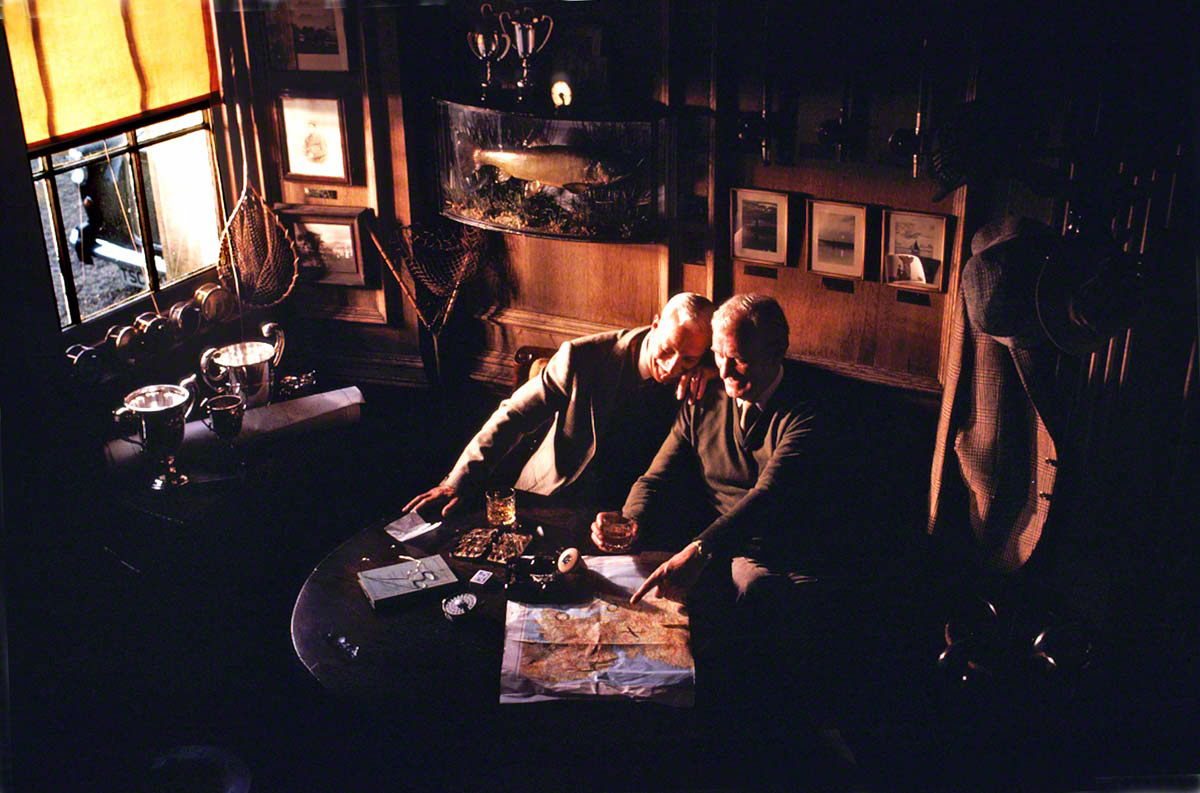
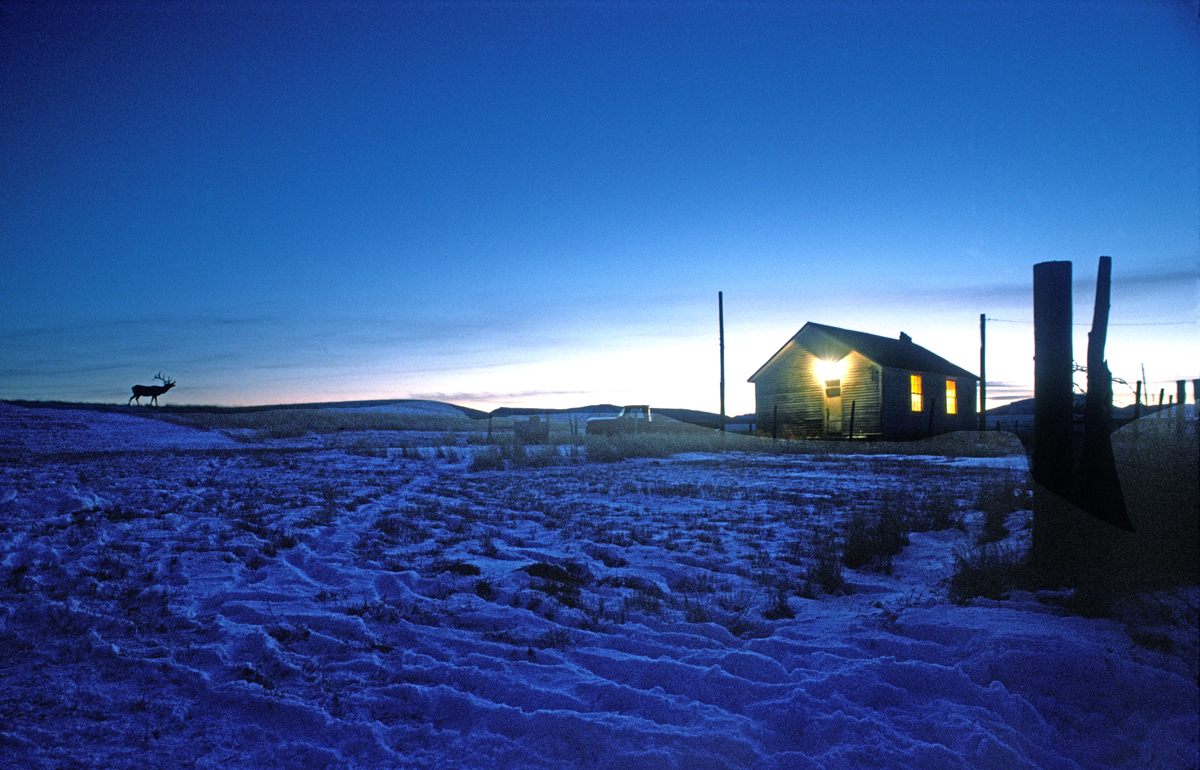
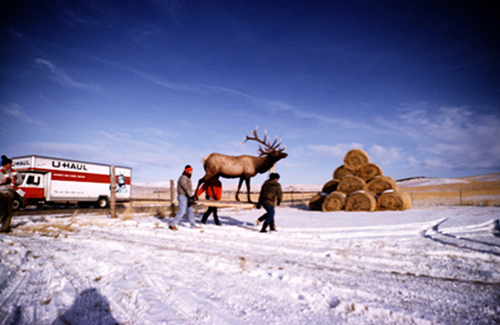
This photo was shot for a company named CompuServe and the premise was that no matter where you lived, as long as you had electricity you could connect to the Internet. After sending out several location scouts, we decided on Montana (in February no less). The house was deserted, so we brought in lights and a generator.

Shown above is the finished shot, and below is how we did it.

Visit my brand new website at: www.joebaraban.com, and check out my workshop schedule at the top of this blog. Come shoot with me sometime.

JoeB


Life Before Photoshop: Sam Houston Raceway

Look ma, no Photoshop


I love to write these posts because they take me back to the really fun times in Photography when we had to figure things out without the use of a computer; when Adobe was a type of housing in the Southwest. Personal computers were a thing of the future and the only time I got close to a computer was when I was shooting them for a companies annual report to the stockholders.

Back then, every time I shot a report the company was so excited that they were computer savvy and ahead of the business curve, I was instructed to take pictures of these huge rooms…after I signed an agreement stating that I would not tell anyone what I saw. Back then an entire floor was crowded with these behemoths. with miles upon miles of wires under the flooring. now, my beefed iMac27 is probably as powerful.

But I digress.

As I tell my online class with the BPSOP, and in my “Stretching Your Frame of Mind” workshops I conduct around the planet, I love the challenge of being a good photographer, not a good computer artist/digital technician. I try to do as much in the camera as I possibly can and use Photoshop for minor tweaking.  It’s kinda sad that the majority of my students and fellow photographers were introduced to photography during the digital era and think that the camera should do all your thinking, and Photoshop will pick up where the camera left off.

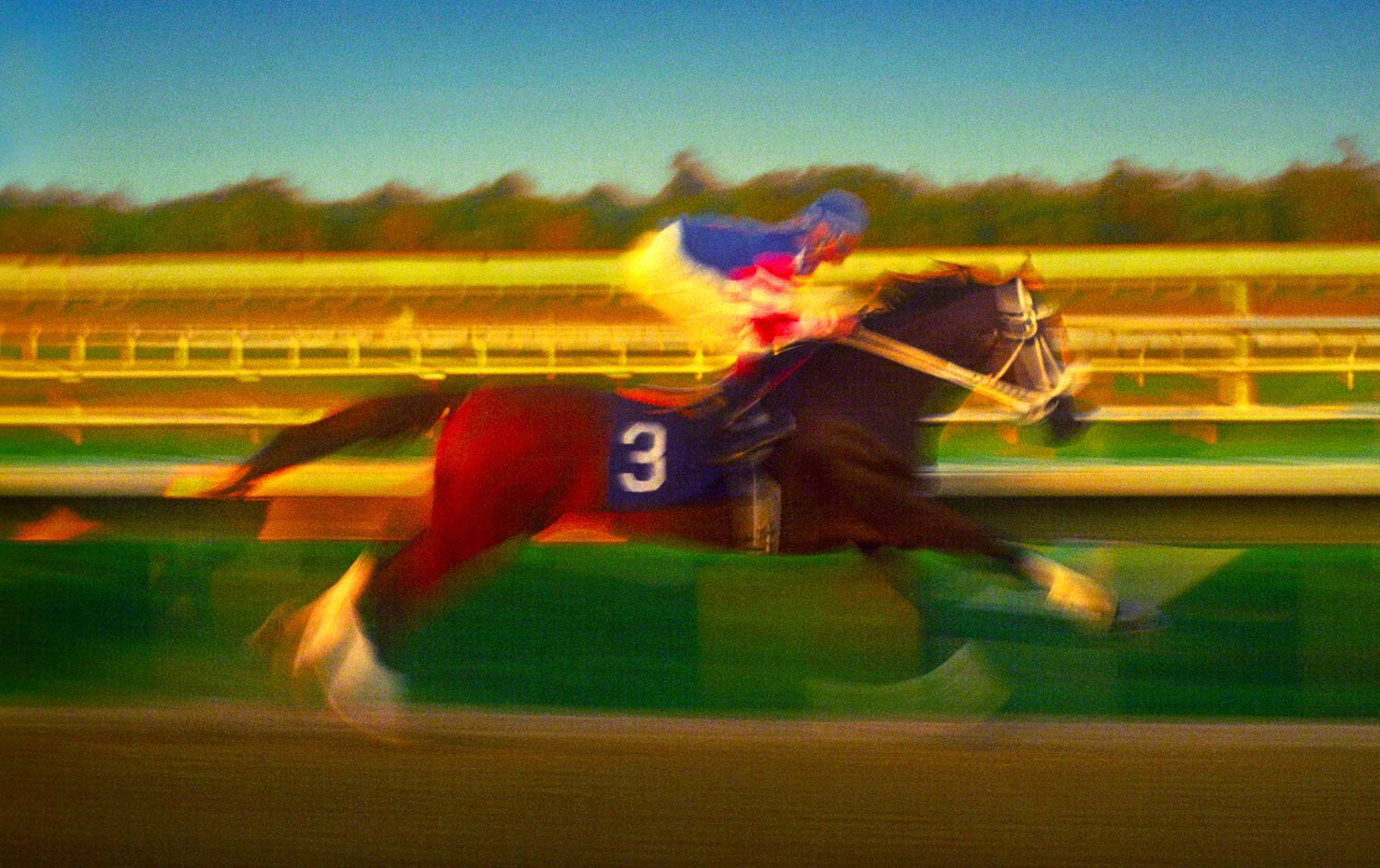
In the above photo, I was shooting an advertising campaign for Sam Houston Raceway, and showed up at sunrise one morning to see what photo opts availed themselves to me. The mornings are always the best time around the stables since all the care of the horses goes on very early.

I asked one of the trainers if I could take an action shot of one of the thoroughbreds during a workout, and he agreed (which was pretty amazing given what some of these horses are worth). I got in the back of a pickup and we started out together on the track. I had put on my 2omm lens and placed it on my a tripod. I wanted to create the feeling of movement so I was shooting at a 1/15th of a second. The reason why the number ‘3’ is sharp is because the saddle and I were traveling at the exact same speed. The horse’s legs are blurred because they were moving at a faster rate of speed. As we came around the final turn heading for the finish line the horse started racing the truck. It was an incredible feeling being so close to this amazing animal; close as in fifteen feet.

Btw, you’ll notice that there’s only sunlight on the back end of the horse. The reason is that we were passing in front of the grandstand that was almost blocking the early morning sunlight. The back end was the only part still in the light…and just for a split second.

What a thrill!!

Visit my website at: www.joebaraban.com, and check out my workshop schedule at the top of this blog. Come shoot with me sometime. I just announced my New York, New York Workshop beginning September 17th, 2019 and ending at noon on the 23rd. This will be my second workshop there and this time we’ll be shooting in all the five boroughs.

JoeB

Life Before Photoshop: Asics Tennis Shoes.

Look ma, no Photoshop!!!

For those out there that have been following these posts, I hope you’re enjoying them as much as I did when I was taking them…way back when Adobe was a type of house in the southwest part of the country.

It was never in question whether I could solve the clients problem or not. If I took on the project, then there could be only one ending…a happy one where everyone lived happily ever after. If there wasn’t a happy ending, you never worked for that advertising agency again. you became persona non grata. If the art director, writer, or account executive went to another agency, and it happened all the time, your name went with him.

There wasn’t anything to help you in those days in the form of post processing. Hell, in the early days there weren’t even computers…just me and my Kodachrome 25.

I teach an online class with the BPSOP, and I also conduct my “Stretching Your Frame of Mind” workshops around the planet. In both cases, I ask my fellow photographers to not use any post processing. Everything they submit has to be right out of the camera. I want people to become better photographers, not better computer artists or digital technicians. Don’t get me wrong, I’m not some old guy that can’t change with the times; quite the contrary. I use CS5 to some degree on just about every image I take…why not? Having said that, I like the challenge of getting it in one exposure, one click, and in the camera. To me that’s what being a good shooter is all about.

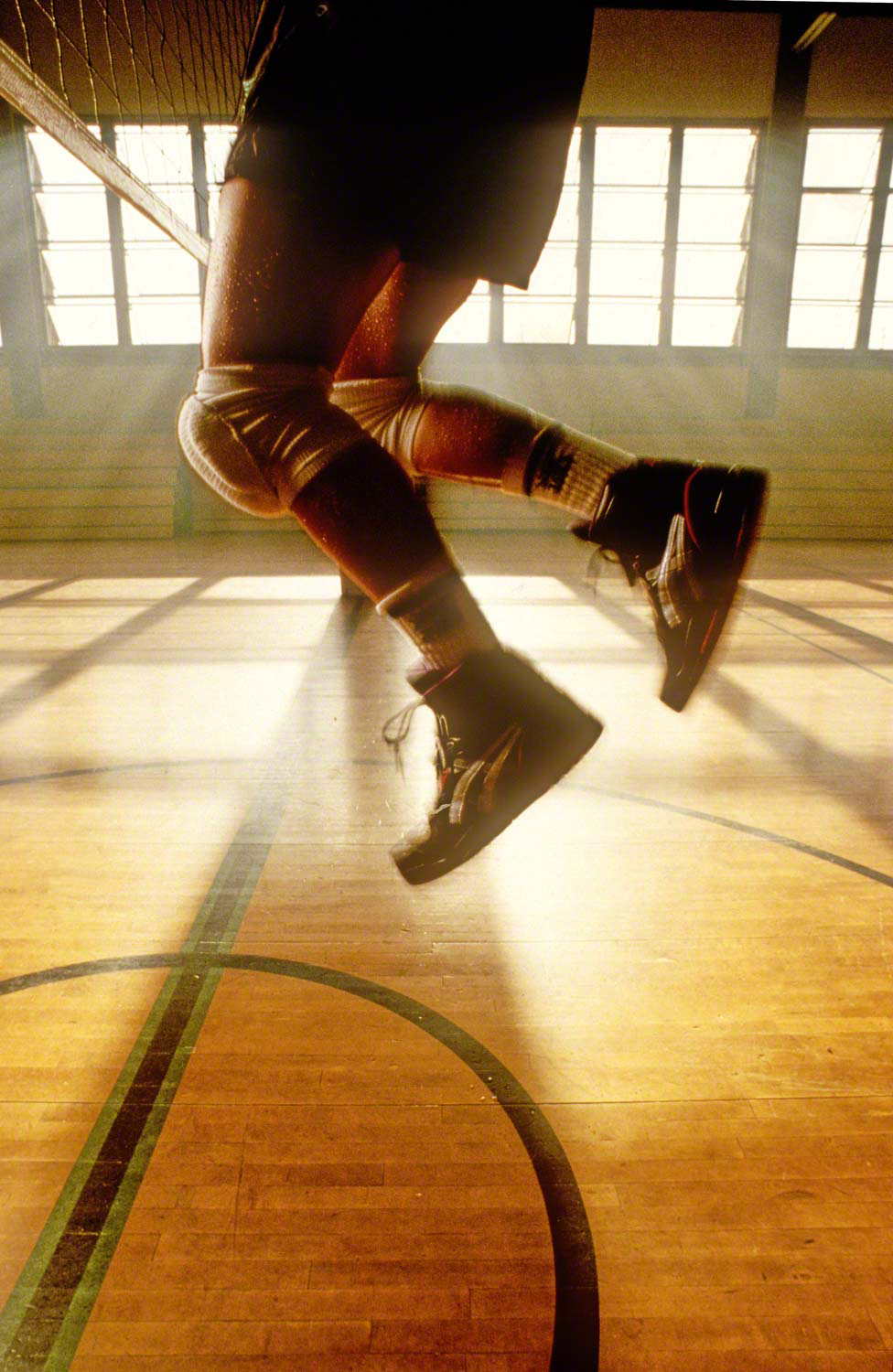
The above photo was part of an advertising campaign for Asics Tennis Shoes. This particular shoe was worn by members of the Woman’s Olympic Volleyball team, and the client wanted a shot that was full of action while showing the shoe.

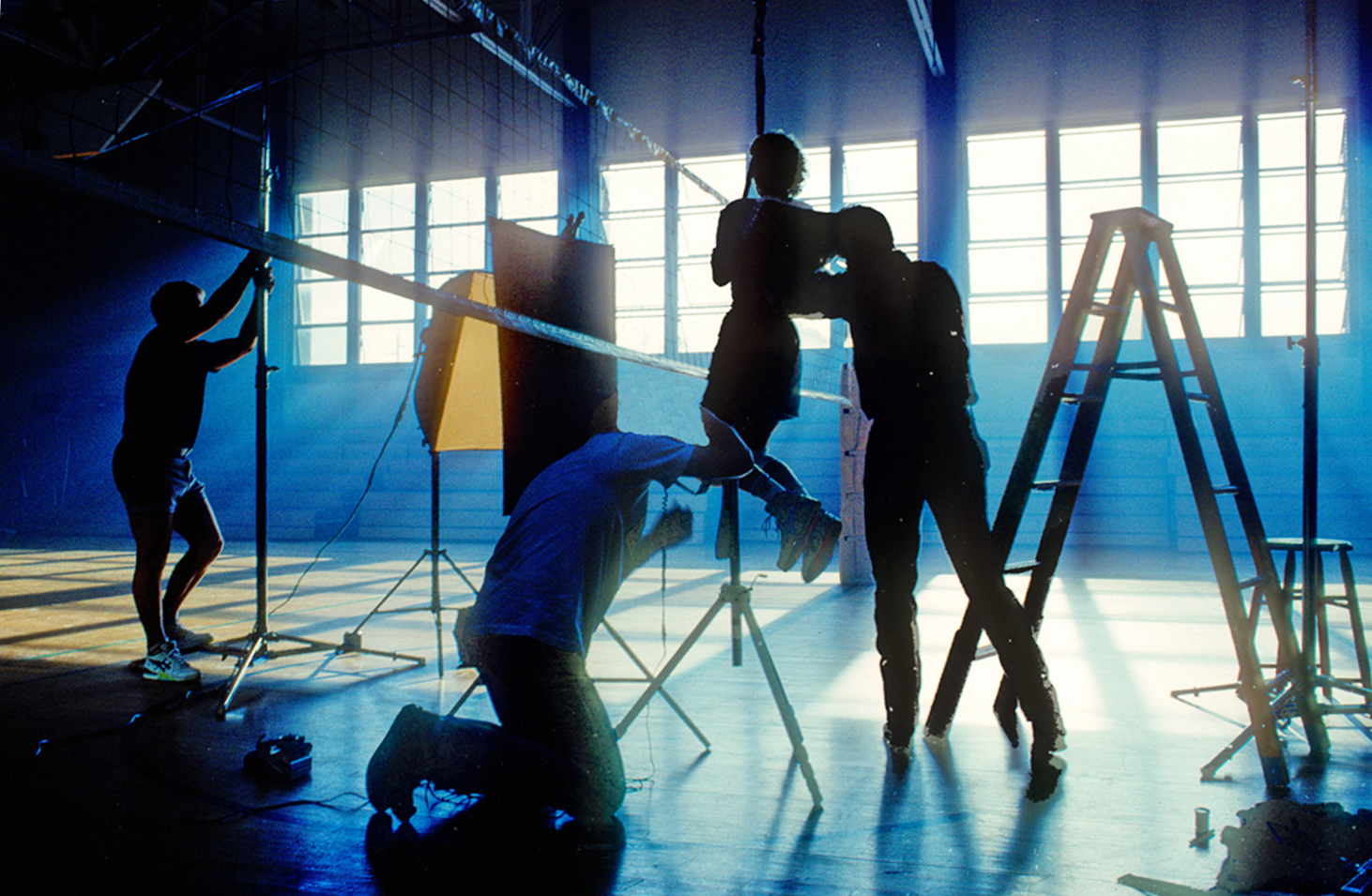
I created a way to make it look as if she was jumping for a ball by building a frame that could support her weight. In those days getting it without the use of electronic flash just wasn’t going to work. We built a harness that had a large bungee cord attached to the top. We could pull her down, let go, and it would spring back with her with it. I used a shutter speed that was slow enough to record the ambient light in the gym, and a synch delay that would fire the large strobe in the soft box at the end of the exposure instead of the beginning. This is what creates the slight blur and feeling of motion. When we pulled her down and let go she sprang back up we would click the shutter at that moment.

Right before I started to shoot, we wafted some fog juice to add to the drama.

The production photo.

Since it was before digital, I could only get an idea of what I was getting by taking a small 35mm polaroid before the actual shot. After that, I would bracket all over the reading my meter gave me. If it wasn’t right on the money, I had nothing to help make it right. Back then, it was just the way it was and if you didn’t think you could pull it off, you just didn’t do it.

I never turned these kinds of assignments down. I loved the challenge of solving the problem, and never thought I couldn’t do it.

Visit my website at: www.joebaraban.com and watch for my schedule at the top of this blog.

JoeB


Life before Photoshop: Accura Legend Photo Shoot

Taking 'Artistic License'
Taking ‘Artistic License’

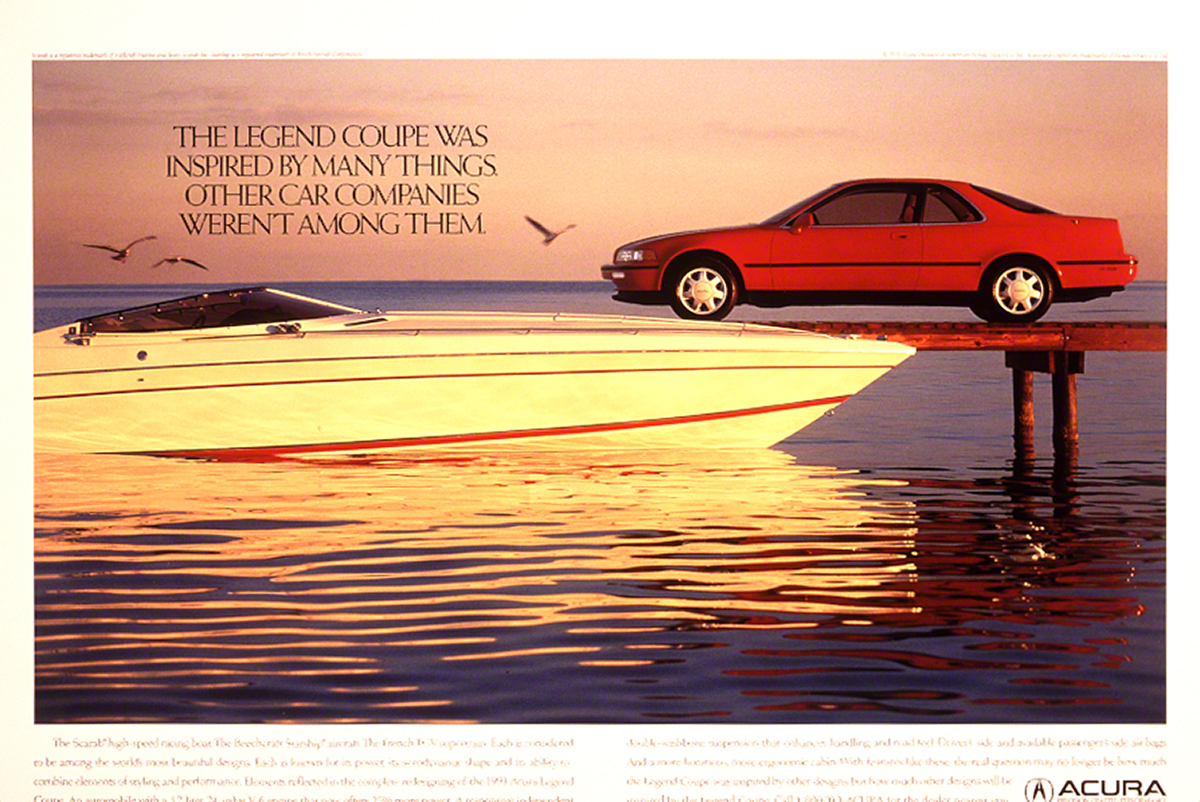
The above photograph was shot for Acura, as a two-page consumer spread ad.

I had hired a location scout on the West and East coast to find a pier that would not be too high over the water. The West coast wouldn’t work, but I found a set of piers in Sarasota that would work perfectly. As usual, the location scout would send me their picks to my studio ahead of time and I would go through them to decide which ones I wanted to see when I arrived a couple of days before the agency people and client. When my team arrived, the location scout took me and my producer to look at the ones I had selected. We settled on the one in the photograph because according to my Sunpath and compass readings it was perfect for the light I was after. Plus, I could shoot off the pier right next to it.

I thought it was going to be a no brainer, but I also knew from a lot of experience that in this business, never think anything was going to be easy; I proved myself right.

The next day, the Art Director and the agency entourage arrived with the two clients in tow. I took the Art Director to the pier I thought would work the best. We scouted the location in the morning to make sure everything was cool with him and he loved it. That afternoon we went for the shoot, but no one had thought about the tide!!!

When we got there that afternoon to shoot the sunset, the  tide had come in (right on schedule I might add) and when we positioned the boat it was now covering the car (the hero!) While the two clients weren’t looking, the art director non-nonchalantly sashayed up to me and asked me with trepidation in his now pallor face if I had a plan ‘B’?????

I thought for a moment then an idea hit me in the head like a big Pepperoni Pizza Pie . I sent my producer back to the beginning of the pier where there was a tavern favored by the locals. I had her go in and offer a twenty dollar bill to anyone that would come out, get inside the boat and lie down.

So what you see in this photo, or actually you don’t see, is fifteen really large inebriated locals that are lying down inside the boat. Because of all the additional weight, we were able to lower it just enough for me to get the shot.

Remember that it was in the days before Photoshop, so whatever I had to come up with had to be done “in the camera”.  So having said this, there’s absolutely no post-processing done to this photograph.

This is all about “Stretching Your Frame of Mind“, which happens to be the title of my workshop. Check it out and come shoot with me sometime.

This coming July 29th will be my 30th anniversary teaching at the Maine Media Workshop. I’ve always picked this time as it’s the week of the Lobster Festival down the road in Rockland. This ofers a unique set of photo ops, different from the Maine Coast, fishing villages and lighthouses. The Lobster Festival is all about color, design, light, energy, people watchng and environmental portraits everywhere you look; some people are there in costumes and loved to be photographed.

In conjunction with The Santa Fe Workshops, on October 2nd I’ll be leading a group in San Miguel de Allende. A beautiful oasis and artist colony, and the entire city is a UNESCO site.

Come join me for a week of fun and photography…what could be better?

JoeB

Life Before Photoshop: Allstate Insurance

Look ma, no Photoshop!

I enjoying this category and I especially love to hear the comments from those that take my online class with the BPSOP when I explain that there was a time when not only did we have to focus our own cameras, but Adobe was a type of house in the SW corner of the USA.

I also love to actually see the expressions of those that take one of my “Stretching Your Frame of Mind” workshops I conduct around the planet if I show my PowerPoint presentation entitled, “Life before Photoshop”.

Unfortunately, the large majority of my students started in the digital era, and can’t fathom not being able to enhance their photos after the shutter has been clicked. It’s almost scary, as in freaks them out, when I tell them that they’re not allowed to use Photoshop in my class, and that I want to see their UN-CROPPED images right out of the camera. You see in my class it’s about becoming better photographers, not better photo-technicians.

Don’t get me wrong, I love CS5, and I use it all the time. But when I use it it’s because I didn’t have the control I needed to create my image in the camera. WOW, how about that content-aware tool…it’s crazy!!!!!! Don’t you just love it???

I digress once again.

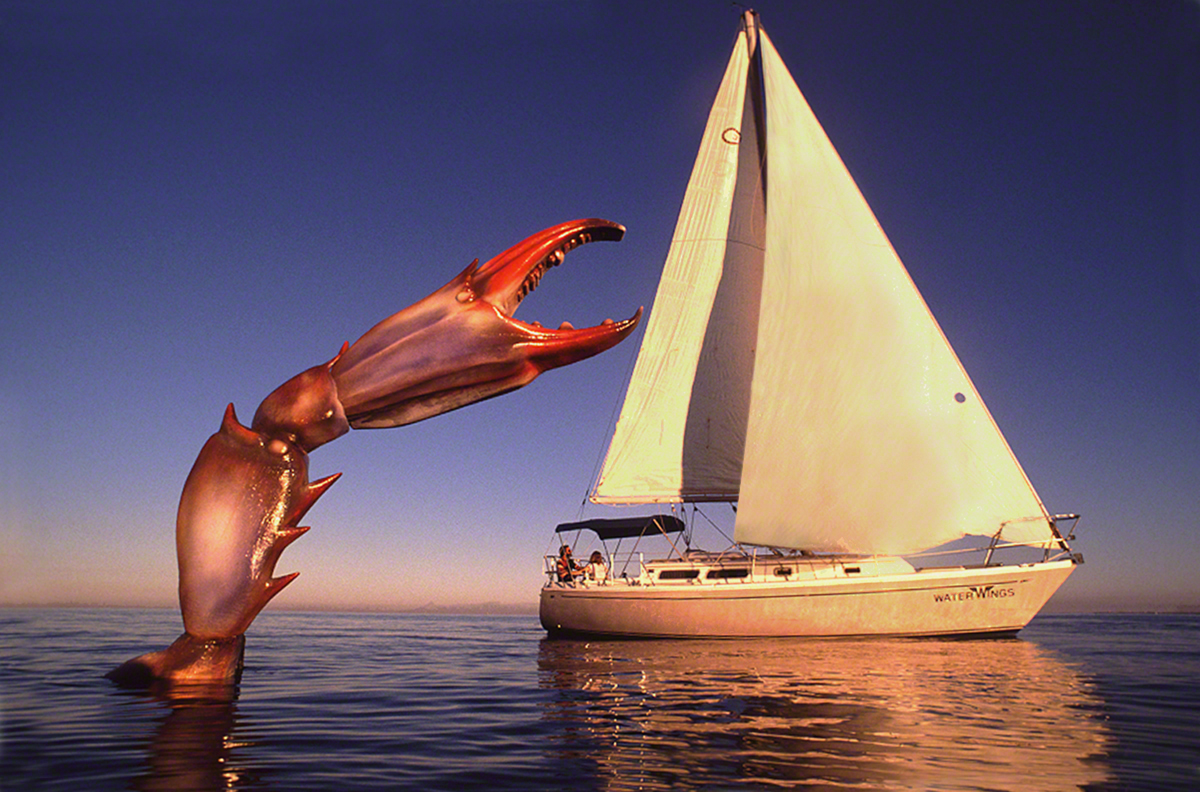
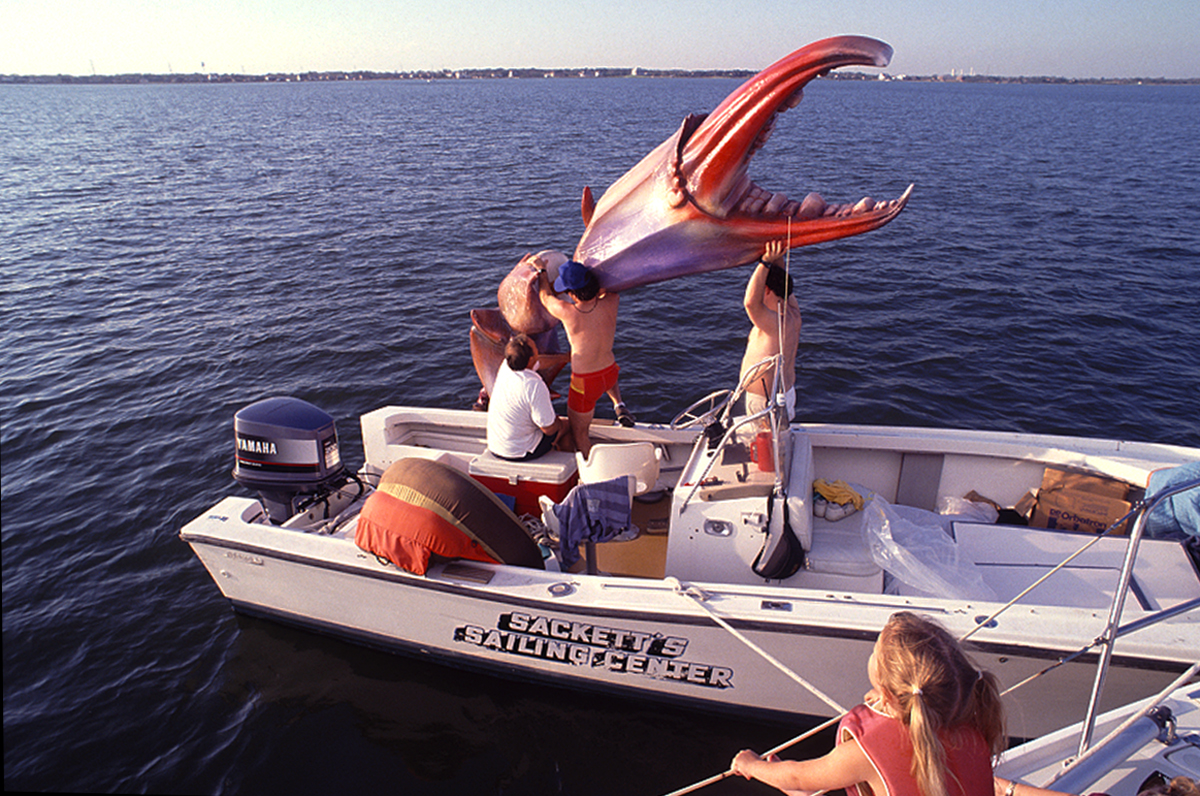
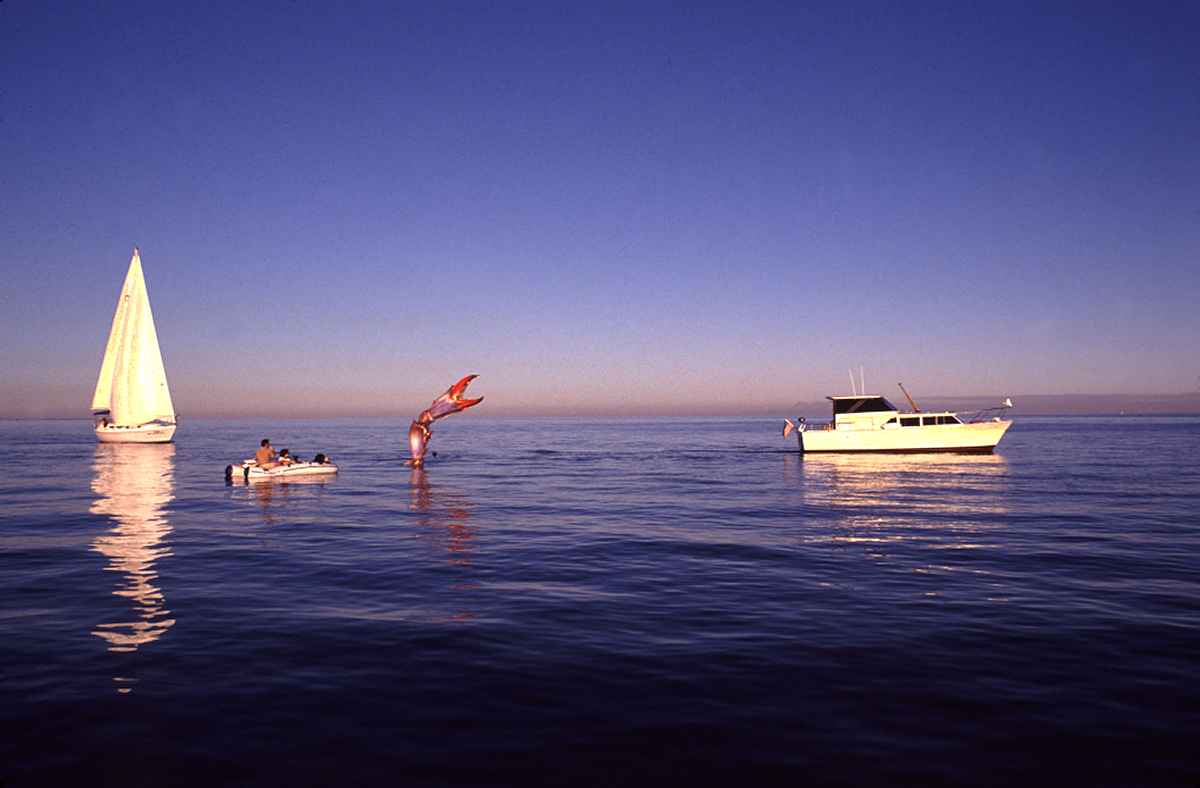
In the above photo, I was hired by the advertising agency that handled a company who insured boats and yachts of all sizes and shapes. The Art Director didn’t have much of a layout to follow, but what he wanted was to show a giant lobster attacking both a motor-yacht and a sailboat. I hired a good friend that’s a terrific model builder, and after we had a preliminary conversation over the size he carved my claw out of hard foam. He also devised a way to keep it standing up in very shallow water (as seen in the photo) while I had a sailboat and a large motor-yacht follow each other around me in a circle at sunset.

Remember that in those days everything had to be in perfect scale since it was to be created in the camera. Now, the claw would be a foot tall, shot in a controlled studio and Photo shopped into the image with just the boats.

What’s the fun doing that??? For me, there’s a sense of accomplishment in knowing that I could do this in the camera. I could never feel that sitting in front of a computer.

But that’s just me!!!

Here’s how we did it. The first photo shows Danny getting it ready, and the second shows me in a Zodiac shooting it.

Btw, the first day as we were getting ready to shot, the device Danny built did not cooperate and wouldn’t stay up. We had to scrub it for the day and let the kinks be workd out. Fortunately for yours truly, the next day was as clear as the day before…so no harm done.

Visit my website at:www.joebaraban.com, check out my 2018 workshop schedule, and come shoot with me sometime.

This coming July 29th will be my 30th anniversary teaching at the Maine Media Workshop. I’ve always picked this time as it’s the week of the Lobster Festival down the road in Rockland. This ofers a unique set of photo ops, different from the Maine Coast, fishing villages and lighthouses. The Lobster Festival is all about color, design, light, energy, people watchng and environmental portraits everywhere you look; some people are there in costumes and loved to be photographed.

In conjunction with The Santa Fe Workshops, October 2nd I’ll be leading a group in San Miguel de Allende. A beautiful oasis and artist colony, and the entire city is a UNESCO site.

Come join me for a week of fun and photography…what could be better

JoeB

Life Before Photoshop: Russell Athletics

Look ma, no Photoshop

I’m sure some of you can relate to the phrase often said by one or both parents or by someone that was in control of your daily lives, and it went like this, “You think you have it tough? I had to walk to school everyday in the freezing cold and two feet of snow.”…or something to that order.

Well, I can honestly say that I never said that to any of my four kids…why? Because they were raised in Houston, Texas!!

But one phrase I have said (repeatedly) to my online class with the BPSOP, and to those that have taken one or more (some ten) of my “stretching your frame of mind” workshops I conduct around our planet is “Once upon a time Adobe was only known as a type of house in the southwest part of the US, and everything had to be done in the camera; one exposure, one click”.

I don’t blame the majority of my fellow photographers that fell in love with photography after the advent of the digital era. That said, these people think that Photoshop, HDR, and all the weird plug-ins are a vital part of image making, and as a result the challenge of getting it in the camera will become obsolete when people like me are long gone.

More’s the pity!! The good news is that I won’t be around to witness it, and the bad news is that I won’t be around to continue the fight.

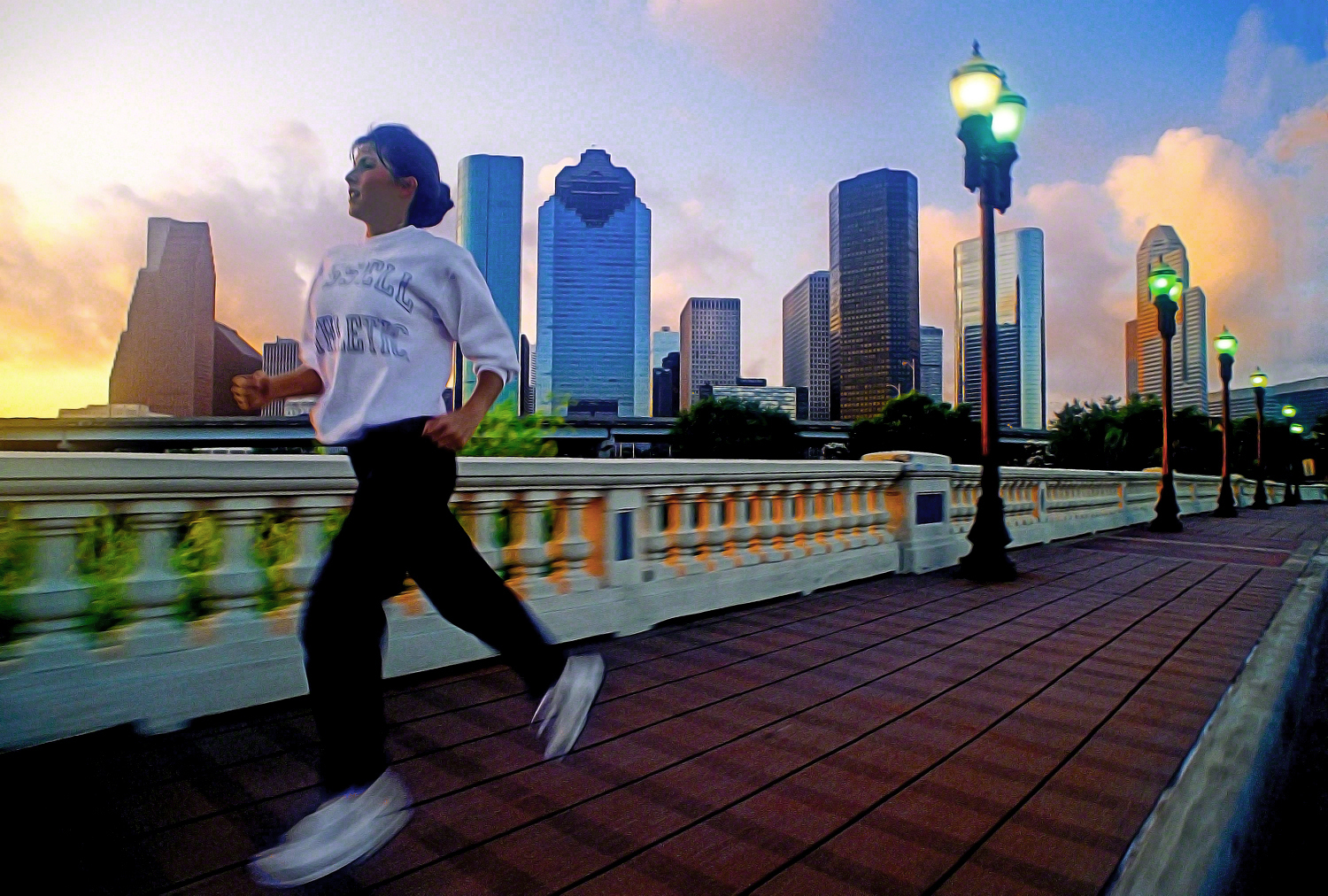
The above photo was challenging because I had to create the movement in the camera. It was a two page consumer spread appearing in sports magazines, and the art director wanted an attractive fit looking woman jogging while wearing clothing made by Russell Athletics.

I picked a location near downtown Houston that was a small bridge that had some character, while showing the skyline. I scouted the location ahead of time with my Sunpath program and hand bearing compass, and determined that sunrise would be ideal as far as having light coming from the 10 o’ clock position.

I was in a convertible with the top down and my assistant was driving alongside her at the same rate of speed she was going. I was shooting at a fairly slow shutter speed so as to make it seem like she was running faster than she was. Since her feet were moving faster than the rest of her they appear to be blurred more.

All this was accomplished in the camera, one exposure, one click.

Visit my website at: www.joebaraban.com and check out my 2018 workshop schedule at the top of this blog. Come shoot with me sometime. I’ve a couple of openings in my Springtime in Berlin workshop next May 23rd. A fantastic city with so many great locations we’re going to be shooting.

JoeB

Life Before Photoshop: New York Stock Exchange

Look ma, no Photoshop!!

For those that follow my blog, I wanted to take a moment to tell you all how much I really appreciate it. I’ve had a post come out every five days for the past six plus years, and  now I have a big following; again thanks so much to everyone for supporting my blog and continuing to tune in.

I love all my categories, but the one that really takes me back in time is my “Life Before Photoshop”. When I look at the production shots it amazes me that there was a time when you had to be dead on as far as the exposure and the way the photograph was set up.

When I show my PowerPoint presentation on this to my “Stretching Your frame of Mind” workshops, I tell them that there was a time when the name Adobe was a type of house in the Southwest part of the country.

I’ll show images to my online classes with the BPSOP as well, and quite a few of these photos were shot even before the onset of computers. In fact, I shot annual reports all the time back then and every company wanted pictures of their brand new computer room.

These were huge rooms with huge machines everywhere. These rooms were kept ice cold for some reason that escapes me now. Now, my iMac 27 with all the bells and whistles is more powerful than all those behemoth computers.

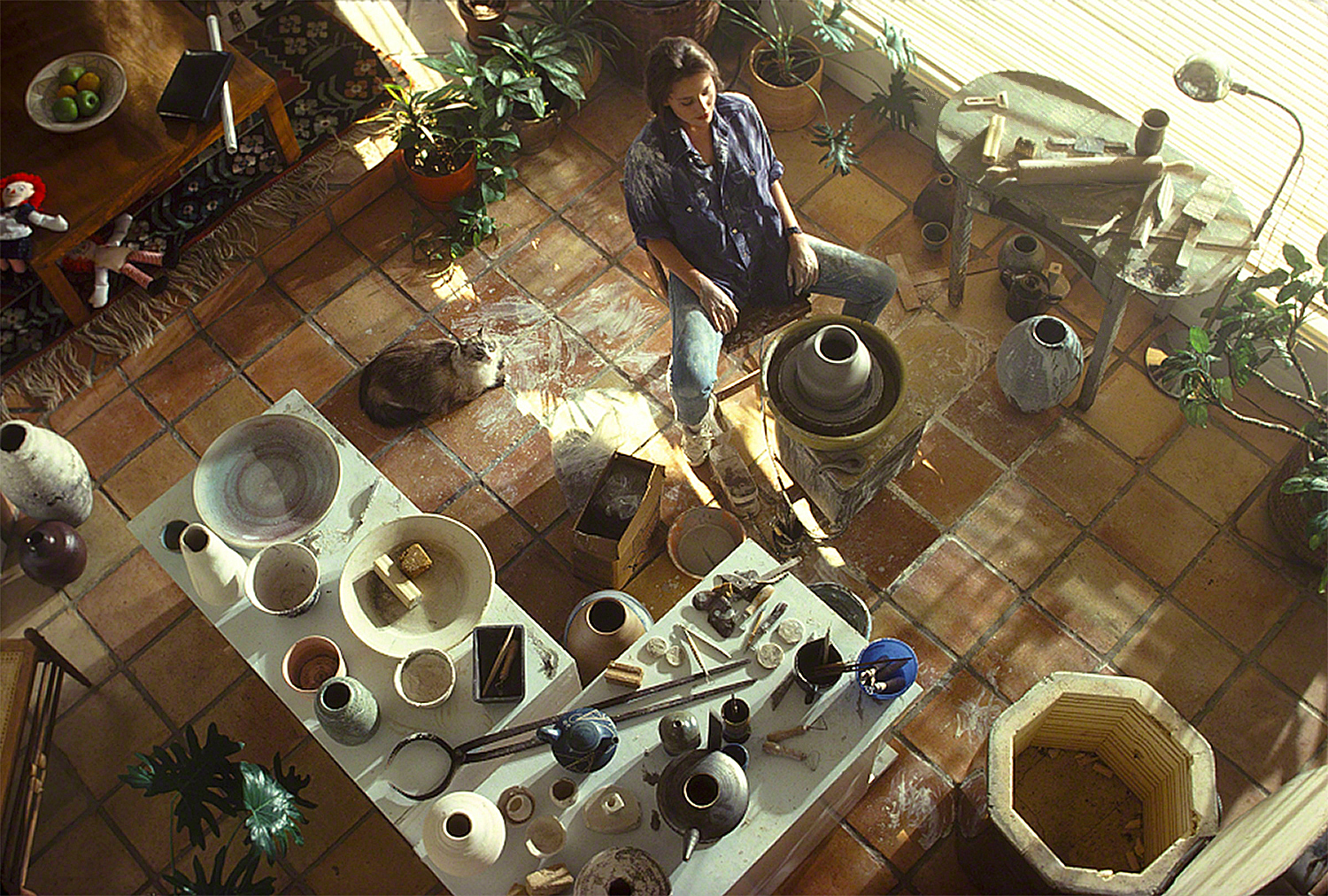
I was asked to shoot a picture for the New York Stock Exchange of an affluent woman in her studio that was connected to the main house. The idea was to show that investments were a good thing and enabled you to do whatever you wanted.

I came up with the idea of making this woman a potter and working on a vase in her studio. After looking for just the right place, and not finding what the art director wanted, we decided to turn one of the rooms in my house into a studio.

We  moved all the furniture out and started with an empty room, then began designing/creating the perfect potter’s studio; bringing in props that one would see in such a studio.

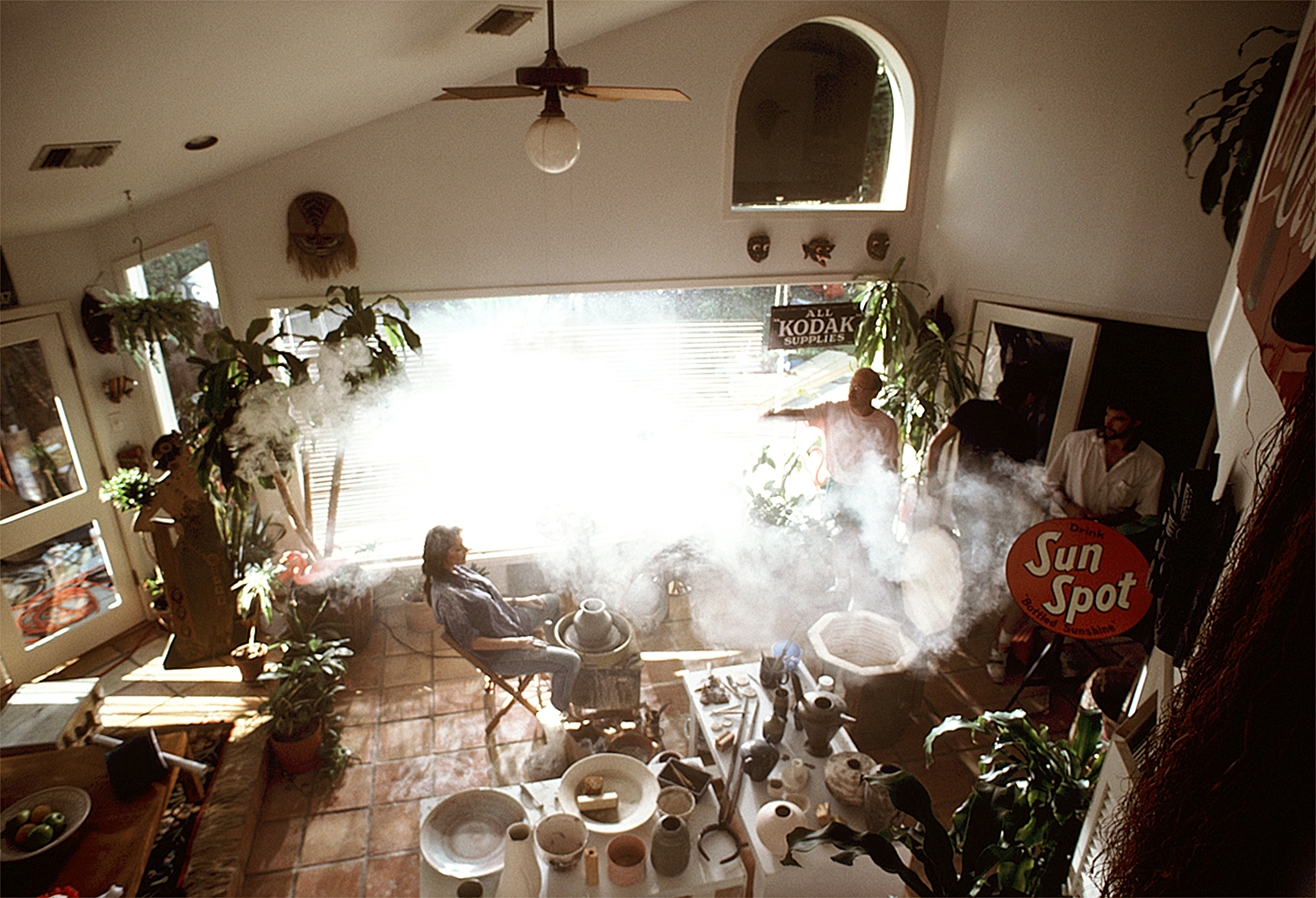
The set up

I had two very powerful 12K Daylight balanced lights that are used in TV commercial and motion pictures outside the room on my deck. To add to the ambience, we used a fog machine to smoke up the room to give it a diffuse, moody, feel good look.

The cat was provided by a friend of mine who was a vet. My producer was actually under the table next to the cat to keep her there for the thirty seconds I needed after the room looked right.

This image is the result of one 35mm Kodachrome transparency, one exposure, one click.

Next February in conjunction with the Santa Fe Workshops, I’ll be returning to Cuba for the fourth time. My next springtime workshop will Berlin next May; an incredibly beautiful city.

If you’ll send me a photo and question to: AskJoeB@gmail.com  I’ll create a video critique for you.

JoeB

Life Before Photoshop: Buick

Look ma, no Photoshop

Back when I was traveling and shooting two hundred and twenty-five days out of the year I had three reps (representatives); one in Chicago, one in New York, and one in LA. Most of my advertising jobs came from Chicago and New York, and the majority of my corporate work (annual reports and brochures) came from Houston (where I was living and still live) and Dallas.

The biggest chunk of automotive assignments came from my rep in Los Angeles, since that’s where most of the advertising agencies that handled car accounts were based.

I loved shooting cars and had a very good reputation for always coming back with “the goods”. These were my favorite assignments since they were usually several days of shooting and several days of pre-production and travel; it didn’t hurt that they were extremely lucrative, but that’s not where my mind was at.

As I’ve said in prior posts, the best examples I have of shooting before any form of post processing was developed is in automotive photography. This was the most difficult genre to shoot since the cars had to be lit perfect and all movement was achieved in the camera. So different than in today’s world where you can have the car sitting still against a background and make it look like it’s moving through the use of Photoshop. The majority of the time the car is photographed on a green screen and then stripped into  some landscape; which seldom looks right.

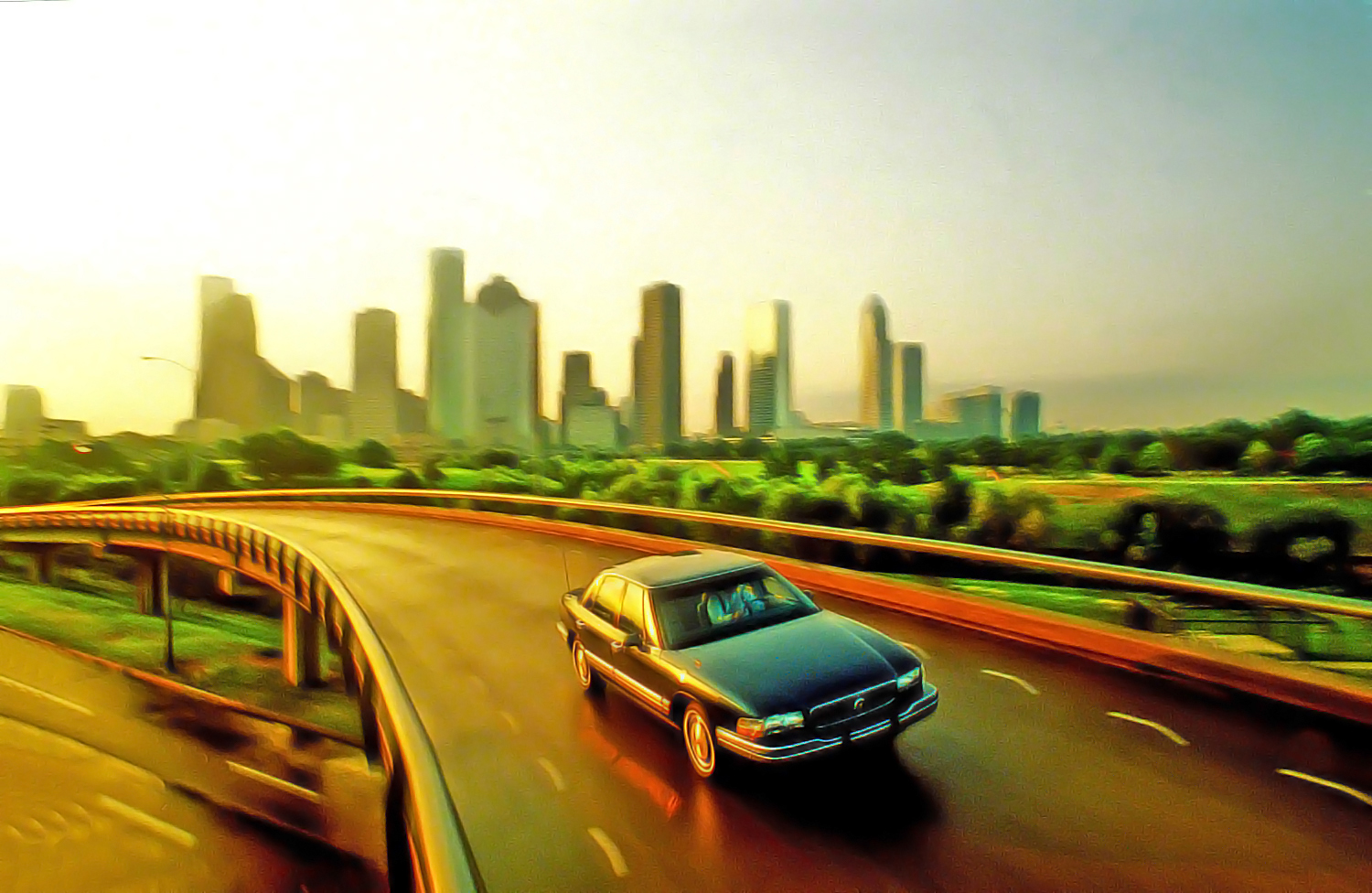
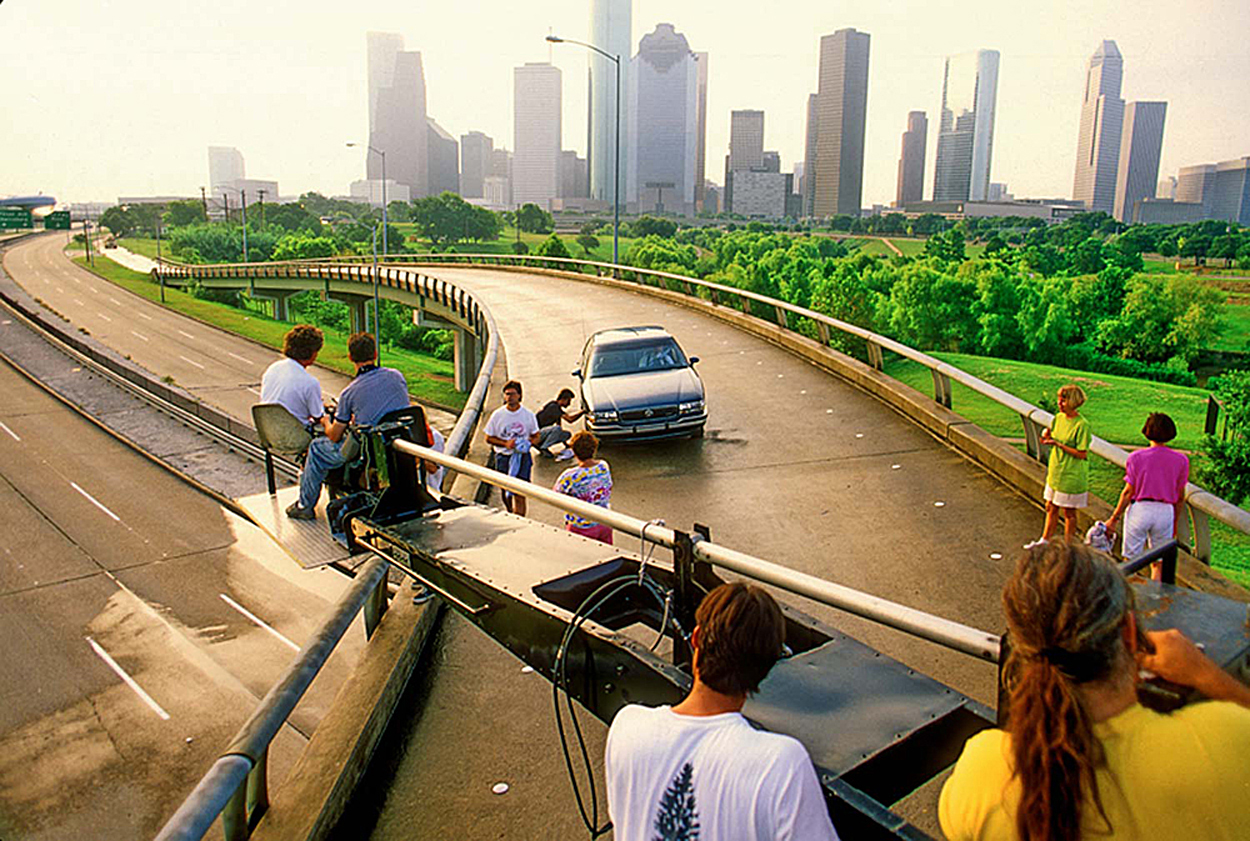
I was extended over the guardrail while we were moving and shooting.

One of the things I ask my online students with the BPSOP and in my “Stretching Your Frame of Mind” workshops I conduct around our planet is to refrain from using any post processing, and to crop only in the camera. I read once that when you crop in front of a computer it’s a sign of sloppy technique and a lack of discipline; I agree.

I want my fellow photographers to take the challenge and do whatever they need to do before clicking the shutter. It will make for a much stronger photographer, and not a more skilled computer artist.

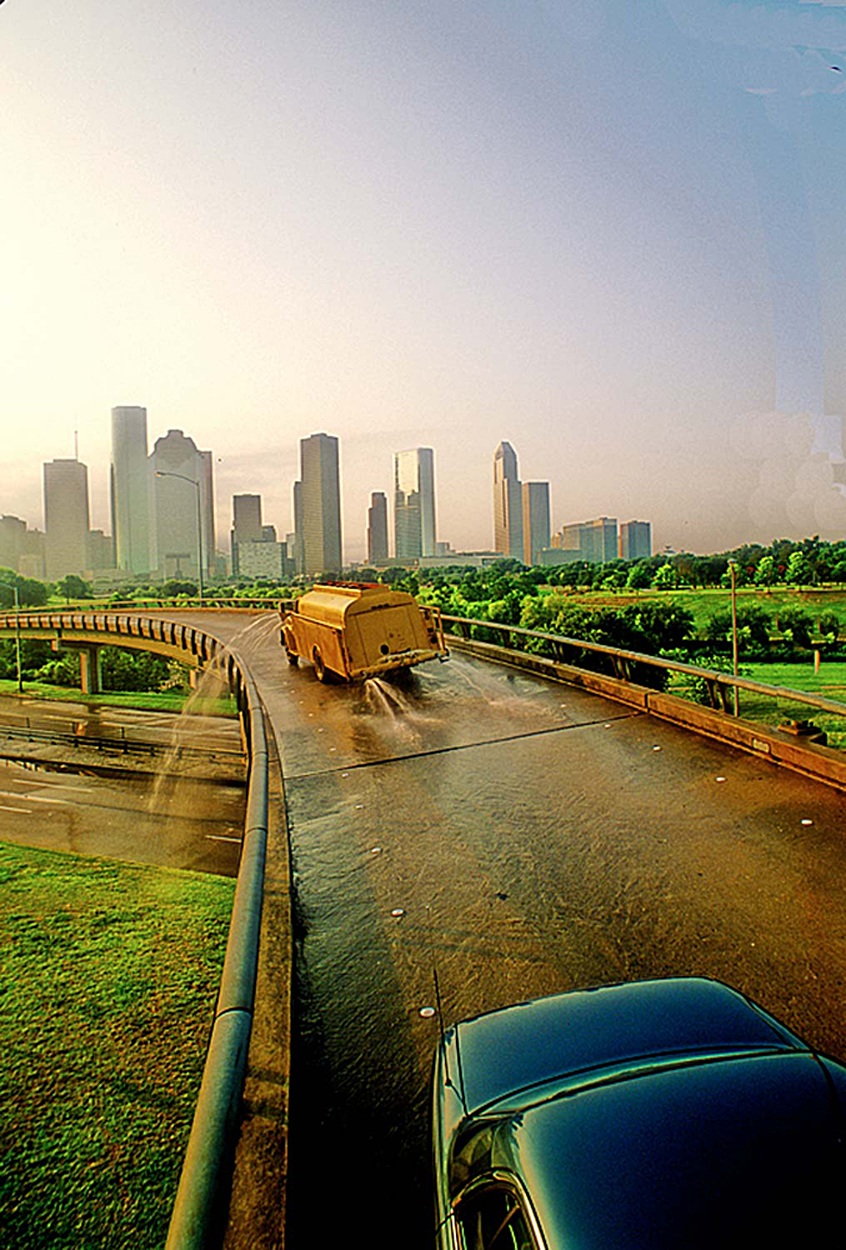
The wet-down with a water truck.

In the photo above, We shot at sunrise and I was sitting/positioned in a crane extending out from a camera car because the Art Director wanted to see the guardrails on both sides of the Buick. both the camera car and the Buick were traveling at the same speed so I could make the car look like it was moving. Right before the start of the shoot, I sent in a water truck to do what was called a wet down. The tricky part was to blur the skyline and have it be out of focus so that the Buick was the main focal point; to add to the effect I used a diffusion filter.

That’s the days when it was fun to be a good photographer and not a proficient computer artist.

Visit my website at: www.joebaraban.com, and check out my workshop schedule at the top of this blog. Come shoot with me sometime. On July 30th I begin my 29th year at the Maine Media Workshops. I’ve had the same week since the beginning. It’s the week of the Lobster Festival down the road in Rockland. It offers a completely different set of photo ops than one would expect when coming to photograph the coastline, lighthouses, and fishing villages of Maine. Come join me and spend a week completely immersed in your love for photography.

Send a photo and question to: AskjoeB@gmail.com, and I’ll create a video critique for you.

JoeB

Life Before Photoshop: Toyota Trucks

Look ma, no Photoshop

I would say that the hardest assignments to shoot before the days of any form of post processing were car shoots. The cars had to look perfect or your automotive career was over. Your name would spread faster than a California fire during the Santa Ana winds.

Besides the projects I shot for most of the Fortune 500 companies, I shot a great deal of car photography; which included billboards, advertising campaigns, and full line brochures. These were incredibly lucrative with six-figure budgets, but one screw-up and you were done…making them fairly stressful.

I loved shooting cars and thinking back I really don’t remember feeling pressure to come back with “the goods”. I always felt confident that given enough pre-production time I could always make the agency and the client happy.

The trick was always knowing where the light was going to be anytime from the moment the sun came up to the last warm rays before sunset; I used a program called Sunpath and a hand bearing compass. Least I not forget the biggest part of a successful shoot, it was also incredibly important to surround yourself with a really professional crew; each one doing what they did best and then having a good producer to make it all work together.

Truth be told, I was in a very small group that paid attention to where the sun was going to be, and an even smaller group that positioned the car in such a way as to create what was called “liquid light”, the nice soft light that ran from the car lights to the taillights. It had to be smooth, soft light that highlighted the side of the car…it had to look that way before you clicked the shutter. No small feat!

AS I tell my online students with the BPSOP, and the ones that take my “Stretching Your Frame of Mind” workshops I conduct around the planet, Light is everything and the only time it isn’t is when you’re street shooting and looking for that moment in time; capturing a person’s gesture or body language that will usually reveal something about that person’s soul.

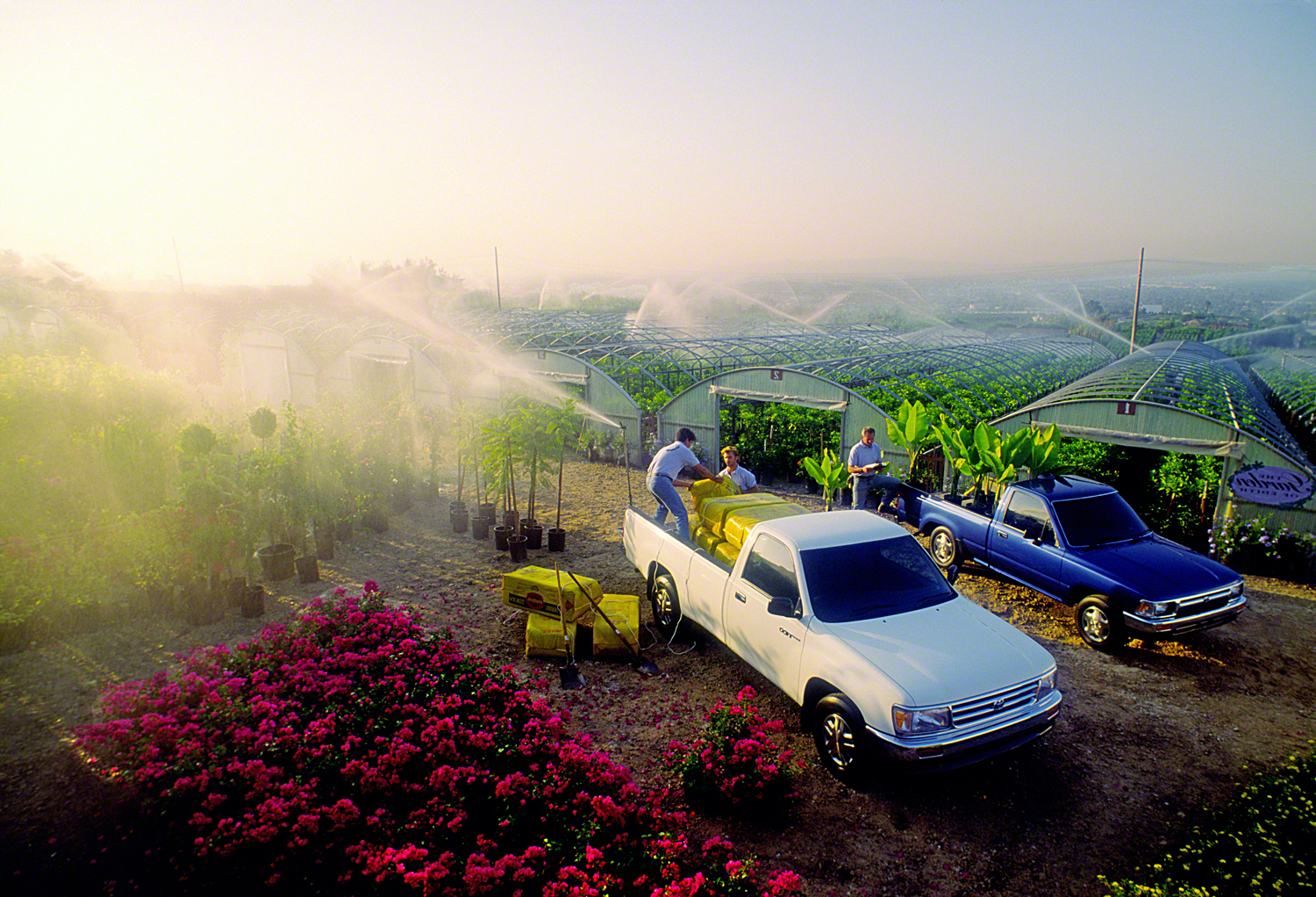
In the above photo taken for Toyota Trucks, I was to find a nursery where we could create a story based on all the different ways to use the  trucks. After having a location scout armed with the Sunpath readings and the compass find me several that would work, the Art Director and I checked out all the ones that received the early morning light I was looking for.

The location we settled on was perfect as it would back light all the flowers we put by the truck all the plants, dirt and fertilizer we put around and in the back of the trucks making them glow. I’m always telling my students and fellow photographers to try to back light anything that’s translucent; it’s my favorite way to light.

I had the car prep company put the trucks in such a way as to get the early morning light running down the side; it’s called the “Law of the Light”, and I’m always conscious of it.

When we were finished and I was satisfied as far as the way it was going to look, we waited until the sun came up. Just when I could see the full sun above the horizon and the light began to stream through my composition, I added one last touch…I had them turn on the sprinklers so they would be lit from behind creating a nice misty effect.

Everything you see here was created before the shutter was pressed and absolutely no help from Adobe; which at that time was a type of house in the SW part of the US.

Visit my website at: www.joebaraban.com, and check out my workshop schedule at the top of this blog. Come shoot with me sometime. On July 30th I begin my 29th year at the Maine Media Workshops. I’ve had the same week since the beginning. It’s the week of the Lobster Festival down the road in Rockland. It offers a completely different set of photo ops than one would expect when coming to photograph the coastline, lighthouses, and fishing villages of Maine. Come join me and spend a week completely immersed in your love for photography.

Send me a photo and question to AskJoeB@gmail.com, and I’ll create a video critique for you.

JoeB

Life Before Photoshop: Shell Rotella Oil Calendar

Look ma, no Photoshop!

I miss the good old days when you had to actually think before you pressed the shutter; you had just one click to do it right.

By today’s standards, it was very difficult to do it all in the camera, but since we didn’t know any better it seem the natural thing to do; it was the only thing to do!

I often think back to some of my photos and think what they would have looked like if Lightroom was around and Adobe was not just a type of house in New Mexico. Maybe I would have been dangerous, but i like the way it turned out.

Having said all this, I certainly don’t sit around every day pining for days gone by. I like to rely on Photoshop when something I want to do can’t be done at that moment…the decisive moment when I press down on the shutter and record what is.

What I don’t do and what I tell my online students with the BPSOP and my fellow photographers that sign up for my “Stretching your Frame of Mind” not to do is tell yourself that you’ll just fix it later. Instead of moving to the right to create a better balance between the negative and positive space, or to get that telephone out of someone’s head, or to fix the ridiculously overexposed  subject the meter told you was just fine by bracketing, people will sit in front of the computer and deal with it then.

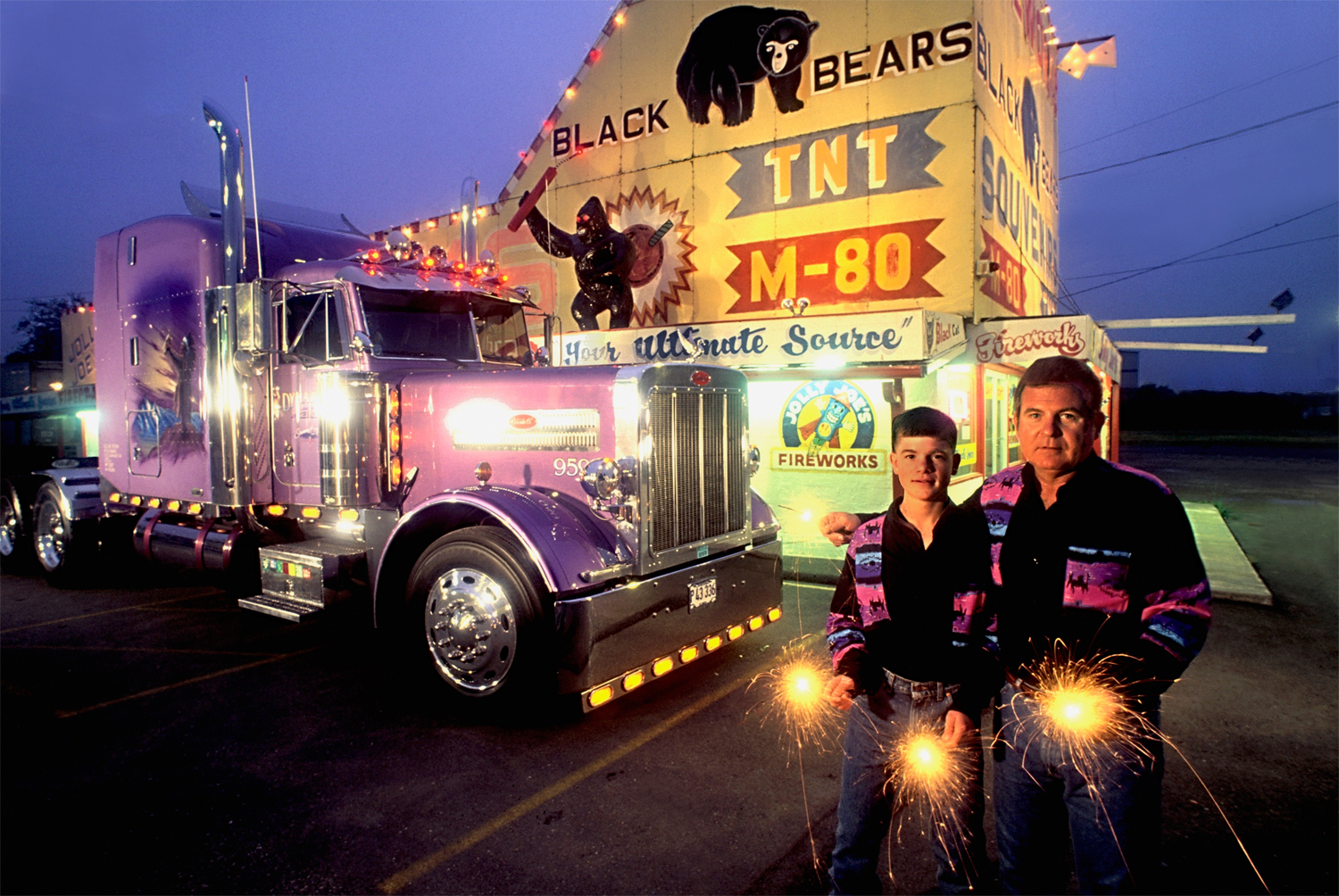
I was shooting a calendar for Shell Oil, and every year owners drive their huge eighteen-wheelers to a designated city in hopes to be featured on one of the month’s pages.

In the past they simply rented a huge warehouse that had a large overhead doors at each end, put up white seamless paper and each rig drove through, stopped, had it’s picture taken and drove out; I wasn’t interested in doing that.

I presented an idea to the art director. The idea was to take portraits of all the owners and try to make it work with a particular month. I sent my producer ahead of time to find me interesting locations I might use as a backdrop. We arrived in Nashville a couple of days early to look at the locations and decide on the twelve trucks we wanted to use. I walked among a hundred rigs looking to pick out the ones that were simply the coolest!

Since I love purple and Manny and his son (who was spending the summer driving around with dad) were great guys I picked their rig to be on the July’s page. We found this great location and went for the 4th of July theme.

What you see was taken on one 35mm Kodachrome transparency, and just one click of the camera.

Visit my workshop at: www.joebaraban.com, and check out my 2016 workshop schedule at the top of this blog. Come shoot with me sometime.

Don’t forget to send me photos and questions to: AskJoeB@gmail.com, and I’ll create a video critique for you.

JoeB