Student Work: Too Stereotypical?

Check out my new workshop on the six concepts in the Psychology of Gestalt: Gestalt Workshop link

Thilo, a student of mine living in Holland, sent me this photo for me to talk about. Here’s what he said:

Hi Joe,

I recently got this shot done at sunrise. No post processing beyond reducing the exposure by 1 stop.
I wonder what’s your opinion on this one. Maybe I am just too much used to the sight of windmills by now, but I wonder whether this might be too stereotypical to be good?”

Cheers,

Thilo”

Here’s a really good photographer that lives in Holland. Since he has grown up around windmills, he might not be as enamored by now.

What’s important to remember Thilo, is that very few people in the world have been around windmills, unfortunately myself included. Other than reading Don Quixote (who by the way was Spanish), I’ve only seen pictures of windmills. I will tell you that if you Google up pictures of Dutch Windmills, at least half of them would make Don Q turn over in his grave. Looking at photos of windmills taken in the middle of the day leaves little room for the dramatic.

Having said that, since you’re Dutch, and are able to shoot windmills all year long, your prime responsibility (as a good shooter) should be to make people that have only seen bad pictures fall in love with not only the historical side of Holland but the romantic side as well.
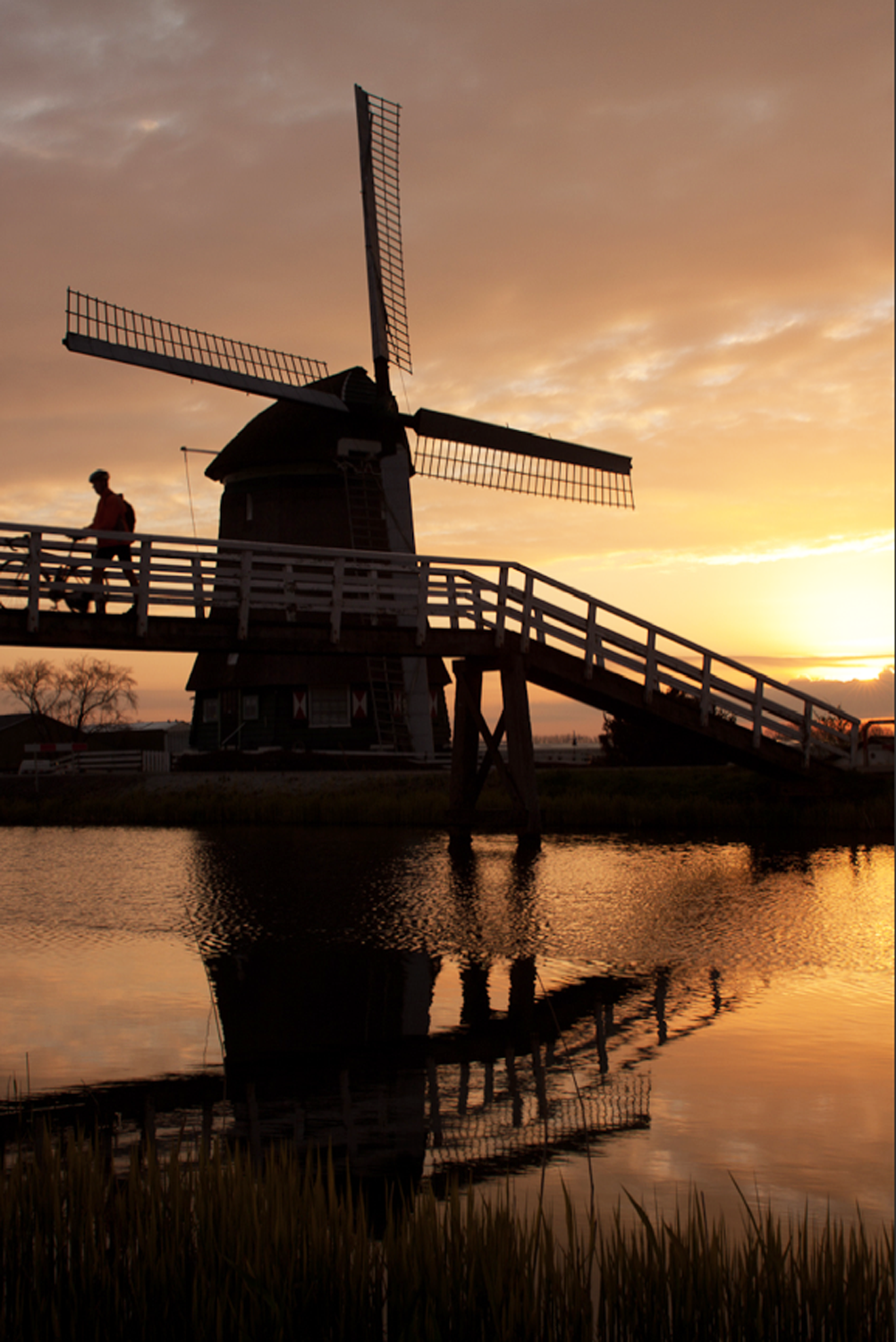
To me, you’ve done this in this photo. There’s a lot to look at besides the windmill; the Visual Tension you’ve created by showing the subject and it’s reflection for one. Adding a human element for another. I also like the fact that you have the person about to leave the frame which also creates Tension and makes the viewer wonder where he’s going by implying content outside of your composition.

One of my personal pearls of wisdom I talk about in both my online class with the BPSOP, and my “Stretching Your Frame of Mind” workshops I conduct around the planet is, “In a perfect world, what if”? What that means is that if you could go back and change anything you wanted, what would you change”? In this situation, I would have turned the windmill so you could see all four vanes (blades).

One last note. When I lightened it by about two stops, it looks a lot better overall. For one thing,  the silhouette of the bicycle is a “quicker read”.

I can look at GOOD photos of windmills all day long…but then I’m a romantic at heart!!!

Thanks for sharing.

Visit my website at: www.joebaraban.com follow me on Instagram: www.instagram.com/barabanjoe. Check out my workshop schedule at the top of this blog. Come shoot with me sometime.
JoeB

AskJoeB: Chambery in the Swiss Alps

Check out my new workshop on the six concepts in the Psychology of Gestalt: Gestalt Workshop link

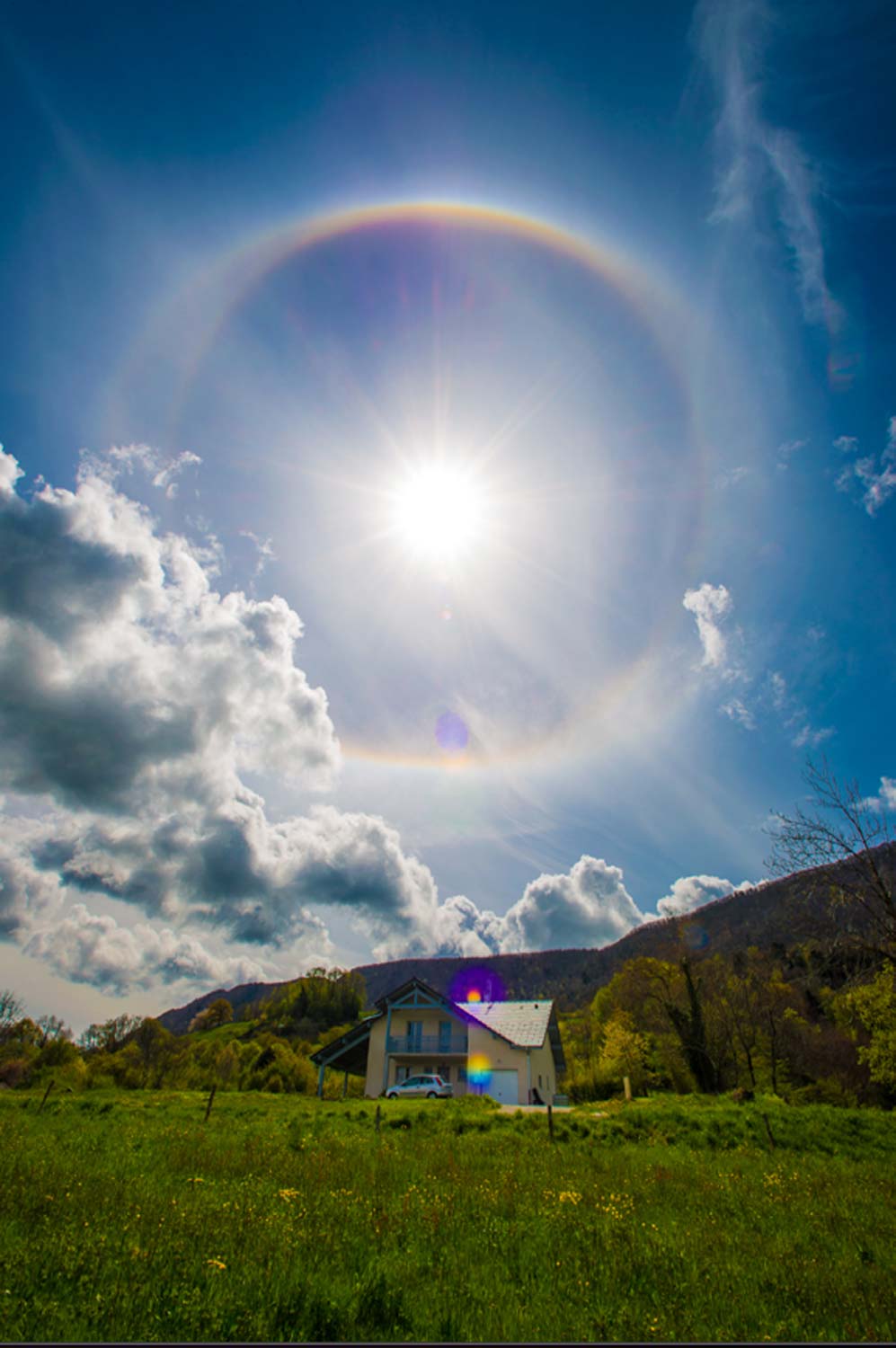
Pierre, a student living close to Chambery, France sent me this photo to comment on. Here’s what he said:

“Hello Joe,
I was looking for professional advices about my photowork, so it is a great chance I discover your blog !
I was a music teacher and I’m trying to change my profession.
I live near Chambery, in the French Alps. This photo I took yesterday is from the house in front of mine.
I was looking to convey the idea of a bright natural wonder.
What do you think about this one ? Is it a worthy work of a professional ? Does it do it ? !!!

Lot of thanks,

Pierre Laily”

Ok, let’s take a look:

First of all, I went to your Flickr page and noticed that you have this effect in several other photos on your site. If I might suggest, you should only show one image that has this bright ring. When you show as many as you have, the fact that it may not be real, and achieved through some software effect really shows up.

Personally, I’m not a big fan of manipulating photos with any kind of effect. In your photo, it doesn’t feel like it’s the real thing. If I’m wrong, please let me know. It’s just that in my fifty-three year career, I’ve never seen this kind of phenomenon happening in nature in so many different photos as you have. Perhaps it’s because I usually don’t shoot when the sun is this high in the sky. So I suppose anything is possible when you’re dealing with nature, especially at the altitude you’re at.

If I can give some advice to a newcomer that I give both in my online classes with the BPSOP and also in my “Stretching Your Frame of Mind workshops, strive to create photos that are created “in the camera”. Learn to use the elements of visual design and composition to make your photos stronger. In the long run, it’s going to make you a much better photographer.

By the way Pierre, I like the shot you have of the ring around the single flower. It has a stronger center of interest. In this photo you submitted, once the viewer sees the ring, there’s not much else for him to look at; the ring isn’t enough. This photo looks like it could have been taken in several states in the US. If I lived where you live, I’d be making sure that the viewer knew it. It’s just toooooo beautiful a country not to!!!

Visit my website at: www.joebaraban.com, and follow me on Instagram: www.instagram.com/barabanjoe. Check out my workshop schedule and come shoot with me sometime.

AskJoeB: What Could I Have Done Better?

"How to make it better"
“How to make it better”

Janet from Ohio sent in her photo of a woman fishing (I’m guessing fishing for Catfish) and as usual I like to have everyone read what she had to say. The reason is that so many of my fellow photographers have had similar situations, and have asked themselves the same thing. Here’s what Janet had to say:

“Hi Joe,

I was out shooting last night and getting ready to go home when I saw this woman with an orange/red jacket.  She was  fishing even though it looks more like she’s deep in thought.  I thought the color of her jacket and the bucket would be a nice echo of the sunset.  Even though I like the last sentence, I actually just  thought the color would look great in a photo.

I am proud to report that I walked up to her and asked if she would mind if I took her picture.  My first try was sad.  The middle of the bridge was coming out of her head!  So I tried again.  As I looked through the view finder, I did make sure that everything in the picture was what I wanted in the picture.

I like almost everything about this photo.  I like the negative space around the bridge, the colors – sunset, jacket etc., the reflection of the bridge and the lights from the other side.  The one thing I don’t like is the white thing that looks like a bucket in the foreground.  Actually it’s part of the dock and isn’t movable. I did little post processing.  I lowered the highlights a little to increase the color in the sky.

So, what could I have done better?”

Janet (from Holland, Ohio)

The firs thing I want to commend you on is the fact that you approached her and asked to take her picture. In my online class with the BPSOP, and also in my “Stretching Your Frame of Mind” workshops, I’ve had so many photographers tell me that they have a hard time asking people to do something for them. It can be something as simple as asking them to move over a little to help the composition, or to ask to take their picture.

I call it “getting over the hump”, and after you do it once, it becomes easier and easier. Not only will you get a yes most of the time, but you’ll walk away smiling after making a new friend that’s also smiling. Btw, always offer to email them your photo.

FYI, she’s both deep in thought and fishing. Since fishing is one of my loves, I can tell you that it’s is a form of meditation…any silent thought is a way to meditate. I can assure you that her reverie will end in an instant the moment she feels the pull on her line!

That said, if you wanted to show her fishing, then you have to ‘show her fishing’. You know she was, but you’re not going to be around to tell the viewer what she’s doing. Show the fishing rod!!! One way to see that is to use my fifteen point protection plan: https://joebaraban.com/dont-forget-to-take-your-fifteen-point-protection-plan/

Your image is underexposed. If you want to learn exposure and when to underexposed and when to overexpose, bracket. Put your bracketed photos on your monitor and look at them. Compare the different exposures then decide on the best one…the one that shows your image in the ‘best light’. Above all, don’t fix it in Lightroom or Photoshop. That won’t make you a stronger photographer!!

Visit my website at: www.joebaraban.com, and follow me on Instagram: www.instagram.com/barabanjoe. Check out my workshop schedule at the top of this blog. Come shoot with me sometime.
JoeB

AskJoeB: What Do You Think?

What do you think?
What do you think?

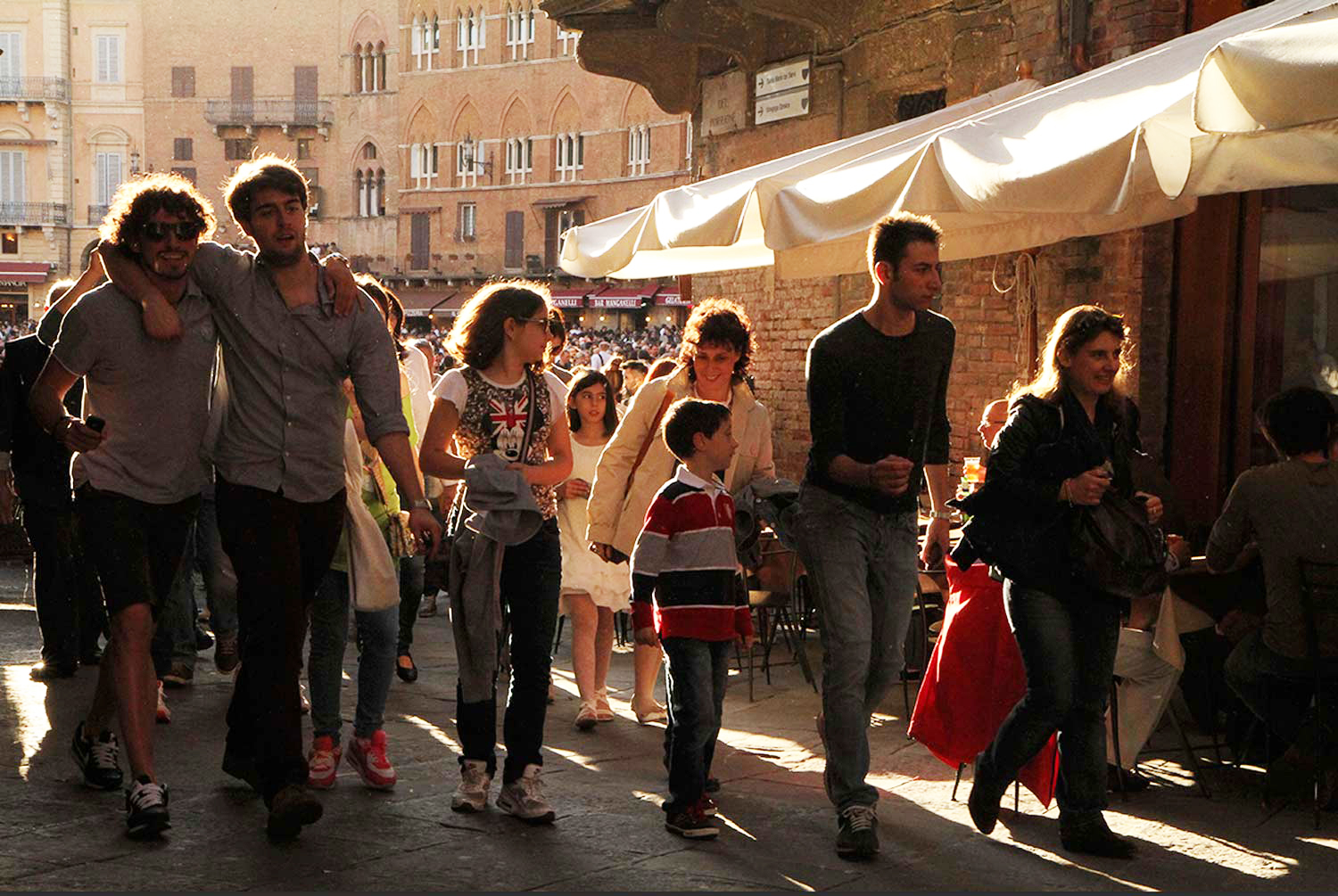
Canice sent me this photo to ask me what I thought. As usual, I like to show what the person said so that others that might be feeling the same thing, or have gone through similar situations can read what was said. Here’s what Canice had to say:

Hi Joe,
Attached is an image I took the last night we were in Sienna during the workshop. You now know why I was late for the last supper !!!

You will recall the square was packed that night and we had arranged to meet up for our final meal on the last night. I had worked my way around the square and figured that if I went up one of the streets leading off the square I might get a shot of some people leaving the square with the sun back lighting them. I hear a lot of photography experts criticizing photos because they say there is no way any highlights should be blown. This has me confused because in this image I feel that the blown highlights on the hair make the image much stronger, What do you think?”

Canice, If I had a dollar for every time I had a fellow photography taking my online class with the BPSOP, or in my “Stretching Your Frame of Mind” workshop I conduct around the planet, tell me that he or she were told by so called “photography experts” to never blow out highlights, I would be sitting by my pool right now, on my island waiting for my French maid to bring me another cocktail. Something blue and frothy with an umbrella hanging perilously from one side.

In my opinion, you should stay as far away from these self appointed experts…why? Because they will lead you down a one-way path…straight down to the burning fires of mediocrity.

WHO ARE THESE PEOPLE, AND WHY ARE THEY CONSIDERED EXPERTS????? If I were Emma Lazarus, and I were also a photographer, I might have written this on the Statue of Liberty for my fellow photographers, not just for the immigrants coming to America:

“Give me your tired, your poor, your huddled photographers yearning to breath free from of all these silly rules. The wretched refuse of your teeming shores. Send these, the narrow thinking photography experts, to me:
I lift my lamp besides the blown out golden door.”

Ok, I digress a tad!!!

I really like your photo!!! I’ll usually go out of my way to backlight something. I’ll also try to blow out the highlights since like you I think it adds a different dimension to it; a dimension filled with Visual Tension and Energy.

Canice, if you remember, some of the ways to generate Visual Tension is the use of light, contrast, and capturing a moment in time and leaving it un-completed. In your photo, you have all three. If i were you I would continue up your dedicated path to glory!!!

Visit my website at: www.joebaraban.com, and follow me on Instagram: www.instagram.com/barabanjoe. Check out my workshop schedule at the top of this blog. come shoot with me.

JoeB

Student Work: Motion Freezing Picture

I recently had a fellow photographer submit this photo into my online class. I always like to include their question so those out there that share the same thoughts, or like to take similar photos can read what they had to say. Here’s what Jean had to say:

“Hello Joe,

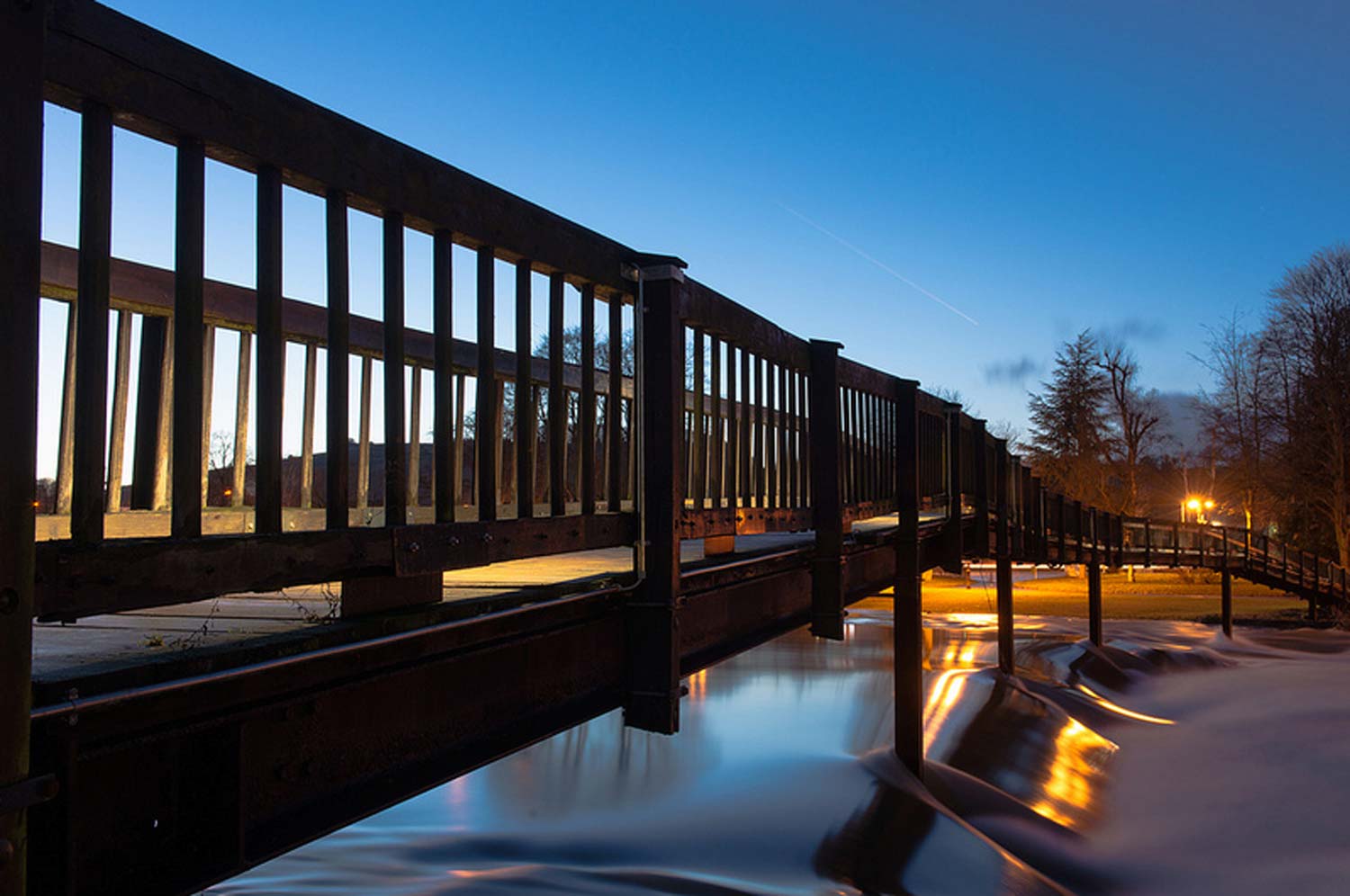
I was in your class last month in your BPSOP and I read your blog coming from and I want to show you one of my ‘motion-freezing’ picture. I’d be glad to hear your critique.
Thanks a lot,

Jean”

First of all I want to comment on the fact that Jean was in my part I class that I teach with the BPSOP. What I teach there is the same material  covered in my “Stretching Your Frame of Mind” workshops I conduct around the planet. That said, I hope some of what I have to say has rubbed off on her. From the looks of this photo I must be a good teacher because it’s a very strong image; it’s filled with the elements of design and composition that I show people how to use in order to take their imagery what I refer to as “up a notch”.

Ok Jean, let’s talk about it.

It’s a really nice photo that takes the viewer on a ride through the frame via the bridge and the water. Visual direction is sooooo important when keeping the viewer an active participant. The more ways we can get the viewer to leave and enter our frame the more energy he or she will use…and that’s a good thing!!! It’s what I teach in my new Gestalt class.

As far as freezing the motion, I think you might really be meaning something else…why? Because you haven’t frozen the motion. By using a long exposure, you’ve made the water look almost placid, with no ripples that would catch the light accentuating them and say movement. If you had shot at a shorter exposure, it might have looked like you had frozen the water and their would have been a different kind of texture than the smooth type you created here. It’s something I would have tried both ways.

That’s not necessarily a bad thing, in fact it usually creates an almost ethereal feeling. However in this example, I think the reflections of the sky in the water being so smooth may not be a “quick read”. At the bottom of the small waterfall, it looks a little like a low covering fog bank. The part of the reflected water appears as it it’s disappearing under the fog. It appears as though the water is cascading over some kind of rock structure that’s rendering the reflections somewhat weird and perhaps a little hard to understand. That’s not a bad thing either!!! It’s also hard to tell where the water ends and the deck (I think) begins.

I think it’s still a beautiful photo, beautifully lit, perfectly exposed, and well composed. There’s lots of things for the viewer to discover and enjoy, and it’s one you should be proud of.

Btw, remember that showing a subject and its reflection is one of the ways to create Visual Tension, and that’s one of the reason your photo attracts the viewer in the way he perceives then processes the information.

Thanks for sharing it on my blog.

Visit my workshop at: www.joebaraban.com and follow me on Instagram: www.instagrm.com/barabanjoe. Also check out my workshop schedule at the top of this blog. Come shoot with me sometime.
JoeB

Student Work: Winter

Aaron from Georgia sent me this winter scene for a critique. Here’s what he had to say:

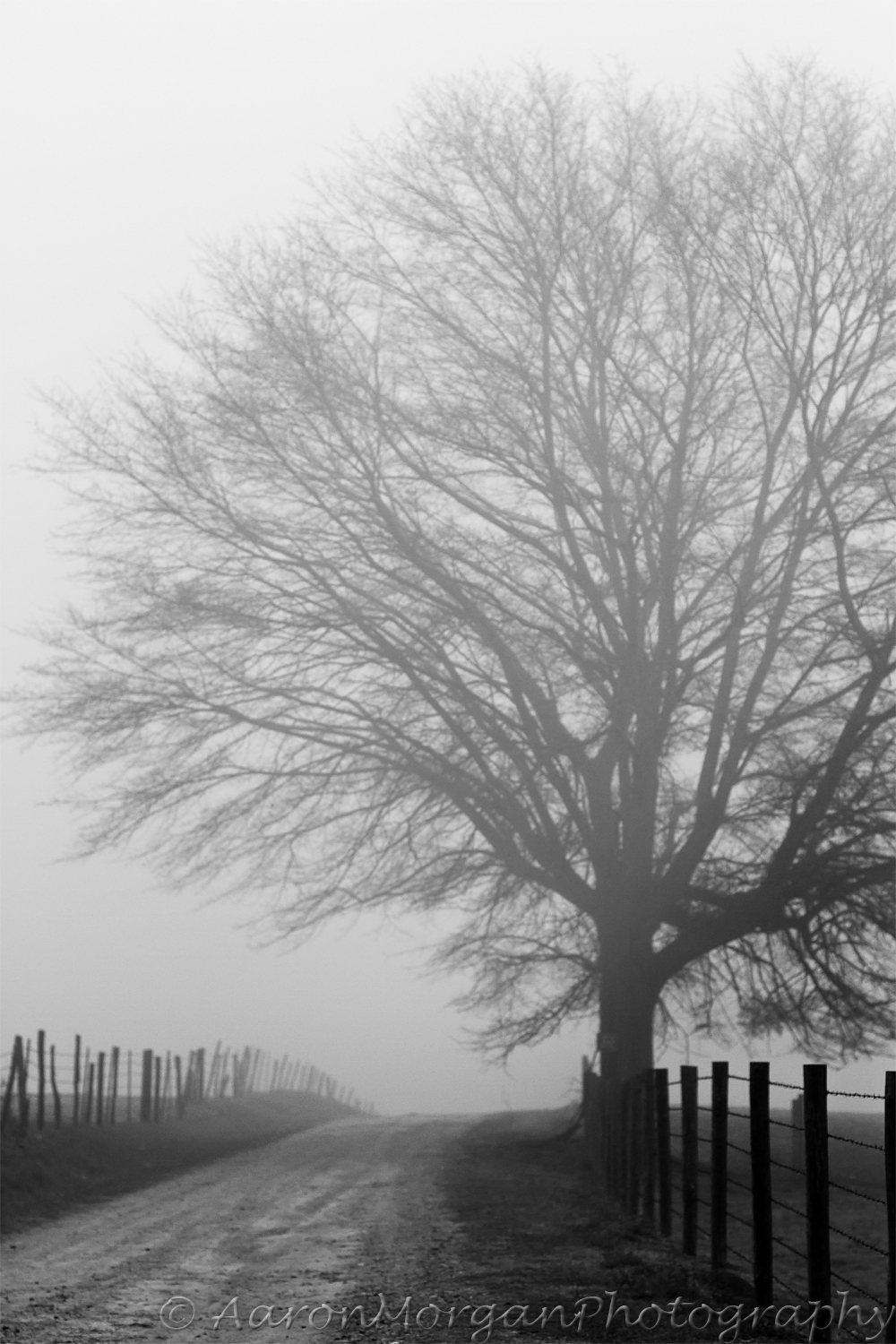
“Hi. I would like a critique on this image. This is one of the better images I have captured for a seasonal winter album. Like all the other pictures in this set, when I squeezed the shutter button, I was attempting to convey a sense of loneliness, cold and mystery. I took about 30 frames at this road near a farm in Eatonton, Ga. On each frame I was looking to use the road and fences as lines to pull a viewer’s eyes into the fog. (Each frame was a little different in composition.) I used a very selective depth of field, focusing on the first fence post on the bottom right of the frame. The image is photo shopped – In ACR, I adjusted exposure, increased the blacks, contrast and clarity. I also sharpened (what little depth of field there is) with ACR. In Photoshop I adjusted the levels.

So my question is: Does this photo convey the feelings of loneliness, cold and mystery well?”

Aaron, although it’s a very nice photo, I can only wonder what it looked like before all the post processing work??????? I also wonder what you would have done before the days of the digital era and specifically Photoshop????  It sort of reminds me of a conversation I had a while back with a student of mine in the class I teach with the BPSOP. She had a similar photo, not as far as a winter scene like yours, but a similar photo with quite a bit of post work. I told her that her photo reminded me of a woman I went out with once (and I do mean once).

Unfortunately, I found out the hard way that in order for her to look good, she would put on high heels (for additional height), a padded bra, fake eyelashes, colored contact lens,  and extensions for her dyed hair. It just struck me funny when you mentioned all the things you did to this photo to make it look good. I realize that this is the way it is now with the digital age and so many photographers that have only seen and composed through a digital camera, are thinking about Photoshop as a way of making their photo look better. I wonder what your photo looked like before you worked on it? I wonder if I could have taken this same photo and made it look good the way I would if I was still printing in my darkroom simply by burning and dodging, the right initial exposure,  and the right grade of paper?

Hummm, but I digress!!!

  Ok,  the first thing I wonder is what lens you used, and what aperture you had it set on. The reason I ask is because you said you used a shallow depth of field, but it seems as if all of this composition is in focus. If you had used a wide angle lens and you had it focused at infinity, then everything would have been sharp no matter what you had it set on. To me, it feels like the fog is making everything look soft.

As far as it looking cold, this kind of fog happens any time of the year just about anywhere in the country. I’ve taught a workshop where we had this exact light and fog most of the week. It was very sad since back then the name of my workshop was called “The Poetry of Light”. The class had a T-shirt made for me that said my class was now called “The Poetry of Fog. This was in August.

If you want to say cold, without being there to tell the viewer that it was indeed cold, you have to say it visually. You know it was cold because you were there, but will someone else that wasn’t there?

You do achieve a sense of Mystery and certainly Loneliness simply because of the fog, and the fact that you can’t see what’s over the hill. Loneliness also comes into play since there’s no one around.

The best part of this photo is the way you used Continuance (a concept of Gestalt) to lead the viewer down the road and fence line. You absolutely achieved that. The fence line is a very strong directional element that is very close to being a Vanishing Point which has created a sense of depth.

It’s a good photo Aaron, and thanks for submitting it to me.

Visit my website at: www.joebaraban.com, and follow me on Instagram: www.instagram.com/barabanjoe. Check out my workshop schedule, and come shoot with me sometime

JoeB

From a Student

So many Elements of visual design in this photo!!

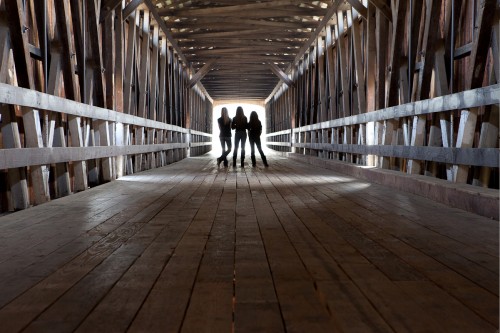
Dawn, a photographer from the West coast, submitted this photo of three girls standing on what appears to be a bridge of some kind.

Ok Dawn, here’s my take on this photo:

You obviously know what you’re doing, you have a keen sense of design, and you have a very good knowledge of the Elements of Visual design…why, you ask?  Because there are several present in this photograph:

These Elements are what I teach online with the BPSOP, and also in my “Stretching Your Frame of Mind” workshops I conduct around the planet.

NEGATIVE SPACE: since everything that’s not positive space is negative space, the negative space I’m referring to is that space that Defines the positive space and gives it meaning. What that means is that the negative space in and around the three girls defines them. It’s that negative space that makes the three girls…three girls. Each one of their shapes is well defined by the use of the negative space, and it’s what I call a “Quick read”.

TENSION: by minimizing the negative space between the outside girls and the bridge, you’ve created Tension, as well as the stark contrast between the girls and the background. Framing the subject within a frame is another way to generate Tension.

VANISHING POINT: By having the parallel liners begin behind the camera and converge at an implied line on the horizon.

PATTERN: Both the floor and the sides of the bridge are Patterns.

TEXTURE: The Texture inside the Patterns.

LIGHT: I love the blown out light behind the girls!!! Also the band of light in front of them.

When you can combine this many Elements, you stand an excellent chance of your photo not only being “up a notch”, but one that will be remembered.

A very strong image Dawn, and I’ll certainly remember it. Thanks for sharing it.

Visit my website at:www.joebaraban.com and follow me on Instagram: www.instagram.com/barabanjoe. Check out my workshop schedule. Come shoot with me sometime and learn about the Elements of Visual Design.

JoeB

Ask JoeB: How Do I Show Scale?

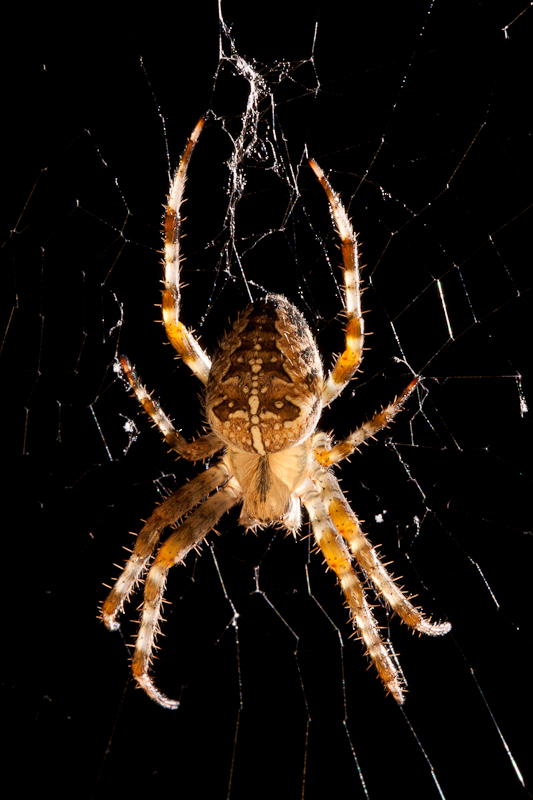
Thilo, a photographer living in Holland, sent me another spider so I wanted to get it close to the other spider that was submitted before moving on to the next submission. He wanted to know how you would show how big this spider is.

In the first spider shot, I suggested Soumyajit show scale as a way of making her spider a quicker read. Since her photo was so busy and the viewer somewhat distracted by everything around it, the spider became less important. In Thilo’s submission, that’s not an issue. It’s a quick read, and the spider is so scary that it’s size becomes less important as Arachnophobia has taken over scale!!!

If Thilo wanted to show scale, he would need to show it next to something that the viewer will immediately recognize and know right away it’s size by comparison. For example, it’s soon to be dinner like a fly, or a moth. If the web was against something recognizable like a fencepost or between barbed wire. By the way, the spider won’t touch it if it’s already dead.

Another way to imply scale is through the use of Tension. In my online class with the BPSOP, and the “Stretching Your Frame of Mind” workshops I conduct around the planet, We work on implementing the elements of visual design and composition into our imagery, and one of the elements is Tension. I’m not talking about the garden variety type of Tension caused by mental or emotional strain. I’m talking about the Tension resulting when forces are acting in opposition to one another.

Three of the ways to generate Tension are to place the subject close to the edge of the frame, to minimize the Negative Space surrounding it, and the use of light. When Thilo used all three in this photo, he made the spider look larger than it might be in person whereas Soumyajit, by placing her spider in the middle of the frame, didn’t create scale through the use of Tension.

In this submission as it the last one, black was used to hide the background. It’s believable in this photo, where it wasn’t in the first spider submission. It’s also much better lit. Also, this spider looks like it could swallow Tulsa, Oklahoma.

Thilo, one last thought to create scale would be to put your finger right next to it!!!!

Visit my website at: www.joebaraban.com, and follow me on Instagram: www.instagram.com/barabanjoe. Check out my workshop schedule at the top of this blog and come shoot with me some time…but not spiders!!!

JoeB


Vertical and Horizontal Lines

Dominant vertical lines

I like to include in a post a photo and question from one of the photographers that follow my blog.

Here’s one from a photographer in Japan, and as usual, I like to show the note that he sent because I find that there are lots of photographers out there that have had similar problems with similar questions on how to fix those problems. Here’s what he had to say:

“Hi Joe,

I am posting a photograph that has to do with lines. This is a photo on the outer part of a temple in Japan. What i want to know is if there are horizontal and vertical lines in one scene, which one takes priority over the other? In this photo, I used the vertical line closest to the left side, but the distortion is still present. It seemed the wooden structure is falling/leaning over to the mountain side. I tried to correct the distortion but in the end, I am still unsure what is the correct way to see. Lens used was the 16-35mm”.

Thank you,

I tell my online students with the BPSOP, and in my “Stretching Your Frame of Mind Workshops” I conduct,  Line is the most important of all the elements of visual design, for without Line none of the other elements could exist. The basic elements of design such as Pattern, Texture, Shape, Form, etc. all need Line to be what they are. In fact, you and I would not exist nor would planes, trains and automobiles because we all have an outLine.

Having said that, the most important Line is the horizon line. That’s the first Line you should correct. Since I almost always shoot on a tripod, the very first thing I do is to make sure my horizon line is straight. The only time it might not be straight is if you saw it from the Space Shuttle. FYI, the “unmentionable” word around the teaching scene is that when you see a photo with a horizon line that’s not straight, it’s a sure sign that a novice took the photo…I’m just saying!!!

Once you have the horizon line straight, then you look at the other horizontal lines and the vertical lines. Never try to correct those lines beforehand since by doing so, you might render the horizon as being off-kilter. If the vertical and other horizontal lines are not correct, then leave them because something made them the way they are. For example the wind, a storm, the ground shifting, bad construction, or just plain old ‘Father Time”. As I said, the horizon line is always going to be straight…no matter what. If you wake up one day and the horizon line is not straight, it would be a good time to pay back any past debts you might owe friends because you won’t have any more use for money!!!

Now that the horizon line has been taken care of, I look for the dominant line, whether it be a vertical or a horizontal. If the vertical lines are close to the edge of the frame, I always straighten them since they are more susceptible to bend; this is especially true if you have a wide angle lens on like your 16-35mm. The wider the lens, the harder it is to use as far as making your lines straight. The wider the lens, the more curve there is in your glass which curves the lines. The key is to always tr to have your camera level.

Correcting the horizontal lines is a matter of tilting your camera to the left or right.To correct the vertical lines you simply tilt the camera up or down. Tilting the camera up and the lines go in and when you tilt your camera down, the lines go out. In the photo you posted, if you would have tilted the camera down (just a touch) you would have corrected the vertical lines WITHOUT affecting any of the horizontal lines. That is once you have the horizon straight.

Hope this helped!!!

Visit my website at: www.joebaraban.com, and follow me on Instagram: www.instagram.com/barabanjoe take a look at my workshop schedule at the top of this blog. Come shoot with me sometime.
JoeB

Ask JoeB: Is this a good use of light, atmospheric perspective and line?

00080005

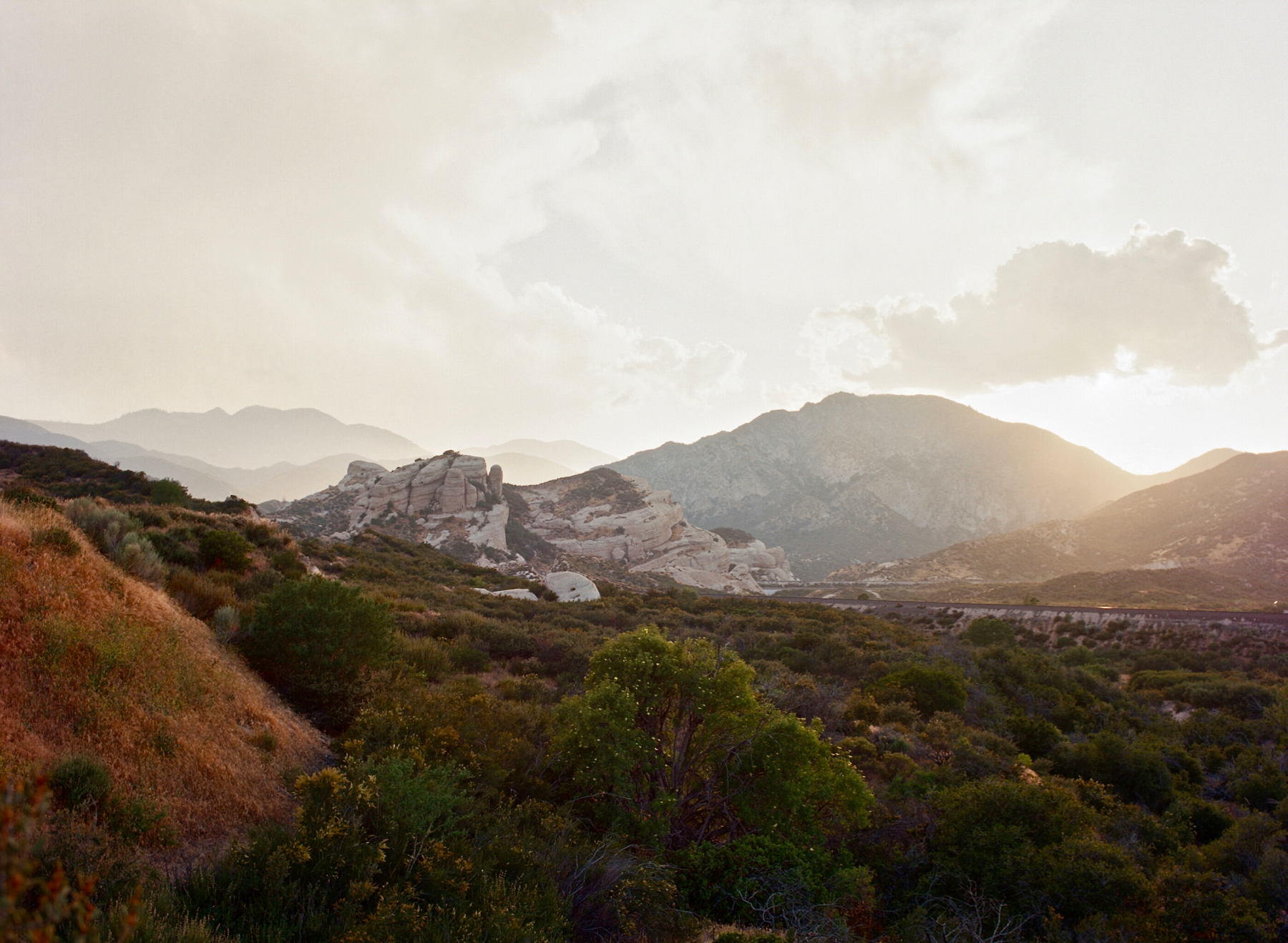
Gary, one of my long time blog followers, sent me this photo to talk about. As usual, I like to let my readers know what my fellow photographers had to say. The reason being that there might have been times when the same situation happened to them, or perhaps they had or have a similar question.

Here’s what Gary had to say:

“Hello Joe,

I know your a big believer in light and how good use of light can really kick your photos up a notch. In this photo I was trying to use the sunlight as best as I could to really make it feel like a tangible part of the picture. Also with virtually every part of the image at the same focus (infinity), I tried using atmospheric perspective with the background mountain ranges to create depth. Lastly I tried using the railroad tracks to create some movement in the picture to help lead your eye to the mid ground rock formation. Of course no train ever seems to come at the right time when I am taking the picture :).

Is this a good use of light, atmospheric perspective and line?”

Thank you,

Gary

Gary,

First of all it’s important for people to know what is meant by Atmospheric Perspective. I talked about it in my online class with the BPSOP, and in my “Stretching Your Frame of Mind” workshops I conduct around our planet. I actually wrote a post in 2014 that touched on it: https://joebaraban.com/quick-photo-tip-adding-depth-to-your-photos/

Atmospheric Perspective isn’t necessarily something you try using, it’s something that’s naturally inherent in our daily lives; simply a scattering of dust particles that’s between you, the subject, and the horizon. As photographers we merely work with it or around it, and it’s not always going to be in our best interest…photographically.

The phenomenon has been around since the time of Roman wall paintings. Leonardo da Vinci wrote about it, ” Colours become weaker in proportion to their distance from the person who is looking at them”.

For me personally, the fact that the farthest away objects takes on the color of the haze is not appealing and as a result I usually try to avoid it.

Take a look Gary:

http://www.screencast.com/t/fOqAHtjFRWVQ

I’m not sure Line comes into play here as there’s not really any leading or directional lines, or a Vanishing Point that moves the viewer around the frame. It’s the depth from front to back that’s moving the viewer from front to back.

One last note…I’m not sure the viewer would ever see the train tracks unless you mention that they’re there. Since you won’t be around to explain your thought process, it would need to be a “quick read”.

I like your photo, as it has a certain quiet mood created by the de-saturation (caused by the scattering of water vapor) occurring from front to back.

Thanks for the submission.

Visit my website at: www.joebaraban.com, and check out my workshop schedule at the top of this blog. Come shoot with me sometime.
Keep sending in your photos and questions to: AskJoeB@gmail.com, and I’ll create a video critique for you.

JoeB

AskJoeB: A photo from a recent class.

From a recent class.

Harry submitted this image for me to take a look at. I always like to show what the photographer says to me. Although it’s not in question form, here’s what he had to say:

“I took your part I and II online classes with the BPSOP over the summer and don’t think my submitted images were particularly good, but the material presented in class has stuck with me. I just finished a nature and wildlife photography class at the local college and I referred to your class material repeatedly, and I always have my artists palette with me! Here’s one of the photo’s from my recent class. Other students may not have seen this as “nature and wildlife” but I couldn’t resist the Line, Shape, Pattern and Texture, with a payoff at the end, a fisherman! I can’t thank you enough for your wit, wisdom and patience as a teacher.”

First of all thanks Harry for the kind words. Not only do I create the artist palette for people in my online classes, but also in my “Stretching your Frame of Mind” workshops I conduct around the planet.

I really liked your photo and I’m pretty sure the viewer will also enjoy looking at all the elements of visual design that are so much a part of it.

Take a look:

http://screencast.com/t/tLVZTjxXFo

Thanks for the submission and I’d love to see more of your work.

Visit my website at: www.joebaraban.com, and check out my upcoming workshop description at the top of this blog. Come shoot with me sometime. I have recently written the description for my next “springtime” workshop to be next May 17th, 2017. We will be spending three days in Vienna, and three days in Budapest. I hope you can join me for a wonderful week in two of Europe’s most beautiful cities…during festival time.
Keep sending in photos and questions to:AskJoeB@gmail.com and I’ll create a video critique for you.

JoeB

AskJoeB: Your Opinion

What's my opinion?
What’s my opinion?

Valeriano sent me these two photos to comment on. I usually like to  copy the question the photographers that submit photos write and some explanation of why they took it, but this time  he choose not to say anything and only wanted my opinion of the photographs.

Well, in that case let’s just get to the video critique of both images:

http://screencast.com/t/MhAKz5ODp

Here’s Valeriano’s second image and video:


My opinion.
My opinion.

http://screencast.com/t/di0FFxjVEHK


As I tell people that take my online class with the BPSOP, and also in my “Stretching Your Frame of Mind” workshops I conduct around the planet, before you raise your camera up to your eye determine where the sun is in relation to your subject. If your subject is anything translucent, try to backlight it as it will appear to be glowing…as it does in Valeriano’s two images.

Really nice photos!!

Visit my website at: www.joebaraban.com, and check out my upcoming workshop description at the top of this blog. Come shoot with me sometime. I have recently written the description for my next “springtime” workshop to be next May 17th, 2017. We will be spending three days in Vienna, and three days in Budapest. I hope you can join me for a wonderful week in two of Europe’s most beautiful cities…during festival time.

Keep sending in photos and questions to:AskJoeB@gmail.com and I’ll create a video critique for you.

JoeB

AskJoeB: What do you think about this picture?

What do I think?
What do I think?

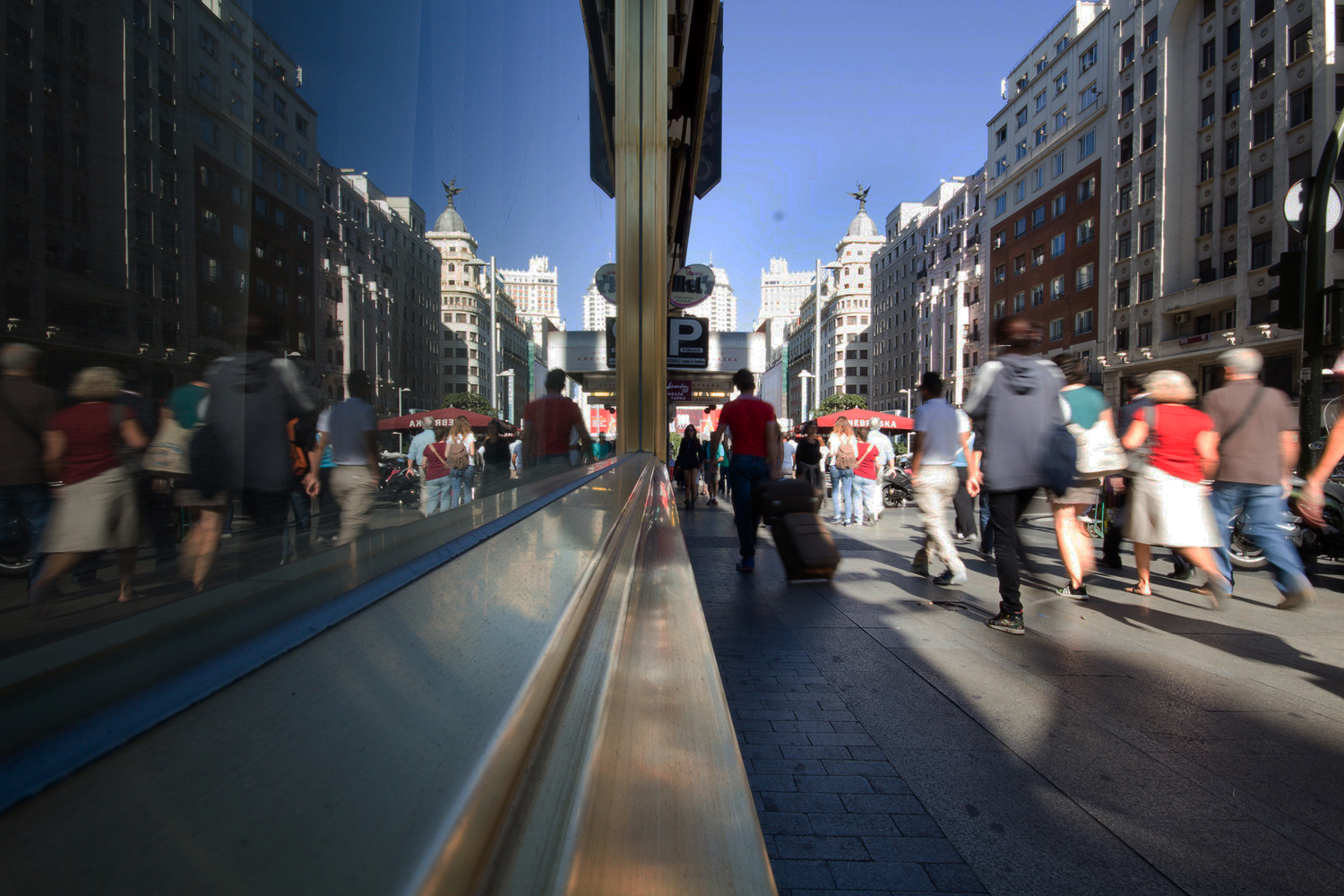
Ana Maria is a past student living in Madrid, Spain that has taken all three of my classes with the BPSOP. Hopefully her next class will be at one of my “Stretching Your Frame of Mind” workshops I conduct around our planet.

I have looked at a lot of her images over the course of the three months of online classes, and I’ve seen so much improvement in the way she now sees, her new approach to her passion, and her ability to “make” instead of take photos.

The above photo is an example of the photos that she’s now taking, and it’s a really good shot that not only draws the viewer into the frame, but moves him around as well.

As usual, I show people what the photographer had to say, but in this submission all she said was:

“Hello Joe,

I’d would like to know what you think about this picture”.

Ana Maria

Take a look Ana Maria:

http://www.screencast.com/t/fnNVaEhh42

It’s a strong photo and it’s all about making pictures. Thanks for submitting it.

Here’s the difference in the exposure the camera told you to take, and the exposure I’m suggesting. If you prefer the exposure from the meter in your camera, then you should continue to listen to it. If you prefer my exposure, I suggest you stop listening to the meter in your camera, take matters into your own hands and learn about the light.

My suggested exposure.

Visit my website at: www.joebaraban.com, and check out my 2016 workshop schedule at the top of this blog. come shoot with me sometime. The end of July marks my twenty-eight year at the Maine Media workshops. It’s a wonderful way to immerse yourself for a week and think about nothing but photography. It’s the same week as the Lobster Festival down the road in Rockland, and offers a completely different set of photo ops than the beautiful Maine coastline, amazing lighthouses, and quaint fishing villages. The full description is at the top of this blog.

I have added a new workshop to my 2016 schedule. On September 21st, ten photographers will get together with me at my evening “meet and greet” to begin a fantastic five-day workshop in New York, New York. Check out my description at the top of this blog. Come shoot with me.

Keep those photos and question coming into: AskJoeB@gmail.com, and I’ll create a video critique for you.

JoeB

AskJoeB: Rays of light

Is the flare distracting?

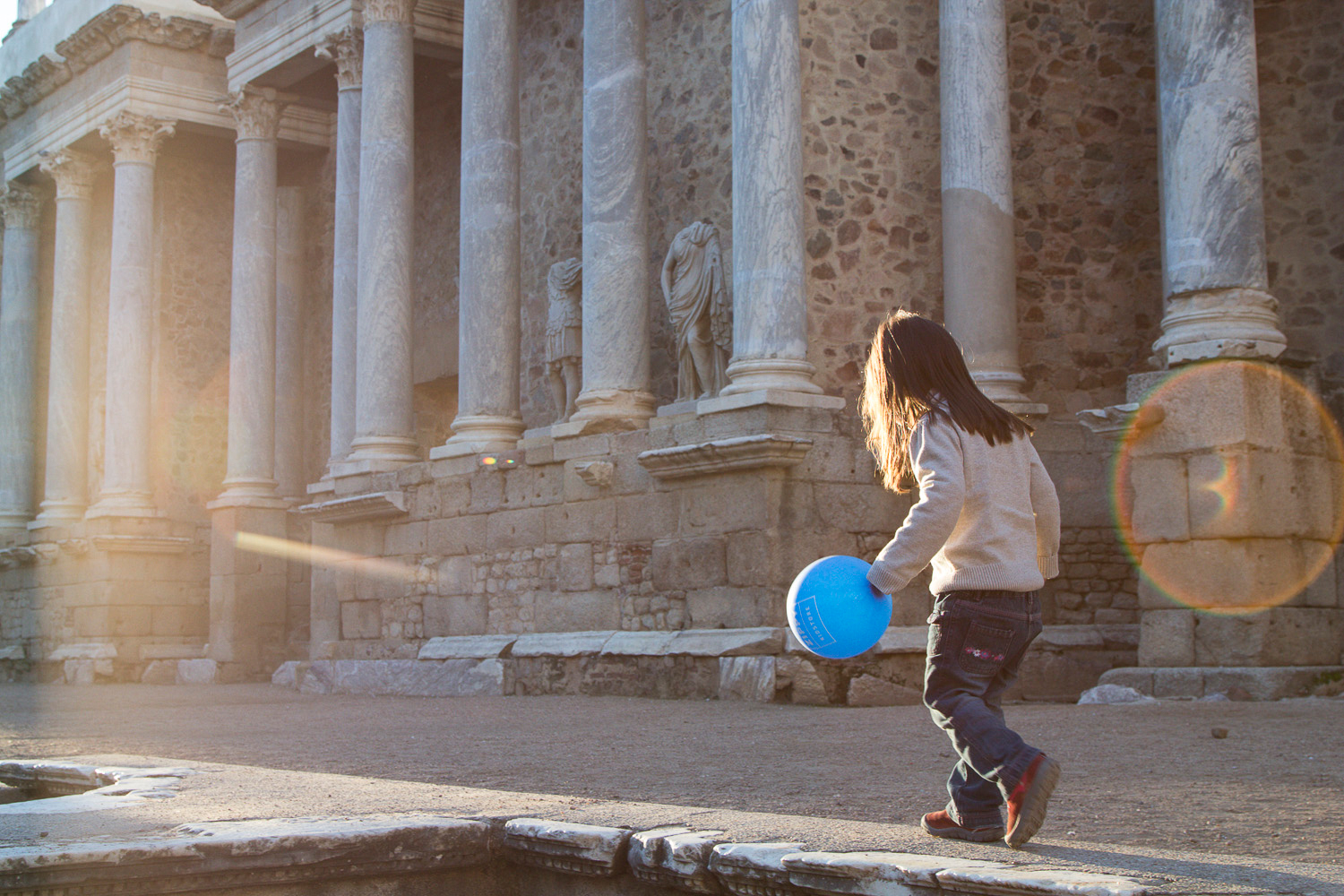
Ana Marie has taken my online classes with the BPSOP, where my fellow photographers learn how to incorporate the elements of visual design into their imagery. We also discuss these elements in my “Stretching Your Frame of Mind” workshops I conduct around our planet.

She recently send me this photo after reading a post in My Favorite Quotes category; one that was once said by Hank Williams. As I like to do, I forward what she had to say since so many has had a similar question at one time or another.

“Dear Joe:

I took a class with you at the PBSOP a couple of years ago.

After reading your post “My Favorite Quotes: Hank Williams” I was interested in having a critique of this picture I took last week at the roman theater of Mérida (Spain).< As I read in your post, I was trying to chase the light taking pictures of my daughter. I wanted to know your critique since I am not sure if the rays of light causing that chromatic aberration are very distracting or is the opposite and they make the picture more interesting.

Thank you in advance, Ana Marie”

Ana, take a look at this video which should answer your question:

http://www.screencast.com/t/2CZwwe9b0

Thanks for your submission, and I hope to work with you on one of my “Springtime” workshops in your fabulous city of Madrid.

Visit my website at: www.joebaraban.com, and check out my workshop schedule at the top of this blog. Come shoot with me sometime. The end of July marks my twenty-eight year at the Maine Media workshops. It’s a wonderful way to immerse yourself for a week and think about nothing but photography. It’s the same week as the Lobster Festival down the road in Rockland, and offers a completely different set of photo ops than the beautiful Maine coastline, amazing lighthouses, and quaint fishing villages. The full description is at the top of this blog.
Keep sending me your photos and questions to: AskJoeB@gmail.com, and I’ll create a video critique for you.

JoeB